Inspiration is the keystone of learning. It’s the engine behind a student’s motivation and the glue that makes ideas stick. But because our school system undervalues the necessity of inspiration, students don’t learn as much as they could.
Why do people learn things?
Usually, because they need to. They’re frustrated by something, either in themselves or the world. Maybe a loved one is sick. Maybe they’re not making enough money to support their family. In both cases, they enter “Survival Mode” and are spurred to action. When the pain of the status quo hurts more than the pain of discipline, people are capable of extraordinary feats of learning.
Survival Mode learning is effective, but it’s not especially enjoyable. It can even cause people to resent the learning process because they associated it with fight-or-flight levels of stress. Even if some of the best feats of learning happen in Survival Mode, it can create resentment if sustained for a long time.
School, for example, is built on Survival Mode. Fear is created with exams, essays, and the carrot of a college diploma at the end of it all. For a while I resented this system because I realized that the hoops of education were mostly a sham. Only once I graduated from college did I develop a love for learning.
If we want an educated citizenry that enjoys learning, we need an alternative: we need to inspire people.
Inspiration: How Learning Starts
Enjoyable learning begins with inspiration—both to get you started and to help you push through the struggles of knowledge acquisition. The way I see it, the need for inspiration inverts the learning process: instead of starting with the building blocks and moving toward curiosity, students start with curiosity and move towards the building blocks. Guided by the light of inspiration, the benefits of memorization become self-evident, and the motivation to learn comes intrinsically.
My teachers didn’t give inspiration the respect it deserves. Too often, they dove straight into the test material before they sparked a flame of desire in us. I still remember learning about the Doppler effect because my junior year astrophysics teacher taught it so well. Had he been like most of my teachers, he would have started his explanation with the following formula:
Then, as I slumped in my chair and counted the seconds until the end of class, he would have defined the following variables:
fo is the frequency observed by the stationary observer
fs is the frequency produced by the moving source
v is the speed of sound
vs is the constant speed of the source
The top sign is for the source approaching the observer
The bottom sign is for the source departing from the observer.
Instead, he started by making the subject come alive.
First, he gave us context: how the Doppler effect shows up in our lives. You experience it whenever an ambulance passes by, he said. Because of the Doppler effect, the sirens have a higher pitch when they’re coming towards you and a lower one as they drive away. The change in pitch reflects the change in wavelength created by the siren. He didn’t stop there. He told us how astrophysicists use this formula to measure how fast the universe is expanding. Together, these stories are so deeply embedded in my mind that I still think of them a decade later whenever I hear an ambulance pass by.
Inspiration is a uniquely human experience because it isn’t motivated by mere survival. It transcends the world of needs and lives in the world of wants. By doing so, inspiration stirs the mind. It’s no coincidence that the etymology of inspire is linked to “the breath of life.” As the sparkle of inspiration enters our bodies, we are animated with a video game style turbo-boost. Though a state of perpetual awe is the natural state for kids (which is why they learn so fast), it’s foreign to most adults. Too often, the wrinkles of age and the weight of responsibility silence the rush of epiphany.
Blinded by age, we can turn to cold rationality, valuing only what we can define and prioritize only what we can measure. When we do, we forget that the wisdom of an inspired spirit exceeds our ability to describe it. The less we insist on a justification for our curiosities, the more we can surrender to the engine of inspiration and let learning happen.
Teaching with Baseball
My favorite analogy is a class on baseball. Nobody falls in love with the game because they’re forced to memorize statistics. They fall in love with it by playing the game themselves, trading baseball cards, and seeing people talk about the game with glittering enthusiasm. And guess what? Anybody who falls in love with the game is going to learn the statistics anyways. Not because they need to, but because they want to.
As a long-time fan of the game, I know the top home run hitters by heart:
1. Barry Bonds: 762 career home runs
2. Hank Aaron: 755 career home runs
3. Babe Ruth: 714 career home runs
I know it not because I was forced to memorize it but because I was obsessed with baseball for more than a decade. For years, I read the sports section of the newspaper every morning.
This kind of inspiration is born out of a kind of enthusiasm where the more you learn, the more you want to learn. As you acquire skills, you realize that perfection isn’t a summit you reach, but an asymptote you continually strive for.
The best chefs, musicians, and filmmakers I know revel in this kind of inspiration. They know that no meal, no song, and no movie will ever be perfect. There is no mountaintop you can reach where you can finally rest on your laurels. Their inspiration is fueled by the dance between ascending the mountain of improvement and marveling at its wondrous, ever-receding peak.
For cultivating curiosity, it seems like every technologist I know read a lot of science fiction as a kid. During his childhood, Elon Musk sometimes read for 10 hours per day. He didn’t start with physics equations though. He started with science fiction books that activated his imagination. Legend has it that Isaac Asimov’s Foundation Trilogy inspired him to extend life beyond earth. Spurred by inspiration, Musk buried himself in the Encyclopedia Britannica by 4th grade.
Reading science fiction doesn’t guarantee innovation, but it can inspire it. Likewise, inspiration doesn’t guarantee knowledge, but it moves the people who pursue it relentlessly.
But if inspiration is so important, why don’t schools harness it?
Why Inspiration is Missing From Schools
Since the school system operates at scale, it tends to squash things that are hard to predict, even if they reflect a student’s unique interest. For an in-person curriculum to scale, students need to be doing the same thing at the same time. The individual nature of inspiration makes that impossible.
Inspiration is also hard to define. Even the most inspired people can’t always define the edges of their own interests—let alone explain them to others. Furthermore, we change. Surprise is in the nature of growth. But by insisting on such a structured approach, schools squash the ambitions of the very students they intend to serve. Ultimately, the kind of rigidity you need to pump millions of students through the school system every year is the antithesis of the kind of flexibility that nurtures inspiration.
Most of all, schools should embrace entertainment because it lets you scale inspiration. Since entertainment means something different to every person, let’s start with a definition: to engage a person’s attention in a way that makes the time pass pleasantly.
Entertainment is not amusement. Entertainment can be nutritious, but amusement never is. Amusement is defined by distraction. Like candy, it’s appealing in the short-term but has few long-term benefits. Usually, when educators criticize entertainment, they’re actually talking about amusement. Though the distinction is subtle, it’s the difference between an educated citizenry and the dystopia of Huxley’s Brave New World.
Historically, educators have run away from entertainment because they assume it will lead to amusement. Throughout my childhood, I sensed an implicit assumption that learning needed to be boring in order for it to be effective. Take the assumption to its logical extreme and teachers face a dilemma of either locking students in a room and force-feeding them knowledge or letting them enjoy themselves, knowing they won’t learn anything.
If there’s anything I’ve learned by writing on the Internet, it’s that small tweaks in the way an idea is packaged can have an exponential impact on how much it resonates. The Greeks knew this intuitively. They wrapped their most important ideas in narratives instead of sharing them outright. Plays like The Iliad and The Odyssey weren’t just a form of entertainment. They provided cultural instruction too. Since they were passed along in speech instead of writing, they had to be memorized and known by heart.
Today, masters of storytelling come from Hollywood and, increasingly, YouTube. They use many of the same tools that the Greeks discovered. Their storytelling philosophy is among the most effective tools we’ve invented for inspiring people at scale, which is why a popular documentary will spark more interest in a subject than the best textbooks ever will. Hollywood techniques aren’t going to make anybody an expert in their subject, but they can kindle the flame of curiosity.
The Role of a Teacher
Though we can use Hollywood techniques, we shouldn’t outsource inspiration to the industrial entertainment system. Teachers have a responsibility too. To date, they haven’t really had to focus on inspiration because they’re guaranteed a captive audience. If people get bored of a movie, they can turn it off. But students can’t skip class without consequences.
The biographer David McCollough once said: “Attitudes aren’t taught. They’re caught.”
Who was your favorite teacher growing up?
Chances are, they cared the most about their subject. They spoke with excitement and enthusiasm. Through wonder and beauty, they made ideas come alive. Just as a good writer takes responsibility for making their ideas clear, a good teacher takes responsibility for inspiring their students.
The physicist Richard Feynman comes to mind. He’s revered not just for winning awards like the Nobel Prize, but for making physics come alive for so many people. It’s no surprise that one of the most popular videos about him on YouTube has the words “fun” and “imagine” in the title. It’s nearly impossible to watch one of his videos and not feel an urge to study physics. From Feynman, I’ve learned that context is the intellectual glue that makes ideas stick. Even physics, which impacts every waking second of our lives, needs to be made relevant with stories, metaphors, and examples.
Ordinary teachers do nothing of the sort. It’s in the nature of bureaucracies to focus so much on the process that they forget about the end result. I saw this in my writing education, which focused predominantly on spelling and grammar instead of what really matters: how to identify, develop, and communicate engaging ideas. People don’t care about adverbs; they care about being respected by their readers. People don’t care about commas; they care about publishing a piece of writing that warms them with pride.
Teachers aren’t able to inspire students when they focus on ideas just because they’re easy to test for. Instead, they should focus on what students need to be inspired. Spoiler alert: grammar and syntax isn’t going to cut it. But even the youngest students can realize the benefits of effective writing. In a world where the average person can spread ideas globally, practically everybody can be niche famous. Learning to write improves your life by helping you think better, attract interesting people, and make more money. Once a student sees the opportunity and enjoys the craft of writing enough to do it of their own volition, they’ll end up learning the granular rules that schools teach at the outset.
Start with Inspiration
All this talk about inspiration reminds me of dinner I once had at my friend Brett’s house. Every Friday, his entire family ate together. Somehow, we started talking about World War I. The youngest kid at the table, a ten year old boy, knew more about it than the rest of us combined. A World War I video on YouTube piqued his interest and led him to all kinds of books and documentaries about the war. Fueled by obsession, he had memorized so many key dates and events that you’d think he was studying for an exam.
From him, I learned that the process of learning is like falling in love with a song. Initially, you’re only attracted to songs that move you emotionally. If they’re catchy, you’ll listen to them enough to get stuck in your head. If the song keeps resonating with you, you’ll learn about the artist and explore the lyrics in depth. Talk to an obsessive and in addition to singing the lyrics for you, they’ll tell you the backstory behind the music.
Learning works the same way.
As with a Feynman lecture or my friend’s little brother, you have to start with something catchy. Otherwise, you risk the toils of Survival Mode.
Critically, you can’t invert the process and expect the same intensity of learning. When it comes to music, we intuitively know that nobody wants to read the lyrics of an album before they listen to the music. But that’s exactly what we do whenever we ask students to memorize nitty-gritty details without inspiring them in a way that makes learning inevitable.
From music, we learn what humanity has always known but many schools have forgotten: learning begins with inspiration.
I also explain these ideas in a video on my YouTube channel.
Acknowledgements
Thanks to Ellen Fishbein for helping me write this essay.
“If colleges don’t change their business model, they’re going to go bankrupt,” I told my professor, two days before I graduated from college.
She looked at me in disbelief.
“Yeah right,” she snickered.
Over four years at Elon University, I had watched the institution abandon its cardinal principles, as it transitioned from a liberal arts college and into a professional training center. Founded in 1889 to “transform mind, body, and spirit and encourage freedom of thought and liberty of conscience,” the school was built upon noble aspirations that united the community. It would provide a way for young adults to come of age by surrounding themselves with the best ideas humanity had ever produced — from the philosophy of Plato, to the sonnets of Shakespeare, to the music of Mozart.
Unfortunately, by the time I graduated, the school had abandoned that original vision.
All the new academic buildings centered around professional majors. Business majors and communications majors monopolized the prime real estate. Meanwhile, Liberal Arts majors were scattered around campus like trash occupying leftover space.
Though I’m disheartened by its priorities, I can’t blame Elon for responding to market forces. As one of my college advisers said to me, “Elon may be the most economically driven university in the country.” The university had to stay in business. No matter how noble it wanted to be or how much it wanted to stick to its original vision, it couldn’t prioritize majors that only a few students wanted to study.1 Financially, it was a smart move. Idealistically, I detested it.
1
The original definition of vocation is more profound than the contemporary one. It’s born out of the Protestant belief that God endows each person with unique talents and an occupation for which they’re uniquely suited. The word “vocation” was first used in the 16th century to describe how God called certain people to particular kinds of work. The term goes back to 1 Corinthians 7:20, where Paul says, “Let every man abide in the same calling wherein he was called.”
With so many colleges struggling financially, the shift in Elon’s curriculum is being replicated by hundreds of American universities. It’s a dilemma. They can leave their original principles behind and become full-on vocational schools. Or, they can double down on their commitment to the Liberal Arts. Right now, they’re stuck in the middle of these options.
Most are turning into professional schools in order to survive. Like my alma mater, they are treating the Liberal Arts like a second-class citizen. But what’s good for their balance sheets isn’t necessarily good for the health of society.
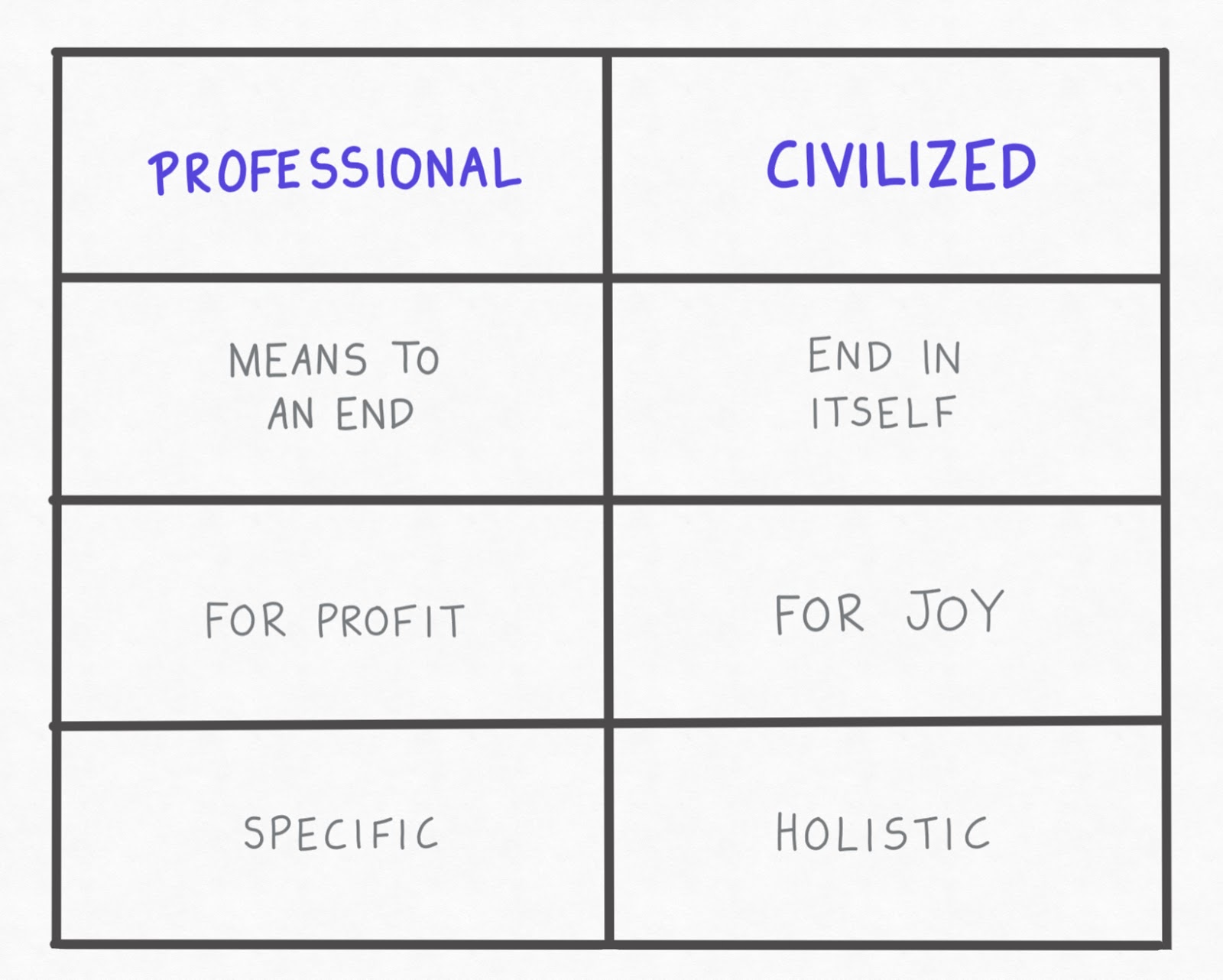
In this essay, I’ll outline a plan for saving the Liberal Arts. I’ll start with their history by going back to the origins of Western thinking. I’ll argue that we can only think about education clearly once we split it into two halves: civilized and professional. To explain why, I’ll outline the evolution of the Liberal Arts, from the ancients to where we are today. I’ll show why we’ve devalued their study by serving our wallets instead of our souls. Finally, I’ll propose a plan to create a modern Liberal Arts school with lower costs, expanded access, and students who graduate with a holistic view of the world and an appreciation for civilization’s greatest works.
Section 2 – Common Vocabulary and Understanding
History of the Liberal Arts
In this essay, I will define the Liberal Arts as knowledge without immediate utility. It tends to be foundational, slow to change, and not the kind of knowledge that will make you a quick buck.2
2
I am also sympathetic to David Foster Wallace’s take on the subject: “I submit that this is what the real, no-bullshit value of your liberal arts education is supposed to be about: how to keep from going through your comfortable, prosperous, respectable adult life dead, unconscious, a slave to your head and to your natural default setting of being uniquely, completely, imperially alone day in and day out.”
When you study the Liberal Arts, you interrogate the fundamental assumptions of society. You make sense of its default programming, from the stories we tell to the ideals we worship. By doing so, you dig beyond the facade of intellectual fashions to explore the invisible codes that govern society.
The ancient Greeks defined the Liberal Arts as the knowledge required by free people to uphold their duty as citizens.3 In addition to political theory, they emphasized rhetoric, politics, philosophy, theology, abstract mathematics, and the natural sciences.4 Those were just the hard skills. They also learned to appreciate the softer sides of life, such as poetry, language, and storytelling.5 That changed with the beginning of the Industrial Revolution when schools abandoned these original Liberal Arts values. Professional demands crept into the curriculum. Schools became an assembly line. Instead of merely “educating” students, they trained them to operate machinery, follow orders, and succeed in the workplace.
3
In fact, the etymology of “idiot” comes from the Greek idiotes, which referred to a private person who was so self-centered that they didn’t consider societal matters.
4
There were seven Liberal Arts in medieval European universities. Grammar, rhetoric, and logic made up “The Trivium,” while geometry, arithmetic, music, and astronomy made up “The Quadrivium.” People have always doubted their validity, which is why the word trivial corresponds to ideas in the Trivium.
5
The Greeks saw public service as a position of honor in a way that is hard to imagine today. The knowledge that was deemed to be of necessity to the citizen was what was most important to living one’s own life successfully.
Today, the Liberal Arts has been watered down so much that the modern definition is meaningless. The Association of American Colleges & Universities defines it as “an approach to college learning that empowers individuals and prepares them to deal with complexity, diversity and change.”
If anybody is aware of a kind of knowledge that doesn’t deal with “complexity, diversity, and change,” please let me know.
Education: A Classical Kind of Leisure
Though we should develop professional schools to help people gain employment, we should not forget education’s ultimate role in nourishing the soul. The word “school” comes from the Latin word skole, which translates to leisure. It describes a place to celebrate the pursuit of knowledge. It stands in contrast to the contemporary grind of slaving through term papers and staying up all night to study for exams just so we can get into the kind of college we can brag about with bumper stickers on our SUVs. But the quest for a diploma that will unlock a prestigious job misses the ultimate point. Often, we salivate so intensely for the eventual diploma that we never stop to ask why it’s worth chasing in the first place. If we continue to value only useful skills, we’ll end up with work-obsessed technocrats who are blind to the transcendent and unfulfilled by the rat race of achievement.
Or maybe, that’s what’s already happening.
We can do better. An expansive vision was best described by Elena Shalneva, who wrote: “The real purpose of education is not to acquire skills. It is to develop the mind. Fill it with knowledge, yes — but also charge it with fire, like a torch, so that, long after we have left the student bench, the mind still gleams and glares and throws a challenge to the maddening mysteries of the world.”
Her vision is a return to a more classical definition of leisure. But not the American kind of leisure where you veg-out by ordering Dominos, cracking open a six-pack of White Claw, and binging Netflix all weekend. It’s an active kind of leisure where you engage in meaningful conversation, contemplate enduring questions, and nurture the soul with everlasting wisdom. It’s recreation, not labor. Active, not passive. And by reminding you that there’s more to life than the physical world, her Greek-inspired definition of leisure is an invitation to lose yourself in the majesty of being.
Ultimately, the Greeks saw leisure as the expression of the highest moments of the mind. Not as a means to an end, but as an end in itself.
Oswald Spengler: Abandoning the Greek Model of Education
In the words of Oswald Spengler, we should strive to be less like the Romans and more like the Greeks.
His magnum opus, The Decline of the West was a bestseller throughout Europe in the 1920s, even though he was just a high school teacher. He argued that the two societies had little in common beyond occupying a similar geography. The Romans focused on the material world and the utilitarian over the spiritual. They saw Liberal Arts ideas as a means to an end. The Greeks were different. They valued the needs of the soul as an end in itself. They idealized a Liberal Arts Education as a way to grasp a reality beyond the stressful demands of industry. To awaken the soul at a young age, they trained children in literature, geometry, sport, and song, which is why we think of math, plays, and poetry when we think of the Greeks.
Where you can understand the Greeks without studying their economic relations, the Romans can only be understood through them. The Rabbi Abraham Joshua Heschel argued that the Romans’ fall from glory came from a short-sided focus on the concrete instead of the abstract. They obsessed over theaters, monuments, aqueducts, bridges, and buildings. Instead of cherishing the nonmaterial, they cherished physical objects like the Colosseum and the Pantheon. And yet, for all its grandeur, Roman utilitarianism reflected a culture of material greed and the forfeiting of worldly wisdom.
Spengler described the Romans as “unspiritual, unphilosophical, devoid of art, clannish to the point of brutality, aiming relentlessly at tangible successes.” Just when you think modern Americans are so different, consider the way we’ve devalued cultural knowledge in favor of technical know-how. Like the Romans, we praise industry and material wealth. In the late 1800s, a student wouldn’t have been admitted to Harvard without knowledge of Classical literature, algebra and plane geometry; familiarity with the laws of physics and elementary astronomy; and knowledge of the history and geography of Ancient Greece and Rome.6 We should scratch our heads at the parallels between the contemporary West and the late-stage decadence of the Roman Empire, which anticipated its collapse.7 Like the roadrunner from Looney Tunes, America has run off the cliff of tradition. Some can sense the cultural decline. It’s only a matter of time before we look down and confirm the fall.
6
I’m making a broader point about Civilized Education (which I’ll describe later in the essay), not a narrow endorsement about the specific knowledge you once needed to get into Harvard. Classical languages, for example, are not as important to me as studying history and philosophy.
7
In the words of one Yale University professor: “Somebody may decide in a few hundred years that the Dark Ages began in 1950. And that those pathetic people impressed with their little technological toys nonetheless didn’t know anything.”
We should not abandon our Greek values. Though we should train students for economic prosperity, we should not lose touch with our humanity. We should embrace the transcendental as well as the tactile; what’s interesting in addition to what’s practical. To make that happen, we’ll need to separate education into two camps: civilized and professional.
The Two Kinds of Education: Professional and Civilized
Colleges must stop trying to do two things at once — preparing students for the workforce while also trying to teach the Liberal Arts — and failing at both.8
8
There is a reason that most American colleges want students to stick around for four years, yet the requirements for their major can be completed in a little over half the time. Unlike their European counterparts that focus exclusively on one specialized area, the American college experience is focused on personal and social development, via dorm rooms and electives alike.
Historically, there have been two kinds of education: Professional Education for people who labor and Civilized Education for people who don’t have to work for a living.9 These two approaches have led to different kinds of teaching, even in the same domains. In mathematics, the working-class builders learned trade secrets while the aristocrats studied theoretical mind exercises like Euclid’s Theorem. But in the modern world, we’ve conflated the kind of education you need to make money with the kind you need to be civilized.
9
Implicitly, the point is that once people have achieved a comfortable level of wealth, they should be expected to pursue higher ends.
Conventional wisdom says that more formal education is better, but we actually need less of it. The public has been sold the lie that a decade and a half on the conveyor belt of academia is the fast track to the American Dream. This is wrong. Four-year degrees are oversold, overpriced, and oversupplied. By turning a college education into a prerequisite for a “respectable” career, we’ve given universities the liberty to charge exorbitant tuition.
Nassim Taleb argues that we can’t agree about what education should look like because we bundle two kinds of learning which should actually be separate. Inspired by him, we should solve our higher education problem by separating education in two parts: one that makes you employable so you can take care of your material needs and another that prioritizes the accumulated history of civilization so you can nurture your immaterial ones.10
10
Taleb’s original words are technical and liberal, but I’ve changed them to professional and civilized to match the rest of the essay.
Professional Education should be inexpensive and available to everyone. Though Civilized Education shouldn’t be required, it should be accessible to those with an active interest in it. If that means young people need to focus on financial stability and making themselves useful, so be it. But higher education should no longer be a mandatory checkbox that traps people in five figures of debt, without the return-on-investment to justify the time it takes or the risks of borrowing that kind of money before you’re old enough to drink a beer.
With that in mind, we need a way to think about Professional Education.
Professional Education
Professional Education should be short and focused. To keep pace with the changing economic landscape, it should be run by nimble organizations, mostly outside of the traditional university system. Students who want to become technicians or architects don’t also need to spend two years reading Chaucer. And yet, due to an outdated model of education, we force them to and make them pay the bill.
Institutions that prepare people for economic prosperity should be separate from those that help them live a flourishing life. We don’t need four years to prepare students for work either. Young adult education should begin with job training, and students should land their first jobs no more than 18 months after that training begins. We’ll call these mechanical skills with a defined set of prescriptions a Professional Education.11
11
The astute reader will notice that most of everything taught in school, even the so-called “arts,” falls under this umbrella. That’s because we rarely aim at the transcendental, even during “higher” education.
Once students have the skills to be paid for being useful, those with an interest should return to school to pursue a Liberal Arts education. There, they can study knowledge and information without the specter of imminent utility hanging over their heads nor the distractions of students who don’t want to be there. This new system will simultaneously lower the cost of a Liberal Arts education while increasing its rigor.
The Case for Civilized Education
Professional Education is relatively shallow, even though the majority of students should focus on it first. It aims to impart skills rather than ask questions of it’s students — and that should be the goal.12 I say that not to criticize it but to be explicit about the trade-offs we make whenever we advocate for professional training. It stands in contrast to Civilized Education, which is geared toward finding truth and cultivating the soul.
12
Yes, certain respectable careers require more than basic skill transfer. To this I say there’s less of a difference between white collar workers like doctors and lawyers and blue collar ones like mechanics and contractors than people care to admit.
That cultivation begins with the study of civilization. There is nothing that guarantees its continued existence. The moral, aesthetic, and intellectual heritage of humanity must be passed down from generation to generation. Otherwise, we will lose these traditions.13
13
In June 2021, I lived in a small Mexican city called Oaxaca. It’s famous for its buzzing cultural scene, especially in art and food. They treat cultural preservation as a cardinal virtue. Locals told me the region was able to preserve its heritage because it wasn’t colonized as heavily as other parts of Mexico. The Oaxacan commitment to cultural preservation was Japanese in its intensity. I must’ve read or heard the word “tradition” 10 times per day. The Liberal Arts is a way to institutionalize a commitment like that.
Culture is to society as style is to the individual. Both are an answer to the sterile ends of pure utility and the cold-heartedness of a survival mindset. All of us are a mere dot on the timeline of history where the dead outnumber the living 14-to-1. Our ancestors speak to us through the artifacts of civilization, and ignoring them is the hallmark of ignorance. It is the task of the cultured individual to surround themselves with their greatest creations, build upon their work, and share the gift of culture with their grandchildren.
There’s a famous Russian saying: “Work does not make you rich, but round shouldered.” Technical specialization without the eventual support of a Liberal Arts education is a good way to get rich but a hollow way to lead a life. Don’t get me wrong. The partnership between specialization and trade has created unprecedented amounts of material prosperity ever since the writings of Adam Smith. But just because a strategy works for the economy doesn’t mean it will work for the soul. Training people exclusively for a job denies them of the heart-driven exploration they ultimately need to nurture their humanity. That’s why higher education must preserve its original mission of furthering our knowledge of truth for the sake of something other than immediate monetization.14
14
It’s not called “higher” for nothing.
Growing up, military funerals were often the subject of my favorite movie scenes. I admired their beauty, even if I wasn’t always able to explain why. On the surface, they seemed wasteful. But in reality, they were soulful because they transcended utilitarian concerns. When it comes to a military funeral, only a cold person (or a technocrat) would call the ritual — filled with trumpets and songs and a star-spangled tribute to a fallen soldier — a waste of resources and manpower. Even though it doesn’t increase GDP, prioritizing things that don’t compute under a rational calculus is a necessary part of a noble society.
Though a Liberal Arts education should not be a baseline, we should aspire to it. If you’re just looking for a job ASAP, skip it. There are faster ways to earn a living. But the Liberal Arts are indispensable for people who want to escape the matrix by exploring the intellectual substrate of society. That said, people should only make financial investments in foundational knowledge once their basic survival is secure. Though a Liberal Arts education should not be mandatory, it should be socially applauded — even more than it is today. Though only a minority of people will choose to enroll, making it an opt-in endeavor will increase the quality and enjoyment of a Liberal Arts education.
Unlike its Professional equivalent which deals in terms of usefulness and return-on-investment, Civilized Education should not be measured by its outcomes at all.15 It is closer to love, the emotion that makes us feel most alive, even though it has no purpose beyond the meaning it provides.
15
It is a disease uniquely of the Professional Mind to feel a compulsion toward having to measure everything in the first place.
As the poet Rabindranath Tagore foresaw in 1917: “History has come to a stage when the moral man, the complete man, is more and more giving way, almost without knowing it, to make room for the … commercial man, the man of limited purpose. This process, aided by the wonderful progress in science, is assuming gigantic proportion and power, causing the upset of man’s moral balance, obscuring his human side under the shadow of soul-less organization.”
Changes to how the Liberal Arts is received have been on the horizon for a century. But recent trends in the American education system have sparked an impetus for change.
The Evolution of the Liberal Arts
When I was in college, the adults in my life repeatedly told me the same thing: “I wish I could go back to college.” Meanwhile, I hated school. It felt like a prison to me. I only did my homework so I could eventually find a job that paid well enough for me to live in my own apartment after graduation. My friends and I valued ideas through a utilitarian lens, believing that they were only useful if they impressed our professors and helped us fatten our wallets after school.16
16
In college, I was in the highest performing academic fraternity. But it was mostly a facade. Even though a disproportionate number of my friends graduated in the top 10% of my class, most of them weren’t interested in intellectual conversations. They measured ideas through an utilitarian lens, and once they left the classroom, their intellectual curiosity disappeared. Fortunately, a number of mentors showed me the virtues of a contemplative life.
During my junior year, a friend recommended a Modern Philosophy class with a big-name professor. The semester would start with Descartes and Spinoza and work through the feminist theories of Cixous, Wollstonecraft, and De Beauvoir. When the syllabus piqued my interest, I walked into the professor’s office to ask about enrolling. But when she told me that the class required 200 pages of reading per week, I cut her off, stood up, and dashed out of the room.
“Thanks for your time, but I’m not a good fit.” Tuesdays, Thursdays, Fridays, and Saturdays would be for beers, not books. Five years later, I see why those adults said what they said. It’s exactly the kind of class I wish I could take right now.
Plato, Aristotle, and the Myopia of Youth
The infrastructure of a Liberal Arts education should not be primarily for the youth. Plato was critical of those who focused too much on philosophy and science at a young age without first learning more practical skills. If he were alive today, he would advise newly graduated high schoolers to focus on becoming self-sufficient. Only once they have career momentum and their strength begins to fail them should they shift their focus to the Liberal Arts. And when that study begins, it should be their sole priority.17
17
Plato knew that being exiled from society would make you useless. He advocated for escape because working toward an end makes you too interested in the utility of ideas. But once you’re removed from the traditional calculus of utility, you can pursue seemingly useless ideas such as the questions of philosophy.
Aristotle argued something similar. No matter how old you are, he said, studying philosophy will be futile if you don’t have life experience. In Nicomachean Ethics, he writes: “A young man is not a proper hearer of lectures on political science, for he is inexperienced in the actions that occur in life … And, further, since he tends to follow his passions, his study will be vain and unprofitable, because the end aimed at is not knowledge but action.” Aristotle concludes that the acquisition of foundational knowledge becomes worthwhile only when it’s done for its own sake.
Beyond the financial considerations, freshmen straight off the academic conveyor belt, who are focused on securing a prestigious internship, are not ready to seriously study the Liberal Arts. At the very least, gap years should be more common. High school graduates should use the time to work, live frugally, discover what they’re actually interested in, and make sure a six-figure education is actually worth it to them.
Being raised by the hard knocks of life will open their ears to history’s timeless ideas too. You can’t absorb the great books without the glue of life experience because they speak to the heart of the human condition. Like a budding rose exposing its leaves and turning toward the sun for the first time, struggle opens us up to knowledge. For the intellectual curiosity required to study the Liberal Arts, you need pain, toil, and heartbreak.
Benjamin Franklin, Thomas Jefferson, and the Great American Debate
The cognitive cleavage between the idealism of a Liberal Arts education and the pragmatism of a professional one goes back to America’s foundation, as symbolized by two of its founding members: Benjamin Franklin and Thomas Jefferson.
In his seminal book, The Protestant Ethic and the Spirit of Capitalism, Max Weber used Benjamin Franklin to illustrate the connection between Protestantism and industriousness. Franklin believed that making money from hard work was synonymous with morality. Traits like punctuality, diligence, and moderation were valuable insofar as they made people productive businessmen. He saw wealth as a beacon of virtue. Weber criticized him ruthlessly. He wrote: “A way of thinking like that expressed by Benjamin Franklin was applauded by an entire nation. But in ancient or medieval times it would have been denounced as an expression of the most filthy avarice and of an absolutely contemptible attitude.”
Taken together, the dynamic between the German sociologist and America’s founding father echoes the division between Greece and Rome. The Greeks would have evaluated Rome by its temples and libraries. But the Romans scoffed at Greek infrastructure as a waning symbol of bygone greatness.
Franklin founded the University of Pennsylvania, where he opposed the study of abstract and high-minded ideas because Americans had work to do and a country to build.18 He lampooned Harvard graduates as proud, self-conceited blockheads who’ve done nothing but attend a finishing school for the children of rich parents.19 Across the pond, Franklin criticized Cambridge for being little more than “a famous seminary of learning” because it taught the useless trifecta of theology, Latin, and Greek. Instead, Franklin argued for a practical approach to education. Indeed, when he went on to found the University of Pennsylvania, he envisioned a university that would “train young people for leadership in business, government and public service” and would drop the classic liberal arts curriculum, preferring instead to focus on a curriculum that focuses on a handful of professions.20
18
Franklin was a pragmatist in his day, but an idealist by our standards. Pragmatically, he was one of the first influential figures to advocate for studying English over Latin and Greek because he wanted to prepare students for careers like politics, law, and business. But he also suggested a diverse range of subjects including arithmetic, astronomy, geography, religion, agriculture, and history. All of them would be supplemented with knowledge of laws, customs, and morality.
19
These criticisms were written pseudonymously in his brother’s newspaper The New England Courant. See Benjamin Franklin and Jonathan Edwards: Selections from Their Writings.
20
See Franklin’s 1749 memo entitled “Proposals Relating to the Education of The Youth in Pennsylvania” and Penn’s founding charter.
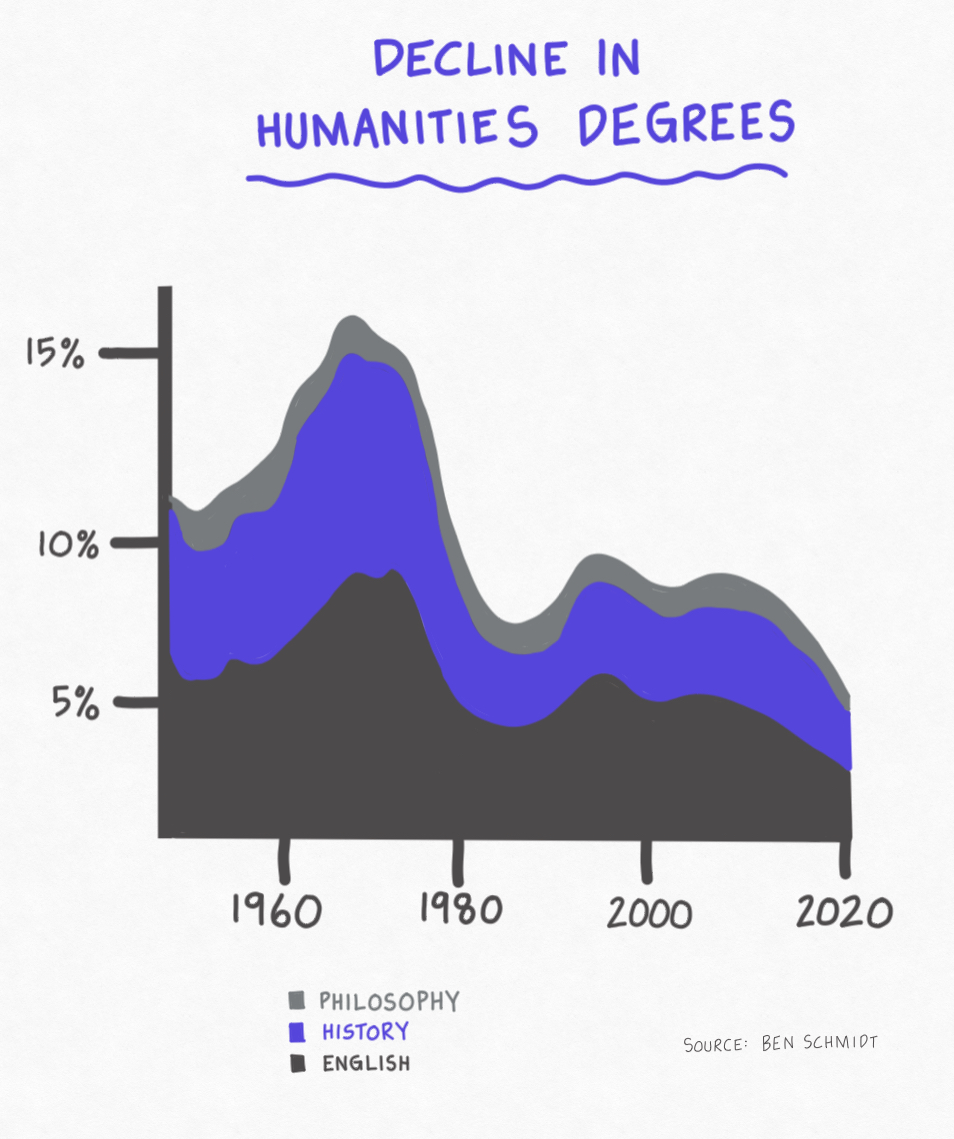
Given Franklin’s influence over America and its universities, I’m surprised it took until the 1980s for college enrollment in the Liberal Arts to drop below 25% of students. That very same year, the business major took the crown as the most popular subject to study in American colleges.
Another founding father, Thomas Jefferson, saw things differently. As the founder of the University of Virginia, he advocated for a school to prepare students not just for industry but to be good citizens as well. America’s always been progressive in its willingness to subsidize higher education, and Jefferson led the way by fighting for the free education of Virginia’s most talented citizens.21 Also the author of the Declaration of Independence, he believed that the health of a Republic depended on its ability to nurture talent that would otherwise be overlooked. Education diffused knowledge and power, so Jefferson saw it as the counterweight to the natural tendency of elites to use their wealth to manipulate laws to create a corrupt and “unnatural aristocracy.” The alternative was a “natural aristocracy” where elites would rise to the top due to merit instead of the wealth of their parents. If so, the talented followers of today would become the leaders of tomorrow.
21
Racial disparities have always existed in American education. Classrooms weren’t integrated until the Brown v. Board of Education court case in 1954.
Jefferson’s students were encouraged to study classic texts.22 His vision aligned with the etymology of the word “university,” which is a synthesis of two words. “University comes from the Latin word universitas, which translates to “complex of all things.” It derives from universus, which means “whole.” True to those original meanings, Jefferson believed that a unified picture of the world could only be discovered by studying the consilience of knowledge. His interest in history didn’t stop him from valuing math and science, which accounted for half of his university’s curriculum. Though he didn’t encourage students to become scientists, he argued that scientific habits of mind and its method of inquiry could be applied across disciplines to create a more educated citizenry. In contrast to Franklin’s belief in a pragmatic higher education, Jefferson used it to produce a more civilized citizenry — moral, competent, happy, well-informed, capable of earning a living, and fit for political and social leadership.
22
As Jefferson once wrote: “I feel a much greater interest in knowing what has passed two or three thousand years ago, than what is now passing. I read nothing, therefore, but of the heroes of Troy, of the wars of Lacadaemon and Athens, of Pompey and Caesar … I slumber without fear, and review in my dreams the visions of antiquity.”
Tocqueville and the American Vision
Less than a decade after Jefferson’s death, Alexis de Tocqueville wrote about how American culture lined up with Franklin’s vision. Even in 1835, he saw how they valued the practical over the philosophical. He showed how students are directed only toward specialist subjects with a profitable return in mind, saying: “There is no class in America which passes to its descendants the love of intellectual pleasures along with its wealth or which holds the labors of the intellect in high esteem.”
Beyond the walls of scholarship, even when it came to government, Tocqueville observed that the average American, when compared to their European counterpart, was uninterested in speculative ethics or the abstract principles of governance. But once the conversation shifted to practical matters like the policy decisions of their local town council or the county judicial system, Americans held an encyclopedic knowledge that was rare in Europe.
Americans have never found consensus on the purpose of a college education. One camp advocates for Franklin’s industrial focus, while the other argues for Jefferson’s idealism of an erudite republic. It’s the same debate all over again: Professional vs. Civilized Education.
The Abolitionist Movement
The etymology of the word liberal comes from the Latin word liber, which translates to freedom. That freedom is the essence of a Liberal Arts education. It comes from its self-directed nature, where students can forge their own path by following the breadcrumbs of curiosity.
Some abolitionists in the American South argued that slaves would ultimately be freed through a liberal education, not a technical one. One interaction between a slave named Frederick Douglass and his master affirmed the freedom-granting benefits of a liberal education. One day, Douglass’ slave master found him reading. Heart bumping, blood rousing, he turned to Douglass and said: “Learning will spoil the best nigger in the world. If he learns to read the Bible it will forever unfit him to be a slave.”
In an instant, Douglass learned that reading was a threat to those who tried to control him. As Douglass recalled: “From that moment I understood the direct pathway from slavery to freedom.”
In accordance with Douglass, the Civil Rights activist W.E.B. DuBois criticized the reduction of education to job training. Arguing against the industrial education movement promoted by the Atlanta Compromise, DuBois worried that a professional education would amount to nothing more than following somebody else’s orders.
His writings were prescient to a haunting degree. They anticipated the way we now belittle the Liberal Arts and any education designed to develop the soul. He wrote: “If we make money the object of man-training, we shall develop money-makers but not necessarily men … The curriculum of that Higher Education which must underlie true life. On this foundation we may build bread winning, skill of hand and quickness of brain, with never a fear lest the child and man mistake the means of living for the object of life.”
Today, DuBois’ words read like the visions of Cassandra, the figure from Greek mythology who was ignored even though she could predict the future because people didn’t want her prophecies to come true. But we should listen to DuBois because he saw how the incentives of industry would reduce higher education from an academy for sovereign souls to a factory for economically minded technocrats.23
23
Speaking of Greek mythology, the technocratic mentality is so totalizing that it shows up in unexpected places. Even our nuclear bombs have boring names now. After the War, America’s nukes had energetic names like Atlas, Titan, Thor, Poseidon, and Trident. But bureaucracy changed that. Today, with names like M-SHORAD, IFPC, and THAAD, our nukes have the kinds of nondescript names that only a technocracy would come up with.
Saving the Liberal Arts
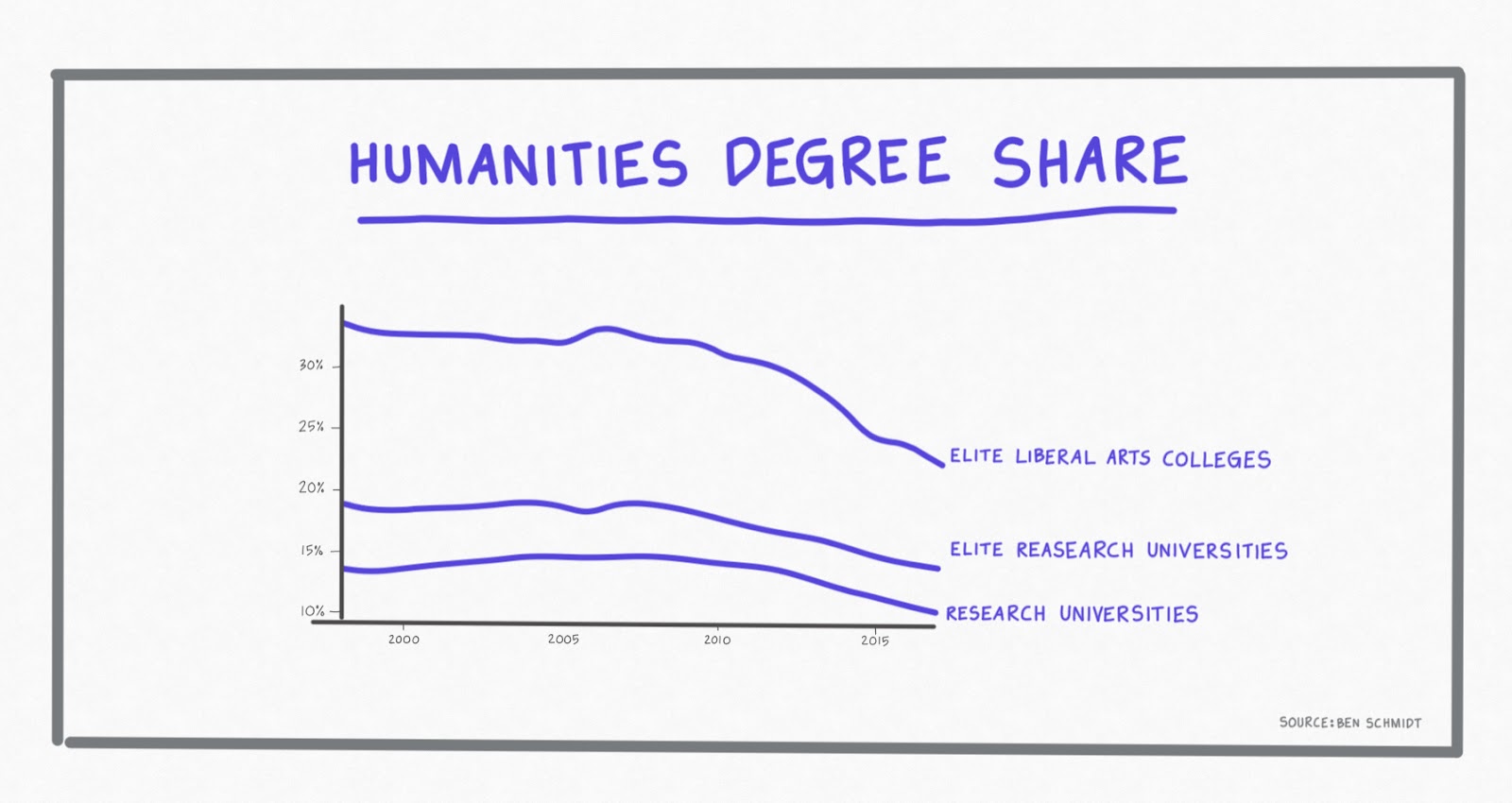
Higher education’s disillusionment with the Liberal Arts is as financial as it is rhetorical. College administrators say they no longer have the resources to sustain Liberal Arts programs like English, history, and philosophy. Even the students themselves are more interested in programs that directly lead to employment after graduation.
Outside of the academy, government leaders have long been critical of the Liberal Arts.24 Without government support, schools are losing the resources and political capital to offer these programs. When he was the Governor of California, Ronald Reagan asserted that “certain intellectual luxuries” are unnecessary and the taxpayer “shouldn’t be subsidizing intellectual curiosity.” By the time Reagan sat in the Oval Office, business had become the most popular major in America. Even President Obama, a Liberal Arts major himself, once said, “We need more folks in engineering, math, science, technology, computer science … I loved the Liberal Arts, so this is no offense … we need more engineers. We need more scientists.”25 And when Florida governor Rick Scott was asked, “Is it a vital interest of the state to have more anthropologists?” He responded, “I don’t think so.”
24
As David Foster Wallace so astutely remarked: “Often in school you study the liberal arts … it’s all very much about the nobility of the human spirit and broadening the mind and then from that you go to a specialized school to learn how to sue people or to figure out how to write copy that will make people buy a certain type of SUV. I know that there is, at least in America, an entire class … of kids whose parents could afford to send them to very good schools where they got very good educations who are often working in jobs that are financially rewarding but don’t have anything to do with what they got persuasively taught was important and worthwhile in school. That’s a bit of a paradox isn’t it.”
25
Obama majored in English and Political Science at Columbia, one of the few schools that has a mandatory Liberal Arts curriculum.
Internationally, similar forces have taken hold. To the north, the government of Ontario has shown a glimpse of what is to come by tying state funding for higher education to labor market outcomes. Down under, the Australian government recently cut funding for university programs in the arts and sciences. Students are encouraged to pursue “job-friendly” subjects instead.
The decline of the Liberal Arts isn’t just a top-down phenomenon. The students themselves have also lost faith. They want jobs, which is why schools like my alma mater have abandoned the Liberal Arts to pursue career-focused majors like finance, marketing, and computer science.
Cost is one culprit. When my aunt attended the University of California at Berkeley in the 1970s, she paid $178 per semester. A decade earlier, a California resident could have had a free education, from kindergarten to a PhD, for virtually nothing. Today, the cost of yearly tuition has risen to more than $13,000 a year for California residents, and the total cost for non-California residents who want to live on campus is more than $55,000 per year. These days, students are more interested in a marketable major than one that will help them live a meaningful life. I understand why. In a world where the majority of students graduate with debt, at an average of $33,000, I see why college kids optimize for financial success. When you’ve been loaned tens of thousands of dollars at 18 years old, it is prudent to think about what job you’re going to get at 22 in order to pay it off.
The changes aren’t just financial. They’re ideological too. In a study conducted during her time there, three quarters of freshmen said college was essential to developing a meaningful philosophy of life. By contrast, only a third said that it was essential to financial well-being. Today, those fractions have flipped.
The anxiety is not purely economic. Even at elite colleges, where tuition is often subsidized and majors are less relevant to employers, students overwhelmingly pursue a professional education.26 Most of their time in the library is spent on short-term memorization instead of comprehension. They just want to recoup their tuition dollars so they can be cash-flow positive as soon as possible and set themselves up for a financially lucrative life.
26
Once, your co-author attended an on-campus recruiting event for Goldman Sachs almost entirely because they had easily the best cheese platter of any of the major banks. Beyond the Brie and Camembert, he found himself in a room full of finance and economics majors. All of them were eagerly shoving their resumes into the beak of the vampire squid itself. It was lost on them that the corporate recruiter, who was an alumnus, studied art history in college before she became a derivatives trader.
The Half-Life of Skills
Professional skills can help you get a job now, but they will lose relevance during your career. In the World War II era, the rate of technological change aligned with the length of an average career. This alignment was a coincidence of history. Today, there is no guarantee that the lessons you learn in college will stay relevant for your entire career.
You’ll experience this tension if you visit any computer science department. Software engineers aren’t using the same languages and frameworks taught 20 years ago, and 20 years from now, those skills will have changed even more. Though programmers can develop job-ready skills with only 12 months of classroom learning, technological change makes many of their skills obsolete almost as quickly. To keep their jobs, software engineers will have to upgrade their skills continuously throughout their careers.
Ironically, given the rate of adaptation for professional skills, the enduring relevance of a Liberal Arts education raises its relative usefulness.
Practical vs. Fundamental Knowledge
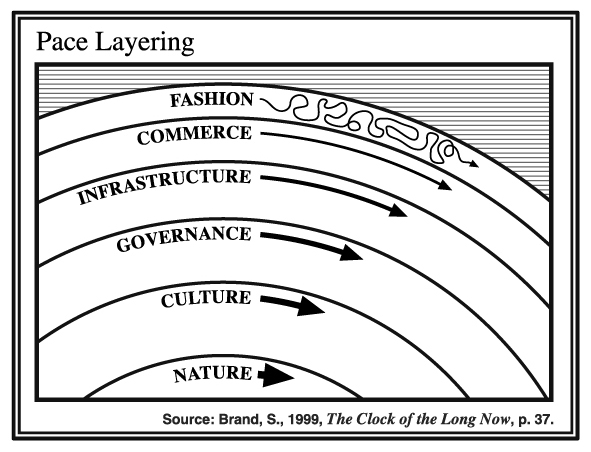
During the course of our lives, the questions of the Liberal Arts will change very little. The case for engaging with them is best described by Stewart Brand’s pace layers theory. With it, he proposes six different layers in the working structure of a civilization: fashion, commerce, infrastructure, governance, culture, and nature.
There’s a trade-off between practicality and timelessness. Knowledge at the top of the chart, such as fashion and commerce, is immediately actionable, but decays the fastest. They’re relevant in everyday life for social and earning an income, but their specifics have a short half-life. Meanwhile, culture and nature are deeper on the chart. They offer fundamental knowledge. Their lessons apply everywhere, even if they’re beyond the scope of conscious thought in most people’s day-to-day lives. The further down the layers you travel, the longer it will take for the knowledge to pay off, but the longer that information will stay relevant and the more widely applicable it will be.
For our purposes, the graph can be simplified to include only two kinds of knowledge: practical and fundamental. Practical knowledge is subject to change in response to trends and technology. It’s usually pursued as a means to an end, like making money or finishing a task. Examples include being a doctor, plumber, or engineer. In contrast, even though people are quick to call it useless, fundamental knowledge is slow to change and pursued as an end in itself. It’s the soil of civilization. All of it has been fertilized by each successive generation. To study the Liberal Arts, then, is to taste the fruit of all this knowledge: poetry, philosophy, history, religion, language, music, and mathematics.
The Usefulness of Useless Knowledge
Though it should not be the goal, fundamental knowledge can sometimes lead to financial well-being.
I’m reminded of Aristotle’s story of Thales of Miletus, who was one of the first Greek philosophers. Thales was mocked for living in squalor because he focused on the Liberal Arts instead of applying himself to work or public service. Tired of the ridicule, Thales used his “useless” knowledge of the stars one winter to anticipate an unusually bountiful olive harvest in the spring. Confident in his predictions, he leased up all the olive presses while they traded at a discount, and when the ensuing harvest led to skyrocketing demand, he pocketed a personal fortune. In reflection, Aristotle wrote that Thales “showed the world that philosophers can easily be rich if they like, but that their ambition is of another sort.”
Thales learned for the sake of learning. He saw interestingness as an end in itself, a goal that has fallen out of favor. Part of the problem is that the posture of high-paying knowledge work looks the same as the posture of contemplation.
Meaninglessness and Meritocracy
Historically, intellectual activity has been a privileged sphere that people were lucky to escape to. The triad of religion, leisure, and philosophy contrasted the drudge of manual labor and commerce.
During a time when it was impossible to work after sundown, we hailed farmers who read the classics with pleasure and industrial workers who could quote Shakespeare. In 19th century Britain, a culture of self-education rooted in the Great Books flourished among the working class. Their curiosity was as intense as their bank accounts were small, particularly among miners from Wales and weavers from England who enjoyed classical literature as much as classical philosophy. The ideas offered an escape from torturous working conditions and the slums they lived in, away from their families.
Today, things have changed. Physical workplace safety is no longer a concern for the kind of people who graduate from top-tier universities. But many are psychologically beat. The urbanites in particular have abandoned religion and ditched the kind of study that those British workers once enjoyed. When life gets challenging, the ones I’ve known double down on their commitment to work. They hit the gas pedal instead of stepping back to take stock of where they’re going. They fail to realize that the cargo cult of productivity offers no salvation. This culture of career obsession without questioning why working hard is worth it in the first place is a byproduct of a culture that doesn’t take the Liberal Arts seriously.
A huge percentage of these jobs are soul-crushing. In the 19th century novel Oblomov, the main character is visited by a friend who works in civil service. Reflecting on his work, he says: “My Lord, what does Man waste his soul on? He’s nothing more than a minor executor of someone else’s minor thoughts. How little of Man is needed here, hardly any intellect, hardly any will, hardly any feeling. Does he deserve to be called a Man? He violates his nature, trades off his soul. The wretch!”27
27
One sympathizes with Oblomov, the character who only has a perspective on himself as third person. He cannot get out of bed because his future is already laid out for him, determined. One can see how Goncharov was looking to satirize the Russian intellectuals of the time.
Two centuries later, the meaninglessness has intensified. In his final book, the late David Graeber observed that across the Western World, a large number of people devote their professional lives to meaningless work and superficial career paths. He calls them Bullshit Jobs. He cites industries like lobbying, telemarketing, and legal consulting because he thinks the economy could mostly operate without them. He contrasts them with teachers, nurses, and mechanics whom we depend upon for basic necessities. Graeber says: “Huge swathes of people, in Europe and North America in particular, spend their entire working lives executing tasks that they don’t even think are necessary, and they secretly believe do not really need to be performed. The moral and spiritual damage that comes from this situation is profound. It is a scar across our collective soul.”
Following social norms for too long without questioning them can lead to cul-de-sacs of resentment. And sometimes, even depression. Maybe that’s why it seems like every young person I know is prescribed some kind of anxiety or depression medication. One recently told me that she buys Adderall from a friend because she can’t get through the workday without it. “I need to focus,” she tells me. And yet, instead of questioning her career trajectory, she doubles down on it.28 Work harder, be more productive, she says. Without equity in what she’s building, her career trajectory is the worst of capitalism: strife without reward, toil without wealth, sacrifice without upside.29
28
You can see where this is going: heavy self-medication to get through crushing arbitrary assignments that people complete because they need to, not because they want to.
29
In 2018, I received a call from a friend who was working in the sales department of a Fortune 500 company. He was “I can’t even get out of bed” depressed. That sorrow manifested itself as an emotional emptiness. Where others felt happiness or sadness, he felt numbness. He was a slave to the company because it was socially rewarded at the cultural and corporate level. All the while, he was blind to a misery that, he thought, only antidepressants could cure. To justify the expense of his marketing major, he is still on those same antidepressants and working that same bullshit job.
The God of Productivity
In the Gospel of Matthew, Jesus asks: “What does it profit a man if he gains the entire world and loses his soul?”
These words double as the intellectual current for this essay: Our obsession with another gospel, the gospel of climbing the career ladder, makes people allergic to non-income producing knowledge. The relentless pursuit of Benjamins turns the contemplative life into a distant and strange intellectual luxury.
Our skepticism of rest is reflected in our attitudes toward the Sabbath. Today, we see the Sabbath as an indulgence for the rich instead of the keystone of a well-lived life. Insofar as the Sabbath is useful, people see it as a way to “recharge” for the workweek ahead as if it exists to make forthcoming labor more productive. But to the spiritual mind, the Sabbath has two meanings: “to rest” and “to celebrate.” The Sabbath doesn’t serve the weekdays. The weekdays serve the Sabbath. It is not an interlude, but rather the climax of the week where even the thought of productive labor is prohibited. Only then can people celebrate the joys of friends, family, and contemplation. Even God needed the seventh day to look back at his work and affirm it as Good, and yet we cannot take time from our yoga classes and self-help videos to do the same with our meager office jobs.
The Jews use the word menuha to describe it. They define it as a chance to distance yourself from the necessary so you can embrace things that give you life. And in turn, it’s a time for the body and soul to rest in unison. In the company of community and scripture, anger can lift and tension can evaporate.
Now that work and leisure bleed into each other though, they are in constant competition. At my first job, co-workers saw meals as such a productivity hit that they drank their calories with Soylent and processed, pre-made snack packs. One acquaintance, the Chief Revenue Officer for a fast-growing startup, wishes he could take a pill so he could work through the night instead of sleeping. One of his direct reports got chastised for not responding to emails at 1:30 a.m. The problem was eventually solved when the C-suite sent a company-wide message apologizing, and said: “We acknowledge your need for sleep.” Now that you can always open your computer and learn something to increase your earnings power, studying abstract philosophy is seen as a kind of intellectual decadence, and therefore, a sin against the God of productivity.
To be sure, America is a wealthier place because it attracts mono-maniacally focused entrepreneurs and innovators. Even though most of us are not Elon Musk or Bill Gates, they inspire us to regularly forgo leisure and the finer things in life. Out of an unquestioned admiration of “careerism,” we worship material accumulation and a productive lifestyle. We will neither accumulate Elon’s wealth nor the humanity he’s sacrificed to build such an industry-defining company.30 With a one-track mind focused on the arduous demands of labor, we’ll become spiritually impoverished. Instead of working to live, we’ll live to work — without the equity that makes it so lucrative for those who do.
30
Indeed, this is no criticism of maniacal obsession, in an area of life. Rather it is a criticism of those who work like the maniacally obsessed without that meaning behind them.
Stuck in this total work mindset, we’ll flock to ideas with a clear utility function. When we do, we’ll lose sight of the value in fundamental knowledge, either because we’re too thirsty for riches or drowning in a flood of debt. Blinded by the myopia of materialism, we’ll focus only on practical business skills out of a fear that anything more fundamental cannot be applied. We may even descend into the Greek idea of a banausos, which describes somebody who is not only uneducated, but numb to poetry and art. With no spiritual view of the world, we’ll agree to a Faustian Bargain in which we live in perpetual toil instead of granting ourselves the time to contemplate the wonder of life.
Lost Happiness
Somewhere inside of us lies the same instinct to follow in the footsteps of the 19th century working class. Though we’re less likely to spend our evenings immersed in the Great Books or talk philosophy with friends at the local pub, college students are yearning for big ideas (even if they can’t escape the utilitarian frame).
At Yale University, 1,200 students — almost 25% of the student body — enrolled in a 2018 course on happiness called Psychology and the Good Life, making it the most popular course in school history. A decade earlier, more than 1,400 students enrolled in Harvard University’s Positive Psychology class, the most popular class in its history as well. However, my friends who took these courses say they were BuzzFeed-shallow attempts to hack happiness because they reduced life’s greatest thinkers to self-help coaches. As superficial as these courses may have been, they imply a widespread cultural emptiness among high-achieving students.31
31
Your co-author sat in on one of these classes for a couple of weeks and was reminded of Galatians 6:7-8: “A man reaps what he sows. The one who sows to please his sinful nature, from that nature will reap destruction; the one who sows to please the Spirit, from the Spirit will reap eternal life.”
But if there’s no practical use, why should we study it?
The Liberal Arts gives us a chance to explore the larger questions of life once we realize that winning the meritocracy game doesn’t guarantee complete happiness. What you lose in immediate applicability when you study the Liberal Arts, you gain in timeless and fundamental knowledge. Practical subjects like marketing, medicine, and engineering are the opposite. They change so fast that a degree in these subjects from a century ago holds little value today. Though they put food on the table, they are inarticulate in the language of the soul: hope, fear, love, hate, beauty, envy, honor, weakness, jealousy, striving, suffering, virtue.
To be sure, this isn’t an anti-science screed. I’m grateful to the software developers who wrote the code you’re using to read this essay and the doctors who cut my skull open to perform a surgery when I was 2 years old. The world is better for science and technology. When it comes to widespread material prosperity, they’re some of the best tools we’ve ever invented. But if we’re not careful, we’ll lose the humanities to their all-consuming orbit of utility. We’ll enter a world governed by cold logic and the tyranny of total rationality, one that’s obsessed with the factual, but blind to the Good and the Beautiful.32
32
An exercise for the reader: Ask yourself whether you believe in the objective existence of Truth, Beauty and Goodness. If you answered yes for some but not all, can you truly articulate why? If you answered No to all, we’d recommend some resources.
We should celebrate the practical elements of the Liberal Arts too. Suppose you’re diagnosed with a terminal illness and stumble into hospice care. Would you rather be treated by a doctor who has only ever taken medical courses, or somebody who, in addition to technical competence, has studied the philosophy of death and what it means for the soul?33 The MRI machine is not enough. In our most tender moments, the Liberal Arts becomes a paragon of wisdom.
33
An extremely well-respected doctor told me that when hiring for his clinical practice, all else being equal, he’d take the candidate who studied something other than pre-med in college over the one who didn’t, everytime.
That’s why, in his sickest moments right before he passed away from terminal cancer, theauthor Paul Kalanithi brought three books to the hospital and into the room he knew he would die in: C.S. Lewis’ Mere Christianity, Heidegger’s Being and Time, and Solzhenitsyn’s Cancer Ward. As he told his wife right before he closed his eyes for the final time: “I need to make sense of my cancer through literature.”
Making Sense of Death
Don’t get me wrong. The fruits of materialism have advanced the human condition. I don’t want to go back to a world without clean water and modern medicine. But there is always a cost to worship. By focusing so much on our material needs, we’ve silenced our spiritual ones. On matters of the soul, we are bankrupt. We are more depressed and suicidal than ever before.
Materially, no society has ever been as wealthy as ours is today. The average person enjoys a level of comfort and sanitation that would’ve astonished even the kings of yesteryear. But that doesn’t mean we’re living in a utopia. As the psychiatrist Theodore Dalrymple wrote: “Having previously worked as a doctor in some of the poorest countries in Africa, as well as in very poor countries in Pacific and Latin America, I have little hesitation in saying that the mental, cultural, emotional, and spiritual impoverishment of the Western underclass is the greatest of any large people I have ever encountered.”
And it’s not just the underclass. Rates of depression and suicide are rising in nearly every socioeconomic class. In Palo Alto, home to the children of wealthy Silicon Valley elites, where kids internalize their parents materialist priorities, the 10-year suicide rates for its main two high schools is between four and five times the national average. More than 10% of high-school students reported having seriously contemplated suicide in the previous 12 months. And it’s not just kids. Between 2007 and 2017, adults between ages 18 to 34 saw a 69% increase in alcohol-related deaths, a 108% increase in drug-related ones, and a 35% increase in death by suicide. And yet, the meritocratic march accelerates.
It feels like we’re living the story of Faust, who makes a deal with a demon to exchange his soul for material wealth. Originally, the trade serves him well. He lives a life of power and pleasure. But eventually, Faust becomes insensitive to human needs in the name of “progress and industrious will.” In time, he sees how the once-shiny allure of riches becomes futile when the Devil claims Faust’s soul and sentences him to eternal slavery. Today, the adjective “Faustian” refers to a situation where greedy people surrender their moral integrity for the ultimately meaningless ends of raw power and success.
How the Education System Failed
Colleges aren’t good at teaching students. But they are effective at their true purpose of curating the labor market. Employers depend on universities to filter quality workers. At the high-end, instead of hiring from a diverse pool of applicants, companies like Blackstone and J.P. Morgan recruit exclusively from Ivy League schools where they know people have been pre-vetted. In exchange, prestigious schools get to brag about top-tier job placement metrics, which justifies their placement at the top of a US News & World Reportranking system that barely ever changes.
Some scholars have argued that when it comes to education, we have cause and effect backward. Higher education is the byproduct of a rich society, not its cause. The economists Lant Pritchett and Alison Wolf have argued that formal education does not generate wealth. If they’re right, education is not as effective as we assume. By associating education with material success, college has been placed onto the conveyor belt of economic development.34
34
You can see this confusion in action by looking to the Antebellum South’s obsession with leisure and Hellenic culture. As Alexis de Tocqueville observed, even with the slaves and ample leisure time and wealth, those of the high society pre-war South were unable to produce many significant cultural or intellectual masterworks. Their focus on seeming educated and idle was, in fact, nothing other than decadent stagnation. Most of the significant cultural masterworks came from the less educated classes. Soul food, for example, came from people who used the cheapest ingredients they could find. When their milk started to turn, they made butter, and they poured that butter over all kinds of foods.
Along similar lines, Malcolm Gladwell has asked a similar question about cause and effect: Does Harvard’s ability lie in its ability to pick the best or to nurture and develop them?35 For clues, we can look abroad. One study found “no evidence that India’s most prestigious colleges offered a better education.” But even if test scores stayed flat, earnings power rose. This implies that elite schools benefit students not because they are better at teaching students, but because they enhance networking opportunities.
35
Several studies have shown that Ivy League admission, not attendance, has the biggest predictor on future wages, which confirms your co-authors first hand experience.
The people you meet is why Harvard can charge such exorbitant tuition fees. For a pure education without the cost of an Ivy League school, there are tons of alternatives. For starters, studying abroad should be more popular. You’ll save money and come back speaking a foreign language. If you’re lucky, your kid might even master the art of cooking an exquisite foreign dish.
But it’s not really about the education. Though every parent wants the best for their children, college is often as much a competition amongst parents as it is amongst children. As irrational as it may sound, tens of thousands of parents look at their toddlers and imagine them holding a Harvard diploma one day. Growing up, one friend’s parents made him chant: “Harvard, Stanford, MIT; Harvard, Stanford, MIT; Harvard, Stanford, MIT.”36
36
He ended up attending Columbia. That experience helped him secure internships in college and a six-figure job after graduation. Ceteris paribus, going to an elite college is almost always worth it, and not just because you get to say things like “ceteris paribus.” However, the real perks are not the ones listed on the brochure. As the late comedian George Carlin once said: “It’s a big club and you ain’t in it.”
And it’s not just parents who drive the system. It’s employers too. Together, they shape the ambitions of our children.
Why the College Model Is Flawed: Employers Drive the System
When people criticize the education system, they complain that it forces students to jump through useless hoops. But that’s exactly the point. The willingness to put your head down and commit to arduous tasks in the classroom signals that you can commit to a monotonous job in the office — which is exactly what most employers want.37 But as the number of people who attend college has risen, signaling competence has become ever-more difficult.
37
The less skill based the work, the more this is true. Consider that the same student who works at Goldman Sachs is signing up to be abused for two years, whereas at Google she is pampered. While at Google she must produce something tangible with her hard skills, the main criteria at Goldman Sachs is the ability to withstand the hazing because very little, non-commodity, hard skills are required at entry level.
Just as drug users have to increase their dosage to get the same buzz, college students have had to increase the number of credentials they acquire in order to signal the same level of job-readiness to employers. The more credentials a student has, the more they signal a willingness to follow orders.
One Fortune 500 recruiter I spoke with tip-toed around the uncomfortable idea that Liberal Arts graduates who’ve developed a moral compass and been trained to ask critical questions are too difficult to employ. She said they’d rather have human robots who can follow orders without considering their role in the economic hierarchy. The more this mercenary system runs the show, the less universities will invest in the Liberal Arts and the more we’ll ignore hard-won cultural knowledge.
Why the College Model Is Flawed: The Tenure System
Being a tenured professor is a rare job because you’re disconnected from market feedback. The tenure system was created to give professors job security so they could pursue the unvarnished truth without worrying about their livelihood. Historically, it’s worked well because society benefits so much from the new knowledge that academics create. For example, whenever you use Google Maps to navigate in your car, you draw on the work of Ivan Getting, who conducted early research studies at MIT’s Radiation Laboratory during World War II. And once you click on your seat belt, you can thank Roger Griswold and Hugh DeHaven, who pioneered early car crash research at Cornell University’s Safety and Research Facility.
And yet, the tenure system can create maligned incentives. A paradox of higher education is that the better the college, the more its professors focus on research over teaching. Quality and prestige often work in opposite directions. The joys of boasting about learning from a world-renowned professor who is known for their breakthrough research often outweigh the alternative of learning from a better explainer of ideas. Since professors are generally remembered for their research, not their teaching, every tenured professor I know wants to spend less time teaching and more time researching.
That said, I don’t blame the professors. Academic prestige comes from the impact of your research and not the quality of your teaching. Why? Because administrators can now quantify the productivity of any scholar by measuring their H-Index or the number of publications they’ve received in top journals.38 As Peter S. Cahn, a professor at the University of Oklahoma explained: “To get tenure, you need a book or a series of articles. If you have great publications but lousy teaching, you’ll still get tenure. If you have great teaching but not-so-great publications, you won’t get tenure.”
38
Here’s the Wikipedia definition: “The H-Index is an author-level metric that measures both the productivity and citation impact of the publications of a scientist or scholar. The H-Index correlates with obvious success indicators such as winning the Nobel Prize, being accepted for research fellowships and holding positions at top universities.”
Without the incentives to focus on teaching, the market for professors self selects for sinecure. Professors can slack because they are among the only performers who have a guaranteed captive audience. If a YouTube video is boring, the viewer will click on another one. If a number of users also click away, the algorithm will stop recommending it. But mandatory attendance and the fear of how your GPA will shape your employment prospects means that students are chained to their chairs like prisoners in their cells. Kids have to show up, no matter how boring the class.
Why the College Model Is Flawed: The Financial Model
The financing model of higher education is flawed too. A college that truly believed it was helping its students achieve career success would allow them to pay in equity instead of forcing them to take out loans.
With income share agreements, students can already defer education payments until they get a job. Instead of paying a lump sum of tuition at the beginning of every semester, they can pay a percentage of their income after school. Students benefit from the incentive for schools to help them perform, while schools benefit from extra revenue if their students graduate with well-paying jobs.
The same strategies that broaden access hasten the decline of the Liberal Arts. Soon, companies will offer insurance packages for incoming university students to hedge the risk of financing and attending college.39 So long as students enroll in economically in-demand majors such as mathematics or software engineering while alsoexceeding a certain GPA and graduating in four years or less, insurance companies will pay off a portion of their student debt — if their salaries aren’t high enough to justify what they paid for college. By subsidizing the risk, the insurance companies will increase the likelihood that college is a smart investment.40 Deferred payment options will shrink the oppressive venn-diagram of people who are unemployed and suffer the slings and arrows of outrageous debt.
39
I know multiple people at multiple projects who are working on this. Though their initiatives are still small, I think these insurance products will become standard.
40
Salary measurements will be benchmarked against the income somebody would’ve received with only a high school degree.
But unfortunately, by pushing students to pursue what is immediately profitable instead of what’s ultimately meaningful, they will devalue fundamental knowledge. That’s because the business models for income share agreements and student debt insurance only work if the students make a lot of money after college. Colleges will drift away from their position as stewards of fundamental knowledge for as long as they promise high paying jobs in return for sky-high tuition prices. That’s not going to change though. The money is too comforting. At this point, the foundation is so cracked that no facade will be able to treat it.
Why the College Model Is Flawed: Declining Standards
Grade inflation was once an abomination, but became normalized toward the end of the 20th century. In 1960, only 15% of college grades were awarded in the A-range. Today, that number has climbed to 43%.
Students don’t take class as seriously as they once did either. The number of hours college students spend studying outside the classroom declined from 40 in 1961 to 27 in 2003. One study found that half of sophomores hadn’t taken a single course the prior semester that required more than 20 pages of writing over the semester, and more than one-third of them dedicated less than five hours per week to studying in solitude.
Alexander Solzhenitsyn once said: “Human beings are born with different capacities. If they are free, they are not equal. And if they are equal, they are not free.”
Equality and exceptionalism are sworn and everlasting enemies. When one prevails, the other suffers. Making the Liberal Arts mandatory invites slackers into the classroom. They force professors to move slowly so students don’t fall behind, which degrades the experience for serious learners. To that end, teachers battle the trade-off between serving average students who just want a good grade and committed ones who want to interrogate ideas to their fullest. Under the current model of large-scale in-person learning, the more America embraces an egalitarian, “no child left behind” approach, the slower our best students will be able to learn.41
41
More than two-thirds of American educators report a widespread lowering of academic standards. In 1960, only 15% of students received grades in the A-range. Today, that figure has climbed to 43%. At Harvard, the portion of grades that are an A or A-, rose from one-third in 1986 to half in 2006.
Why the College Model Is Flawed: Low-End Disruption
Back when only a small percentage of people graduated from college, acceptance into a university sent a sufficient hiring signal to employers who looked for traits like conformity, socialization, and reliability. Degrees themselves were scarce, so it didn’t matter what a student studied.
But in the late 20th century, as going to college became synonymous with the American Dream, the standard Liberal Arts diploma lost its shine. Its value came from scarcity. That’s why Yale classics majors could make $200,000/year as postgraduate derivatives traders in New York, while somebody at a less exclusive state college had to major in software engineering to advance to the next step of a ladder she’d been climbing since kindergarten. Job anxiety is rising even at elite schools. In the 30 universities at the top of U.S. News & World Report rankings, as many degrees are now awarded in computer science as in history, English, languages, philosophy, religion, area studies, and linguistics combined.
As we saw before with Jefferson and Franklin, American education is plagued by a schizophrenia of purpose. On the one hand, the idealism of a Liberal Arts education is supposed to make you a virtuous and high-minded person. But on the other hand, that same education is valued by how well it prepares you for a rote industrial job that pays the bills. In the arms wrestle between them, higher tuition costs and the reduced strength of a college degree tilt the balance toward job preparation.
Historically, elite universities have responded to the ferocious demand for admissions by raising prices instead of increasing supply. Peter Thiel has argued that if a Harvard president announced their intent to quadruple its enrollment, they’d be immediately fired. Like a good nightclub, universities are popular because they set a limit on how many people they let in. The line out the door is a feature, not a bug. Enrollment statistics validate his theory. In 1977, Harvard had an endowment of $2 billion and a freshman class of 1,585 students. In 2017, the endowment had grown to $37 billion, but the freshman class was capped at 1,659 students, meaning that during that 40-year time span, class sizes grew 5% while the endowment grew by 1,750%.
But universities outside of the Ivy League and their near-equivalents have a grim future. In the internet age, self-disciplined people need less formal education than they used to. Colleges have lost their monopoly on access to information. Though they still boast about how many books they have in their libraries and all the academic journals that they subscribe to, every student now carries more information on their smartphone than any university will ever be able to provide.42
42
Knowledge is no longer a limiting factor, but universities are still a Schelling Point for brilliant people. For creative fields in particular, it helps to surround yourself with like-minded people who can supercharge your pursuits.
Colleges are expanding their student life offerings too. The number of students who said their college’s “good reputation for social and extracurricular activities” was “very important,” doubled between 1983 and 2019.43 Maybe it’s because students know that social success can be a better predictor of career earnings than academic prowess. One study of Harvard University students showed that members of selective final clubs earn 32% more than other students, and are more likely to join America’s elite class. If so, the returns to attending Harvard are high not because students learn more, but because they gain access to exclusive social circles and elite social status. But when it comes to information transfer from teachers to students, colleges over-serve their customers.
43
From 24 to 48%.
Before he passed away, Harvard professor Clayton Christensen predicted that 50% of the 4,000 colleges and universities would close or go bankrupt by the year 2035. Colleges have responded by prioritizing majors with a clear return on investment.
Online learning is a classic example of Christensen’s theory of low-end disruption. From an information transfer perspective, online education is already better than the in-person alternative. Virtual students don’t have to commute, their classes have better geographic diversity, and in addition to investing more in lectures, teachers can create small group discussions with the click of a breakout-room button. But online education is more of a threat than a savior to universities because they don’t have the culture or the institutional capacity to adapt. With extravagant amenities like rock-climbing walls and dorm rooms that look like the Four Seasons, today’s colleges over-serve their target audience. Most students don’t need four years of vocational education to find a job, and they don’t want to pay a yearly tuition fee that costs as much as a souped-up Mercedes.
Do We Have Too Many College Graduates?
The problems with college are the unintended consequences of the American Dream.
In 1960, 8% of Americans received college degrees. This was a great triumph. Before then, a “higher” education was reserved for those who were landed gentry in the Victorian period, those who were monastic in the Middle Ages, and those who held slaves in Antiquity. Until the mid-20th century, higher education was held up as the exclusive right of people with superior wealth, status, or potential.
In the period immediately after World War II, people who attended university had better social and financial outcomes. This set the stage for the democratization of college as a pillar of the American Dream.
Our understanding may have been backward though. The postwar period was an anomaly, and we shouldn’t consider that 30-year period as a baseline. With the economy booming and wages high for relatively unskilled labor, going to university and getting an English degree was a reliable enough proxy for one’s efficacy as a worker. Thus, students could translate the cost of a degree into a family-supporting income. Military veterans who needed financial support could pay for their education with the G.I. Bill. That’s why almost ~49% of college students were veterans in 1947. Education was made even more affordable by government-guaranteed loans for veterans who wanted to buy homes and start businesses. In the decade after the war, almost 10 million veterans received G.I. Bill benefits.
We still feel the second-order effects today. America was now on a mission to make college available to all. If government loans made it financially possible, cultural pressure turned saving for college into a social obligation. Today, the numbers have spiraled out of control. My friend’s financial adviser calculates that his son’s 4-year college degree will cost $738,000. In order to pay for it, he’ll have to save $1,600 per month for the next 18 years.
Now that almost everyone has a bachelor’s degree, the return on a diploma is no longer guaranteed. Add the transition from repetitive factory labor to knowledge work, and the recipe for upward mobility no longer holds. By 2016, that original 8% of Americans who had college degrees in 1960 more than quadrupled.44
44
The number of college-degree holding Americans grew even faster because of population growth.
The political scientist Peter Turchin calls this elite overproduction. There are too many smart people trying to fill a finite number of roles in institutions where the number of appealing job openings is growing more slowly than the population, especially when you account for the surplus of foreign students in the past three decades.
This supply and demand imbalance explains why there are more than 5,000 janitors in America who have PhDs.
Working-class jobs that could once be performed by anybody with the skills to execute them now require a diploma. As higher education permeated American life, people looked down upon adults without degrees as if people with nothing beyond a high school diploma were second-class citizens. These cultural shifts drove a belief that increasing the number of college graduates was by default a good thing. Though the intentions were good, standards fell, and the rigor of education declined.
Students Should Study the Liberal Arts … Later
Maybe Plato was right when he said that people aren’t prepared to study the Liberal Arts until the age of 30. He feared that studying philosophy at too young an age would lead to a life of lawless hedonism. In Book VII of The Republic, he writes: “Let us take every possible care that young persons do not study philosophy too early. For a young man is a sort of puppy who only plays with an argument; and is reasoned into and out of his opinions every day; he soon begins to believe nothing, and brings himself and philosophy into discredit.”
With that in mind, the future I envision may surprise you. It breaks the mold of walking the conveyor belt of K-12 education where the only goal is to grit your teeth hard enough to get into a prestigious college, in order to receive a well-paying job.
My suggested alternative is to study the Liberal Arts later in life. At community colleges and elite universities alike, there exist entire programs designed exclusively for people who took time off before college.45 Columbia University has the largest such program, founded by then university president Dwight Eisenhower after World War II to accommodate newly returning veterans. Today, one-third of undergraduates are enrolled in it.46
45
Other notable late-in-life college attendees include French chef Jacques Pepin, author Nassim Taleb, Weezer’s Rivers Cuomo, Metallica guitarist Kirk Hammett, Leonard Cohen, and famed investor Li Lu.
Perhaps the most interesting example is Thomas Reardon, a 2008 graduate of Columbia’s School of General Studies, where he gave the commencement speech four years later. He came from a family where kids were taught to respect learning and get a job as fast as possible. That philosophy led him to a chance meeting with Bill Gates when he was 21 years old and shortly thereafter, a job at Microsoft. There, he worked on the early versions of the Windows operating system and came up with the idea for Internet Explorer as a component of Windows 97.
After leaving Microsoft, Reardon met a physicist named Freeman Dyson who encouraged him to brush up on his Latin and read a Roman philosopher named Tacitus. Those words of encouragement led Reardon to Columbia, where he swapped computers for the classics. After starting college at the age of 30, he double-majored in literature and classics, graduating magna cum laude.
The curriculum drew him to Seneca’s Letters and Homer’s Odyssey, which he read in their original languages. That Liberal Arts education led him to the sciences. First, the foundational knowledge of biology. And later, a more practical PhD in neuroscience. Eventually, this theoretical work prepared him to found a company called CTRL Labs, where he’s exploring the future of neural interfaces, which will allow people to control computers with only their brains. Four years after starting the company, he sold it for somewhere between $500 million and $1 billion. Listen to Reardon speak today, and he’ll credit that education with his continued success, even if it’s hard to trace the cause-and-effect.
What can we learn from him?
Once Reardon became wealthy, he withdrew from the matrix of money-making so he could nurture his mind with foundational knowledge. His decision was obviously correct to anybody in a pre-modern society where rencouncing material goods for the fruits of knowledge was a moral virtue. The Greeks believed that contemplative people were closer to the divine because they were removed from the mindless accumulation of riches. They knew that the allure of materialism disappears when you engage with the cardinal questions of a contemplative life. But today, leaving money on the table to explore the Liberal Arts is met with incomprehension.
You don’t need to be wealthy to lead an intellectual life, so we should respect Reardon not for the money he made, but for resisting the gravity of utility in favor of the eternal ideas that illuminate the Liberal Arts.47 As we formulate a solution, we should ask ourselves: “How can we create a similar experience for people who don’t have as much financial security as Reardon?”
47
It’s the pull that leads children to think of adolescence as a time to collect experiences solely so they can become an attractive college applicant. Once they arrive in college, that same pull leads them toward a full schedule of extracurriculars so they can find a job when they graduate.
How Churches Get It Right
You shouldn’t need to attend four years of college to earn a living. Instead, we should make it cheap and expedient for young people to receive a professional education and develop practical skills. After a year of training in the classroom, they can do an apprenticeship where they can get paid to learn instead of paying to learn.
These changes will help young adults achieve financial stability, build economically rewarded skills, and break free from parental dependence. They should study the Liberal Arts when they’re older. Rather than forcing students to slog through Dostoevsky when they are 18 — when they’re all wondering, rightly, how this is going to help them find a job — we should create schools for amateurs of all ages so they can read Crime and Punishment and The Brothers Karamazov later, when they have the life experience to appreciate it.
This lifelong approach to education is just like the body of a church. When I lived in New York, I wanted to study Christianity, so I spent a lot of time with people at Redeemer Church. By far, the virtue I respected most was their commitment to lifelong education. They followed Plutarch’s dictum: “I grow old ever learning many things.” No member would ever be told to stop deepening their relationship with God because they’re too old. But that’s effectively what’s happening at universities. Even if they don’t have an official age limit, there’s a social stigma against grey-haired students. My bible study attracted a wide range of people as young as high school and as old as grandparents. In contrast, university student bodies have little age diversity.48
48
In 2019, I participated in a series of Christianity-focused discussion groups in New York City. From starry-eyed college students to contemplative grandparents, the groups had more age diversity than any community I’ve ever been a part of, which enhanced the quality of every conversation. Formal education has no such age diversity. The experience was unlike what you’ll find at a standard university where only 16% of students are over the age of 30 and less than 4% are over the age of 50. There are few official rules preventing senior citizens from going back to college, but everybody knows it’s weird to have a 78-year-old next to a bunch of hungover college kids who just want to party.
Today, most students are only able to formally study the Liberal Arts between the ages of 18 and 30. They only have four years during their undergraduate degree, and only the most academically ambitious of them continue their studies into graduate school. Of those who pursue a master’s degree, most stay in academia. For Oxford’s Bachelor’s of Philosophy graduate degree, one of the top programs in the world, more than 90% of graduates work in academia or pursue a doctoral program once they finish.
But if students could take Liberal Arts classes later in life, a much greater percentage would learn for the joy of it. Once again, the religious metaphor holds. No Church expects its congregants to only study the Bible for four years, with an option to keep studying as long as you plan to become a priest. But that’s what we do with the Liberal Arts.
Four years. That’s it.
In Praise of Rest
Plato would have criticized today’s Westerners who compromise an erudite life and salivate over wealth instead, even when they’re swimming in riches.49 In a criticism of his contemporaries, he observed that their love of wealth “leaves them no respite to concern themselves with anything other than their private property. The soul of the citizen today is entirely taken up with getting rich and with making sure that every day brings its share of profit. The citizen is ready to learn any technique, to engage in any kind of activity, so long as it is profitable. He thumbs his nose at the rest.”50
49
Plato advocated for an aristocracy, ruled by philosopher-kings. He argued for the synthesis between politics and philosophy because he believed that only educated leaders could make a society prosperous. To realize his vision, Plato founded one of the West’s first known organized schools, where he hosted students like Aristotle. Ahead of Plato, Socrates believed that only a select number of people were qualified to practice philosophy.
50
I applaud Plato’s general sentiment, but it’s incomplete without a reminder that people predominantly gained wealth by acquiring land. Compared to other kinds of wealth, land ownership contributes to the culture of inherited wealth that Thomas Jefferson feared so passionately. Though we should celebrate leisure, that leisure should come from the fruits of companies that benefit society instead of the zero-sum game of land ownership.
An Online Liberal Arts Education
The online education market will force university professors to compete with professional creators who’ve mastered the art of captivating an audience. In a voluntary approach to education like the online courses that have become so common, students don’t owe their teachers anything. They can skip classes, blow off their homework, and usually demand a refund. But college is different. Students have to attend class.
As the world goes digital, traditional academies will have to keep pace with advancements in online education. Maybe the knowledge transfer between online educators and tenured professors will oscillate so fast that universities will keep pace, and maybe even surpass, the cutting-edge of pedagogy. But don’t get your hopes up. Somehow, I have a hunch that a system that still takes the entire summer off so kids can work on the farm will struggle to adapt to the internet. According to every signal I have, it ain’t gonna happen. Online education software isn’t hard to use, but you can’t teach effectively until you have enough technical fluency to focus on the ideas you’re sharing instead of the tools you’re using to deliver them.
The sclerosis of academia, combined with the speed of innovation will tilt the balance in favor of online education. You’ll see the evidence in our language. Just as “online business” and “e-commerce” are redundant terms in an era where customer interactions are digital, “online education” will also just become “education.”
I took some Liberal Arts classes in college, but don’t remember much. I was partially to blame though. I was a slacker during my freshman and sophomore years. Most of my friendships revolved around parties instead of knowledge. But once my intellectual curiosity muscles activated during my junior year of college, I struggled to find peers to discuss ideas with.
The campus culture didn’t help. Some of my classes were even hostile to learning. Taking class seriously wasn’t a socially rewarded activity. I distinctly remember sitting in the back row of a philosophy class with 32 other students, 30 of whom were on Facebook instead of listening to a teacher who didn’t have the balls to stand up for himself. Two years after I graduated, my sister heard about my college reputation through a friend who said: “Half the kids liked you, half the kids hated you. The kids who knew you socially thought you were cool, but the kids in your classes rolled their eyes at you because you were such a try-hard.”
Learning on My Own
A try-hard, I am.
By the time I graduated and began a full-time job, my interests shifted toward economics. I even considered enrolling in a master’s program for it. Not for professional purposes, but out of curiosity. For guidance, I emailed a PhD economist from Harvard who advised me against pursuing a graduate degree because I’d learn the kind of ideas you need to become an economist, not the kind you need to become an intelligent citizen of the world. Economics departments, he said, increasingly focus on an empirical, numbers-driven approach called econometrics. So instead of enrolling in a master’s program, I learned the discipline by watching free Marginal Revolution University videos on YouTube.
After economics, my interests shifted toward philosophy. This time, I wanted to go beyond YouTube and learn with a committed group. I read Plato’s Symposium, where Socrates discussed how grappling with ideas through dialogue helps people digest them.51 But during my four years of living in New York City, I found no satisfactory method of Socratic study. I attended meetups, but without the skin-in-the-game of tuition or a discerning admissions process, there was too much variance in the quality and commitment of attendees.
51
The question-and-answer format of dialogue aids in learning because true knowledge does not come from the ability to recite a truth, but rather give reasons and arguments for that truth. No matter how much we wish it were the opposite, knowledge can’t be poured like water from the container of a teacher into the container of the student’s mind. It has to be digested, and conversation is the best way to do that. Two millenia later, Montaigne built upon the Socratic method when he counseled students to doubt what they hear and judge ideas independently of the person who said them. He believed that true knowledge came not from parroting ideas back to authority figures, but from applying ideas in new and unexpected contexts.
When public meetups didn’t work, I tried private ones. First, I found a tutor to train me in philosophy. Then I convinced six friends to join me. We read parts of Plato, Hobbes, Rousseau, and St. Augustine, but without a financial commitment to the cause, we were only able to meet once per month.52 When we did meet, we never had enough time for more than a cursory introduction to each philosopher.
52
Alfred North Whitehead once said: “The safest general characterization of the European philosophical tradition is that it consists of a series of footnotes to Plato.” And yet, we only devoted one discussion to Book VII.
Finally, I audited a class at Columbia University. Even though the teacher was an esteemed philosopher, the class was terribly boring. He knew the material well, but didn’t plan what he was going to teach until he stepped into the classroom. One day, as if the hands on the wall clock had stopped ticking, he spent the first 15 minutes of class thinking about how he wanted to change the syllabus. He may have been an expert, but he loved to ramble. Even though I was a sit-up-straight-and-turn-my-phone-off student, he couldn’t hold my attention. If I taught like that in Write of Passage, I’d go out of business.
As frustrating as those experiences were, each provided an insight. Meetups showed me how the internet could bring together people who would never otherwise find each other; the small tutoring group showed me how the questions of philosophy could foster friendships; and the class at Columbia showed me how formal education can expand your horizons by forcing you to study books you wouldn’t otherwise read.53 Without that class, I wouldn’t have read Max Weber’s Vocation Lectures or his Protestant Ethic and the Spirit of Capitalism, both of which inspired this essay.
53
Indeed, a lot of a good liberal arts education is being forced to read, understand and respond to books you’d otherwise only lie about having read.
These combined insights revealed the future of the internet-enabled Liberal Arts education, which I’m now ready to outline. 54
54
If you’re skeptical of online for-profit schools, I don’t blame you. To date, most of them have failed and some have been littered with fray. Students at the University of Phoenix owe $35 billion in taxpayer-backed federal loans, and their default rate is higher than their graduation rate. But the tide is changing. Online education tools, such as live video conferencing and community management have become much better in the past decade. As they’ve improved, the cost of running a school has also fallen. I know this from experience. I run a writing school called Write of Passage. We are profitable and don’t depend on any government grants. As you can see on our website, students rave about the course too. Though an online course is less holistic than a full-on Liberal Arts school, it shows how the cost of education is destined to fall as the experience improves. As William Gibson once said: “The future is already here; it’s just not evenly distributed yet.”
Three Guidelines for a Liberal Arts School
Liberal Arts schools have three predominant failure modes: (1) It should not become a “how to be successful” course, (2) teachers should promote free thought over ideology, and (3) students may lose interest in a rigorous curriculum if their work lives get intense. To prevent these failure modes, there are three guidelines Liberal Arts schools should follow: Don’t focus on practical skills, prize free thinking over ideology, and target an older audience of professionally established people. We’ll take each in turn.
First, the school should not promise any kind of immediate practical skills. Doing so would create a utility-obsessed culture, targeted at students who want to maximize their return on investment. A market-driven curriculum will create McDegree programs where students study the kinds of self-help books you find in the philosophy section of an airport bookstore. Think of already-popular books like Aristotle’s Way: How Ancient Wisdom Can Change Your Life, which reduces the great Greek philosopher into a self-help guru. In the words of one Amazon reviewer: “Too little Aristotle. Too much Oprah.” As for marketable skills, none should be pursued directly. They’re beside the point. Nevertheless, students will learn how to interpret, analyze, and evaluate complex texts, which will teach them to instantly smell bullshit on the page. By doing so, they’ll use words in rigorous ways and rebel against the wishy washiness of contemporary discourse.
Second, it must promote free thought over ideology. Today, most roll their eyes when they hear the word intelligentsia because we no longer trust the elites who govern society. But under the original Russian definition, its members also had to act with decency, dignity, and honor. They were missionaries who said what was true instead of what was popular, even when it lowered their social credit score.55 Today’s academies have few such people, in part because the cultural DNA of the West makes institutions more and more homogenous over time. One study of Liberal Arts colleges found that 40% have zero registered Republicans as faculty members. Yeah, you read that right. Zero. At Williams College, long considered one of the world’s top Liberal Arts schools, the faculty ratio of Democrats to Republicans is 32:1. The more a discipline resembles the Liberal Arts, in subjects like English and sociology, the more ideological the faculty becomes. That kind of echo chamber prevents students from pursuing truth. As Thomas Sowell wrote in Intellectuals and Society: “In the schools and colleges, the intelligentsia have changed the role of education from equipping students with the knowledge and intellectual skills to weigh issues and make up their own minds into a process of indoctrination with the conclusions already reached by the anointed.” Some students believe that debating professors can only hurt their grades so they become as ideological as the departments themselves. But a Liberal Arts school should be the opposite. Its members should respect leftists and right-wingers alike, so long as they reason toward their conclusions. Its leaders may even choose to teach a specific doctrine such as critical theory on the left or free market libertarianism on the right. So long as that perspective is explicit and students are encouraged to push back, I have no issue with it. Ignorance and blind ideology, though, should never be tolerated.
55
As Elena Shalneva explained: “Intelligentsia is the modest hero who risks her life with a smile; the non-conformist who speaks the truth at his peril; the friend who never betrays … Never inclined to hover righteously above the rest, they were tolerant of all backgrounds and circumstances, and they admired talent.”
Third, students should be encouraged to study the Liberal Arts later, after they’ve established professional skills. People who are employed struggle to pursue a Liberal Arts education not just because they have busy schedules, but because the material can feel so disconnected from daily reality. As I write this, a friend who was the most committed undergraduate philosophy student I’ve ever known says that since he started a full-time job, he’s lost the motivation to study dense philosophy. He now sees the questions of philosophy as so abstract that they’re irrelevant.56 But three months ago, when he was studying in Columbia’s philosophy department, the rituals of email and PowerPoint slides felt just as irrelevant as the writings of Hegel and Heidegger feel now that he’s the Chief of Staff for a fast-growing startup. Following in Plato’s footsteps, he believes that you have to escape society to study philosophy because it requires a monastic disposition, where you’re free from the demands of normal life. After all, you can only see the Matrix once you’re outside of it.
56
The completion rate should be much higher than the standard 2% of massive open online courses (MOOCs), but that doesn’t mean it should be 100%. A school where everybody finishes is way too easy. Like a standard university, the school should have a rigorous admissions process, but it should have far less patience for slackers.
Non-Academic Academics
The transition to the internet will also change the content of what people study. As universities have become more professionalized, especially at the graduate level, they’ve become less attractive to people who want to explore a buffet of ideas. Increasingly, it seems like the great polymaths I know work outside of the academy.57 They are non-academic academics who study with the seriousness of a working college professor, but write with the freedom of a retired one.
57
Even if there is a selection bias, I stand by my point. It’s getting easier and easier to get your ideas published if you work outside of the academy. Furthermore, scholars who work outside of the academy are more incentivized to communicate clearly, so they can reach an audience of laymen.
Today, Oxford’s famous master’s program in philosophy is marketed not as a place for amateur seekers to grapple with the questions of Western civilization, but as a prerequisite for a PhD and teaching students in philosophy. Graduates who pursue careers outside of academia are the exception, not the rule. Those who stay specialize in obscure niches of philosophy because the journals and tenure systems don’t reward transformative, wide-aperture discoveries.58
58
As Robert A. Heinlein once wrote: “A human being should be able to change a diaper, plan an invasion, butcher a hog, coon a ship, design a building, write a sonnet, balance accounts, build a wall, set a bone, comfort the dying, take orders, give orders, cooperate, act alone, solve equations, analyze a new problem, pitch manure, program a computer, cook a tasty meal, fight efficiently, die gallantly. Specialization is for insects.”
Weber observed the trend toward specialization more than a century ago. Since scientists and academics had to concentrate on something specific in order to be successful, the system incentivized incremental discoveries at the cost of grand and fundamental breakthroughs. Weber’s theory still rings true today, as shown by University of Colorado philosophy professor Michael Huemer who writes: “You’re practically forced to take on incredibly tiny, hyper-specialized questions, because it is impossible to read the literature on a big question. If you’re thinking of writing on free will, for example, you’re going to find thousands of articles and books on that. So you pick something smaller – say, whether free will is compatible with determinism. But guess what? There are still hundreds of things to read on that. That’s still too many for a non-robot mind to absorb. So you have to take some small aspect of the compatibility question.”
Academic writing won’t get through peer review unless it builds upon existing literature and presents a new idea. At first glance, these requirements seem reasonable. After all, people who develop new knowledge should probably familiarize themselves with the existing literature. We should also be skeptical of anecdotal evidence and celebrate the scientific method. But in practice, it comes at the cost of grand theories that challenge a field’s core assumptions. The overreach of science has created a generation of people who are so skeptical of intuition that they don’t trust knowledge that isn’t backed by a study. Taken to its extreme, that worldview can be blinding. As Paul Chek said so forcefully: “I don’t need a randomised controlled trial to know that a kick in the testicles is going to hurt.”
Since it’s impossible to read all the literature on a big question, the incentives of academia turn scholars into hyper-specialists. The system turns generalist revolutionaries like Spengler who don’t conform to the prevailing intellectual narrative into outcasts. Especially in fields where you need funding, it’s hard to do scientific research that doesn’t conform to the prevailing narrative. Given all that, we should create an alternative to academia for PhDs. Instead of climbing the hierarchy of academia, they should be able to teach all kinds of online classes. At the very least, it’ll increase their BATNA (best alternative to a negotiated agreement). Universities will have to pay PhDs more and treat them better once the alternatives to being a traditional professor are financially lucrative.
The Oversupply of PhDs
An economic insight lies at the core of the solution: There’s an oversupply of PhDs who can leave the university system and start teaching online.
Even though they’re subject matter experts, universities can pay them little without a lot of career security because there are so many of them. It’s basic economics. When supply goes up, wages go down. That, though, presents an opportunity for online Liberal Arts schools: Hire the foremost expert in a given subject who can also teach well, double their pay, and commit to selling the courses on their behalf. For the students, sell an expensive online course, but anchor it against the exorbitant cost of traditional education. Then, use that money to double the salaries of your PhDs.59 Put together, you have the formula for a profitable business that democratizes learning, radically improves the lives of those PhDs, and also lowers the cost of an education for students.
59
When I explain this idea to people, they push back by saying that most PhDs aren’t effective lecturers. I agree. But even if that’s true, you don’t need that many PhDs to make this a successful business. Think in absolute numbers, not percentage terms. They’ll come marching in droves if you can double their pay, give them a path to higher status, and provide a better work experience by allowing them to focus more on ideas and less on bureaucratic drudgery.
Though online, this school won’t be anything like the first wave of online courses, which were defined by pre-recorded videos and low completion rates.60 Though they digitized the lecture format, they lacked alumni networks, group learning tools, and the rigor of a live cohort. But until the industry matures, it will remain oriented around individual courses that are led by individual instructors with domain expertise. But eventually, the nexus of attention will shift to schools that control the end-to-end experience. Once it does, they’ll provide a meaningful alternative to a traditional university education.61
60
Most massive-open-online-courses (MOOCs) have 2-3% rates.
61
Today, the admissions department is the university’s main sales channel because students don’t really choose schools based on the quality of a single professor. But online education will change that. Professors who build their own audience will have more economic leverage than today’s university professors because they’ll be able to recruit students and meaningfully increase the school’s revenue. Those who do will receive a percentage of a student’s tuition if they remain in the school system and take classes with other professors. For example, what if Sam Harris decided to teach? Since his email list and social media following would be bigger than the school’s for multiple years, he’d recruit the majority of students.
What’s Next?
Higher education has two ends.
Professional Education should prepare students for the world of industry so they can earn a living. The current system takes too much time and costs too much money. As we find ways to speed it up, we should remember that professionalizing education is only part of what it takes to build a great civilization. Like a home without decoration, it won’t have any soul, even though the basic necessities are taken care of. Shelter is only the first step. To make a home come alive, you need colors, patterns, and totems of personal significance.
For that cultural Feng Shui, we need the Liberal Arts.
We should raise citizens with trained and cultivated taste who can simultaneously thrive in society while questioning the structures that drive it. With the extended focus on Professional Education at the early stage of a career, we should create opportunities for students to receive a Civilized Education throughout their life where they can appreciate life beyond the almighty Dollar. A liberal education should welcome elderly students. Once it starts, it should never have to end. Bringing it online will turn it into a global experience, replete with a level of intellectual diversity that universities aim to offer but fail to deliver.
We should study our society, both so we can harness its gifts and alleviate its flaws. Only then can we accept the circumstances of our life without becoming a slave to the cards we’ve been handed. Wesleyan President Michael Roth, the author of the best book I’ve read on the Liberal Arts, once wrote: “Education is for human development, human freedom, not the molding of an individual into a being who can perform a particular task. That would be slavery.” Up until now, our colleges have followed a philosophy of giving young people freedom early and waiting until the postgraduate years to focus on a profession. Only toward the end of the 20th century did a bachelor’s degree become a prerequisite for most jobs and professional academic study such as a master’s or a PhD. We should return to a world where Civilized Education is not mandatory. Where students can postpone the Liberal Arts to acquire technical skills that are rewarded in the economic marketplace. Students are already asking for the changes, as shown by the changing composition of majors.
College was once a place to explore the True, the Good, and the Beautiful without regard for utility. But today, it’s seen as a means toward the end of finding a job. Ideas that aren’t economically valuable are belittled as useless knowledge. Materialism has become our North Star. As a society, we measure progress in changes to the material world, where we prioritize what we can see and measure. We evaluate ourselves by productivity, our economy by the availability of cheap goods, and our civilization by the rate of technological progress. We’ve forgotten about our human need for wonder, beauty, and contemplation. Today, we worship the Factual, the Useful, and the Monetizable.
Our lives are now governed by the demands of materialism. Don’t get me wrong. The fruits of clean water and modern medicine are miraculous. But what good is a materialistic utopia if it comes at the cost of a spiritual one? We are more indebted, depressed, and suicidal than ever before. And yet, we continue to worship technological progress and material abundance as if they will elevate the soul. As so, we run and run and run — hoping that all that effort will save us. But if people feel too constrained to pursue wonder and beauty as ends in themselves, are we really making progress?
This was, by and large, the role of spiritual religion for thousands of years. Judaism taught us not to worship false idols. Christianity taught us to imitate Christ and remember that the meek shall inherit the earth. Buddhism tells us that everything we need to be happy has been with us since we were born and that there is nothing “out there” that will save us. In a world without God, the Liberal Arts is the last place where people can take a systematic step back from society to see what we miss when we play its games. And now, we’re losing that too.
As Yale Professor William Deresiewicz wrote, students graduate as “intellectually and morally un-curious, uninterested in exploring the larger questions about the meaning of life, and unwilling to take intellectual risks. They are comfortably bourgeois and achievement oriented, but they care little about the inner self and the soul.”
Upon reading these words, one friend said: “This is put into words why I dropped out of Harvard.” With that mindset, it’s no surprise that students are abandoning the Liberal Arts. To the extent that we want to produce a nation of workers, that’s okay. But we need to be honest with ourselves: Today’s universities have abandoned the Jeffersonian vision of raising a civilized citizenry. Though they claim to value the benefits of learning for the sake of learning (as shown by “how to live a better life” commencement speeches), student job placement has become their most important metric.
Mistaking money for cultural well-being is like mistaking a roof for a home. ROI-brain only speaks in the language of materialism, and we should be skeptical of it. Otherwise, our lives will follow the leash of cheap pleasures and distracting dopamine hits. Corporations, too, will continue to sell instant improvements without regard for their long-term effects.
Gold should not become our ultimate God.
Until recently, this was common knowledge. Even John D. Rockefeller, the wealthiest capitalist of the 19th century, was more driven by God than the mindless accumulation of riches. He followed the motto of his Christian minister, who preached: “Get money; get it honestly and then give it wisely.” From that day forward, he saw a spiritual link between making money and improving the world around him. He adopted a Protestant work ethic where he found his calling and applied himself with all-out devotion as if his riches were a blessing from God. I’m not saying that Rockefeller was a saint. He was as flawed as the rest of us. My Christian friends would even argue that neither wealth nor his charitable works earned him salvation. But unlike the Titans of our day, he saw himself as a mere instrument in a symphony whose music transcended practicality. Taken all together, the Liberal Arts is the meta-recognition of our world. Its benefits transcend mere utility and the limits of language.
It’s time to break the university’s monopoly on teaching them. Because of the internet, alternatives are financially feasible for the first time. They will succeed by lowering costs, paying teachers well, and expanding access to a Liberal Arts education. Like a Church, they’ll also provide a life-long experience for committed seekers.
Ultimately, the Liberal Arts reminds us that the mindless pursuit of material prosperity will not save us. If we cannot question the systems that guide our lives, we will be enslaved to them. Nor will we be saved by comfort, pleasure, or a respectable job that impresses our family at the Thanksgiving table. Only with a Liberal Arts education will we develop the capacity to thrive as conscious adults. By studying the foundations of how we think, who we are, and how we got here, we’ll gain control over our minds and create a more flourishing civilization.
Appendix A: Paying for Teachers
How will teachers get paid?
Since so few employees are needed to operate this online school, they’ll be able to receive a larger percentage of the overall tuition revenue for classes they teach compared to colleges.
For the sake of argument, let’s assume that the average adjunct makes $50,000 per year (some estimates are as low as $25,000, but I want to be conservative). These adjuncts already have the knowledge that comes with a PhD, but command the pay or prestige that comes with being a professor. Many of them have spent decades walking the academic track. To incentivize a change in direction and account for the career risk of leaving academia, we’d need to pay them more than what they’re currently earning.
My back-of-the-napkin intuition says we can guarantee teachers an annual salary of $80,000. They’d have more time to research too. The academics I know don’t devote as much time to their own research as they’d like. This study of professors in the Netherlands came to the same conclusion. The authors found that full-time professors only spend 17% of their time on their own research. Those professors are overworked too. They work an average of 55-hour weeks and 11-hour days. Add it all up and they spend less than 10 hours per week on their own research. And remember, the lives of these professors are the light at the end of the tunnel for young academics. Taken all together, some academics will be drawn to a school that can guarantee them more time for research.
Teachers will be expected to teach six courses per year, which is roughly what the academic world already expects of them. In addition to the $80,000 per year for each teacher, we should set aside $60,000 for a course manager who can handle logistics. Add in an extra $60,000 for miscellaneous marketing and operations costs, and you have a burn rate of $200,000 per professor. Assuming a tuition cost of $500 per class, a professor would need to teach 400 students per year to return the investment.
Achieving those numbers will be difficult at first. Since you have to own the demand to succeed on the internet, such a school will need to turn marketing into a core competency. Profitability will emerge from brand and scale. A quality reputation will attract top-notch lecturers with subject matter expertise. The better the brand, the less of a reputation hit they’ll take from leaving academia. Teachers won’t be limited by scale either. Unlike a traditional university, they’ll be able to teach thousands of students at once. Classes of that size will fund more coaches and course managers who can improve the experience for students.
Classes of this size might sound like science fiction, but I’m writing from firsthand experience. I just completed a cohort of my Write of Passage class with 342 students, and my business partner just finished a Building a Second Brain cohort with 1,620 students. Both courses are profitable too. Though there are kinks to sort out at scale, my experience tells me that large cohort-based courses can provide a better alternative for the Liberal Arts.
Students will benefit from an improved course experience; professors will benefit from more research time and an increase in pay; and the school itself will be profitable enough to reward and incentivize these initiatives.
Marketing is the core challenge, but I’ve outlined my plan in the section below.
Appendix B: The Marketing Strategy
There’s a famous saying in Silicon Valley: “First time founders focus on product. Second time founders focus on distribution.”
The opportunity to build a Liberal Arts school with internet scale reminds me of Netflix. The company can outspend traditional TV studios because its investments can reach a larger customer base. This school should set its sights on a global audience from the beginning. Even if the Western canon will appeal to Western audiences, there’s no reason to discriminate against countries. When it comes to business, the internet brings the gift of a global customer base and the curse of global competition. It rewards people who have direct relationships with their audiences.
Even with the internet, it’s surprisingly difficult to find high-quality Liberal Arts lectures. Two problems stand out: depth and inconsistency. Specifically, online content is over-indexed on introductory ideas, and a surprisingly high percentage of popular content isn’t very engaging. Suppose you want to study a philosopher in depth. Where do you go? The Great Courses deliver consistently great content; it’s expensive and the bonus materials aren’t very helpful. Audiobooks are nice, but they’re written for readers instead of listeners. YouTube is the optimal solution, but there’s a discoverability problem. Most good lecturers are hard to find, and the vast majority of content is geared toward novices.
From a marketing perspective, the first step is to attract a large audience of people who are obsessed with the Liberal Arts. That starts with a YouTube channel. We’ll invite professors to deliver 45-90 minute talks on the subject of their choice. Like Michael Sugrue’s channel, they must be entertaining and dense with insight, with all of the rigor and none of the stuffiness of your standard college professor (look at how students talk about him). Quality standards will be ruthless. People should prepare for the lectures like they prepare for a TED talk. If a lecture isn’t engaging, we won’t publish it.
First, we’ll recruit speakers from our personal networks. We’ll ask our most articulate friends to give talks on the intellectuals of their choice, starting with 5-10 part series on high search volume philosophers like Plato, Nietzsche, and Girard. No animations. Minimal editing. More rigorous than SparkNotes, less in-depth than The Great Courses. As the channel grows and it becomes a household name in the intellectual community, professors will start asking us to give lectures. Doing so will become a rite of passage. As it does, the channel will become an intellectual hub of the Liberal Arts world.
Inspired by Colossus, each lecture and each segment of those lectures will become building blocks on an intellectual tower of knowledge. Over time, we can remix those blocks like LEGOs. We’ll work with professors and a professional production team to create mini-documentaries on the Western canon and create learning curricula to help people learn about disparate topics. Everything we produce will be entertaining enough to capture attention, educational enough to keep people engaged, and inspiring enough to make people want to enroll in the school. Though these lectures will satiate curiosity, they’ll never be able to satisfy it. Scholars spend years grappling with these texts, so I’m under no illusion that we can get to the bottom of them in a short lecture series. Ultimately, the joy of studying the canon comes from reading and discussing the texts with an intelligent group of peers and a subject matter expert who can guide the conversation.
There are three core assumptions here. First, we can fund the channel with profits from the education business. Since we know there will always be a widespread desire to learn about the Western canon, the videos will have a long shelf-life. To grow an audience around the school, we can mention our email list at the bottom of each video. By building relationships with these lecturers, we will also attract a constant pipeline of people who could become future lecturers on the platform. Second, the economic success of The Great Courses and podcasts like Philosophize This proves that there’s demand for this channel. We can play in their arena because we have a different business model. Instead of monetizing the content, we monetize the conversations around it and the network that emerges from that. Third, high production values align the incentives for all parties. The channel (and with deliberate branding, the school) becomes the hub for learning about the Western canon. Professors benefit from free distribution and Hollywood-level production values that they’d otherwise have to pay thousands of dollars for. Students benefit from easy discoverability and tons of in-depth lectures that don’t exist right now.
By becoming the best place to discover, search, and consume the Western canon, we will become the leading destination for learning the Liberal Arts.
Acknowledgments
Most of all, I’d like to thank my co-writer Jeremy Giffon.
I’d also like to thank Will Mannon, Tyler Cowen, Tiago Forte, Johnathan Bi, and Justin Murphy for the conversations that led to this essay.
Finally, I’d like to thank Elisa Doucette, Joaquin Roman, Chris Angelis, Sarah Ramsey, Terri Lonier, Tara Lifland, Kevin Rapp, David Drysdale, Dan Stern, and Scott Burkholder for their extensive edits.
Philosophers are the most rigorous thinkers I know.
Like intellectual boxers; they come to understand ideas by making them fight with each other. Their style of analysis is effective because it’s so bloody. One friend calls his style “violent thinking.” He talks about thinking like a soldier talks about interrogation. He subjects ideas to ruthless torture, shaking them and grabbing them by the throat until they can no longer breathe and, eventually, reveal their true nature.
The way he dissects ideas reminds me of something the smartest kid in my middle school class used to do. On the weekends, he’d take computers apart and put them back together, so he could understand how they work. He rarely reconstructed them in the same way he dismantled them, though. For the joy of play and the pursuit of efficiency gains, he searched for new ways to reconfigure the machines. Every now and then, he’d find a performance improvement that even the designers didn’t consider. But usually, his risks didn’t pan out. Even when he reached a dead end, he always learned something about why computers are made the way they are.
Good philosophers are like my friend from middle school. But instead of playing with computers, they play with ideas. Writing takes them a long time not because they’re finger-happy keyboard warriors, but because they rip ideas apart until they’re left with only the atomic elements. Once the idea has been sufficiently deconstructed, they put it back together. Usually, in new ways.
That thinking process happens through writing, where we navigate the hazy labyrinth of consciousness. Most roads lead to a dead end. But every now and then, the compass of intuition leads to a revelation that the top-down planning mind would’ve never discovered. To that end, most of the time a philosopher spends writing doesn’t involve typing. Rather, it’s a form of intellectual exploration—following intellectual embryos and running into various roadblocks on their way to discovering an idea’s mature form.
The point is, you can read all the Wikipedia summaries you want, but they won’t give you a holistic understanding of an idea. That only happens once you have a layered, three-dimensional perspective, which writing helps you achieve.
Charlie Munger calls this the difference between “real knowledge” and “chauffeur knowledge.” He tells an apocryphal story about Max Planck, who went around the world giving the same knowledge about quantum mechanics after he won the Nobel Prize. After hearing the speech multiple times, the chauffeur asked Planck if he could give the next lecture. Planck said, “Sure.” At first, the lecture went well. But afterwards, a physics professor in the audience asked a follow-up question that stumped the chauffeur. Only Max Planck, who had the background knowledge to support the ideas in the talk, could answer it.
From the chauffeur’s story, we learn that you understand an idea not when you’ve memorized it, but when you know why its specific form was chosen over all the alternatives. Only once you’ve traveled the roads that were earnestly explored but ultimately rejected can you grasp an idea firmly and see it clearly, with all the context that supports it.
The more pressure people feel to have an opinion on every subject, the more chauffeur knowledge there will be. In that state of intellectual insecurity, people rush to judgment. When they do, they abandon the philosophical mode of thinking. In turn, they become slaves to fashionable ideas and blind to unconscious assumptions.
Fashionable Ideas
Since ideas are invisible, people underestimate the extent to which they can go in and out of fashion. But ideas are like clothing. They change with the times and reveal how much the actions of others influence our decision making. And it’s not just the conformists. Even counter-cultural styles have consistent tropes. This is how culture acts as an operating system for how we perceive the world. It’s the standard we revert to when we don’t think for ourselves. We laugh at the things people in the 70s used to wear, but if we could see ideas in photos, we’d do the same for our thinking.
The faster you jump to conclusions, the more likely you are to default to fashionable thinking. People who don’t have the tools to reason independently make up their minds by adopting the opinions of prestigious people. When they do, they favor socially rewarded positions over objective accounts of reality.1 A Harvard anthropologist named Joseph Henrich laid the empirical groundwork for this idea in his book, The Secret of Our Success. In it, he showed that evolution doesn’t prioritize independent thinking. Humanity has succeeded not because of the intelligence of atomic individuals, but because we’ve learned to outsource knowledge to the tribe.
1
One study found that the people who feel the most authentic are, in fact, the more likely to betray their true nature and conform to socially approved qualities.
In one example, researchers found little difference between the brains of chimpanzees and two-and-a-half-year-olds on various subsets of mental abilities, such as working memory and information processing. Social learning is the glaring exception: humans are such prolific imitators that they even copy the stylistic movements of people they admire, even when they seem unnecessary. Most of this happens outside of conscious awareness. And they don’t just copy the actions of successful people. They copy their opinions, too. Henrich calls this “the conformist transmission” of information. All this suggests that social learning is humanity’s primary advantage over primates and, in Henrich’s words, “the secret of our success.”
But sometimes, that conformity spirals out of control. Our ideas become as ridiculous as the fashion trends of a bygone era. I suspect that the Internet has accelerated the rate at which new ideas become trendy, compounding this risk. Given that, our culture needs people who can reason independently and stand like sturdy steel beams in the winds of social change. They serve as a counterweight to those who default to socially rewarded positions, which often look appetizing on the menu of potential perspectives. Independence comes with a cost, as shown in multiple religious texts. Though Judaism and Islam both allow people to publicly deny religious faith during times of persecution, they expect believers to maintain their faith as much as possible in private. But as Duke University professor Timur Kuran has shown, people who try to maintain a secret religion for a long time usually abandon their faith. Psychologically, the burden of falsifying your beliefs in public is too heavy to shoulder. That’s when the magnet of culture pulls us in and kidnaps our beliefs.
Along those lines, if there’s anything I’ve learned about marketing, it’s that repetition is indistinguishable from truth. The more people are exposed to an idea, the more likely they are to believe it. The more fashionable it is, the more exposure it’ll receive. But the popularity of an idea doesn’t make it correct. Like the secret menu at In-N-Out Burger, the best options aren’t always advertised.
Unconscious Assumptions
Philosophers are trained to look for these unconscious assumptions and make them obvious.
By definition, we’re blind to what we can’t see. When looking for answers, we’re like the proverbial drunk who only looks for their keys in places where the light is shining. This Spotlight Effect distorts our thinking and limits the ideas we can discover. That’s why philosophers spend as much time studying the spotlight as the ground itself.
Jumping to conclusions limits your ability to discover the truth, because you can’t jump to conclusions outside the spotlight. Philosophers know that every idea comes packaged in an implicit frame. Practically speaking, writers like Noam Chomsky argue that the modern limits on speech are implicit, not explicit. By law, you can say just about anything. But that’s not the case in practice. There’s a frame around the range of acceptable opinions, which allows for lively debate only within that range. That’s how thought control happens. The assumptions of a culture determine the aperture of mainstream thinking. Knowing that axioms will mold the ultimate shape of an idea, good philosophers tend to critique the premise of an idea—the frame—instead of the conclusion.
My Why You’re Christian essay demonstrates the process I use to interrogate my ideas. For years, I thought my belief in human rights had nothing to do with religion. That was my unconscious assumption. But when I studied the intellectual underpinnings of the human rights concept, I realized that I’d inherited that idea from the Bible. Only then did I see how the spotlight of my assumptions warped my worldview. And only through research and conversation did I see how those assumptions acted like an invisible cognitive prison. It wasn’t until I realized I was locked up that I could escape the walls of dogma—or start to. The scary thing was that, like a teenager who wears the same clothes as all the other kids at school, I unconsciously accepted the intellectual assumptions of my social environment. Only by spending time with orthodox Christians, who I mostly disagreed with, did I see the myopia of my worldview.
Luckily, I learned an important lesson: when you restrict yourself to one side of the intellectual spectrum, you limit your capacity to find truth.
F. Scott Fitzgerald, who wrote The Great Gatsby once said: “The test of a first-rate intelligence is the ability to hold two opposing ideas in mind at the same time and still retain the ability to function.” That’s what philosophers do so well. By oscillating between radical extremes, you put ideas at war with each other in the name of truth. By doing so, you stretch each idea to its logical conclusion. Even if you hold passionate opinions (and the best thinkers I know do), you’re better off spending time with people with intellectual grace, who aren’t afraid to challenge your thinking and reveal your unconscious assumptions.
Intellectual grace is a necessary caveat because it’s a gateway to the cognitive frontier. You can’t really be honest with people who will think you’re a bad person if you disagree with them. Fear of callous retaliation, however subtle, limits your capacity for truthful conversation. Like the writer who stumbles into all kinds of dead ends, you can’t experiment with new ideas unless you’re willing to take intellectual risks. That’s where intellectual grace comes in. Only when others are charitable and give you the benefit of the doubt can you wholly reason towards truth and explore interesting ideas that may be flawed.
Philosophy, like regular life, is best experienced with an attitude of intellectual grace. “What can this person teach me?” is a much more productive question than “How is this person wrong?”
Sitting with the Question
It took me two years to unearth the unconscious assumptions I had about human rights. Had I stayed attached to my beliefs, I wouldn’t have discovered the truth. Given the time it took to find it, I have a name for this process of intellectual discovery: “Sitting with the question.”
These days, people leap to conclusions because they feel pressure to have an instant opinion on every topic. Whenever a new controversy bubbles up in the news, they jump on the intellectual bandwagons of people they want to be affiliated with. They favor group loyalty over independent reasoning. It’s the epitome of tribal thinking. One day, they’ve never thought about the conflict of the day; the next, they’re posting passionate screeds on Instagram like they received a PhD on the subject. Worse, their flaming infernos of polluted rage are louder than a flushing airplane toilet. Meanwhile, when I talk to actual scholars about their beliefs, they start with the premises of my question instead of the conclusions of their answer. They’re upfront about tradeoffs, too. Ultimately, they say something like: “Well, it’s complicated.”
I’m not saying that you shouldn’t have strong opinions. After all, the world progresses when people with conviction take action, often against the tide of consensus. Skepticism can also come at a price—I’ve met a number of philosophers who are so skeptical of all claims that they’ve effectively paralyzed themselves. Taken together, strong opinions are something you have to earn. You don’t earn them by accumulating every credential you can snag like a shopper on Black Friday, but rather through rigorous writing and sustained dialogue. You don’t need decades of experience to take a stand on a complicated issue, but you sure as hell need more than 24 hours.
The less time you give yourself to think, the more you’ll settle on socially rewarded points of view. The early research on this idea goes back to a psychologist named Robert Trivers, who did most of his work in the 1970s. He argued that the human brain was designed to deceive itself. We distort information to make ourselves appear better than we actually are. In his book The Folly of Fools, Trivers argues that a contradiction lies at the heart of human intelligence. Our brains are simultaneously designed to seek out information and destroy that information after we acquire it. Specifically, our minds evolved to make sense of the world not in ways that are true, but in ways that help us survive. But once all that information enters our minds, we ignore critical information and believe self-serving falsehoods. Often, the more we distort information, the more rational we think we are. And so, we applaud ourselves for clear thinking even though we see the world through a tainted prism of self-serving beliefs. Summarizing his work, Trivers once said: “We deceive ourselves the better to deceive others.”
With Trivers here and Henrich before, we see how self-deception is a structural part of human nature. Given the nature of blasphemy, people are more honest in private forums than public ones. That’s not necessarily a bad thing. Sometimes, a little bit of lying maintains social cohesion.
Only by understanding our biology can we upgrade our thinking at a societal level. As a culture, we will always condemn radical thinkers, even though we celebrate ones like Copernicus and Martin Luther (who both attacked the orthodoxies of their days) in our history books. The history of Western thought is littered with cautionary tales about the dangers of thinking like a philosopher.
The Dangers of Thinking Like a Philosopher
On warm evenings, when I have some time to wander, I like to walk through the University of Texas campus in Austin. Like many other colleges, it’s built around a magnificent bell tower that looms large in the campus skyline. Inscribed on this one are the words: “Ye shall know the truth and the truth shall make you free.”
Though it’s an inspiring message, it warrants a caveat. There are consequences to pursuing the truth, especially in public. Since people don’t like it when their ideas are attacked, there are social consequences to thinking outside the cultural spotlight. This is one of the oldest lessons in Western philosophy. Socrates was one of the first philosophers to get cancelled. He expressed his views openly, even though it led to accusations of impiety and moral corruption. Eventually, he was sentenced to death. Even though Plato called him “the wisest and most just of all men,” Socrates couldn’t transcend the social punishment of questioning cultural dogmas. Today, philosophers mythologize his death as a way of striving towards a culture that encourages free thinking.
Sorry, but history predicts that many of your foundational beliefs are wrong, and they’ll be proven wrong in the future. Though it’s fun to mock the ideas of people who lived before us, there’s no reason to think our grandchildren won’t laugh at us in turn. Even if history is an unceasing sprint toward the future, human nature doesn’t change. Only the laws of physics are more predictable. What’s happened in the past will happen in the future — again, again, and again. Given the chance, most people would ignore the lessons of history and punish the next Socrates.
As appealing as it sounds in theory, people are scared to think like a philosopher in practice. Social media has turned so many into public relations professionals who pursue likeability instead of truth. That’s why people speak along pre-vetted party lines and silence their edgy ideas. First to others, later to themselves. When anything you say online can be instantly accessed with a Google search, the costs of independent thinking aren’t worth the benefits to most people.
Sometimes, I wonder if the fear of offending others contributes to the popularity of abstract art. These days, it seems like every office building, conference center, and apartment complex has the same abstract art on the walls. None of it says anything. It reflects a culture of spinelessness in which people are afraid to take a stand, fearing the repercussions of saying something bold in public. Driven by this new calculus, some artists conclude that it’s best to speak without saying anything at all. In the words of one person on Twitter: “Anything with form has meaning, and therefore could invite controversy. The world we are bringing into being will exalt the talentless, the spineless, the shapeless, the meaningless.”
If history is any indicator, the social consensus has settled on all kinds of wrongheaded ideas that people are too scared to critique, especially in public. The pressure to have an opinion on every important topic has incentivized lazy thinking, the consequences of which we feel every day. Only by expanding our intellectual aperture and attacking our own ideas can we wage war on the narcotic of cheap, bumper sticker arguments. As we do, we can identify the intellectual cancers that plague our culture and constrict our worldview. Through the twin principles of reason and rationality, philosophers risk their social credit scores in the short term to improve civilization in the long run.
Becoming an educated citizen starts with understanding the lineage of your beliefs. For example, look at this iconic line from one of America’s founding documents:
“We hold these truths to be self-evident that all men are created equal.”
This is the most famous sentence in America’s Declaration of Independence. It’s the driving intellectual force behind the nation’s constitutional belief in legal equality. Educated citizens base their commitment to American ideals on it. This commitment shows up in our theories of democracy, in which each citizen has an equal vote, and our justice system, in which all humans are supposedly equal under the law.
But there’s a problem: human equality isn’t self-evident at all.
John Locke, whose intellectual ink is tattooed all over the Declaration of Independence, knew this. His theory of natural rights is based on the idea that God owns us as property. Human equality is self-evident only if you assume, as Locke did, that God has given us the natural rights that modern Americans take for granted. The original Constitution says that our “unalienable rights” are a result not of secular rationalism, but rather an omnipotent God who endows us with those rights. To that end, the pillars of American law rest as much on the Bible as on the writings of Enlightenment thinkers. Even our most “rational” beliefs are downstream of religious thinking.
This creates cognitive dissonance for secular people who advocate for human rights. While they might not realize it, nine times out of ten, they’ve unconsciously inherited a belief in human rights and are unaware of the foundational ideas which underpin that belief. So now, they’re faced with a head-scratching dilemma: one of their central beliefs — human rights — is self-evident only if God says so.
In other words: If you believe in human rights but don’t believe in God, you need a logical explanation for why they’re self-evident.
Human Rights: A Relatively New Idea
History teaches us that until recently, people operated under a very different moral code. In the barbarian world, the weak were exploited by the strong and enslaved by the powerful. Ancient Rome provides an example. Citizens believed that neither the poor nor the weak had intrinsic value, which is why Caesar was able to kill one million Gauls and enslave a million more. It’s also why Roman infants were routinely abandoned like Moses in the baby basket. To the modern mind, these actions are repugnant.
For that, we have to credit Christianity. The historian Tom Holland has called it the “most enduring and influential legacy of the ancient world, and its emergence the single most transformative development in Western history.” Religious or not, every Westerner bathes in the waters of Christian ideology. Those droplets are born from Christ’s insistence that every human is a child of God and the way St. Paul urged people to “welcome one another” across all social and ethnic barriers. Until recently, in Europe, to be human was to be a believer and to be a believer was to be Christian. Yes, we credit the Greeks for shaping our view of the good life. But even they were interpreted through a Christian lens. Aristotle through Aquinas, Plato through St. Augustine.
We are desensitized to Christianity’s influence on Western thought not because it’s irrelevant, but because it’s so all-consuming. Consider this: the coordinates of time and space are both measured in reference to Christ. The year at the top of every calendar denotes the number of years since Christ was born. When it comes to space, “The West” is any place to the West of where Christ was crucified.
Our mainstream notion of human rights is also a byproduct of Christianity. Human rights exist in their modern form because the Bible says that every person is made in the image of God—imago dei. In turn, each person is granted unalienable rights, and those rights can’t be taken away. But the contract breaks down if human beings aren’t special. If humans are in the same category of every other animal, there is no intellectual scaffolding to uphold either human rights or the legal equality of man. Appealing to human rights just because we say so is as baseless as appealing to astrology or the will of Zeus. Even if a group of people can agree on how to treat people in the moment, consensus can change at any moment. Today’s virtues can become tomorrow’s vices. Like a sand castle, the tenets of morality can be destroyed by the tide of public opinion.
Without the word of God, all we have are opinions. Morality and justice are downgraded from indisputable truths to mere preferences and shared fictions. Both of those can change on a whim. In a world of one person’s word against another, the most powerful person will control the moral landscape. This problem is one of the central themes of Dostoyevsky’s writing: in an 1878 letter, he asked why he should live righteously in a world without a god. Assuming that there is no afterlife and that the police wouldn’t catch him after a wrongdoing, he asks: “Why shouldn’t I cut another man’s throat, rob, and steal?”
Today, our answer boils down to human rights. To Dostoevsky’s point, without the hand of God to shape human morality, many people will conclude that the benefits of a righteous life aren’t worth the costs. In theory, we could base our belief in human rights on rationality and the mutual agreement that some actions are better than others. Maybe one day, people will worship the United Nations’ Human Rights charter like they worship the Bible today. Doing so would take us away from the woo-woo of religion and towards the rigor of secular reason, where we can logically discern the differences between good and evil. But in practice, no matter how much we’d like it to be otherwise, an objective and unchanging belief in human rights can be justified by faith and faith alone.
Though the intrinsic worth of every person is a keystone of Western morality, Christianity’s influence has been stripped out of the narrative. At the time of this writing, the Wikipedia page about human rights doesn’t even mention Christianity.
Maybe it’s because, as a post-Enlightenment society, we crave scientific explanations for our beliefs. But neither the laws of physics nor the principles of chemistry can serve as a foundation for human rights. In the language of David Hume, science can tell us how the world is, but not how it ought to be. Philosophy can’t save human rights either. Immanuel Kant argued that humans deserve special respect because they are rational creatures, and therefore, ends in themselves. But that argument has problems too. Why should we only respect rational beings? And as individuals, are humans only as worthy as they are rational?
One reason we underestimate how much Christianity has influenced our thinking is that we’ve removed religious education from our schools. The same people who tout the virtues of being well-read skip right past the Bible, the most popular book in human history. To my amazement, I made it through 16 years of schooling without ever reading the Gospels. That thinking continues into adulthood, where we’ll binge-read biographies about some hot new tech CEO while skipping the one about the most important figure in Western history: Jesus Christ.
Recognizing the Influence of Religion
I’m not saying that we should force people to be religious. After all, I’m a tepid non-believer myself. But being secular doesn’t give you a hall pass to ignore your Christian influences. We should study religion not to dogmatically accept faith, but to understand the foundations of our worldview. As we do, we should ask ourselves: “Is Christianity true?” And if you think it’s bogus, then: “Why do I let these ideas influence my worldview so strongly?”
Even humanism, which prides itself on a kind of rationality that can only be achieved without the dogmas of religion, was seeded inside the soil of Christian ideas. Given that, it’s no coincidence that all the biggest international humanist conferences (except one) take place in cities inside of Christian countries: Oxford, London, Oslo, Washington D.C., Brussels, Hannover, London, Mumbai, Boston, Paris, and Amsterdam. If you investigate the intellectual lineage of humanism, you’ll see how it grew out of the seeds of Christ and how they were nurtured with the teachings of the Bible.
Ever since the Enlightenment, the march of intellectual progress has followed the compass of empiricism. Intellectuals in particular have tried to silence religious explanations for the creation of the world, and the decline of religious affiliation shows that their ideas are catching on. Look, I get it. The “Man in the Sky” idea of God seems ancient. Comical, even. Centering your life around a book written 2,000 years ago seems like the antithesis of progress. Even if old ideas tend to stick around because they’re true or useful, embracing all those old Biblical philosophies is lunacy in our fast-changing world. But something about this argument is unsatisfying.
Cafeteria Christianity
Some intellectuals have tried to navigate this conundrum by becoming Cafeteria Christians. It’s like they’re at a hotel buffet, where they can take the foods that look appetizing and reject the rest. Cafeteria Christians want to adopt the most useful parts of the tradition and reject everything else.
This a-la-carte philosophy isn’t new. It’s what Thomas Jefferson did two centuries ago when he wrote the Jefferson Bible. Specifically, he reduced the Bible into a self-help book by removing all the miracles but keeping the sound life advice. The problem is that you can’t pick and choose theology without becoming a slave to intellectual fashions or destroying the integrity of those ideas in the first place.
Knowing that, some intellectuals have kept the New Testament intact but embraced a metaphorical interpretation of it. When this “spiritual, but not religious” crowd compliments religion, they do it backhandedly. Religion is a “useful lie,” they say. The argument goes like this: Even if religious ideas aren’t literally true, the world is a safer and more prosperous place when we buy into them. Thus, we should deceive ourselves and become religious even though — wink, wink — it’s false.
They justify this worldview with empirical data. For example, one study found that attending weekly religious services raises people’s happiness as much as moving from the bottom quartile of income to the top. Moreover, doubling their rate of religious attendance raises their income by nine percent. Another study found that the percentage of Americans who rated their mental health as “excellent” fell for everybody except those who attended a religious service in the past week. Under this belief system, religious ideas are worthy not because they’re true, but because they make us happier and more successful. If so, religion is, indeed, the opiate of the masses.
The problem is that you can’t just pick certain ideas from the buffet if you want to be intellectually honest.
Intellectual Honesty
The atheist scholar Christopher Hitchens was once interviewed by a unitarian minister who called herself a “Liberal Christian.” Though she identifies as a Christian, she doesn’t believe Jesus died for her sins. Instead, she reads the scripture metaphorically. Hitchens, who was one of Christianity’s fiercest critics, responded by saying: “I would say that if you don’t believe that Jesus of Nazareth was the Christ and Messiah, and that he rose again from the dead and by his sacrifice our sins are forgiven, you’re really not in any meaningful sense a Christian.”
Echoing Hitchens’ point, Christianity is unique among religions because it has a self-destruct mechanism. The book of I Corinthians says that the truth of Christianity hinges upon the resurrection’s historical reality — meaning that the story of Christ dying on the cross and coming back to life must be literally true. So if you discover that Christ was not raised, you should stop being Christian. End of story. Specifically, the text says: “If Christ has not been raised, your faith is futile… Those also who have fallen asleep in Christ are lost. If only for this life we have hope in Christ, we are of all people most to be pitied.”
Others say that Christ was a brilliant teacher, but not the son of God. Appealing as that argument sounds, C.S. Lewis critiqued this perspective half a century ago. He argued that you can’t accept him as a great moral teacher without also accepting his claim to be God. Since Jesus’ claims were so outlandish, he couldn’t have been just a great moral teacher. You must take a stand. Christ was either the Son of God or a madman. Lewis writes: “You can shut him up for a fool, you can spit at him and kill him as a demon or you can fall at his feet and call him Lord and God, but let us not come with any patronizing nonsense about his being a great human teacher.”
Though I find myself doing it all the time, thinking of religion metaphorically instead of literally is problematic. Christianity, and therefore the moral underpinnings of the West, is long-term stable to the extent that enough people believe in all that Christ claimed to be and the literal truth of his story. Ultimately, a religious affiliation built upon metaphors instead of hard truths is a worldview that’ll crumble under the weight of scrutiny.
The Many Buckets of Faith
I have a confession to make: I’ve spent my entire life in this metaphorical camp. Growing up, I attended a Jewish school where I took 40 minutes of both Hebrew and Biblical studies every day. But as early as elementary school, I thought I was above religious thinking. I “knew” that Moses didn’t actually part the Red Sea and didn’t ascend Mount Sinai to have an actual conversation with God. All that sounded as counterfeit as the tooth fairy. Even as I sang the Torah portion during my Bar Mitzvah to a crowd of a couple hundred friends and family members, I rejected the teachings I was chanting. Only after college did I discover that the ideas I passionately rejected, particularly the Old Testament and the Ten Commandments, were the bedrock of my moral philosophy.
Not just mine, all my friends too — and we didn’t even know it. In retrospect, that’s why we strive to treat disabled people with dignity and it’s why sentences like this one from a government official inspire head-nodding agreement: “A city is measured by how it treats the least of its brothers and sisters. That’s what we all believe, that’s what we’ve grown up believing, and it’s who we are.” We agree with these ideas because Christianity is the invisible frame around modern thought. These moral conclusions are shaped by the Beatitudes where Christ instructs us to bless the poor, the meek, and the persecuted. Until Christ, those blessings were reserved for the rich and powerful.
In what came as an even bigger surprise, I realized that society’s most passionate critics, most of whom claim to be secular, usually have the most Christian values of all. They’ve studied in elite universities, they live in major cities, and they’re proud members of the intelligentsia. Human rights, a centerpiece of their moral outlook, is inconsistent with the rest of their worldview. Though they pride themselves on evidence-based thinking, they’re intellectually bankrupt on the topic of human rights. They look down on people who inherit religion from their parents, but unquestioningly inherit ideas from the culture in which they swim and the media they consume. Though they explicitly reject the Cross, they are de facto mouthpieces for the itinerant preacher who lost his life on it. And of course, their “self-evident” commitment to human rights is self-evident only because of the heavy, but unseen, hand of Christianity.
I call people in this group “Religious Atheists.”
As a member of this tribe, I don’t have a problem with the conclusions. I have a problem with the ignorance caused by the blind dismissal of religion, and the way they mock the assumptions that underpin their worldview. This group of Religious Atheists is the fastest-growing religious group in America. In 2000, almost 70% of Americans considered themselves to be a member of a church, synagogue, or mosque. In just two decades, that number has fallen to below 50%. It’s a group of people who want Christianity without Christ. They want community without communion, the kingdom without the king, and like Thomas Jefferson, morals without miracles.
Again—I’m a member of this group. My worldview rests on two contradictory axioms: I don’t believe in the resurrection of Christ, but I passionately believe in human rights. I’m pulled towards agnosticism because I don’t have enough evidence to be a believer. Deep down, I’ve chosen to remain an agnostic because the existence of God is beyond my comprehension. Asking me about God’s presence is like asking an ant what I should order at In-N-Out Burger. The sentence doesn’t compute. Further, the idea that the son of God was born of a virgin, traveled through contemporary Israel performing miracles, died on a cross, and came back to life seems as bizarre to me today as it did to the Romans two millennia ago. And yet, the intellectual history of Western civilization orbits around this story.
But because of my commitment to human rights, I’m implicitly committed to Christian ideas—or at the very least, a moral philosophy that’s propped up by the Bible. And it’s not just me. American law and culture are thoroughly Christian too. Though I’m closer to an atheist than a believer, I shiver at the nihilistic conclusions of a world without God. One where morality follows intellectual fashion and leaders rule by the cold calculus of Excel spreadsheets. That, in turn, has opened my ears to the truth of Judeo-Christian teachings.
As for my religious odyssey, I’m still not sure where I’ll end up. I know I want to live critically, which starts with an examination of my worldview. I don’t want to follow in the footsteps of my friends, who’ve ignored the influence of religious ideas on the making of the Western Mind, not to mention my teachers, who didn’t stop to investigate the words “self-evident” when they taught the Declaration of Independence.
Their actions don’t square up with their beliefs. They don’t believe in God because there’s no empirical reason to believe in him. But at the same time, they believe in human rights, which can be justified only by the very God they don’t believe in. They also can’t explain what makes human beings special or why the value of a human life should transcend cultural boundaries. Ultimately, there are two ways to justify a belief in human rights: you can either construct a bottom-up, rational argument, or you can surrender to the supreme word of God.
Thanks to Ellen Fishbein and Bill Jaworski for the conversations that led to this post, and to Brent Beshore and Tyler Cowen for their feedback.
My life is better because of microwavable meals. They taste good and fill me up, and they’re ready in 5 minutes. Still, I wouldn’t want to have one every time I eat: I’d miss out on the joys of fresh food and the hard-to-measure satisfaction of meal preparation. Switching to an all-microwave diet would rob me of my humanity, making me feel soulless and uninspired.
And yet, America has become a Microwave Economy. We’ve overwhelmingly used our wealth to make the world cheaper instead of more beautiful, more functional instead of more meaningful. We don’t value what we can’t quantify, so our intuitions are given short shrift. In the name of progress, we belittle the things we know but can’t articulate. The result is an economy that prizes function over form and calls human nature “irrational”—one that over-applies rationality and undervalues the needs of the soul.
The Problem with Microwavable Meals
Microwave meals are incomplete. They have neither the craftsmanship nor the aliveness that makes food a cultural pillar of every society. We know this intuitively. I mean, can you imagine having a microwavable meal for Thanksgiving? Something about it seems off, right?
I don’t know about you, but I feel a twinge in my soul whenever I prepare a microwave meal. It’s as if I’m trading away my humanity for hollow convenience. We eat microwavable meals because they’re cheap and easy to make. Even if some of them are delicious, they’re less likely to be healthy, and I feel worse about myself after I eat one. As I take that first bite, I feel like I’ve caved to the futile allure of cheap hedonism and distanced myself from more natural ways of eating. As the synthetic heat steams on my tongue, I think about how each aspect of the meal is designed for scale and instant gratification. I think about how the complexities of modern goods are hidden from consumers, as opposed to the Sears catalogues I used to read at my grandparents’ house, which featured blown-up diagrams of the appliances they sold because people used to nerd out about how things were constructed and form emotional connections with their prized possessions.
But today, in the name of convenience, we have no such attachments. When our things break, we are more likely to throw them away instead of finding the joy in repairing them. And then I think about how microwave meals reflect the world we’re moving towards: one that aims to distill the complexities of human nutrition into a scalable scientific formula, with lab-created foods that can be consumed in seconds, and where the negative externalities are unrecognized and unaccounted for.
This urge to microwavify the world isn’t limited to the food industry. In Technics and Civilization, the historian Lewis Mumford writes that our industrial mode of thinking has caused us to devalue the kind of intuitive knowledge that leads to beauty. He writes: “The qualitative was reduced to the subjective: the subjective was dismissed as unreal, and the unseen and unmeasurable non-existent… art, poetry, organic rhythm, fantasy — was deliberately eliminated.”
As Mumford observed almost a century ago, the world loses its soul when we place too much weight on the ideal of total quantification. By doing so, we stop valuing what we know to be true, but can’t articulate. Rituals lose their significance, possessions lose their meaning, and things are valued only for their apparent utility. To resist the totalizing, but ultimately short-sighted fingers of quantification, many cultures invented words to describe things that exist but can’t be defined. Chinese architecture follows the philosophy of Feng Shui, which describes the invisible — but very real — forces that bind the earth, the universe, and humanity together. Taoist philosophy understands “the thing that cannot be grasped” as a concept that can be internalized only through the actual experience of living.1 Moving westward, the French novelist Antoine de Saint-Exupéry said: “It is only with the heart that one can see rightly; what is essential is invisible to the eye.” And in Zen and the Art of Motorcycle Maintenance, Robert Pirsig describes how quality can’t be defined empirically because it transcends the limits of language. He insists that quality can only be explained with analogies, summarizing his ideas as such: “When analytic thought, the knife, is applied to experience, something is always killed in the process.” All these examples use different words to capture the same idea.
1
“The Tao is forever undefined.
Small though it is in the unformed state, it cannot be grasped.
If kings and lords could harness it,
The ten thousand things would naturally obey.
Heaven and earth would come together
And gentle rain fall.
Men would need no more instruction
and all things would take their course.
Once the whole is divided, the parts need names.
There are already enough names.
One must know when to stop.
Knowing when to stop averts trouble.
Tao in the world is like a river flowing home to the sea.“
— —
Tao Te Ching – Lao Tzu – chapter 32
As a society, it’s as if we’ve read too many blog posts about the 80/20 rule. When you strip away too much of the non-essential, you lose the kind of craftsmanship that endows an object with soul and makes the world feel alive.
When you choose to live outside the Microwave Economy, you swim against the current of culture. I’m not saying that we should ban microwaves or microwave meals — or even look down on these things — but we should be aware of the all-consuming pull of quantification and explicitly state the tradeoffs we make when we engage in the Microwave Economy. Otherwise, we’ll get more of the generic language, generic music, and generic homes we see today.
America is Becoming a Microwave Economy
The tradeoffs of making the world more efficient are too light to be felt until they’re too heavy to be broken. Consider dictionaries. Modern definitions have none of the nuance they had a century ago, as demonstrated by the changing definition of the word solitude.
A quick Google search defines it as “the state or situation of being alone.” This definition is accurate in the way that microwavable foods are fulfilling. Though it’s not wrong, it misses the precision that makes solitude such a subtle and delightful word.
Contrast that with what you see when you look up “solitude” in the Webster’s 1930 dictionary:
In contrast with Webster’s definition, Google doesn’t differentiate solitude from loneliness, where your inability to connect with another human turns into pain. Yet there’s a huge difference between loneliness and the purposeful sort of solitude, where you choose to distance yourself from others to reflect and cultivate your mind. Solitude is a chance to escape society and gift yourself the time to explore the contours of your own consciousness. The shortcomings of Google’s definition don’t end there. Solitude requires isolation. You can’t really experience it in a New York City apartment. It requires the seclusion of a desert or the enchanted isolation of a National Park. Solitude is a state of mind, too. Slow… deliberate… contemplative. A chance to withdraw from the Hydra of digital life — to-do lists, Twitter feeds, read-it-later apps, group chats, Instagram DMs, those weird text messages you get every now and then from an unknown number where you have to choose between the awkward “hey, who is this?” reply or not responding at all, bills to pay, documents to sign, and emails to respond to — where every time you finish a task, two more are assigned to you. Solitude is desirable for the freedom it gives you. Distanced from social demands, you can simply follow the wishes of your heart. It’s like an extensive, eyes-open meditation. As the chatter of your mind slows to a serene silence, you turn to slower activities like journaling, meditating, and the kinds of classic novels we’ve always wanted to read but never get around to. In total, the limitations of Google’s definition show how we drain the world of texture when we strip out the subtleties.
I see a parallel in recorded music. When the original Phonograph cylinders were invented in the late 1800s, they were the earliest commercial way to record and reproduce sound. People could play music wherever they wanted for the first time. The LPs that followed them didn’t have the depth of 45s or 78s, but they stuck around because they were easier to maintain. Music has since moved away from cassettes, CDs and now MP3 recordings which reduce file sizes by stripping away 75-95 percent of the original audio — the parts that are theoretically beyond people’s hearing capabilities. Reflecting on this trend towards convenience, the musician David Byrne wrote: “It’s music in pill form, it delivers vitamins, it does the job, but something is missing. We are often offered, and gladly accept, convenient mediums that are ‘good enough’ rather than ones that are actually better.”
Don’t get me wrong: I’m all for the convenience offered by efficiency gains, and I still remember how magical it felt to hold my blue 4GB iPod mini in the 5th grade, knowing that it could play 1,000 different songs. It’s the second order effects that concern me. One study found that in the past 50 years, musicians have restricted their pitch sequences and reduced the variety in pitch progressions. During that same time period, the majority of pop music has embraced the same 4/4 beat structure — meaning where there are four beats per bar and every new bar begins at a count of the first beat. It’s stuck because it’s the easiest signature to compose a song around. Fast and simple, just like the microwave. One writer called it “the largest scale homogenization of music in history.”
Smaller values of β indicate less timbral variety: frequent codewords become more frequent and infrequent ones become even less frequent. This evidences a growing homogenization of the global timbral palette. It also points towards a progressive tendency to follow more fashionable, mainstream sonorities.
The Microwave Economy is all-encompassing, and the homogenization of sound is the natural response to its gravitational pull. Convenience, not quality, is the driving force behind contemporary music — and modern life in general — but most people are blind to this.
We’re Microwaving Ourselves and We Don’t Even Like It
One of the weirdest things about modern urbanism, and the Microwave Economy in general, is that we build the opposite of what we like. We adore Europe’s narrow and car-less streets, but build skyscraper-lined cities with sterile shopping malls and six-lane roads, where pedestrians are always on edge. But the Microwave Economy is most visible in architecture, where the industry has overwhelmingly directed its innovative muscles towards making things scalable instead of more beautiful. It has prioritized machine-like reproducibility over workman-like craftsmanship. In accordance with Mumford’s observation, the real estate industry focuses so much on easy-to-measure attributes such as square footage and the number of bedrooms in a home. But by doing so, it devalues the unmeasurable — but definitely still real — attributes that give a home life, such as natural light and the build quality of a home.
A peculiar part of the Microwave Economy is that wealthy people aren’t immune to it. Escaping the Microwave Economy has little to do with money. You can buy flashy, but you can’t buy meaningful.2 One friend, who owns a home that belongs on a reality TV show, speaks with a self-deprecating chuckle whenever he references his McMansion.
2
I originally wanted to include the word “taste” here. But you can buy taste by hiring a designer. That said, most of the professionally-designed homes I know look the same. They’re one-of-a-kind in the “limited edition” sense, but don’t have the hand-crafted soul that gives homes vitality.
Even if his home is grand, it’s cartoonish. To the untrained eye, the chandelier above the front door looks swanky. But as you ascend the spiral staircase on your way to the game room and get a closer look at it, you see how synthetic the crystals actually are. No matter the light conditions, they don’t create the dazzling distortions of color that only a real crystal can do.3 It’s no coincidence that America, the engine of the Microwave Economy, even changed the definition of a crystal so that it could contain less lead monoxide and therefore, be easier to manufacture. A crystal needs 10x more lead monoxide in Europe to be considered an official crystal. Thus, his chandelier is like a porn star. From far away, it has exaggerated features that capture your attention. Glamorous, you think. It’s only when you get up-close and see how lurid they really are that you begin to wonder where else you’ve been tricked and how else the home is phoney.
It’s not the garish materials that surprise me. It’s that not even the rich and famous can transcend the Microwave Economy. Developing taste has nothing to do with the fatness of your bank account or your proximity to a Restoration Hardware gallery. Just think about it: if wealth could buy charm, the world’s wealthiest country wouldn’t be the center of the Microwave Economy.
If architecture could be a cliche, my friend’s home would be it. If he’s proud of his home, it’s because he’s proud of all the money he made to buy it, and not because of the sweat he exhausted to make it a meaningful place. That’s why his McMansion has the same Koehler faucets, the same Bed, Bath & Beyondlight fixtures, the same Schlage door knobs that beep like a truck in reverse whenever you try to open them, the same flimsy cabinets, and the same paper thin doors that tempt me to run through them like Harry Potter and the 9 ¾ platform.
Though my last apartment wasn’t nearly as nice, I experienced this deceptive build quality firsthand. This Brooklyn apartment had all the fancy appliances: a WiFi connected security system, doors that I could unlock with my phone, and a Nest thermostat that used artificial intelligence to predict my desired temperature. Futuristic, I know. Even better, I was the first tenant to ever live in the building. As sexy as that sounded when I moved in, I regretted that decision by the time I moved out. For the sake of this essay, let’s focus on just the bathroom. During my first winter in the apartment, part of the ceiling turned into a polka-dotted blue and green mold, which implied some kind of spooky situation that I was too intimidated to resolve. The tiles on my bathroom floor were cut so lazily that I could see the coarse-grained plaster underneath. The shower was even worse. Whenever I turned the water on, I had to stand in the corner and shrivel my body like a raisin because 90% of the faucet angles caused the water to leak through a small crevice between the door of the shower and the glass around it. Though I happily made sacrifices to afford New York rent, this bathroom went a step too far. But thankfully, I’m as graceful as an Olympic gymnast. Had it not been for my supple dexterity, I would have had to choose between keeping my body clean and the floor dry. Oh, and I swear. I must have contacted the building management with a new problem every two weeks. Not to mention the aesthetics. On the shower floor itself, contractors who almost certainly won the job because they bid the lowest price had left a white Sharpie mark that said “Tile #248.” It was as if the construction workers stole it off the sample shelf at Home Depot and walked out the front door with it. Looking back, the quality of that bathroom was the equivalent of a student’s rough draft being handed to the teacher instead of a final paper. The general ideas were there, but nobody bothered to check for spelling or punctuation.
To Solve the Problem, You Must See the Problem First
The pernicious thing about the Microwave Economy is that even after writing this essay, I will still fall prey to it. Knowing about it won’t make me immune to it. But only once I’m aware of it can I develop a plan to escape it. For too long, I was trapped in an intellectual slumber that only the nightmare of my Brooklyn bathroom and the soullessness of my friend’s McMansion could wake me up from. Until then, I didn’t see how the relentless grain of culture was pushing me towards such a microwave aesthetic.
3
This is where I rebel against minimalism. Though it’s a worthy counterweight to the excess of 20th-century materialism, it undervalues how material goods can become an extension of our personality. Though we shouldn’t stockpile things, our souls are nurtured by items that reflect who we are, where we’ve been, and what we stand for.
Nor did I understand the Paradox of Modern Home Design: We’ve never had so many options, but because we’re so overwhelmed by them, we all trust the same curators to make buying decisions for us. Sometimes, it’s Wirecutter. Sometimes, it’s the best-seller list on Amazon. Sometimes, it’s the curation of Fortune 500 department stores that homogenize the world but advertise the illusion of choice. Simon Sarris calls this standardization the Aesthetic Deep State: “As the availability of stores like Home Depot (founded 1978) and Lowes (21 stores in the ’60s) spread — both have over 2,000 stores each today — the commodification of house hardware intensified. Today it is easier to find the things you are looking for quickly, for example if you need a replacement doorknob. This also means that everyone’s doorknobs look almost the same. As manufacturers and distributors consolidate, while carrying only a few brands, the details of houses converge… Before you can choose any options, you are limited by which choices are even available.”
IKEA, too. If you search their website for 6 foot x 8 foot high pile rugs, you’ll see 31 options. At first, their selection feels abundant. But then you remember that IKEA earns more than $45 billion in revenue per year, which means that there are tens of thousands of other people with the same rug you bought because it “expressed your individuality.” So by trying to be different, we end up becoming the same.
Opting Out of the Microwave Economy
When I moved into my Austin apartment, I feared that I could fall into the traps of the Microwave Economy. I had all the usual excuses: work was busy, and I didn’t want to spend too much money. My options are also limited because Austin’s public transportation system is basically non-existent and I don’t own a car.
I created this 2×2 decision matrix to distance myself from the Microwave Economy. Just as I still eat a microwavable meal from time to time, I was okay with some generic items. I wanted an apartment that wasn’t just homey, but meaningful. But I didn’t want my living space to look like a West Elm advertisement. So I categorized all my purchases into four categories:
1. Generic and Cheap: A “generic” object is something that’s commonly found in people’s houses.Generic products are functional and utilitarian, and just like a microwave meal, getting them fast and cheaply matters more than getting the perfect one. Scissors. A laundry hamper. Even though I use them all the time, I have no idea who makes them.
2. Generic and Expensive: For anything in this category, I want to find a bargain. Though these items are some of the most expensive things in my apartment, I don’t care about the brand. I just need them to work. My couch comes to mind. From the day I moved in, I knew I wanted an 8-12 foot sectional couch. As long as it was clean, comfortable, and reasonably priced, I didn’t care where I bought it. I also didn’t see the couch as a “statement piece” or anything like that. I tried some local furniture stores, but their offerings were beyond my budget. So I used platforms like Wayfair and Facebook Marketplace instead, both because they’re affordable and my friends had good things to say about them.
3. Stylish and Cheap: A stylish object makes your environment your own, reflecting your personality and creativity. Like a home-cooked meal, it’s where you get to express yourself. For me, this category included house plants, pots to match the blue accent color throughout my living room, obscure coffee table books like Lewis Mumford’s Architecture as a Home for Man that the owner of my local bookstore gifted to me, a 1972 New York subway map that inspired my love for map design, two framed TWA advertisements that showcase New York and San Francisco (the two cities where I’ve spent the most time), and a 2,864 page Miriam-Webster dictionary from 1958 (the same year my mom was born). Or it could be something you made. Or thrifted. Or received as a hand-me-down from a friend who recently moved. All of these totems have a personal story and all of them give me the comfort of a home-cooked meal. Together, they add up to an environment that makes somebody say: “This space is so David.”
4. Stylish and Expensive: These are the rare purchases that stick with you for years. They own you as much as you own them, so buy them deliberately. They’re the things you’ve wanted for years and would haul with you if you moved across the country. All of these purchases have a story behind them. Here, my definition of expensive is “a purchase that stings.” Due to their cost, I try not to make these purchases impulsively and aim to have a story behind them. For this apartment, my 1-150 scale United Airlines Boeing 737 model airplane comes to mind. Model airplanes were my favorite thing to collect as a kid. I’ve wanted to fill my home with them since Bill Clinton was the president.
I’m proud of my apartment, but it’s still more microwavable than I’d like it to be. The IKEA coffee table in my living room is my biggest regret. Its minimalist style looks like something you’d find in a hospital. It was advertised as unique because of its “distinctive grain pattern.” But deep down, I know that this Lisabo coffee table is just like all the other ones I saw at the IKEA showroom — all of which are 56 inches long, lined with the same protective coat of clear acrylic lacquer, and referred to as “Article Number 702.976.58” by the in-store computer system. Someday, I hope to replace it with something more meaningful, just like I want to stop eating microwavable pasta and start making it myself.
Until now, convenience has won the battle. That said, I should probably start looking for a more stylish table.
The most popular part of the newsletter is a section called “Coolest Things I Learned This Week.” It’s fun and eclectic, interesting and intriguing. This is a collection of the most popular ideas I shared in 2020.
Subscribe here if you want to see ideas like this every week.
Use Punctuation to Communicate Your Mood
If you want to improve your writing, match your punctuation to the mood.
If the scene is tense, keep your sentences short. Be quick. Maintain pacing. And, if you want to slow the pace, add commas and other kinds of punctuation that ask the reader to stop, pause, slow down… and reflect.
The Sudden Explosion of Breweries
Happiness: Smile Curve
Most people’s happiness levels change throughout their lives. It follows a U-Shape. Just remember, it looks like a smile.
Derek Thompson (who is my favorite journalist these days) added two observations:
Happiness bounces back fast in our 60s—faster than it declines in any other decade.
Happiness in life is U-shaped, declining until our early 50s and then coming back.
Nassim Taleb’s Definition of Success
Pulled from Taleb’s excellent commencement speech at the American University in Beruit:
“For I have a single definition of success: you look in the mirror every evening, and wonder if you disappoint the person you were at 18, right before the age when people start getting corrupted by life. Let him or her be the only judge; not your reputation, not your wealth, not your standing in the community, not the decorations on your lapel. If you do not feel ashamed, you are successful. All other definitions of success are modern constructions; fragile modern constructions.”
In Praise of Tradition
“Tradition means giving votes to the most obscure of all classes, our ancestors. It is the democracy of the dead. Tradition refuses to submit to the small and arrogant oligarchy of those who merely happen to be walking about.” — G.K. Chesterton
“The dead outnumber the living 14-to-1, and we ignore the accumulated experience of such a huge majority of mankind at our peril.” — Niall Ferguson
“The more modern type of reformer goes gaily up to [a fence] and says, “I don’t see the use of this; let us clear it away.” To which the more intelligent type of reformer will do well to answer: “If you don’t see the use of it, I certainly won’t let you clear it away. Go away and think. Then, when you can come back and tell me that you do see the use of it, I may allow you to destroy it.” — G.K. Chesterton, The Thing (1929).
People in Power are Getting Older
People in power are much older than they used to be.
The average age of new CEOs for S&P 500 companies is rising.
Of the 30 heads of top American universities, 28 were born between 1946 and 1964.
The age where independent researchers receive grants is steadily climbing. At the National Institute of Health, the percentage of grant funds given to scientists under the age of 36 fell from 5.6% in 1980 to 1.5% in 2017.
College professors and grant winners are rising in age too.
“My job is to hold a mirror up to nature, which means I need to reflect true human nature — how we think, how act, and the great paradoxes in all our decisions.”
Gutenberg Parenthesis
Orality and Literacy is an under-rated gem of a book. Through the lens of the Gutenberg Parenthesis, the author Walter Ong suggests that despite its dominance and prestige today, print literacy is an exception in the long arc of human history.
He argues that through electronic media, we may be in the process of restoring earlier modes of communication, which are based on speech instead of writing. As it does, it will fragment the number of perspectives in the world. As Ong wrote: “One of the oddest things about printing was that it delivered monopoly control over the expression of the truth to those who controlled publication.”
1) Words: You explore so many new ideas that you no longer have the language to say what you want to say. 2) Metaphysics: You debate your values and base-level assumptions because they determine your conclusions. 3) Humor: Your cheeks are sore, your eyes are watering, and your stomach hurts from laughing so hard. 4) Creativity: You leave the conversation excited about a new idea and inspired to start working on it.
I want to remove clocks from my life as much as possible. I dream of only having one clock in my house. Instead of telling the time, it’d toll only three times per day.
9am: Time to start creative work
12pm: Time to start non-creative work
10pm: Time to sleep
I’d consider adding a fourth toll at 7pm to remind me that it’s time to stop working altogether.
This is a recipe for learning anything. First, observe how other people work. Second, do the work yourself. Third, show somebody else how to do what you just did.
This idea comes from surgical training, where students observe a procedure, perform the procedure on their own, then teach another person how to conduct the procedure.
55% of Americans think that K-12 education is on the wrong track
The role of school may change from a place where students are taught a central curriculum, to a safe space they can go all day for free where they are encouraged to pursue their curiosity and interests.
Of the top 100 US colleges, only 7 were founded in the last 100 years, and none were founded in the last 50 years. This is in contrast with the top 100 companies, where 64 were founded in the last 100 years. Top 100 Colleges from US News and World Report Rankings.
This idea is named after Max Planck. It states that scientific change doesn’t happen because people change their mind. Instead, the consensus shifts because old scientists pass away and young ones have different views.
As Planck wrote: “A new scientific truth does not triumph by convincing its opponents and making them see the light, but rather because its opponents eventually die and a new generation grows up that is familiar with it. . . An important scientific innovation rarely makes its way by gradually winning over and converting its opponents: it rarely happens that Saul becomes Paul. What does happen is that its opponents gradually die out, and that the growing generation is familiarized with the ideas from the beginning: another instance of the fact that the future lies with the youth.”
This is what a 5MB hard drive looked like in 1956. For a comparison, the iPhone 11 Pro Max has 512 GB — meaning it has 102,400 more memory than the hard drive in the photo above.
Add memory per pound or square foot and you’ll get an ever bigger number.
Nearly twice as many American women are tattooed as men (39% vs. 21%).
The rates hold true for hidden (30.2% vs. 16.7%) and visible tattoos as well (8.5% vs. 4.1%).
I also liked this quote from the study: “The rise in popularity of tattoos constitutes one of the most significant cultural trends in the West. A mere two generations ago, tattoos were largely reserved for criminals, sailors, and circus freaks. Today, 40% of Americans aged 26-40 have at least one tattoo.”
Fun Etymologies
Freelancer translates to “a sword for hire.” Originally, it referred to medieval mercenaries who fought for whichever country paid them the most. Today, the sword is a good metaphor for the sharp specialization that defines a freelancer’s work.
Muscle comes from the Latin word musculus, which translates to “little mouse” because people thought that the shape of muscles looked like mice running under the skin.
The word clue comes from the story of Theseus in Greek mythology. In it, he gets stuck in a maze. To find his way out, he unravels a ball of string called a “clew” which helps him escape. In the same way, we unravel strings of clues to solve mysteries.
One of my favorite questions to ask these days is, “Who is today’s Cassandra figure?”
It refers to somebody who is right about the future but has answers we don’t want to hear. The idea comes from Greek Mythology, where nobody believes (or likes) Cassandra even though she can see the future. Apollo grants her the gift of prophecy but turns it into a curse when she does not return his love.
For a movie-based outline of the idea, I recommend this clip where Cassandra tries to warn Troy’s citizens about its impending fall.
Eyes, Ears, Smells, and Animals
This is from a short book I read over the weekend called Man and Technicsby Oswald Spengler.
Herbivores (animals who eat plants) are ruled by the ear and most of all, scent. But carnivores (animals who eat other animals) rule with the eye.
“Scent is the characteristically defensive sense. The nose catches the point of origin and the distance of danger and so gives the movement of one’s flight the appropriate direction, away from something. But the eye of the preying animal gives a target. The very fact that, in the great carnivores as in man, the two eyes can be fixed on one point in the environment enables the animal to bind its prey. In that hostile glare there is already implicit for the victim the doom that it cannot escape, the pounce that is instantly to follow.”
The Stages of an Edward Hopper Painting
I enjoyed this series of sketches behind Edward Hopper’s “Morning Sun.” I always try to look for the process behind my favorite paintings because they reveal the chaos and messiness of the creative process.
You can’t jump from A to Z. You have to walk from B to Y.
When People Move Fast
These are my favorite examples from a collection of fast-completed projects from Patrick Collison, the CEO of Stripe”
BankAmericard: Dee Hock was given 90 days to launch the BankAmericard card (which became the Visa card), starting from scratch. He did. In that period, he signed up more than 100,000 customers.
JavaScript: Brendan Eich implemented the first prototype for JavaScript in 10 days, in May 1995. It shipped in beta in September of that year.
The Alaska Highway: Starting in 1942, 1,700 miles of highway were built over the course of 234 days, connecting eastern British Columbia with Fairbanks, Alaska.
Luckin Coffee: Luckin Coffee was founded in October 2017. Their first stores opened on January 1, 2018. On September 3, 2018—245 days later—they passed 1,000 directly-operated stores in China.”
Disneyland: Walt Disney’s conception of “The Happiest Place on Earth” was brought to life in 366 days.
Islamic Architecture
Islamic architecture makes my soul come alive. It’s the vibrant colors, the endless symbolism, and the rhythmic geometric patterns.
Predictions About Airplanes
Intellectuals thought human-powered flight was impossible just before the Wright Brothers took their first flight.
In the words of American astronomer Simon Newcomb: “The demonstration that no possible combination of known substances, known forms of machinery and known forms of force, can be united in a practical machine by which men shall fly long distances through the air, seems to the writer as complete as it is possible for the demonstration of any physical fact to be.”The predictions against flight didn’t end there. Even after the Wright Brothers had flown, other scientists doubted the potential for commercial air travel.
Another astronomer named William H. Pickering said: “The popular mind often pictures gigantic flying machines speeding across the Atlantic and carrying innumerable passengers in a way analogous to our modern steamships. . . . [I]t is clear that with our present devices there is no hope of competing for racing speed with either our locomotives or our automobiles.”
The law states that when a measure becomes a target, it ceases to be a good measure.
The most famous example comes from the Soviet Union. When the factories were given targets for how many nails they needed to produce, they make small and useless nails. Then, when they were measured on the basis of weight, they made a few giant nails. Before the measure, numbers and weight correlated well with the success of a factory. But once they were made targets, the measurements lost their value.
Likewise, hospitals in Britain were taking too long to admit patients so a penalty was instituted for wait times longer than four hours. In response, some hospitals asked their ambulances to stall or take the long road to the hospital. Even though the roundabout path hurt patients, it shortened hospital wait times.
Finishing times spike around notable goals, such as 3:00, 3:30, and 4:00. Humans are driven by goals, so we kick up our effort when the next one is in sight.
The novelist Raymond Chandler used to write on index cards on his typewriter. He had one rule: something had to happen on every notecard. By following the rule, his stories moved at a brisk pace. For Chandler, it trained him to be crisp and direct.
The online writing equivalent is to make sure your reader has an epiphany every 250 words. This heuristic makes your prose more concise, which increases the regularity of “woah, I didn’t know that” moments which make reading so enjoyable. It works for podcasts too. Gimlet founder Alex Blumberg says something new should happen every two minutes. It’s not that you can’t explore the depths of an idea. But just as good comedians nest mini-jokes inside of larger ones, good writers keep readers engaged with an epiphany every 250 words.
Beyoncé records albums by renting out multiple studios at the same time.
She jumps between rooms, where she brainstorms ideas and works on different songs with different musicians and different producers. Once she loses momentum, she changes the vibe by switching studios.
How to Live Longer
The literature of people called Centenarians, who live 100 years or longer shows they don’t live longer once they get a disease. Instead, they take longer to get diseases in the first place.
That’s not obvious. It could be the case that Centenarians acquire disease at the same rate as non-Centenarians but are more resilient to disease once it sets in. Instead, their superpower is how long they can go before the onset of disease. But once the disease arrives, even Centenarians don’t have much of an advantage over anybody else.
Here’s the takeaway: If you want to live longer, focus on delaying the onset of chronic disease instead of trying to live longer once you have chronic disease.
Unfortunately, the healthcare system is mostly geared towards curing diseases instead of preventing them in the first place.
Why Movies Cast Twins for Kids
When Hollywood producers have kids in their movies, they look for identical twins. Due to child labor laws, kids can’t work as much as adults. They also have school and other commitments that make all-day acting difficult. But movies with twins can get twice as much acting time with kids.
The Rise and Fall of Cigarette Sales
Christopher Alexander’s Thoughts on Home Design
Once you start looking for these observations, you’ll see them everywhere. They come from Christopher Alexander, a design theorist and UC Berkeley professor with a cult following among software engineers.
1. Make a path between the street and the front door of the house.
2. Add a step to change the level between the sidewalk and the door.
3. Change the walking surface and the light quality to create a “transition space” between home and street.
4. In every room, light should come from two sides. More than any other pattern, having light from two sides will make-or-break the ambiance of a family room. Rooms lit from two sides have less glare, more natural light, and help us see each other’s faces.
5. The south side of the house should face outdoors. The sun rises in the east and sets in the west. So naturally, the north side is dark and dusky, while the south side is bright and luminous. The sun should make the south side welcoming and enjoyable.
This is a wonderful story about the early days of Square. Incredible ingenuity.
“Connecting a credit card reader to the iPhone was risky. The only approved way to connect any piece of hardware to an iPhone was through the dock connector. Apple had a lengthy and expensive approval process to use the dock connector, special chipsets you had to use, royalties on each unit, and a bunch of other rules on top of the seventeen from the banking world that we were already breaking. On the other hand, every phone on the market, not just the iPhone, had this simple little microphone jack that was designed to take an audio signal. In other words, if we could make the data on a credit card appear to be the output of a microphone, we could read the magnetic stripe through the microphone jack. The audio software developer’s kit was part of the standard iPhone libraries, which meant that we could write some code without having to ask anyone at Apple for permission. By using the microphone jack to circumvent Apple’s dock connector rules, we could have a working prototype in a week.”
Instagram did a study in 2016 on the algorithmic feed. People who saw the algorithmic feed but were told it was the chronological one loved it. Meanwhile, people who saw the same feed but knew it was algorithmic, hated it.
Instagram’s feed was also designed to encourage people to share more posts. The most important metric wasn’t time spent or engagement, but which post encouraged people to share more original photos.
Before the Industrial Revolution, the Jews played a negligible role in the history of science and technology. Even though they were a talented bunch, they couldn’t access many European institutions. Prior to the 19th century, they weren’t allowed in most universities.
Things changed in the late 18th century when the United States granted them additional legal rights, including access to universities. France followed in 1789, and so did other nations. In the wake of these changes, Jews flooded top-tier schools.
By 1889, 30 percent of all students at Vienna University were Jewish. Between 1870 and 1950, Jews were over-represented among figures in the arts and sciences. Then, in the second half of the 20th century, Jews received 22 percent of the Nobel Prizes in chemistry, 32 percent in medicine, and 32 percent in physics — even though they were less than 1 percent of the world’s population.
Question: How do you learn so fast? Lots of people read books and talk to other smart people, but you’ve taken it to a whole new level.
Elon Musk: I think most people can learn a lot more than they think they can. They sell themselves short without trying. One bit of advice: it is important to view knowledge as sort of a semantic tree — make sure you understand the fundamental principles, like the trunk and big branches, before you get into the leaves/details or there is nothing for them to hang on to.
Or, as Elon Musk said in his Ted Talk: “If you wanna do something new, go for the physics approach of first principles reasoning. Get the fundamentals and reason up from there.”
When thinking about the future, think through the second and third-order consequences of new inventions. A good science fiction writer can predict the car, but a great one can predict the traffic jam.
For example, the creation of 15 million Model T’s induced demand for gas stations, repair shops, and replacement parts for those shops. Americans who owned cars could also travel which created demand for vacation destinations, all of which needed hotels for people to rest their heads.
In The Black Swan, Nassim Taleb writes about two groups who were shown an image of a fire hydrant so blurry that people couldn’t recognize it.
For one group, the resolution rose slowly, in ten steps. For the other, it rose faster, in five steps. The increased resolution stopped at a point where both groups could see an identical image. Then, researchers asked participants from each group to identify what they saw. The members of the group that saw fewer intermediate steps were able to recognize the hydrant much faster.
Researchers concluded that the more information you give to somebody, the more hypotheses they will create along the way. The effects are detrimental because people see random noise and mistake it for information.
Malthus famously predicted that humans’ standard of living was inversely proportional to how many people we needed to feed. Thus, as the number of people on Earth grew, our standard of living would fall. People’s need for food is greater than the earth’s ability to provide it, he said. But the opposite has happened.
As Josh Brown states: “Between 1980 and 2019, the world’s population increased from 4.4 billion to 7.6 billion or by 73.2 percent. The time price of commodities fell by 74.2 percent.
The biggest falling commodities, measured by percentage change in time price are:
“You and Larry David wrote Seinfeld together, without a traditional writers’ room, and burnout was one reason you stopped. Was there a more sustainable way to do it? Could McKinsey or someone have helped you find a better model?
Who’s McKinsey?
It’s a consulting firm.
Are they funny?
No.
Then I don’t need them. If you’re efficient, you’re doing it the wrong way. The right way is the hard way. The show was successful because I micromanaged it—every word, every line, every take, every edit, every casting. That’s my way of life.”
The Chinese term 報復性熬夜 translates to “revenge to stay up late,” where people who can’t control their daytime life delay their sleep to relish their night time freedom before bed.
Wing clouds only happen at takeoff and landing when there’s water vapor in the atmosphere, which causes a cloud to form on the top of the wing. The higher the airplane’s angle of attack, the higher the likelihood that condensation will form. Since airplanes fly slower when they’re close to the ground, there‘s more time for wing condensation to develop.
The difference between a modern playground and this one from 1900 says a lot about how society has changed.
On the topic of playgrounds, I enjoyed this comment on Hacker News: “I remember reading something somewhere about the real issue with risk and playgrounds… that modern playgrounds often hide risk, whereas older playgrounds it would be more obvious. The idea is that there were clearly places (high up, requiring climbing skill) in the old playgrounds that kids would slowly work their way up to conquering. Because the risk was obvious, kids would approach it with caution and build up skills to get there. In contrast, a lot of injuries occur when ‘safe’ playgrounds have kids try to do things the equipment is not designed for, but because of the way they are made don’t appear to be dangerous as they actually are. Giving kids the ability to assess risk accurately, and develop the skill to take that risk, is the important part.”
If they have to agree on a flavor, they’ll pick chocolate or vanilla every time. Groups of people don’t agree on what’s cool or interesting. They agree on what’s easy.”Consensus” is just another way of saying average.
Starting salaries of law school graduates follow a bi-model distribution, where many people have a starting salary of $40,000 – $60,000 per year. On the other hand, there’s a large group of people who make ~$160,000.
Knife Theory of Hiring
When you first start a company, you need Swiss Army Knife people who can do a little bit of everything.
Once your company gets big, you need a bunch of kitchen knife people who do one thing very, very well.
The Mind of a Writer
This sculpture of Franz Kafka represents how ideas turn in a writer’s multi-layered mind.
Why People Homeschool
By far and away, the top reason parents choose homeschooling is because they’re concerned about the environment of the traditional schools they would send their kids to.
Towards the top of the list, other reasons include dissatisfaction with academic instruction and wanting to give their kids a religious education.
Facebook Estimates
Facebook users overestimate the time they spend on the app but underestimate the number of times they open it every day.
Logistics Costs The average trucking cost per mile is $1.82. A friend who is writing a paper on the impacts of autonomous driving shared this with me, and she makes the case that self-driving electronic trucks will change these percentages significantly. Self-driving trucks would bring down driver wages and fuel costs in particular. Since they have fewer moving parts and don’t need oil changes, electronic cars are easier to maintain and service. I want to return to this chart in a decade to see how the percentages have changed.Also, if you’re interested in trucking costs, I recommend this video from Wendover Productions.
Apple doesn’t let villains use iPhones in movies. As Knives Out director Rian Johnson said: “Apple, they let you use iPhones in movies but, and this is very pivotal if you’re ever watching a mystery movie, bad guys cannot have iPhones on camera… Every single filmmaker who has a bad guy in their movie that’s supposed to be a secret wants to murder me right now.”
It seems to be a new policy, though. In House of Cards, Frank Underwood was the villain and he carried an iPhone. So if you’re watching a new movie and somebody has an iPhone, they’re not the bad guy. Oops, was that a spoiler alert?
The Enlightenment simultaneously helped and hurt Jews in France. It helped them because public law told people to treat everybody equally, which gave Jews civil rights. But it hurt them because the reason-driven Enlightenment mindset challenged the Jewish idea that they were the “chosen people.”
Count Clermont-Tonnerre described the circumstances in 1789: “One must refuse everything to the Jews as a nation but one must give them everything as individuals; they must become citizens.”In France, Jews were granted full rights as citizens. But they simultaneously abandoned their collective distinctiveness and autonomy.
The Future of Architecture
I don’t know what the future of architecture looks like, but it should be inspired by Bahá’í temples.
In order, these images are from America, Chile, India, and Papua New Guinea.
Compared with other CEOs, Elon Musk expects work to be done on short time scales. One Friday, he visited SpaceX headquarters where he asked the staff how long it would take to remove cars from the parking lot and start digging a hole for the Boring Company tunnel. Two weeks, they said.
Elon was skeptical. After gathering information, he said: “Let’s get started today and see what’s the biggest hole we can dig between now and Sunday afternoon, running 24 hours a day.”
Three hours later, the cars were gone and there was a hole in the ground.
Men are more likely to wear beards in countries where they have to compete with each other for women.
The data comes from the Pew Research Center, which collected information from 14,032 men in 25 countries. The authors conclude that beards make men look more masculine, which helps them with sexual selection, but the authors couldn’t confirm if beards contributed to higher reproductive success.
The most important race in the cycling world was born out of financial desperation. It was created by a French newspaper called L’Auto around the turn of the 20th century. The staff was tasked with finding ways to increase circulation and one 26-year-old sportswriter suggested hosting the biggest cycling race in the country’s history.The first race occurred in 1903 and was an instant hit. The race tripled L’Auto’s circulation from 25,000 – 65,000 newspapers per day, and over the next three decades, the newspaper saw a 34x increase.
By the year 1500, more than 100 universities were founded in Europe. But between the 1300s and 1820, no new universities were established in England.
None. Zero.
In 1320, Oxford and Cambridge leveraged their early success to petition King Edward III to block the formation of new universities within England. At the same time, they encouraged alumni not to give lectures outside of the two campuses. With the policy in place, both universities secured a 500-year head-start where they built reputations and networks of influence in England.
A Story about Picasso
Picasso was once sitting in a park. A woman saw him and asked if he could draw her a portrait.
Picasso agreed, finished it, handed it to her, and said: “That’ll be $5,000.”
The woman was confused: “But it only took you 5 minutes.”Picasso said: “No, it took me my whole life.”
The Wisdom of Small Talk
Small talk builds relationships because it says “I care more about you than being productive.”
Toyota has a decision-making principle called “gemba.” Instead of depending on hierarchy, the people who are closest to what’s happening make decisions. Toyota believes that the more hands-on knowledge a decision-maker has, the better their decision will be.
It comes from the Japanese word genchi genbutsu, which translates to “go and see.”
Peter Turchin is one of the most interesting sociologists I’ve come across. He blames “elite overproduction” for many of America’s challenges and argues that there’s a surplus of smart young Americans fighting for admission to elite colleges and graduates fighting for the same job slots. All that competition, he says, causes society to fracture and is one of the chief causes of political instability.
In both cases, the number of people fighting for admission is rising much faster than the number of available slots. Thus, the prices of important cultural industries such as schooling and housing are being bid up.
The Amish want technologies that direct their attention to the community, and second, they don’t want to serve technology so they make technology serve them. To decide, they ask two questions:
1) Will this technology strengthen my family?
2) Will this technology strengthen our community?
The Amish also have “early adopters” who can use new technologies with permission. Based on how that person behaves, the community decides how they want to use the technology.
Two Sides of Light in Every Room
When choosing a living space, pick the room where the light shines from two sides.
I first learned this idea from Christopher Alexander in The Timeless Way of Building, which is one of my all-time favorite books. Light that comes from multiple directions feels more natural, which gives a space life. If you’re in the Northern Hemisphere, at least one of those windows should face South so you can maximize sunlight.
Alexander writes: “This pattern, perhaps more than any other single pattern, determines the success or failure of a room. The arrangement of daylight in a room, and the presence of windows on two sides, is fundamental. If you build a room with light on one side only, you can be almost certain that you are wasting your money. People will stay out of that room if they can possibly avoid it.”If you don’t have windows from two sides, you can replicate the effect by hanging a mirror on the wall opposite of where the sun shines.
Arete
The Greek standard for moral virtue, which translates to “excellence of any kind.” In the Homeric poems, Arete is associated with bravery and effectiveness.
Originally, in the 5th and 4th centuries BC, the word applied to quieter virtues like justice and self-restraint. But that changed with Aristotle, who expanded the term. Eventually, Arete began to encompass excellence in mind, body, and soul.
You’ll notice that Arete has the same root as aristos, which is where the word aristocrat comes from.
Traditionally, sleep researchers have said that dreaming is a way of replaying moments from our waking life. Though our “learning neurons” fire more during sleep, new research indicates that the theory falls short for two reasons: (1) replay is more associated with non-REM sleep than REM sleep, where the most intense narrative dreams happen, and (2) researchers can’t confirm that memories are actually being replayed.
Most of the time, people dream about experiences that haven’t happened. Dreaming memories is so rare that it’s an indicator of PTSD. Dreaming is more like deep learning. Instead of trying to remember a specific moment instantly, we try to generalize our learnings to be broadly applicable. Our brains don’t focus on specific experiences because that’d be a form of over-fitting, where we lean too much from a specific experience instead of generalizable lessons from it.
In the words of Michael Mayer: “The space of possibilities is wider than our experience set. Perhaps the purpose of dreams is to combine our experiences in novel ways to generate a wider training set for the mind.”You can’t randomize your experiences while you’re awake, so according to this theory, dreams give us self-generated “corrupted” inputs so we can generalize learning and improve performance in waking life.
From one of my favorite Twitter accounts: “Before elevators, the classic 5+2 Parisian apartment house looked much the same as good apartment buildings have done since the days of ancient Rome. Far more economically diverse than today: shops on ground floor, the rich on top of that, then middle class, at top, working class.
Rich people weren’t interested in walking up all those stairs, so the higher you got in the house, the smaller and cheaper the apartments got. Today we have elevators, so these houses are more economically homogenous than they used to be, often the top floor is the most expensive.”
Writing this Annual Review, I realize that I’m incredibly fortunate.
While some people spent the quarantine alone, I moved into my childhood home and spent five months with family. While America saw the worst unemployment spike in recent history, my business grew because the pandemic normalized online learning. And while others watched their loved ones suffer from the Coronavirus, I don’t know anybody who had a bad case of it. My fortune was mostly a matter of circumstance and for that, I am blessed.
This Annual Review has five parts. I’ll start with the highlights, reflect on the goals I set in last year’s Annual Review, set goals for 2021, celebrate milestones, outline what I’d like to improve, and end with a list of open questions.
800 Write of Passage Students: We didn’t meet this goal because we originally planned to run three cohorts in 2020, but only ended up running two because everybody was so burnt out. Personally, running the July cohort was one of the most challenging months of my life, mostly because I re-designed the entire Write of Passage curriculum from scratch. Doing so required 20-30 hours of focused work per week, in addition to the demands of my usual publishing cadence and leading 300 students. But because we exceeded our financial goals for the first two cohorts, we were able to postpone the final cohort of the year and effectively pause business activities between October and December.
Despite the challenges of running the course, I’m thrilled with the product we’ve built. In terms of revenue and quality, we’ve reached my five-year goals for Write of Passage in less than two years. The student experience improvements can all be traced back to the work of Will Mannon, our Director of Student Experience. Of everything he’s launched, I’m happiest about our Alumni Mentor program. In addition to three-weekday sessions and our “CrossFit for Writing” sessions on Saturdays, students opt into intimate discussion groups, hosted by one of eight alumni mentors. They’re like clubs in colleges, which offer a level of friendship beyond the standard student experience. Because of initiatives like the Alumni Mentor Program, we achieved our goal of having a 60% student completion rate.1 In addition to the Alumni Mentor Program, we launched a mechanics of writing curriculum, segmented video recordings, formalized our Saturday live writing workshops, added an Initiation Week, a student directory, a Write of Passage knowledge base, a media library, a new course forum on Circle, student-led interest groups, and invented the course roadmap diagnostic assessment that’s become standard among Cohort-Based Courses.
Grade: B
120,000 Words on My Website: This year, I realized that word count is a terrible metric for my writing because it creates the wrong incentives. We know this from school, where assignment word counts degrade the quality of your writing. Good writing isn’t necessarily short, but it’s always well-compressed. Superfluous elements are removed so the essential can shine. Knowing that, I abandoned this goal towards the end of the year.
The catalyst was an essay called The Tyranny of Numbers, which argues that the over-dependence on numbers is the root cause of many societal problems. Striving for 120,000 words put me at risk of Goodhart’s Law, which states that “when a measure becomes a target, it ceases to be a good measure.” Even though my word count has been correlated with my writing progress in the past, knowing about the metric encourages me to game it. Setting an explicit goal breaks the historical relationship between word count and productivity. To date, the best solution I’ve found for improving the quality and quantity of my writing is time — or the number of days I complete a 90-minute writing session.
Grade: N/A
Secret Biographical Essay: I planned to team up with the founder of a multi-billion dollar company to distill his worldview into a long-form essay, similar to what I did with Peter Thiel’s Religion. But it fell through at the beginning of the pandemic because the company had to shift their attention. I’m already in contact with his team to see when I can resume the project.
Grade: N/A
Visit Three New States and Three New Countries: The Coronavirus looked at this goal, laughed, and said: “Nope!”
Grade: N/A
50 Days of 1-on-1 Time with Friends: The Coronavirus made it hard to see friends for most of the year. My highest concentration of friends is in New York City, but I only lived there for two months this year: January and February. From April to September, I lived with my sister at my childhood home in San Francisco (my parents were absent for the first few months because they were taking care of my grandmother at a retirement home in Florida, but they joined us in June). Though the pandemic made socializing difficult, I spent three months with five friends in particular. Beginning in September, we rented an Airbnb together in Austin, Texas. Together, we enjoyed all kinds of activities: tennis lessons, group dinners, tubing on Lake Travis, and lectures on topics like polling data and quantum electrodynamics.
Grade: A-
Goals for 2021
80,000 email subscribers: Email lists are the blocking and tackling of online business. They’re not sexy, but they’re effective. Growing mine is the most important project in my professional life. Assuming that the quality of my work continues to improve, nothing else correlates as strongly with Internet serendipity and the success of Write of Passage.
The good news is that because my list grew by 348% this year, I’ll end 2020 with 45,542 subscribers. I hope to increase the absolute number of new subscribers in future years, but I don’t think I’ll ever have that kind of percentage growth again. That said, I’m disappointed by the way my growth rate slowed towards the end of the year. When it comes to growing my list, I have three core challenges: (1) I don’t enjoy the work of improving email funnels, (2) I hesitate to implement suggestions because I don’t want to degrade the reader experience on my website with pop-ups and calls-to-action, (3) I haven’t been able to customize my website because I’ve been using Squarespace until recently.
In 2021, I’m going to solve all these problems. (1) I’ll hire an email growth consultant who has built six-figure email lists, (2) I’ll make sure they balance the taste of a brand marketer with the conversion mentality of a performance one, and (3) I’ll work with my website design team to reduce friction in my conversion funnel. As I do, I’ll double down on the growth tactics that already work well for me, such as sharing my free writing courses: a 5-day Twitter course, a 7-day writing one, and a 50-day writing one — all of which I deliver by email. I’ll also keep sharing my Friday Finds links page. People rave about it, and 5.86% of the people who visit become email subscribers before they leave.2
Email subscriber growth in 2020
40,000 YouTube Subscribers: I spent the second half of 2020 experimenting on YouTube. Doing so felt like a return to my past. YouTube — not writing — inspired me to start sharing ideas online. I originally wanted to be a YouTuber, but I stopped making videos when I realized that writing could help me learn faster. I’m returning to YouTube because it’s becoming such a force in my intellectual intersection of learning, knowledge work, and building online businesses. As my business partner Tiago Forte said to me recently: “The YouTube generation is financially sustainable now.” I uploaded video clips from my podcast, mini-video documentaries, and behind-the-scenes looks into my writing process. Based on view counts and subscriber goals, I wasn’t very successful.
Through it all, I remained unsure about my goals for the channel. My rational mind wanted me to double-down on my Personal Monopoly and focus on writing for the Internet, while my intuitive mind wanted to focus on whatever I’m excited about. The tug-of-war is on-going, but my intuition now has the upper hand. The conventional wisdom of building a YouTube audience is so soul-deadening that it ruins the fun of making videos. Make your videos actionable, they say. Stay in your niche. Target the masses. Speak like you’re talking to a 5th grader. And if you simply follow your curiosity and wander between ideas, you won’t build a following.
Dumbing down your videos may be the optimal strategy, but I refuse to pursue it. One of the driving ideas behind my work is that smart people are under-served, and geeking out on ideas that intrinsically interest you is the best way to attract those people. Thus, compared to other creators, I don’t think too much about the total addressable market for ideas, and that philosophy is going to drive my YouTube strategy. I’ve already found a part-time production manager and a team of editors to help me. Together, we’re building a creation pipeline to produce each video. The plan is to create video essays inspired by two of my favorite channels: Wendover Productionsand CCK Philosophy. I like how they have B-Roll and custom animations, which shift the viewers attention from the creator and onto the ideas they’re presenting. I assume that they take between 15-20 hours to edit, and I’ll be working with a team to make the videos crisp, entertaining, and educational.
I like to start projects when they’re already 80% done, and these YouTube videos are the perfect example because each one will build upon an article I’ve already written. To begin, I’m making a three-part series inspired by my long-form essay about Peter Thiel. Now that I’ll be sharing the same ideas on multiple platforms, I can invest even more energy into learning and writing which is what I enjoy doing most.
To record the videos, I’m building a home video studio with decorations, a boom microphone, high-definition camera, professional lighting, and sound-proofing foam panels that’ll make it easy to produce each video.3
700 Write of Passage Students: While the rest of the world is focusing on reducing friction in the learning experience, we want to increase it. Most courses pride themselves on ease of study. In self-paced courses for example, students can learn whatever they want, wherever they want. The idea sounds appealing, but the low completion rates for online courses suggest otherwise. Most students don’t do the work and the drop-off rates are steeper than the face of El Capitan. With Write of Passage, we do the opposite. It’s expensive, not cheap; challenging, not easy; time-limited, not forever ongoing. In this vision, I’m inspired by the Navy Seals. The rite of passage of becoming one inspires memories, life-long friendships, and levels of personal growth you won’t find in friction-free courses.
To increase friction, we’ve raised the price of Write of Passage. Every time we do, the experience improves because the median student is so much more committed. Cheap courses sound great until you realize that the vast majority of students never follow-through on them because the initial investment is so small. That’s why $49 courses don’t have engaged student bodies. But students show up to Write of Passage knowing that it’s going to be one of the most intense online learning experiences they’ve ever had. While internet intellectuals are up in arms about the sunk cost fallacy, big initial commitments are the motivation people need to fight through the challenges of learning a meaningful skill. When you have a group of people doing it together, outcomes improve too.
It’s like the gym. Everybody knows that you don’t get ripped by paying for a membership. You have to sweat and grind through the pain, which becomes enjoyable when you have a group of committed people to motivate you. This “Soul Cycle Effect” is why people push themselves harder in a workout class than they do on their own. Next year, we’ll double-down on the Soul Cycle Effect. To ensure a group of dedicated students, we’re limiting the number of people who can enroll in Write of Passage cohorts, and our first one of the year will be capped at 350 new students.
Two Long-Form Essays: I’d like to become one of the world’s best long-form essayists. Doing so is a multi-decade project. As a reader, I like long-form essays because they’re long enough to establish an emotional connection with the author but short enough to enjoy in a single evening. As a creator, they’re long enough to become an intellectual obsession but, as opposed to books, short enough to feel like a temporary stage in your life. As one writer said to me: “Choose your book carefully because you’ll be married to the ideas for a decade.”
But by demanding my best thinking, each long-form essay alters the direction of my intellectual life. What the Hell is Going Onset the direction for my career, The Ultimate Guide to Writing Online laid the intellectual foundation for what I teach in Write of Passage, and Peter Thiel’s Religion sparked my exploration of Judeo-Christian teachings. They’re the truffles of my intellectual life: rare, precious, and delicious when taken care of. Because they’re so long, they attract the highest quality people into my intellectual orbit.
I ran into a creative block after publishing News in the Age of Abundance, and it took six months for me to find another long-form essay worthy topic after I published it. To prevent such extended stretches of uncertainty in the future, I plan to always have my next one in the pipeline. That way, I can let my subconscious stir on the central ideas for months before I start writing it. For my next essay after Saving the Liberal Arts, I’ll be writing about how time created a culture of anxiety. I’m generating my thesis in a Twitter thread that I’ll return to once I start writing the essay.
Finish My Private Pilot’s License: Every year gifts me with at least one big surprise. On a personal level, learning to fly an airplane was the biggest one this year. I’ve been mesmerized with flight since childhood. I still remember dragging my father out of bed during middle school to watch the Airbus A380 land at the San Francisco airport for the first time. My childhood room is still covered with well-created airplane magazines (Airports of the World was my all-time favorite). Learning to fly has always been the top agenda on my bucket list, but I knew I wouldn’t be able to pursue it until I left New York City, where the closest airport suitable for recreational flying is 45-minutes outside of Manhattan.
I started flying in late-October. I’ve been flying out of Austin’s international airport, next to the Boeing 737s and Airbus A319s. Since starting, I’ve been building my skills by flying three days a week and taking an online course (Footnote: In the industry, this course is known as Ground School). To date, I’ve flown for 25.3 hours in the cockpit of a Cessna 172 and landed a plane 50 times. Two months into the process, I’m ready to fly solo. That said, I’ll need another three months to prepare for two Federal Aviation Administration (FAA) knowledge tests (one oral, one written) and a check-ride where I’ll fly with a government official. Once I pass, I’ll be halfway to my ultimate, multi-year goal of receiving an instrument license which will allow me to fly in any weather conditions.
I credit my Loft House roommate Nick Yoder for pushing me to fly. He lives life more fully than almost anybody I know. Materially, he’s frugal. He buys cheap shoes, rarely splurges, and drives a 15-year-old car. But whenever he’s excited about an experience, he makes it happen. Two weeks before we moved to Austin, he called me to suggest that we learn to fly together. Immediately, I said yes. He did all the difficult work of finding a flight school and showing me how to pass my medical exam with the FAA. Without him, I wouldn’t have pursued flight lessons.
Working with a Philosophy Tutor: Working with a philosophy tutor was one of my favorite parts of living in New York. Now that I plan to stay in Austin for a while, I’d like to find a new one. Once I do, I’ll recruit a group to join me and split the cost. Ideally, we’d meet twice per month and study one book for three months at a time.4 To find the tutor, I’ll go through friend networks and contact a graduate student at the University of Texas in Austin. PhDs are particularly good to learn from because they tend to say yes to intellectual “side hustles” and are already engaged in the ideas I’d like to study. Or maybe, a reader in Austin will contact me directly. Who knows?
Get Tournament-Good at Tennis: Learning to play tennis was another surprising development this year. I started playing with my roommate at the Loft House. She played in high school, and after seeing her passion for tennis shine during the US Open, I suggested that we start playing. After three nights on the court, I was hooked.5 By taking weekly lessons for two months, I went from a beginner to “good enough to rally, but still has the worst serve I’ve ever seen” in just three months. Next year, I’d like to play in at least one tournament. To do so, I’ll need to find a new instructor who is as analytical and committed as I am. That way, I can train with the seriousness of a college athlete, even though I’ll be playing in casual tournaments.
Things to Improve
Fragmented Attention: Every study I’ve seen about multi-tasking shows how unproductive it is. It’s pernicious not only because it hampers your ability to focus, but also because it makes time go by faster which puts you in an unproductive flow state. It’s what Andrew Sullivan calls “distraction sickness.” Starting immediately, I want to defragment my life and live life in “full-screen mode.”
You enter full-screen mode when you’re focused on one thing at a time. But instant access to the Internet can make that difficult. Do you ever check Twitter on Zoom calls? Or your email at the gym? I do both all the time and I’d like to change that. I wouldn’t be surprised if I shift my attention 300 times per day. In the past, I’ve reduced digital distractions with two strategies: writing down every distraction that I had and doing ten push ups for each one, and keeping a piece of paper next to my computer that says: “There’s nothing more important than the most important thing you can be doing right now.” Next year, I’d like to get back to these habits.
Morning Commitments: In A Gentleman in Moscow, there’s a clock that only tolls twice per day: once at noon, once at midnight. The Count’s father uses it because he believes that people should be too busy with work in the mornings to hear the chimes between waking and noon. But by noon, having had an industrious morning, he believes that people should be free to enjoy themselves.
Using a similar philosophy, if I could create my own clock, it’d tick three times: first in the morning when it’s time to start essential work, second in the afternoon when it’s time to stop all work, and third at night when it’s time to go to sleep. During my three-hour essential work window, I’d prioritize “The Magical Three,” a three-hour window where I tackle my two daily priorities: 90 minutes of writing and 45-minutes of fitness. The rest of time would serve as a buffer for food and travel.
The Ruthless Elimination of Hurry: Derek Sivers likes to tell a story about the time he lived on the beach in Santa Monica, where he used to ride his bike on the 15-mile path next to the beach. For years, he sprinted whenever he traveled the path. No matter how hard he cycled, it took him roughly 43 minutes to ride the tail. But after a few months, all that effort made him less excited about the ride. One day, he decided to do the same ride, but chill. Instead of going all out, he took it easy — 50% of his usual effort. Instead of grinding his teeth as he looked at the finish line, he looked around at the dolphins in the water next to him and the pelicans flying over him. When he finished, he looked at his clock: 45 minutes.
As he reflected: “Wait — what?!? How could that be? Yep. I double-checked: forty-five minutes, as compared to my usual forty-three. So apparently all of that exhausting, red-faced, full-on push-push-push I had been doing had given me only a 4 percent boost. I could just take it easy and get 96 percent of the results. Which then makes me realize that half of my effort wasn’t effort at all, but just unnecessary stress that made me feel like I was doing my best.”
I think about Sivers’ story all the time because I’m such a hurrier. And that hurry comes from seeing wealth and achievement as cures for my own feelings of inadequacy. But hurry and presence are incompatible. By definition, you can’t give somebody your undivided attention if you’re thinking about something else and all my worst mistakes come from being in a hurry. Given the shortness of life, how can I live efficiently without hurrying? And at what point does the desire to maximize my days interfere with my ability to enjoy them?
A desire for movement is in my nature. I’ve always been hyperactive. I relish the opportunity to pursue inspiring, self-chosen goals. But no matter how strong the allure of productivity is, working so hard that it turns into a battle isn’t sustainable, which is why I burned myself out after the recent Write of Passage cohort. But at the same time, the sacrifices I’ve made have put me on a career trajectory that I’m very proud of. Balancing the two is the daily challenge of every ambitious person. Ultimately, I’d like to adopt a more focused approach to work where I move deliberately instead of hurrying, and maintain my ambition but drop the anxieties behind it. If Sivers’ metaphor holds, I can accomplish almost as much with a considerable increase in happiness levels.
Things to Celebrate
Time with Family: I spent more time with family this year than I have in the past five years, combined. My sister and I lived together at my childhood home in San Francisco between April and June, while my parents were in Florida taking care of my grandmother. But after my parents came back in June, we all lived together for the first time since 2013.
In late March, when the pandemic peaked in my former home of New York City, I was on a work trip in Mexico. With the pandemonium at its peak, I flew back to San Francisco to wait things out with my sister. I unexpectedly stayed there for five months until the end of September. Through it all, the forced quarantine brought our family closer. We’re an active bunch so it can be hard to get us all in the same room, but the forced quarantine made it easy for us to enjoy walks, meals, and long conversations together.
Twitter: Twitter’s been the center of my intellectual life since 2014. In college, I still remember a friend making fun of me for refreshing TweetDeck so often. But I didn’t crack the code on building an audience there until mid-2019.
Twitter’s the only social network that rewards you for the quality of your thinking, and it’s fast-becoming the intellectual hub of Silicon Valley and the investment community. In April, when I had some spare time during the pandemic, I created a course called How to Crush it on Twitter.It focuses on how to use Twitter to learn faster, create career opportunities, and spark real-world friendships. They say that teaching is the best way to learn, and my experience validates that claim. Since launching the course in June, I’ve already doubled my Twitter audience using the tactics I explain in it. For an introduction, I recommend this YouTube workshop, and this five-day email series.
With that said, I spend wayyyyyyyy too much time on Twitter. Ten years into using it, I still haven’t found a way to tweet regularly while also resisting the magnet of notifications and the never-ending feed of new ideas. I check Twitter compulsively. If I have 30 seconds free, I pop open my phone and tap on that little blue bird. Next year, I’d like to change that. I already put my phone out of arm’s reach when I write and in another room when I read at night. For now, I’ll leave this as an open question: How can I use Twitter instead of letting it use me?
Website Redesign: You can file this story under the “I didn’t deserve it, but I’m extremely grateful” category. During the summer, while walking with a friend in Marin County, I ran into WordPress CEO Matt Mullenweg. Though we’d only met once, when I interviewed him on my podcast, few people have been more helpful in my career. Back when Write of Passage was just an idea, Matt and his team at Automattic led and funded all the web development for the business. It was transformative at the time because I didn’t have the money to build a course-worthy website. Because of his generosity, every Write of Passage student also receives a free full year of WordPress Premium.
This time, when I saw Matt, I was looking to build a cohesive visual identity. Colors, shapes, logos. You name it. While doing so, I also wanted to build a new personal website. Unfortunately, I didn’t know any designers or web developers who I trusted with my brand. When I spoke with high-end design agencies, their cost proposals were way beyond my budget. Once again, Matt offered to lead and fund the project. He connected me to WordPress’ Director of Special Projects and their team of designers and engineers. Together, we embarked on a three-month branding and web development project that led to the website you’re reading this on right now.
We wanted something distinct, sophisticated, and instantly recognizable. Once we found the right shape of purple and the drop shadow boxes to support the images, we implemented them across the site. By keeping things simple, we simplified the design decisions for future projects.
Studying Philosophy: I’ll remember 2020 as the year that I seriously started studying philosophy. I’m less interested in “meaning of life” philosophy, and more interested in economic systems and political theory. My motivation to engage with it was spurred by friendships with two former Columbia philosophy students: Jeremy Giffon and Johnathan Bi. At the beginning of the year, I audited one of their classes, which focused exclusively on Max Weber’s ideas. Though the class ended early due to the pandemic, it was one of my first introductions to the rigor of philosophical discourse, partially because the processor was the former Director of the Frankfurt Institute for Social Research, which was one of the most important philosophy hubs in the 20th century.
Philosophy is notoriously difficult to learn, both because the canonical texts are poorly written and because they require so much context to understand. While living in New York, I learned it by working with a tutor who is receiving his PhD at Columbia. And to explore it on my own, I listen to podcasts like Philosophize This and lecture series from people like David Harvey and channels like CCK Philosophy and Yale Courses.
Angel Investing: I experimented with angel investing this year, and backed six companies: Roam Research, Primer, Everything, Rize, Circle, and a still-unnamed education company. They fall into the three categories that define my career: education, knowledge work, and the creator economy.
Assuming that most of my investments will go to zero (and they will), angel investing has two benefits: learning and relationship-building.
First, I’ll focus on the learning part. Investing helps you learn faster because it gives you a stake in the outcome. There are two ways to make money as an investor: betting that the world will stay the same and betting that the world will change. Warren Buffett has made his money betting that the world will stay the same. The less the world changes, the more he succeeds. BNSF Railway, where Buffett recently invested $44 billion is the largest non-financial company in the Berkshire Hathaway portfolio. But angel investors tend to back companies that are trying to change the world. For example, my portfolio company Primer is betting that homeschooling will be a much bigger part of the future. There are 54 million students in the United States, and if 2% of them switch to homeschooling, the market will grow by 40%. Backing Primer is a bet on that change. Each investor update gives you a window into the ways the future is going to be different from the present.
Relationship-building is the second benefit. Professional relationships are often fuzzy. Are we friends or competitors? Could we ever work together? By aligning your interests, angel investing is one of the fastest ways to solidify relationships. As a practitioner, when you make investments, you also stamp yourself into the social structure of an industry. You gain admission into group chats with the kinds of people you’d never be able to meet otherwise. In this case, I wish the world worked differently because angel investing creates an industry aristocracy where the rich get richer by having exclusive access to the hottest investments.6
Podcast Production: One of the main benefits of writing an Annual Review is to make my frustrations explicit. Last year, I wrote that I wasn’t enjoying the podcast anymore: “I’ve fallen out of love with the podcast. Each recording is a logistical pain, it doesn’t feel innovative enough, and it’s not growing as fast as I’d like it to.” I’m happy to say I’ve changed that. As I wrote in How I Produce a Podcast, my assistant and I spent the first half of the year building a production system for each episode. Furthermore, I didn’t enjoy lugging equipment from Brooklyn to Manhattan and back whenever I recorded an episode. But the pandemic normalized virtual recordings, which are much easier to produce and almost as good as in-person ones.
Next year, I’ll shift my attention to growing the podcast. In my opinion, the podcast’s popularity doesn’t reflect its quality and I’d like to change that. I’ve tried sharing clips on YouTube, but they have low retention rates. YouTube experts tell me that viewers don’t want videos of two people talking on Zoom, even though the in-person equivalents are quite popular. The surest way I know to grow the podcast is to grow my audiences on YouTube, Twitter, and email which gives me a taller stage to share the podcast from. In the email domain, I also added a weekly newsletter that I publish alongside every episode with quotes, clips, and highlights from every episode (you can subscribe below).
Keep up with the podcast
Enter your email to receive information about every new podcast.
Emails will include links, quotes, videos, and exclusive behind-the-scenes features.
In the name of growth, I’m thinking about changing the name of the show and doubling-down on a theme. Doing so will give listeners more predictability with what to expect. To date, the podcast’s been one of the best serendipity vehicles in my life and any change should encourage that. I’ll also change the podcast introduction to encourage reviews, which will improve the podcast’s placement in search algorithms. Right now, I have 76 ratings on the iTunes Podcast app. By the end of next year, I’d like to have 500.
Email Consistency: I didn’t miss a single edition of Monday Musings or Friday Finds. Every week, no matter what else was happening, I sent an email. I’m very proud of that.
50 Days of Writing: The challenges of running July’s Write of Passage cohort put me into a writing slump. To snap out of it, I started writing short articles about the writing process. Since they came so easily when I started, I set a goal of publishing 100 articles in 100 days. But by Day 20, it became such a grueling challenge that I was no longer able to prioritize my Liberal Arts essay.
Note: If you’d like to receive 50 lessons about writing in the next 50 days, enter your email here and I’ll send them to you.
Open Questions
Operationalizing Write of Passage: It’s time to build systems that make it easier to run Write of Passage. The more the course can run on auto-pilot, the easier the cohorts will be to run and the more attention we can give to students.
To date, I’ve been responsible for the curriculum. In July, we re-designed every idea, every slide, and every example from scratch. Because of all that work, we now have a foundation to build upon for the next few years. We even designed each session as if it’ll become a chapter in a book I eventually write about the Write of Passage methodology.7 For the beginning of 2021, we’ve also hired a professional video team to re-record every module and make them suitable for the next few years.
When it comes to operationalizing the course, we plan to build a repeatable series of launch emails, polish the Alumni Mentor Program, and write our emails to students in a way that we can re-use them between cohorts without losing the personal touch that makes Write of Passage so distinct. We’re hiring a full-time Director of Course Operations who’ll be responsible for automating our back-end systems. Done right, these initiatives will make our lives easier and improve the student experience.
To date, when it comes to online education, partnering with Tiago Forte is the best decision I’ve made. Most courses have spiky workloads which makes it hard to hire full-time employees. Tiago and I avoid the problem by using the same team for Write of Passage and his course, Building a Second Brain. By doing so, we effectively double our rate of learning and cut our expenses in half. And at the beginning of every year, we come together and co-host an Annual Review Workshop.
The Sabbath: In a marvelous essay called I Used to Be a Human Being, Andrew Sullivan writes about the tension between noise and silence in the Judeo-Christian tradition. The tension between motion and reflection, getting through the day and getting a grip on your whole life. For centuries, the Sabbath defined Western life. It offered a weekly moment of calm and a chance to reflect on your place in the world without life’s usual distractions. Then, it suddenly disappeared.
As recently as the 1960s, Blue Laws forced businesses to close on the Sabbath. Only the Church was open. John Mark Comer calls them a “government-mandated speed limit on the pace of American life.” The malls were closed and there were certainly no brunches. But Sundays are no longer reserved for rest and worship. They’re now a chance to eat out, finish errands, and get a jump-start on the work week. To be sure, I would vote against the details of the world I just mentioned. We’ve gained a level of freedom and we should celebrate that. But at the individual level, religious or not, we owe ourselves a chance to reflect on where we’ve been, where we are, and where we’re going.
Beginning in the fall, I committed to a weekly Sabbath. One day per week, usually on Sundays, I keep my calendar open to slow down and reflect on life’s most important questions. To my chagrin, I haven’t taken it seriously enough. I’ve skipped a few Sundays when life got busy. Next year, I’d like to be more deliberate about blocking the time and postponing all productive activities. Though I’m exploring a number religions, particularly Judaism and Christianity, I don’t yet subscribe to any particular creed. As a non-believer, the best word I’ve found to describe my philosophy of the Sabbath is otium, a Latin word for leisure. But it’s not the American kind where you sit around and do nothing. It’s the Roman kind where you play sports, contemplate life, and consume transcendent art.
A Consistent Revenue Stream:Write of Passage launches are the thing I enjoy least about my work. Since I only earn income two times per year, so much of my livelihood rides on each one. And it isn’t just me. I have two full-time employees and a bunch of contractors to pay as well. To reduce the stress of launching new cohorts, I’m looking for ways to supplement my income with a more consistent revenue stream that’s worth the opportunity cost of not focusing on Write of Passage. That extra financial security would give me the liberty to make bolder bets in my career and enjoy the process of launching the course instead of fighting the emotional weight of volatility.
As important as this goal is, I didn’t make it a goal because I don’t want to rush towards it. Rather, I want it to be an open question that looks in the background of my subconscious mind. So far, I’ve considered raising an investment fund, acquiring a software company, starting an eCommerce company, and launching a subscription to my podcast.8
Organizing My Writing: Structuring ideas is my biggest writing challenge. I’m good at making a lot of specific arguments, but struggle to tie them all together into a coherent thesis. Since my essays aren’t well-structured, I also tend to repeat myself. To fix this, I’m studying logic with my writing coach. Doing so, we believe, will help me fit my ideas into logical chains of arguments that’ll give direction to my essays.9
Fitness: I don’t enjoy weight lifting as much as I used to. I’d like to change that, either by finding a new fitness routine or maybe even diversifying the kind of music I listen to during my workouts.10 Right now, I devote 2.5 hours per week to weightlifting. Any more than that bores me. Beyond the steel, I also walk for 1-2 hours per day, usually with friends or while taking phone calls. But fitness automatically becomes more enjoyable when you start training for something. Training for a Spartan Race in 2019 was the most motivated I’ve felt in the gym as an adult. If they come back in 2021, I’ll run more of them. For cardio, I’ll keep playing tennis twice per week with lessons on Monday mornings.
Being Prolific: The Internet rewards people who are prolific. Due to the structure of online information platforms, the people who publish the most, grow the fastest. Committing to a consistent publishing schedule has brought me to where I am. But now that I have a sizable audience, I’d like to switch my focus away from continuous output and towards excellence. My two favorite examples are Paul Graham, who has been publishing stellar essays for more than a decade. He is prolific, but mostly because he’s been writing for so many years. Last week, a friend sent me one of his essays from 2003. When it comes to long-form essays, he’s the model I’d like to follow. In the words of Anthony Trollope: “A small daily task, if it be really daily, will beat the labors of a spasmodic Hercules.”
Footnotes
1 Measured by the number of people who attend the final live session. Another 10% of students watch the live sessions asynchronously.
2 In the world of email marketing, that is a very high conversion rate.
3 The investment is worth it because I can also reap the rewards of it in Write of Passage.
5 My mind comes alive in solo pursuits with enough variety to stay fresh, but enough consistency to reward obsessive knowledge and a mastery of technique. Golf, flying, writing, and tennis all share these traits.
6 It’s the Matthew Principle: “For to every one who has will more be given, and he will have abundance; but from him who has not, even what he has will be taken away.” —Matthew 25:29
7 I’ve spoken with numerous publishers, but am not close to finalizing anything. Though it’d be good for the school, I don’t enjoy writing about writing as much as I enjoy synthesizing random ideas.
8 For now, I’ve decided against launching a podcast subscription because I don’t want to limit the reach of my ideas. I’d rather optimize for growing my audience, and use that reach to invest or monetize products.
9 The process of clarifying what I’m trying to say begins with two questions: (1) what is my pain point? and (2) what reasons do I have for believing it’s true?
10 I usually listen to electronic music because it’s tailor-made for workouts, but I could switch into rock or hip-hop.
“All great ages have left a record of themselves in their styles of building. Why should we not try to find a style for ourselves?” — Karl Schinkel
Have you noticed how much of the world now looks like an Apple store?
Blue Bottle Coffee is the ultimate example. With white walls and wood countertops, every non-essential item has been removed in the name of efficiency. Retail products rest on bamboo shelves on the edges of the store. Like Apple, Blue Bottle uses the theatrical tactic of hanging its giant logo in the store without the clutter of the company name below it. Noise is dampened with tall ceilings instead of soft surfaces. To make the space as airy as possible, every non-essential piece of furniture has been removed.
The architect Paul Frankl once said that “Style is an external expression of the inner spirit of the time.”
Minimalism is the defining style of our age because it represents utility and efficiency, two of the virtues we treasure most. According to Google data, minimalism peaked in 2007 right with the invention of the iPhone.¹ The rise of minimalism reflects the shape of technological progress during its ascent: in the past 40 years, we’ve hidden as much complexity as possible and watched computers swallow a number of physical objects. In the Microsoft ecosystem, paper became Word, slides became PowerPoint and mail became Outlook. But as objects magically ascended into “the cloud” and technology abstracted the complexity of how things worked, skeuomorphism went out of style. Apple’s ethos of smaller and thinner bled into the design of society. Apple doubled down on minimalism when Steve Jobs realized that the loudest keynote “wows” came from the combination of smaller products and faster computing speeds—futuristic hyper-minimalism, sometimes at the expense of usability. I kept my 2014 MacBook for six years because it had so many ports that Apple removed in later versions, which forced users to travel with so many dongles that connecting them all made your computer look like a power plant.
The problem with minimalism is that it’s boring. Not Apple, with its tasteful balance of wood and glass. But the flood of copycats who’ve copied its design have none of Apple’s feng shui. Contemporary minimalism lacks the flair of the energy that inspires people. Now, minimalism isn’t a bold statement, but rather the path of least resistance, where everything that could stir up a fight is removed. Now that its original design philosophy has played out, there’s nothing novel about it anymore. Minimalism has reached its dead end.
In that way, minimalism reminds me of late-stage modernism.
Modernism
The Modernists believed that form should follow function. Though their buildings were as ugly as minimalism is boring, the Modernists saw beauty in them because they were cheap, and therefore egalitarian. Like today’s minimalists, they criticized ornamentation and focused only on the essentials. But like minimalism, modernism was cold and uninviting. In the end, it repelled people.
The gold standard of modernism, at least in theory, was the Pruitt-Igoe in St. Louis, conceived as an “oasis in the desert.” Architectural Digest called the proposal “the best high apartment of the year.” To manufacture equality among residents, the elevators only stopped at the 1st, 4th, 7th, and 11th floors—that would reduce congestion by forcing residents to use the stairs. To create camaraderie, those same floors had communal laundry rooms, garbage chutes, and public gathering spaces. But that paradise was a pipe dream. The world turned against the concrete towers that the Modernists had once pushed for, and local residents kept away from it due to high crime rates. So many people moved out that almost half of the buildings were boarded up by 1971, and five years later, all 33 buildings were demolished. In retrospect, the Pruitt-Igoe mirrors the rise and fall of modernism.
Modernism’s collapse is a reminder that total efficiency is for robots. It was inspired by a noble and egalitarian vision of the future whose reality was as hostile as its vision was inspiring. From it, we learn that humans want to live in a world decorated by color and pattern. A world without ornamentation is as bland as soup without spice—and humans want spice.
Art Deco
Art Deco was spicy. In contrast to Le Corbusier’s focus on utility and the order of straight lines, Art Deco spoke in a vocabulary of maximalism: chevrons, zigzags, wings, geometric designs, and stylized bouquets of flowers. Fashionable in the era of Gatsby, it represented luxury, exuberance, and faith in technological progress.²
The modernists believed Art Deco celebrated wealth to the point of decadence. Even if it did, it spurred technological growth by making people believe that on the ground, transportation would shatter speed records while airplanes dashed through the skies above them.
It inspired ambition and a dose of productive hubris. New Yorkers, for example, wanted to build an airship station at the top of the Empire State Building. The group of investors behind it wanted it to rise higher than the adjacent Chrysler Building, and when they learned that they needed an extra 200 feet, they dreamed up a docking station at the apex. The docking station would have been above the 102nd floor of the building, where it would have welcomed passengers from faraway lands like Europe and South America.³ But in this instance, ambition did not triumph over practicality. The winds were too strong, and the landings required too much manpower.
While designers were dreaming of the sky, others were painting on the ground. When I lived in New York, exploring the lobbies of skyscrapers was one of my favorite daytime activities. They were defined by magnificent murals that celebrated flight, speed, and technological might. They sang with dazzling colors, Aztec-inspired motifs, and ceilings that outlined the history of communication. Each told a different story, which often reflected the building’s core tenant.
The Chrysler Building was funded by Walter Chrysler, the head of the Chrysler car company, so the lobby was made to impress automobile magnates. The lobby honors the machine age with a mural named “Transport and Human Endeavor,” which pays homage to “energy and man’s application of it to the solution of his problems.” On it, you’ll find airplanes like The Spirit of St. Louis and a muscled giant who builds in the name of mechanical triumphs.⁴
Ceiling mural with Deco triangles at the Chrysler Building
Mid-20th century modernism died because it was as lifeless as contemporary minimalism. The new lobbies in New York all seem to have the same granite walls, the same glass doors, and the same abstract art in the lobbies. None of them stand for anything and they all share the same Airport-like aesthetic. Unlike Art Deco, they say nothing about the contemporary world or the stories of the people who built them.
For the past couple months, I’ve been living in a maximalist Airbnb. Each piece of art tells the story of its eclectic owner, who’s been collecting items for the past two decades. The similarities with minimalism end with the exposed plumbing and the factory-floor steel that supports the house.
As I walk through this home, I see masks from Indonesia, a typewriter that looks like something my grandpa used to use, enough arts & crafts materials to support a third-grade classroom, pillows in every color of the rainbow, a red and green Persian carpet, Tiger paintings from southern India, a Mancala game set, an eyes-closed buddhist statue, and collectibles from a coffee table made out of six tree trunks. Each item is an instrument, and the full orchestra is playing in harmony. It takes talent to bring all that stuff together, and that in itself makes the space feel more human.
The living room of my Airbnb
The fire pit in my Airbnb in a room that we named “The Meditation Room”
My bedroom in the Airbnb
A friend once told me that depression isn’t feeling negative things; it’s feeling nothing at all. If that’s true, we shouldn’t be surprised that minimalism is the aesthetic of our age of depression.
After minimalism, I imagine a world where creators can express their style as confidently as people express their personality in the company of loved ones. I imagine a world lit up by shapes and colors that glitter with rhythm and sing with significance. And I imagine an aesthetic that abolishes the homogeneity of contemporary design and injects the world with visions of a better tomorrow.
Like Art Deco, it should have an eschatology of progress.
Footnotes
¹ Minimalism peaked for a second time in 2014, right after the launch of a documentary called “Minimalism: A Documentary About the Important Things.”
² In its era, the Art Deco style was known as “Modern Classic” or “Streamline Moderne.”
³ Ambition always lives at the frontier. Sometimes, it transcends what’s realistic. Art Deco inspired ordinary folk to fantasize about a wondrous tomorrow. But today, it’s hard to find exciting visions of the future. In seems humans are rarely inspired by immaterial visions of the future, in part because we’ve evolved to get excited about things we can see and touch. When something feels out of control, we assume the worst which is why we feel such pessimism about what the world of tomorrow will hold. Virtual reality is clouded by the dystopia of Ready Player One, the fear of iRobot, and the apocalypse of I Am Legend.
⁴ Even Le Corbusier, the eventual father of modernism celebrated New York’s energy: “New York has such courage and enthusiasm that everything can be begun again, sent back to the building yard and made into something still greater, something mastered!”
Thanks to my writing coach Ellen Fishbein for working on this essay with me.
Choosing to learn in public is the best career decision I’ve ever made.
I started my podcast as a 22-year old. In less than four years, I’ve interviewed astrophysicists like Neil deGrasse Tyson, entrepreneurs like Claire Lehmann, creators like Sara Dietschy, actresses like Jennifer Morrison, and writers like Seth Godin. Many of my guests have become friends. Tiago Forte became my business partner and my single biggest intellectual influence, while Tyler Cowen has given me three career-accelerating grants. Today, my podcast serves as one of the largest marketing channels for my online writing school: Write of Passage.
The best part about hosting a podcast is having in-depth conversations with people you’d never otherwise meet. The same people who ignore an email about “picking their brain” are delighted to explain their worldview to you with a microphone in front of them. If they like the interview, they’ll promote it on your behalf, which will grow your audience and attract future guests.
I’ve now recorded more than 100 episodes. During that time, I’ve refined the way I prepare, produce, and promote interviews. In this article, I’ll describe that process in extreme detail. If you run a podcast, I encourage you to download the templates and implement the systems I share in the screenshots.
Preparation
My preparation process has two phases: ambient and active. I usually interview people I’ve been learning from for a long time, not because I want to interview them but because I’m interested in their work. The ambient phase begins before I know it when I’m reading a future guest’s book or listening to one of their interviews out of curiosity. During this ambient phase, I’m constructing a model of their worldview and a sense for why they’re interesting. The active phase begins when I contact them to formally invite them on the podcast.
Contact:
When I started the podcast, I had no email list and an audience of less than 1,000 Twitter followers. I contacted guests through cold emails, direct messages on Twitter, and personal introductions. Contact people directly if you can. Almost everybody, no matter how powerful they are, reads their personal email. If you can’t find somebody’s email with a Google search, find their personal website or the website of the company they work for. Then, send emails to the following addresses:
First letter in first name @ website URL
First name @ website URL
First name.Last name @ website URL
Last name @ website URL
The likelihood that somebody will agree to an interview hinges on the quality of your email. Good emails are short and personal. They get straight to the point and show the recipient that you’re familiar with their work. Start your email with 1-2 sentences of specifics about what you like about their work and explicitly state that you want them to come on your podcast.
When I emailed Tyler Cowen, I demonstrated familiarity with his work by mentioning his interviews with Ben Sasse and Camille Paglia. Then I mentioned his polymathic approach to learning and sparked interest by introducing conversation topics I knew he’d enjoy. If I were to re-write this email, I would have been more specific. I would have talked about the intonation of a question he asked in a recent interview or a story he discussed in one of his books.
You can also increase your chances of contacting a big-name guest by emailing them before a book tour. Many authors reject podcast appearances until they release a new book. Once the book goes on sale, they accept a massive volume of interviews in a short amount of time. Knowing this, I spend a lot of time following book announcements. You can find new releases on Amazon or at your neighborhood book store, and the best strategy is to go a step further and look for books coming out in 3-6 months. Email authors right when you hear they’re launching a new book. When you do, offer to record the podcast early but release it when the book comes out.
Twitter is an even more effective way to contact people. The best part about having somebody follow you on Twitter isn’t that they read your tweets. It’s that once they hit the follow button on your profile, you can direct message them.
A small percentage of people also keep their direct messages open on Twitter for people who don’t follow them. It’s a less crowded channel than email so reach out to people on Twitter whenever you can. Your success rate will be particularly high for people who’ve been following you for a while and already engage with your tweets. If you haven’t established a relationship, start engaging with theirs. Once you’ve established a connection, keep your invitation brief because by definition, they already know who you are. Chances are they’ll know about your podcast too.
Some of your guests will take years to attract. I first asked her to come on the podcast in 2018, but didn’t receive a response.
Keep your message short. Know that the recipient will see your message and look at your profile before responding to you. They will look at your follower count, profile picture, and the quality of your tweets before they respond. While your follower count is mostly out of your control, you can boost your chances of a response with a professional-looking picture and high-quality tweets.
Back when my audience was small, and I first started writing online, I asked every guest for a personal introduction to a friend they thought I should interview. For example, Meagan Cignoli led me to Meagan Morrison, who led me to Greg Rosborough. If you’re going to ask people for introductions, be clear about the kinds of people you want to interview. From the beginning, I wanted to interview well-spoken investors and entrepreneurs who loved to learn.
If I could describe economics in a sentence, I’d say that the easier it is to do something, the more people will do it. So if you want people to make introductions to their friends, write an introductory email they can copy and paste. Besides saving your guest time, you will introduce yourself better than the other person ever could. Make it short. Add context with hyperlinks instead of additional sentences.
But having a small audience is not an excuse. If you’re looking at me and saying “I give up because his audience is so much bigger than mine,” you shouldn’t. That’s how I feel about people like Joe Rogan but I’ve been able to figure it out. Recently, I was talking to a YouTuber who felt like an imposter because he only had 1 million subscribers. No matter where you are on your journey as a creator, there is always somebody with a bigger audience than you. It’s a law of the Internet that no matter what kind of audience you want to build, it is not too late.
Questions:
Derek Sivers has an article called “I’m a Slow Thinker.” When somebody invites him on a podcast, he asks the host to send them questions months in advance. He spends hours writing from different perspectives before choosing the most interesting answer. Then, once the recording begins, he tries to make his answers sound spontaneous.
Here’s why he does it: “People say that your first reaction is the most honest, but I disagree. Your first reaction is usually outdated. Either it’s an answer you came up with long ago and now use instead of thinking, or it’s a knee-jerk emotional response to something in your past.”
He’s observed that his best answers come after he’s had some time to think about it from experience. The same is true for me, but I’ll go a step farther. Even my mid-conversation epiphanies are juicer when I’ve had time to think about what I’m going to talk about before-hand.
When I started podcasting, I thought it wasn’t kosher to tell people what we were going to discuss. That obsession came from college, where I worked for the school news station and studied investigative journalism. But lively, trust-filled conversations represent an alternative to got-you-style-reporting where people share their best ideas openly. In that way, podcasts are like a dance. The host leads, the guest follows, and both people are trying to create a beautiful experience for themselves and a worthwhile one for their audience.
I try to write questions that catch the guest off guard. In a respectful way, never a hostile one. And not because the questions are sharp, but because they inspire an epiphany. Luckily, the bar is low. The majority of podcast hosts ask the same mind-numbing questions like “Tell me about how you started your company” and “what is a mistake you made, and how did you rebound from it?” They’re too conventional to be interesting. It’s better to speak to your guest’s specific interests. For example, I asked Nadia Eghbal to make the case for buying a sports car after she purchased one, Tyler Cowen to talk about why he only eats three bites of ice cream, after I found Claire Lehmann’s forgotten GoodReads profile, I asked her to talk about her top-rated book: The Custom of the Country. None of my guests had ever talked about these topics on a podcast. Since these questions were unique and surprising, they all elicited an engaging response.
Questions from my conversation with Grant Sanderson. Adding references to each bullet point helps me remember the context of the question, which improves the quality of my question.
As masters of surprise, good interviewers know how to create an environment where their guests say as many insightful things as possible — that they’ve also never shared in public. The art of asking questions is about unlocking knowledge inside the interviewer that they’ve never shared publicly and often, never even knew they knew.
Good questions remind me of oil fracking, where people dig vertically and then horizontally. Asking basic questions is like looking for oil on the topsoil. You’re not going to find it there. Whenever I think of a question, I “dig vertically” by thinking of two ways to make it more specific, and “horizontally” by adding a unique perspective.
Original question: what’s your favorite novel?
Fracking vertically #1: what’s your favorite economics book?
Fracking vertically #2: what’s your favorite microeconomics book?
Fracking horizontally: what does your favorite novel teach us about microeconomics?
I struck the oil of a unique question by fracking into the original question the guest has probably never been asked before. There’s some nuance though. No matter how many questions I send, the best questions are unpredictable because they follow-up on a previous answer. Listen for the golden silences in conversation when people express themselves in the absence of words, often through their eyes or breath.
As Patrick O’Shaughnessy once wrote: “The clues to what each person loves most are usually buried in another answer… People usually have a sort of default script that they follow, and the best stuff is when you go off-script and look for things that are surprising, counterintuitive, unusual.” Listen for speech patterns that imply that somebody wants to talk about a topic more. When the energy in their voice rises when they’re talking about something, explore it. If they say something like “it’s kind of a tangent, but…” or “we can come back to that later in the podcast,” ask them about it right away.
As helpful as they are, follow-up questions don’t work until the guest trusts you. Only then does the guest hear a generous curiosity in your voice instead of an antagonistic one.
Production
Setup:
Invest in good audio. My biggest professional regret is not investing in audio quality sooner. I had no disposable income when I started the podcast, but I should have realized how much its success hinged on audio quality. Lesson learned. People can ignore bad video, but bad audio quality will drive them crazy.
After four years of rickety sound, my audio technology is now top-notch. For a microphone, I use the Shure SM7B Cardioid, which is the same one that Joe Rogan uses. I control the audio levels with a Behringer UMC204HD audio interface and improve the audio quality with a Cloudlifter CL-1. To make things easy for myself, I also use a RODE PSA 1 Swivel Mount which is an easy-to-use microphone stand that swings around my desk so I can adjust the position of my microphone as needed. It’s an expensive setup, but I’ve never had trouble with it.
Now that the podcast is getting more popular, I’m adding video. I record every conversation on Skype using Call Recorder. The audio quality sometimes lags, so I ask guests to record the files locally on their computer and send them to me after we speak. QuickTime for Macs, Sound Recorder for PCs. That way, the audio quality isn’t impacted by a slow internet connection.
For my guests, I created a page with the setup details for every show. It explains where people can find the podcast, contact my team, find my social media channels, and set up their computer for remote recording. I refer them to the Notion page whenever a guest has questions, where they can find the answer they’re looking for 95% of the time.
Like a trip to the Four Seasons, we want to make the guest experience as seamless as possible. A guest should never feel confused. If they do, it’s our fault. We confirm the podcast recording via email 24 hours before every podcast and email a “Guest Page” with essential details, such as contact and recording information. Depending on the guest, I often send another follow-up email 15 minutes before the podcast with the most relevant information. If guests are anything like me, they won’t read our first email until 5 minutes before the podcast recording and that second reminder will sit right at the top of their inbox.
If you want to become a good interviewer, develop a desperate need for knowledge. As an interviewer, your job is to get guests to say as many insightful things as possible — that they‘ve also never shared in public. Your conversation doesn’t exist in a vacuum. Listeners can search all your guest’s interviews, so you should discuss fresh topics.
When it comes to explicit interviewing styles, I think of podcasts on a 2×2 axis. One axis is focused on learning vs. entertainment, and the other is about hanging out versus interviewing. There are successful podcasts in every corner, but I want the podcast to be 90% learning-focused and 70% interview-focused.
I want listeners who are focused on the conversation, which is why I try to pack such a density of insight into each episode. I don’t want listeners who are halfway engaged. I want ones who take notes on every episode and publish their summaries. Every episode is geared towards helping the reader learn as much as possible, and the interview-heavy format keeps me focused on my guest without silencing my personality too much.
An interview is like a conversation, but they’re not the same thing. A conversation is an unplanned ping-pong of ideas between two people. An interview is like a performance, designed to illuminate how somebody’s brain works. In a conversation, you talk whenever you feel like it. But in an interview, you only talk when you need to.
Silence is one of the biggest differences. In conversation, people are quick to fill up moments of quiet. When one person stops talking, the other person begins. Sometimes, people even talk over each other. But interviews are different. Resist the temptation to speak right when your guest comes to a pause because many of their greatest epiphanies sit on the other side of that silence. After an extended pause, guests are likely to share fresh ideas because they wouldn’t have paused if they knew what they were going to say next.
Here’s what Robert Caro, one of America’s greatest biographers, said about silence:
Silence is the weapon, silence and people’s need to fill it – as long as the person isn’t you, the interviewer. When I’m waiting for the person I’m interviewing to break a silence by giving me a piece of information I want, I write “SU” (for Shut Up!) in my notebook. If anyone were ever to look through my notebooks, he would find a lot of “SUs” there.
Let your guest break the silence. Don’t worry too much about silence in the final podcast. Silences are easy to delete in post-production, and most podcast players automatically skip through silences.
Don’t try to sound smart by talking a lot. Instead, display your brilliance by asking intelligent questions a listener would’ve never thought to ask. That doesn’t mean you should let the silences linger. Silence is like fire. A little bit is healthy and helpful, but too much is deadly and destructive. Too much will kill the momentum of the conversation. Although you can cut the gaps in post-production, they will zap the conversation’s energy.
Listen for things that surprise you. Sometimes, that means you should surrender to the tangents of your guest. If they’re excited about something that seems important, but you don’t quite understand why, roll with them. Though you’re in charge of the conversation as the host, it’s often good to let your guest lead and watch where they take you. Tangents are the spice of conversation, so entertain them without letting them drag. Take back the lead once they lose momentum.
Sometimes, listening for surprise requires a friendly skepticism. The kind of that comes from a place of wonder, not a place of conflict. When I interviewed Claire Lehmann, she argued that childhood education should focus on learning facts. Based on my model of education, that seemed like a terrible idea. When I asked for clarification, she shared stories about child psychology and how her son uses YouTube. Though her answer didn’t convince me, that intellectual adventure was a highlight of the podcast.
Asking the right, specific question is like walking through the wardrobe in The Chronicles of Narnia, which opens into an expansive world of adventure and serendipity. Clouded by a culture of false modesty, people in our society are afraid to talk about what makes them exceptional. Ask a writer about how they do research, and instead of talking about how hard they work or how they were born with a knack for speed reading, they’ll share platitudes like “you just have to read a lot.” But spend enough time with a writer and you’ll see how much their strategies vary. Tyler Cowen is a hyperlexic which means he can read 3-5 books in a single evening with better recall than the average person. This discovery process is inefficient because he follows so many rabbit holes that don’t amount to anything. But he says it’s a comparative advantage because other writers aren’t willing to create the space for such an unpredictable discovery process. These are juicy answers, but you can only find them with concrete questions. The more specific your question, the more your guest can give an answer that reveals their exceptionalism but would otherwise sound pretentious.
Preparation will keep you calm, but the best moments in conversation will happen when you’re in unexplored territory. You know you’re in unmapped space when your guest begins to lead the conversation. As an interviewer, you can’t possibly prepare for this moment, so you should follow your guest towards novel ideas they’ve never discussed in public. At that point, you will transcend the plane of ordinary conversation. As control shifts from the mind to the heart, your guests can discover things they never knew they knew. You know it’s time to pull out of the tangent when the conversation is constrained by language itself. You’ve exhausted the idea when your guest can’t find the words for what they want to say. When that happens, it’s your turn to lead the dance again.
Post-Interview:
Every interview ends with a deep breath. When I interview people in person, guests receive a second wave of ideas after the microphone turns off. At times, I’ve asked for their permission to hit record again, and they usually say yes.
Digital recordings are different. Both people want to move on with their conversation once it’s over. The local audio recording is the only thing I need from guests. Then, I ask if they’d like me to send the conversation for review before it goes live. That’s it.
Once the guest signs off, I open a production page with all the information my team will need to edit, publish, and promote the podcast. The worksheet takes time, but it reduces all back-and-forth among our team. I start by recording an introduction to the podcast while the conversation is still fresh. It includes a short bio and a summary of what we discussed. Then, I upload the files to Dropbox and link to them on my production page.
I designed the sheet with editing in mind. I add all the audio files: guest recording, host recording, and the guest introduction. Podcast editing is much easier when the two audio files are separate, so I try not to send files with both our voices on it. The audio levels usually need to be adjusted in different ways on each track, but that’s only possible if they are separate. Separate audio tracks also make it easy for engineers to remove parts of the podcast where we talk over each other.
For edits, I work with an engineer whose edits are based on my style guide. One of my favorite obscure PDFs is called 11 Laws of Showrunning. While it was created to produce excellent movies and TV shows, it inadvertently doubles as a guide for podcast hosts. My favorite insight is that when you lead a creative team, you should give them a concrete vision. As screenwriter Javier Grillo-Marxuach author writes:
“As a showrunner, you must communicate your vision so that everyone understands it, and then preach it, day in and out, to the point of exhaustion until everyone feels it in their soul like a gospel. And here’s the great part of successfully communicating a shared vision: your employees will love you for it.”
Be clear about what you need. Describe the path towards success. Too many creatives are fuzzy about what they want because they don’t do the hard work up-front of describing their vision so the people who work for them can know exactly what they need. Instead, they don’t give feedback until the people working for them spend hours on a project that’s going in the wrong direction. When people work hard on discarded projects, morale drops.
To heed these lessons, I created a style guide for my editor. Together, they illustrate a unified feel for every episode and describe the kinds of sections that should be removed for every episode. I want to attract creators and high-powered people, so the podcast should be fast-paced and dense with ideas. The episodes should feel as relevant in two years as they are today, so we remove ideas that will age the podcast. For example, as we created this style guide, we removed a section from the Sara Dietschy episode where we speculated about the Coronavirus back when the news cycle was changing every 12 hours, and the fiasco peaked in confusion. Then, there’s the little things. There are many times where I’m listening to the guest so intently that I forget to think of a question. When that happens, I take a while to warm up to the question I want to ask, so we remove the filler before the heart of what I’m trying to say.
For my production manager, I start by linking to all the video files. That way, she can edit the videos and publish them to YouTube. To upload files to my website, I link to the guest’s headshot and a written podcast summary. I also add 2-4 recommended links with a one-paragraph summary of each one, which I share in a weekly podcast promotion email. I end by writing down where the best quotes from the podcast will be. They tell my team where to look for quotes I can share in my Twitter thread and short clips we can publish on YouTube.
The post-podcast page takes 30-45 minutes, but once I finish it, I don’t need to think about the podcast again until it’s live. It also gives my team of two people all the information they need to produce the weekly promotion email, which I simply proofread before sending it on Wednesdays. Even if you aren’t able to hire a team, collecting essential information into a single location will save you time and make you organized.
Description for my interview with Claire Lehmann.Links from my interview with Eric Jorgenson.Potential quotes from my interview with Morgan Housel.
Promotion
My podcast promotion system falls into three buckets: email, YouTube, and Twitter. Email is the stickiest platform I use. Most of my tweets are seen by ~20% of my audience, but even with 40,000 subscribers, my emails have more than a 50% open rate. That makes it my most effective communications channel and the hub of my digital life.
Email:
I’m in frequent communication with my email subscribers, mostly through my two weekly newsletters: Monday Musings and Friday Finds. From those newsletters, they can opt-in to hear more about Write of Passage, which fuels the entire operation.
For years, I shared my podcasts on my main email lists: Monday Musings and Friday Finds. Even though they received good distribution, they were often lost amidst other ideas. The format didn’t allow me to share the best segments from the podcast such as quotes and links to further reading. I wanted to remedy the situation with a weekly podcast email but didn’t have the time to write another weekly email. To create it, I sat down with my production manager at brunch. We had one guideline: produce an excellent podcast email with little time investment. Doing so meant that instead of creating new assets, we’d get more out of the ones we already created. With them, we wanted to create an email that was more than an announcement. We envisioned a learning destination, filled with quotes and links that aren’t available anywhere else.
First, we wrote a list of assets we could create for every episode, at a low cost: full YouTube video, 3-5 YouTube clips, and a full transcript. Then, we created a list of ideas to share in the weekly email: quotes, key concepts, the description, links to YouTube clips, and further reading. Crucially, none of these assets require additional time investment from me. All these are byproducts of the time I spend preparing for episodes and recording the podcast. An insightful 1-minute clip can become the basis of a tweet, the subject of a YouTube video, a section of my newsletter, and a quote I can reference in a future essay.
Most podcast listeners subscribe to way more episodes than they can listen to. We can use my listening behavior as a case study. I subscribe to more than 30 podcasts but only listen to a few regularly, but I’d be more likely to listen if the hosts of my favorite shows send me an email to accompany new releases.
In anticipation of this weekly email, I’ve been collecting emails from podcasts listeners who want to receive an email every week under an “Interested in the Podcast” tag in my email distribution system. I’ve held off sending the first email because until now, I haven’t found a time-efficient way to construct the email. Each email was 2-4 hours of work because before I hired a podcast producer, I didn’t have any existing assets to pull from, such as quotes and YouTube videos. Nor did I want to copy and paste existing assets such as the show notes on my website. The email was only worth sending if it broke new ground and accomplished a goal that wasn’t executed elsewhere.
I tell my Write of Passage students to turn their intellectual residue into a useful weekly email. If you’re an active information consumer, send a newsletter with the best things you’ve found recently. By doing so, you can get more mileage from the time you’re already devoting to learning. You’ve already done most of the work for an exceptional newsletter. With 30 minutes of extra work, you can polish up those ideas and share them.
Making productive use of intellectual residue is like adding burnt ends to a Bar-B-Que meal. I first learned about them when I ate at Joe’s gas station joint in Kansas City. For years, chefs tossed the burnt ends in the trash because they were too charred to sell. One day, the owners at a restaurant called Arthur Bryant’s handed the ends to customers waiting in line. The favor didn’t cost them much because they would have otherwise thrown them away. But that hold-me-over snack forever changed Kansas City barbeque. The idea became a trend in 1972. Across the city, chefs trimmed off the brisket tip, re-sauced them, and put them back under the fire until the slices were charred. Today, burnt ends sell out faster than any other item on the menu.
My weekly podcast email is a “Burnt End Asset.” Just because you’re not creating it from scratch doesn’t mean it can’t be profitable. Consider Amazon. From 2005-2015, the company turned its Burnt End costs into delicious revenue streams. Jeff Bezos turned fulfillment expenses into Fulfillment by Amazon, marketing costs into Amazon Prime, and technology costs into Amazon Web Services. Through those efforts, the company turned $18 billion of investment into $239 billion of value — a 33% annual rate of return.
Inspired by Amazon’s business growth, each section of the email is like a cost center that I want to turn into a revenue stream. Instead of doing a bunch of new work to create new ideas, I can re-package existing assets such as the quotes we already collect and put on the website, the clips we already edit and upload to YouTube, or the production document I complete after every interview.
YouTube:
Easy video recording is one of the advantages of recording podcasts digitally. Setting up video and audio for in-person podcasts used to take 30 minutes per episode, not to mention the energy I burned lugging my equipment around New York City. With Skype, I open my computer one minute before I start recording, press a button, and the video automatically downloads.
YouTube is an excellent podcast discovery engine. I listened to Joe Rogan clips on YouTube for months before listening to my first full episode. Then, when I do listen, I can picture Rogan and his guests because I can picture the recording studio and their facial expressions. If you choose to upload video, supplement the full recording with 3-5 highlight clips from each episode. Doing so will increase discoverability, especially for people who are new to your podcast.
On YouTube, most of your views will come from the recommendations tab. People who look at your video have two key pieces of information: title and thumbnail. For your titles, focus on the topic of the video and your guest’s name. If your title mentions your podcast’s name, put it at the end of your title because people who aren’t familiar with you don’t care about the name of your show. Once your title is complete, anchor your thumbnail with a high-quality photo. If you can, ask your guest to pose for a photo that you can re-use for the thumbnail. If you choose to add text to your thumbnail, make sure it’s easy to read. Bright text over a dark background usually works best. If you really want to optimize, put your text on the left side of the thumbnail so the video length numbers on the bottom right of the YouTube thumbnail don’t cover the words.
As you’ll see in the thumbnails below, the text is on the left and the image is on the right.
YouTube’s algorithms can extract much more information from text than video, so the more text-based information you can give the algorithm, the better it will understand your videos. Start your description with a 100-300 word summary of your video. Lower in the video, you can introduce yourself, encourage viewers to subscribe to your channel, and share links to your social media handles. For every video, you can also pin a message to the top of the comments section. I pin a link to my Monday Musings email list because it’s the best way for people to follow the show.
Twitter:
Twitter is a difficult place to promote podcasts because it’s a text-based platform and the click-through rates to links are low. If you’re going to promote your podcast on Twitter, don’t just write “check out the new podcast I just published.” Nobody engages with those tweets. Instead, add your top quotes or takeaways to the tweet.
Create a thread where people can explore key quotes and high-level ideas from your podcast. Quotes are simple because you don’t need to flex your creative muscles to share them. You simply need to transcribe what the guest said. To do that, I recommend Otter. Don’t worry about oversharing. The number of people who don’t know about your podcast is much bigger than the number of people who feel like they got everything they needed from a summary.
I finally interviewed @MorganHousel about how he writes so well.
We talked about telling entertaining stories, what makes online writing different, and why listening to loud music helps him think.https://t.co/BNa090bHLt
Ultimately, I’m working towards a Personal Monopoly in the podcast world. Jerry Garcia once said: “You want to be the only person who does what you do.” That applies to podcasts too.
My favorite example is Krista Tippett, host of the On Being. She explores the spiritual life of writers, entrepreneurs, and religious figures with an emotional tenderness you won’t find on any other podcast. Every episode is a journey through the soul. The environment she creates is as contemplative as a meditation retreat and as homey as the stuffed animal you used to hug as a kid.
On the other side of the spectrum, Rhonda Patrick explores the intersection of health and performance. Where most people focus on the 20% of information that gets them 80% of the benefits, she focuses on the 80% of the information that gets them the final 20%. She’s published papers with titles like “Ubiquitin-Independent Degradation of Anti-Apoptotic MCL-1” and “Vitamin D and the Omega-3 Fatty Acids Control Serotonin Synthesis and Action, Part 2: Relevance for ADHD, Bipolar, Schizophrenia, and Impulsive Behavior.” But unlike other researchers, she can explain these complex topics to average people without diluting the rigor of her work.
My podcast orients around a single question: How can you use the Internet to live a better life? Within that domain, my answers orbit around three themes: work, learning, and relationships. Within that box, I jump all over the place, from the principles of knowledge management to the mechanics of growing an email newsletter to how economic theory can influence your dessert order. The more I refine my Personal Monopoly, the more preparation, production, and promotion snap into place.
Experiences become shareable creations the way tree sap becomes maple syrup.
It takes 50 gallons of sap to make one gallon of syrup. So whenever I feel like I don’t have enough ideas to create something meaningful, I go collect more experiences and spend time processing them by writing and talking to friends.
Even writers who work full-time spend most of their hours away from the keyboard. Full-time authors, for example, don’t actually type for 40 hours per week because they’d have little to say if they did. Instead, they spend most of their time collecting experiences. By the time they sit down to write, they’ve already experienced what they plan to write about, even if they aren’t entirely sure about what they’re going to say. By sitting down to make sense of their existing ideas instead of trying to invent new ones, writers at their computer mold the wet clay of experience into shape.
When they succeed, their stories are well compressed. They’re tight, and the drama pulls the reader into the story as if they’ve been grabbed by the collar. We’ve all suffered those droning stories that lack the punch that defines good communication, and by extension, good art. Maybe you’ve heard grandma’s World War II stories drag on and on at the Thanksgiving table. Or maybe you’ve watched a movie whose plot moved so slowly that you fell asleep in the theater (that’s what happened to me during Hateful Eight. Sorry, Quentin Tarantino).
If a story can’t get to the point, it will lose the audience’s attention. That means to ship something excellent, you have to be willing to cut what may have taken weeks or months to produce. As West Side Story librettist Stephen Sondheim once said: “You have to throw out good stuff to get the best stuff.”
That doesn’t mean that every story needs to focus on the climax. That’d be ridiculous. But as Sondheim indicates, the process of gathering ideas and distilling them into a smaller, more compressed form is the essence of creative excellence.
Driven by Compression Progress
Delicious syrup is the goal, but it can be hard to know where to find sap. Even when it’s right there, falling from a tree, it’s produced slowly. In the same way, when you’re a creator looking for ideas, daily life moves with tooth-gritting slowness. Sometimes, I wish I could speed life up to 1.25x speed to collect experiences faster. But no matter how hard I try, the hands rotate around the clock at the same pace.
Like a maple syrup manufacturer looking for sugary sap, the best I can do is to get better at knowing where to find ideas that will improve my writing. But if you don’t know where you’re going, where should you look?
A 2008 Cornell University paper called Driven by Compression Progress suggests an answer. The authors argue that people make sense of the world by making it simpler and more beautiful—by making compression progress. They assert that creators move towards compression progress not by following their rational mind, but by following their intuition for what’s interesting. In doing so, they compress large data sets into elegant deliverables which are easy to share and remember.
When we make “compression progress,” we become like Nike, which compressed its entire marketing philosophy into three words: “Just Do It.” Or Nassim Taleb, whose succinct book Antifragile cites almost 500 books in the bibliography. Einstein, too, explained a large portion of how reality works a simple formula: E = mc².
Einstein once said: “The supreme goal of all theory is to make the irreducible basic elements as simple and as few as possible without having to surrender the adequate representation of a single datum of experience.” In more modern terms, we remember Einstein’s words as “things should be made as simple as possible, but no simpler.”
Einstein’s compression is hard to see because it happened in the abstract, but Pablo Picasso showed the same process of compression in concrete form.
In the image above, Picasso aims to capture the essence of a bull. He ends with a collection of simple lines that illustrate the outlines of his beloved animal. But understanding of compression — and ultimately, the creative process — begins with a closer look at this series of images.
At the top of the page, Picasso begins by sketching a bull. Even though he wants to end with as few lines as possible, his 2nd and 3rd drawings are more detailed than his first one. The horns are sharper and the tail is defined with sharp contrast. Only around the 4th or 5th drawing, when Picasso breaks the body into parts, does the image become simpler than Picasso’s initial drawing.
Crucially, Picasso couldn’t have started with the simple image that he ends with. Thinking so is the same fallacy that drives people to say “I could paint that” whenever they visit a modern art museum. Even if it’s true, it misses the point. Had Picasso started with only a small number of lines, just like the image he ends up with, his final rendition wouldn’t have been as pure. It wouldn’t have had the right rhythm or proportions between lines. Only by going through the process of compression can he find the ultimate distillation of a bull.
Picasso’s painting and “Driven by Compression Progress” are a reminder that we should not worry about the productivity of our curiosity. By handing the reins of discovery to the wisdom of instinct and following the path of maximal interestingness, we can find the kinds of unexpected discoveries that yield compression progress. This, though is the paradox of creativity: your work is done when it looks so simple that the consumer thinks they could’ve done it, which means they won’t appreciate how hard you worked.
Although the process of compression is useful, it’s unable to capture the finest pixels of reality. For example, MP3 file compression works by reducing the accuracy of sound in ways that are beyond the hearing capabilities of most people. Likewise, turning an image from a RAW file into a JPG works by reducing the number of colors in an image, but only in ways that are imperceptible to the human eye. Both forms of compression work by delivering an almost-as-precise end product that travels more efficiently than its uncompressed alternative.
Compression can conjure the essence of an experience, but never the real thing. At best, their representations of reality can be useful because they distort reality. Sensing the inevitable shortcoming, artists are often tortured by their inability to describe what they experienced with the detail they felt in the moment.
The Map is Not the Territory
In Alice in Wonderland, Lewis Carroll tells the story of a character named Mein Herr who makes an uncompressed map of the country that’s the size of the country itself. The map is perfect, but nobody can use it because it’s the size of the country itself. It’s a to-scale rendition of the landscape, but without compression, it’s useless. Unfolding it would cover the whole country and prevent the sun from even hitting the earth.
Scholars have been grappling with this theme since Plato’s theory of forms. In his book Science and Sanity, philosopher Alfred Korzybsky wrote: “A map is not the territory it represents, but, if correct, it has a similar structure to the territory, which accounts for its usefulness.”
More recently, Rene Magritte highlighted the same phenomenon in his most famous painting, The Treachery of Images. Below his painting of a pipe are the words “Ceci n’est pas une pipe,” which is French for “this is not a pipe.” As he’s trying to show, it’s a representation of a pipe.
Magritte shows that painters will run into the map/territory distinction whenever they try to draw what they see. Even if they can create beautiful representations of reality, they can never recreate precisely what they saw with their eyes.
In 2015, I was moved to tears at a Porter Robinson concert. To date, his Worlds live set is the best piece of art I’ve ever seen. Standing in the audience, a football field away from his all-glass DJ stand, I felt like he was speaking to me personally as he told the story of his entire childhood in just 90 minutes. In a desperate attempt to capture the moment, I recorded videos of the lionhearted bass drops and the sea of voices in the crowd. But even with a high-end smartphone camera, I was able to preserve only a slice of that divine moment. Whenever I show the recordings to friends, it looks to them like every other EDM concert they’ve seen: “Looks cool, bro.”
And I’m stuck thinking, “You just had to be there.”
Late in the evening, whenever I’m nostalgic for that live show and long for something comforting, I’ll open my phone and re-watch the highlights. But no matter how many times I pray for a different outcome, that intense feeling is forever gone. Never again will the bass assault my senses like it did on that warm Baltimore night.
As a fan of electronic music, the delta between the territory of lived experience and the map of recorded videos makes me want to throw my phone off a 17-story building. To my despair, videos will never recreate the embodied experience of majesty I felt during Porter’s live set. But as a consumer, I appreciate when creators run their ideas through an unforgiving filter of compression until only the finest minerals are left. The more information is compressed, the more efficiently it can travel from creator to consumer. Even if it’s an incomplete representation of reality, few things are more satisfying than concentrated gems of information that express a lot about the world.
But Distorted Maps Can Be Useful
Maps can be useful, even if they’re inaccurate. In fact, we use distorted maps all the time. For years, I didn’t realize that Brooklyn was so much bigger than Manhattan because of the design of the subway map, which makes Manhattan look way bigger than it actually is. But there’s a good reason for the distortion. If the subway map was drawn to scale, riders wouldn’t be able to navigate through Manhattan, where the density of tracks is highest. New Yorkers can efficiently use the subway because the map lies about the city’s geography.
The New York City subway map distorts—and compresses—the landscape in additional ways. For example, it only shows the main streets above ground, and it makes them look straighter than they actually are. Central Park looks like a square, even though it’s much more of a rectangle. Instead of showing every transit hub, it shows only the airports, and even when it does, the map removes the runways and makes the terminals seem bigger than they actually are. The end result is a well-compressed map that shows only what riders need to see.
Like a maple syrup manufacturer, New York’s map designers removed irrelevant details of the map until they were left with nothing but a collection of sugary sweetness. At the cost of accuracy, most of the city’s details have been removed so passengers can focus on getting to their destination.
In that way, the map is like a diamond — a form of ultra-concentrated carbon compressed in the earth’s molten core, 100 miles below your feet, at temperatures of 2,000 degrees Fahrenheit, where pressure exceeds 725,000 pounds per square inch. Just like diamonds and just like maple syrup, only by exposing our ideas to the force of compression can we trim the excess until we’re left with nothing but the sweet taste of compression.
This year has brought so many unexpected changes that I needed to gather my thoughts and reflect on the ways my life has transformed.
I had planned to spend the year living in New York, but the Coronavirus put a wrench in my plans. I’ve spent most of the year living with my family in San Francisco. I’ve ended my New York lease, and will be moving to Austin, TX in the fall.¹
In quarantine, I’ve had more time alone than ever before, which has helped me make meaningful progress on my goals. I’m writing this review during my second Write of Passage cohort of the year.
In this essay, I’ll review all aspects of my work life. I’ll begin with strategies for working with a personal assistant, an update on my writing and podcast, and end by focusing on the future of my online writing school.
Personal Assistant
Hiring a personal assistant has been one of my biggest wins of the year. It’s my second attempt at hiring one. The first one didn’t work, mostly because I didn’t take the process seriously enough. Since I wasn’t ready to hire somebody full-time, I didn’t give my first assistant the attention he deserved. For my second go-round, I did things differently. I worked with Great Assistant and paid them a hefty fee to source and train my assistant.
It seemed like a crazy decision at the time, but I’m glad I did it. My assistant is a pillar of my life now. Instead of handing her low-value tasks and expecting her to figure things out on her own, I have two weekly meetings with her. Together, we draft standard operating procedures for course operations, newsletter editing, and podcast production. In the first three months, she’s written 30+ standard operating procedures, mostly focused on Write of Passage and publishing newsletters, the podcast, and YouTube videos.
I think of company operations like a bucket. First, you have to build the bucket. Then, you have to fix the leaks. Until now, most of our attention has gone towards building the bucket. We’ve covered leaks up with duct tape, but haven’t had the time to make structural reinforcements. For the second half of the year, I’d like to fix leaks with long-term solutions. Doing so will require a new kind of leadership because slowing down to focus on details is against my temperament, but across the business, we need to streamline our systems.
I’m reminded of Steve Yegge’s Google Platforms rant where he talks about how teams at Amazon are internally separate. Bezos’ kingdom is a meeting-light culture where teams communicate through service interfaces. No other forms of interprocess communication, such as direct-linking and communication back-doors, are allowed. The teams’ service interfaces work with developers in the outside world, which is the essence of Amazon’s service-oriented architecture. Even if the company operates at a much bigger scale than Write of Passage, I want to borrow their simplified communication principles.
In our business, every urgent text message indicates an upstream leak in our standard operating procedures. For example, when my assistant asks me for the title of an upcoming podcast right before it goes live, we know that we need to add that step to the document I send her right after we record the podcast.
As a remote work company, we should all write down our repeated processes. Otherwise, we will be so dependent on back-and-forth communication that everybody in the business will be tethered to their phones. Onboarding, too, will be difficult because new hires will have to adapt to so many implicit organizational norms.
As humans, we should do as little work as possible. Our minds should be occupied by systems design, so software can execute tasks on our behalf. Software never sleeps, rarely breaks, and even the most expensive software-as-a-service platforms cost a fraction of what it takes to find, hire, and onboard an employee. Everybody on our team should look for ways to automate their own work. Each team member is an architect with a huge influence over thousands of students’ experiences, so we must hire brilliant people. As Alfred Whitehead once said: “Civilization advances by extending the number of important operations which we can perform without thinking of them.”
In the long-term, the less we have to think about repeated tasks, the better. But don’t mistake that as an excuse for sloppiness. We should take copious notes whenever we execute a task for the first time. We should answer questions like: What took surprisingly long? Where did we make mistakes? What didn’t we like working on? Taking consistent notes will prepare us for the postmortem we do after every launch and cohort. These postmortems come in long lists of tasks to fix and projects to work on, and we also write long-form memos to accompany major strategic decisions. In sum, in the second half of the year, my assistant Becca and I will focus less on giving her more responsibility and more on making her more efficient with the responsibility she already has.
North Star Podcast
To date, podcast operations are the biggest success I’ve had with my assistant. At the beginning of the year, I I was burnt out on recording it. Dealing with my audio engineer, testing for quality, and uploading the podcast took four to five hours per episode. Since that time wasn’t as enjoyable as writing essays, I stopped publishing interviews. Then, Becca arrived. She now edits every episode and works directly with my engineer. My only responsibilities are sourcing guests, recording episodes, and recording the introduction. She manages everything else.
Our standard operating procedures for the podcast fall into four steps. I record the podcast, send the episode to my audio engineer, who sends it to my assistant so she can publish it to my website.
With a simple system in place, we’ve been able to maintain a weekly publishing schedule. Along with the consistency, I’ve upgraded my audio quality with purchases such as the Shure SM7B, the same microphone that Joe Rogan uses. Now that the podcast sound is up to my standards and is easy to produce, I can move on to higher-order projects such as growing the show’s audience, rebranding it, and eventually launching a subscription.
Growing the podcast is a priority because of the access it brings. It’s an effective way to meet people I’d never otherwise meet. For example, I interviewed Tiago Forte in 2017 and now he’s my business partner. Sara Dietschy, Jennifer Morrison, and Steve Cheney have also become friends. Now that my newsletter is growing by ~1,000 subscribers per week, my pitch to potential guests is more attractive than it’s ever been.
For example, here’s a recent email I sent to Seth Godin (the interview will be published in November).
Oops! There’s a typo in my email. But I think that proves my point… in the most embarrassing way.
Most people who follow me still don’t know I have a podcast. After all, it’s not what I’m known for. Compared to essays and Twitter, the tactics for growing a podcast have never been clear to me. Doing so begins with consistency, so I plan to maintain a weekly publishing cadence. But that’s just the first step. Before the end of the year, I’d like to publish the episodes to YouTube (with video whenever possible). As the world’s second-largest search engine, the platform will attract new listeners and improve search visibility. I’ll also target guests with large audiences, especially ones who are promoting their books and therefore grateful for the invitation. Thus, I plan to promote the podcast with micro-content such as quotes and short videos to share on Twitter and YouTube.
I may eventually launch a podcast subscription, but I’m on the fence about it because the podcast may be more productive as a marketing engine for Write of Passage, rather than a direct monetization channel. Monetizing it directly, however, would push me to hire a full-time producer which would accelerate growth for the podcast. At a high level, the subscription would include detailed show notes and transcripts for each interview I record. For listeners who want to hear more from me, I’ll create subscriber-only Ask-Me-Anything episodes and an audio complement to all my essays where I’ll add context to the main ideas. For now, if I do launch the podcast, I won’t create a forum or any additional subscriber-only essays.
My Writing
First, the good news. I’ve published 23 articles so far this year, which is almost one per week. I’m happy with that cadence, but I’ve fallen off a bit in the past two months due to the demands of running Write of Passage.
The average quality of my essays is rising. Of all the ones I’ve published this year, I’m most proud of a short article called The Price of Discipline and a long-form one called News in the Age of Abundance. I’m proud of the former because it reflects the progress I’ve made with my coach, Ellen Fishbein. She’s pushed me away from “the share a fact, add a quote, and prove it with data’‘ writing style I’ve leaned on until now, and towards a more playful style inspired by personal experiences.
Now, the bad news. Teaching others to write has ironically given me less time to write myself. I haven’t been able to maintain a daily, 90-minutes-per-day writing practice. Doing so is easy to neglect because it isn’t urgent. But over the long-term, it’s an essential habit to maintain because it promotes my business and brings me so much satisfaction. My writing practice demands a level of intellectual rigor that no other activity can provide. Contrary to every piece of conventional Internet advice, the longest essays are the most productive ones, as long as they’re exceptional. I welcome that challenge. As my ambitions for length grow, the bar for clarity, coherence, and interestingness does too. Luckily, there’s a fix: waking up earlier, writing before the day begins between 8 am – 10 am, and creating systems that allow me to delegate work.
In the second half of the year, I’d like to shift my focus towards long-form essays.²
Along with the podcast, long-form essays attract the highest-quality people into my life. Write of Passage benefits too. Without high-quality people, it’s just another writing school. With them, it can blossom into an alternative to a traditional MBA, with a community as intelligent as an Ivy League university.
Writing is nature’s way of showing you how sloppy your thinking usually is. My mind tends to skip between topics, and the quarantine has made it worse because my Twitter usage has increased. At its worst, I develop BuzzFeed Brain where I find myself skimming instead of reading, secretly hoping my next intellectual breakthrough is just a thumb-scroll away. Long-form writing, however, re-activates my focus muscle and that’s why I do it.³
You can’t write 10,000 intelligent words about a topic until it has lived in your mind for an extended period of time. Only then can you explore the contours of an idea and analyze it from every perspective. Whenever I start an essay, the main idea is tangled like a pair of old headphones. I don’t find momentum until I can draw the main idea simply and summarize it in the length of a tweet.
Angel Investing
I don’t know what my investing future looks like, but I enjoy doing it. To be sure, angel investing isn’t a smart financial decision on a risk-adjusted basis, but that’s okay. I don’t really invest to make money. I do it to learn and support admirable people who work in my areas of interest: education, productivity, and the creator-economy.
Write of Passage is a Venn-diagram of all three areas. Since we educate people to become productive creators, I have a unique window into all three sectors. I’ve now invested in a creator-economy business and two education-related ones.
My investment thesis is fueled by rapid improvements in creator-focused tools: Stripe, Patreon, Shopify, Substack, Zapier, Teachable, and Supercast come to mind. At the same time, intelligent people are under-served by the information economy. Information may be abundant, but high-quality public thinking is scarce. Just as Stripe wants to increase the GDP (Gross Domestic Product) of the Internet, I want to increase the Internet’s GDC⁴ (Gross Domestic Content). The world needs more people like Rhonda Patrick, Jason Crawford, Maria Popova, and José Ricón, so I intend to invest in businesses that help creators monetize.
I’ve made two investments in the education industry. The first is focused on higher education, the second on homeschooling. The higher education one, my biggest investment, is still in stealth mode. The founders describe the company as “Amazon Web Services for college degree programs.” The team has already implemented 37 degree programs at 10 non-profit, accredited, four-year universities and now have ~80 more colleges pursuing these programs through their faculty governance process. Reading the quarterly investor reports makes me feel like I’m on the ground floor of a still-secret, soon-to-be skyscraper.
To shake up the homeschooling market, I’ve also invested in Primer. An increasing number of children are learning from home, despite the challenges of starting a homeschool and building a curriculum. From 1999 to 2012, the percentage of students who homeschooled doubled from 1.7 percent to 3.3 percent, and today, there are 2.4 million homeschoolers in America.
Parents say a “lack of community” and not being able to stay home to teach are the main reasons why parents don’t homeschool their children. But if 2 percent of the 54 million students in the U.S. switch to homeschooling after Coronavirus, the market will grow by 40 percent, which makes now the right time to place a bet. As the founders explained in their mission statement, Primer’s first product is a series of interest-based communities designed for students, with built-in homeschooling compliance for parents.
Deep Reading
You can tell a lot about who you want to become by the people you admire. Nassim Taleb tops my list. For years, he spent 30-60 hours reading per week and it shows. Same with Tyler Cowen, whose erudition comes to life in his Conversations with Tyler podcast. Both have taught me that the more you learn, the more color you see in the world. For example, New York City skyscrapers stopped being utilitarian objects after I learned about the Art Deco architectural style. Knowing the history turned those monuments of capitalism into towering works of art. Whenever possible, I visited 30 Rock and the Chrysler Buildings to marvel at the Deco-style lobbies. In them, I saw the optimism of the Roaring ‘20s, an age that worshipped steel that kissed the heavens and the airplanes that soared above them.
But building a business makes deep reading difficult because the move-fast neuroticism I need to build Write of Passage is the opposite of the contemplative mindset I need to soak into a 17th-century work of philosophy. In reflection, the hours I’ve spent grappling with Marx’s Das Capital and Weber’s The Protestant Ethic and the Spirit of Capitalism have simultaneously been my most challenging and rewarding moments of the year thus far.
Ultimately, I’d like to devote at least 10 hours per week to deep reading. That time would be devoted entirely to books and long-form essays. Right now, I’m lucky to get five. I hesitate to add deep reading to my calendar because I don’t want to make it a chore, but leaving time unscheduled should solve the issue. Paradoxically, finding the time begins with improving business operations, which takes away time from deep reading. Or maybe, I’m caught in the same pernicious cycle that plagues our industrial society: We keep inventing things that save us time, but it feels like we have less free time than ever before.
Write of Passage
The school has been a smashing success. I never dreamed that my work would be so fulfilling, especially as a 25 year-old. As a three-person team, we’ve already taught more than 500 people from more than 30 countries how to write this year.
Write of Passage is transforming in surprising ways. When I built the first version of the course in February 2019 with Tiago Forte, we set out to create an online writing course. Now, it’s transitioning into an educational, online social club. Unlike other courses, it’s not about watching a bunch of videos. It’s about publishing consistently, building friendships, and making writing a collaborative experience.
In the early days, the course was limited by a sparse curriculum and a lack of knowledge about running online courses. Since starting full-time on January 1 this year, Will Mannon (who is responsible for the quality of the student experience) has raised the bar with an obsessive commitment to student needs. As an alumnus himself, he understands their psychology in ways I never will.
We balance each other well. I prefer long stretches of productive solitude, but Will jumps to the social responsibilities of our work. As a duo, we are weakest in the organization bucket. Both of us are quick to take action, which often comes at the expense of systems design. To date, we’ve compensated for our nascent processes with sheer willpower.⁵ We both work our asses off. During the current cohort, each 90-minute live session requires 5-7 hours of planning, rehearsal, and slide design. But if I’m being realistic, our cadence isn’t sustainable. I’d like to shift our attention towards simplifying the business and making it easier to run, even if it comes at the cost of 2020 revenue. When in doubt, we’ll choose the system with the fewest moving parts.
Until now, Write of Passage has felt like an experiment. For most of 2019, I mumbled when I spoke about it because the student experience had so much room for growth. Spurred by all the improvements we’ve made and the intimidating quality of people in the course, I now stand up straight and speak confidently about the business.
Maybe I just needed a vision for it. In August 2019, I had dinner with economist Tyler Cowen in Manhattan’s SOHO district. When I shared my long-term vision for what I’d like to do with my career, he encouraged me to clarify my goals and raise my ambitions. That’s exactly what I’ve done.
I now have a 10-year vision for Write of Passage, which will become the business school of the future. The long-term student journey will follow a seven-step process: Start with the Write of Passage cohort, take Building a Second a Brain with Tiago Forte, return for future cohorts, become an alumni leader, join the club, launch a business, and graduate once it’s profitable — all while growing your audience.
Ultimately, I’d like to help launch hundreds of niche Internet businesses. In order to do that, I want the community to have the camaraderie of a CrossFit gym, the commitment of CrossFit participants, and the global reach of the CrossFit brand.
The success of the school is limited by email marketing, launch operations, student quality, student experience, and long-term student success. I’ll take each in turn.
Email marketing
Email is the center of everything we do. Most businesses have one central metric, where everything else works out if you get it right. For example, in the early days of Facebook, the entire company was oriented around growing its active user base. When I visited Facebook HQ in 2014, I remember seeing a large wall showing its up-to-the-minute growth in daily and monthly active users. For me, the equivalent metric is the number of quality email subscribers. Quality is measured by email open rate, the number of interesting email responses I receive, and likelihood to join Write of Passage.⁶
To send emails, I use an email service provider called ConvertKit. Until now, I’ve built the system haphazardly and done what was most convenient in the moment. The system works for simple tasks like writing weekly newsletters and running writing workshops, but unfortunately, it doesn’t support launches well. The point of an email service provider is to help people opt in and out of certain email lists depending on their preferences. That way, I can offer casual readers and potential Write of Passage students different experiences.⁷
Beyond email, the business is profitable enough that we can afford to reduce technical debt instead of focusing solely on revenue growth. If we don’t simplify our systems now, we’ll pay the price later.
One of the biggest challenges in running a business is knowing when you should double down on your core strengths and when you need to suck it up, improve your weaknesses, and work on important projects that aren’t in your wheelhouse. It pains me to say this but designing email systems does not suit my strengths. The slow, detailed nature of architecting systems claws at my soul. But this is a high-priority project that must get done, so it falls in the “Damn, I gotta suck it up and do it category.” Details matter. I’m going to rope in my assistant Becca, my business partner Tiago, and maybe even a ConvertKit consultant to re-architect the system.
Just as product subscriptions give you recurring revenue, email subscribers give you recurring attention. Compared to Twitter followers and podcast listeners, people who join my email list are much more likely to stick around and join Write of Passage. From my newsletters, they can opt-in to learn more about the school, which raises the chance they’ll sign up. The same principle applies to almost every online creator: Writing online without building an email list is like playing Monopoly, passing GO, and not collecting $200. Publish consistently, grow your email list, and you have a winning formula.
To date, I’ve never missed a single edition of Monday Musings or Friday Finds. Not one. I set a goal of 50,000 email subscribers with a 50% open rate by the end of the year, and I’m proud to say I’m well ahead of my pace. I now have 35,864 email subscribers and a 53.26% open rate. The list is growing by almost 1,000 people per week, so if I can sustain that pace and grow at 150 subscribers per day, I will finish the year at 60,000 subscribers.
I didn’t anticipate the steep growth trajectory because I came into the year disappointed with my 2019 email list growth. It wasn’t a consistency problem. It was a lower conversion rate one. Lots of people were reading my tweets and visiting my website, but only a small percentage were signing up for my email list. To remedy the situation, I focused on lead magnets which did little for list growth at the beginning of the year. Email subscriber growth trajectory exploded after I re-designed the home page on my website and launched my email courses: a writing-focused one and another Twitter-focused one. Beyond the courses, I’ve grown the list by adding free writing workshops with online writers like Matthew Kobach, Anne-Laure Le Cunff, and Sahil Lavignia.
To continue growing my list, I plan to host a writing workshop with an online writer every two weeks. In addition to being fun, they double as an email growth channel because the majority of attendees subscribe to my email list. My writing workshops will serve as an unprecedented window into people’s creative processes. Even though the Internet is littered with superficial productivity content such as “8 things successful people do every morning,” people are starving for an in-depth look into how people perform their craft. Knowing that, I’ll ask each guest to codify their writing process by creating slide decks or sharing live demonstrations.
Everybody will benefit. Guests will benefit from the show’s reach, viewers will benefit from a detailed window into the writing process, and I’ll benefit from learnings I can share with my Write of Passage students.
Launch Operations
Running launches is fast-becoming one of our core competencies. Most businesses make money every day, but when you run an online course, you only make money a few times per year. Thus, every launch is high-stakes, especially when you have full-time workers to pay.
We’ve had two launches so far this year. The uncertainty of outcomes made both launches emotionally challenging, especially the February one when the stress and anxiety caused my health to collapse. It was the sickest I’ve been in my entire professional life. Worse, since we had no automated launch procedures set up, Will had to pull all-nighters just to get our students enrolled. I’m not proud of that. As a leader, that’s the last thing you want to see. Part of the problem was that we held our major launch events during the live enrollment period, which compressed three weeks of work into one. To be fair, it was Will’s first time running a course as a full-time employee, so he had a steep learning curve, but after the launch, we brainstormed a plan to reduce stress for future launches.
To prepare for our latest one, Will and I spent a week together in Los Angeles. I was in charge of curriculum improvements, he was in charge of student experience improvements, and we teamed up on launch-related tasks. Like always, we went to Walgreens to purchase pens and Post-It notes. Then, we planned. We audited every live session and assignment. I built a new writing curriculum from scratch. Will designed our alumni mentor program, architected the course forum, and made a list of ways to automate internal launch operations. At the end of the week, we put together a full launch plan with every email, workshop, and podcast we’d publish in the month of June.
If the February launch required 10/10 effort, the June one required an 8/10 — enough stress for everybody on our team to have a small emotional breakdown during the 8-day window when students can enroll in the course. We gave ourselves six weeks to focus on the launch, but 80% of the work still happened during the last week. We executed too slowly in the last week of May and first week of June, in part because I spent those two weeks moving from Brooklyn to San Francisco. Due to the nature of the business, launches will always be stressful, but I’d like to get them to a 5/10.
For the June launch, my new assistant worked with Will on a number of behind-the-scenes launch maneuvers. For example, Will delegated crucial operations to my assistant, such as editing the workshop videos, and making both the course calendar and the Zoom links for the course. Moving forward, we will show her how to enroll new students, test integrations, and help with unforeseeable customer service issues such as launch emails not going to students who’ve changed their email address and no longer receive my newsletter.
These edge cases are a thorn because so much of our knowledge is tacit. For example, email addresses are our unique identifier for students. Whenever a student changes their email, we have to update every internal system manually. Since we still don’t have a standard operating procedure for email updates, it takes a lot of time. Individually, these edge cases are not a big deal, but collectively, they create lots of stress. To lower our cortisol levels, I need to give Will time to build systems and back-end infrastructure. Until then, the business will overly depend on him, which means more work for him and more key-man risk for the business.
Student Quality
Improving the quality of the Write of Passage community is now a bigger priority than increasing profit. Don’t get me wrong: profit is the lifeblood of the business. Without it, I can’t support my students or the people who work for me. But for the foreseeable future, when we often have to make tradeoffs between growing revenue and increasing the quality of the community, I’ll tend towards the latter goal. We don’t just want smart students. We want people who are curious, generous, and optimistic. That way, Write of Passage can continue to be a beacon of hope in a world of cynicism.
Write of Passage’s moat is exceptional students. Our school can only compete with traditional MBA programs if the student body is superb because post-collegiate education is as much about the network you build as what you actually learn.⁸ Fortunately, it is trending in the right direction. In the current cohort, we have a senior vice president at a major Silicon Valley company, the CEO of a $100 million company, and a two-time New York Times Best Selling author.
In the words of a returning student: “For some reason, the first 2 weeks of this Cohort have felt exceptional compared to the last one (even though I really liked the last one too). I’m not sure how to describe it, but there’s a different energy to it, and like 90% of my breakout rooms have been better than the ones I had in the previous Cohort. I’m not sure if it was something you guys did differently, if it’s the fact that I know what to expect, or if it’s the selection of people this time around.”
We also have students from more than 25 countries, which makes it a global experience unlike anything most students have ever been a part of. To give you a sense of the global flavor, we have people from Panama, Bahrain, Singapore, Holland, South Africa, Germany, India, Malaysia. Hong Kong, Australia, England, Scotland, Portugal, Spain, Thailand, Nicaragua, Saudi Arabia, Japan, Guatemala, Belgium, and the United Arab Emirates.
We are still in the early days of creating the Write of Passage culture. As I said to our team of seven alumni mentors last week, “We picked you because you will have an outsized influence on our culture.” As stewards of the community, we all have a duty to set the tone for good behavior and intellectual standards.
To improve the culture, I’m drawing inspiration from institutions and creators. Of all the young educational institutions I admire, Y Combinator has done the best job attracting the right people for its goals. I’m particularly interested in the early cohorts, which attracted people like Brian Chesky and Patrick Collison, who went on to build Airbnb and Stripe respectively. Likewise, I want Write of Passage to be a blazing fire of ambition where we students encourage each other and build lifelong friendships. That begins with attracting the right people online.
Of all the creators I admire, Patrick O’Shaughnessy has the best job building a kind and intelligent audience. His Invest Like the Best podcast is superb. He dives deep into the weeds of business topics and doesn’t stop to explain ideas you can Google like disruption theory and price elasticity. Last year, he hosted a conference called “Capital Camp” for podcast listeners which had the best selection of people of any conference I’ve ever been to. Every attendee was intimidatingly intelligent, which made every conversation fruitful. If we succeed, Write of Passage will blend the ambition of Y Combinator with the curiosity of Patrick’s podcast audience.
Student Experience
Earlier this year, I audited a course at Columbia University. I joined because the entire semester was focused on a single philosopher, Max Weber, so I knew it’d make me learn about him. To my surprise, the class was terribly run. Since it lacked energy, I spent more time looking at the clock than the professor — who was a renowned philosopher, but a terrible teacher. To understand why he was able to teach so poorly at one of the world’s top universities, follow the incentives. Tenured professors are divorced from the demands of the market. They won’t lose their job, even if their teaching is poor. Their reputations are built on the quality of their research, so teaching students isn’t always a priority.
Online teachers are different. If they do a poor job, their bank accounts will dry up. As a result, the rate of improvement for online schools is much faster than the rate of improvement for Ivy League ones. Fortunately for them, the Ivy Leagues will stay around because their reputations are so strong. However, mid-tier liberal arts universities have a grim future. Without a culture of innovation or technical competence, hundreds of them will go out of business in the next decade.
Just as Ivy League schools offer more than classrooms, online education is moving beyond the realm of learning. Like the top universities of today, the best online schools of tomorrow will have thriving alumni networks and in-person social events. Write of Passage will lead the way. On the surface, it is an online writing school, but it’s really a vehicle for changing identity at scale. You can’t possibly complete all the Write of Passage assignments and still feel like the same person. It is already an intense experience with many moving parts, such as live sessions, the community forum, mentor groups, live meetups, and CrossFit for Writing (a weekly session where students go through a nine-step rapid fire process to draft an article in two hours). It’s like a writing-focused Coachella, where you can’t possibly attend every event in a single cohort.
With ~300 students in the current cohort, it’s big enough to help people push through the fear of writing to an audience. If publishing an article on your website is like recording a TED talk, sharing an article with the Write of Passage community is like speaking at a Toastmasters event. Speaking on a smaller stage helps you work out the kinks before an audience of acquaintances, just like Write of Passage.
For most students, the psychological blocks to writing online are a bigger roadblock than the physical ones. Many students are plagued by a fear of writing online. Their struggles are paradoxes which exist beyond the realm of logic. For example, students are simultaneously annoyed that nobody reads their work and worried that once they publish their next article, their friends will laugh at them and expose them as an intellectual fraud. According to logic, both of those things can’t be true at the same time. But human emotion exists beyond the realm of logic.
I’m fluent enough in the logical realm that stepping into the emotional one feels like learning a new language, and right now, I only understand the basic vocabulary. In search of a new arena of wisdom, I plan to spend more time in personal coaching and growth experiences over the next decade. I’ll focus less on tactical challenges and more on psychological ones.
Until today, I’ve built Write of Passage for the mind. Now, it’s time to start building it for the heart. In order to do that, I’ll need to venture beyond the black-and-white domain of logical truths and into the subtler, multi-colored realm of emotional ones. To be frank, I don’t know how to do that, mostly because so much of modern coaching and psychology seems like a nugget of gold buried under a pile of bullshit.
Long-Term Student Success
Every cohort is emotionally taxing, so we plan on running fewer ones but making the ones we do run bigger and better. In the past 14 months, I’ve run five of them. But in the next 18 months, I plan to only run two. The scale and rarity of cohorts means Write of Passage may lose some of its intimacy. In the early cohorts, the course had the cohesion of a secluded log cabin because there were so few people. By the final live session, we often had only 20 people on the live calls. This cohort, we will have more than 150. Though I won’t miss the high drop-off rates of early cohorts, I already miss the small-group interaction I had with students in the first few cohorts.
Nevertheless, the student experience has vastly improved. To re-create the small group environment as the class has grown, we’ve added eight Alumni Mentor groups with 20-40 students each. At the surface, they’re designed to help students stay consistent with their writing. Students who attend every week meet people who hold them accountable for writing consistently and attending their live sessions. Together, they exchange feedback, share encouragement, and learn from an alumni mentor who has built a consistent writing habit of their own. The groups are open to everybody, but we encourage students to attend the same one every week. I think of the groups like a 6 am Tuesday morning SoulCycle class. Even though reservations are open to everybody, the majority of cyclists attend that same class every week, so many of them know each other. That’s the familiar experience we want to create for our students.
Our first glimmer at alumni-run consistency happened with CrossFit for Writing. In the four months between Cohorts #4 and #5, two alumni ran a session every weekend and had 10-15 students on every call. That’s the kind of initiative I want to see from our alumni. If we’re going to fulfill the Write of Passage vision, it needs to become way bigger than myself. I want to shift the spotlight away from me and onto our community leaders. Already this year, I watched Charlie Bleeker lead the chat during the first Cohort 5 live session and Ana Lorena Fabrega turn the Write of Passage ideas into a full-fledged curriculum for 9-to-11-year-old kids.
The school’s culture hinges on the leadership of our alumni. We need them to step up and model etiquette for the chat, article feedback, and breakout rooms. New students will follow what they do because even though it’s hard to be the first person to do something, it’s easy to be the tenth.
As of now, mentors can only officially help a few times per year when we run the live cohorts. In the next few years, I’d like to create a year-round community where students can help each other publish continuously. With it, Write of Passage will become like a fitness group. In CrossFit, for example, you start by learning basic exercises, such as squats, deadlifts, and bench presses. But everybody knows you don’t get ripped by learning the exercises. You get ripped by consistently working out, and that’s why people sign up for memberships.
Write of Passage is the same. Joining the course makes you familiar with ideas like Personal Monopolies and the Paradox of Specificity. But like fitness, you can’t become a successful online writer until you put in the reps. Doing so is easier with a peer group, which is why so many students return for many cohorts. Writing consistently will never be an easy task. Nobody is expecting it to be. But by giving people a community of people to work with, we can make writing more rewarding and enjoyable.
To deliver on that promise, we need to build a more efficient organization. Back in the early days of Amazon, Jeff Bezos asked the entire company to focus on an acronym called “GOHIO” for one year. It stood for “Getting Our House in Order.” As Eugene Wei wrote, every group spent the year learning how to scale volume without linearly scaling headcount or spending. Bezos wanted to see how systems would break and which ones needed to improve most. By doing so, Bezos could identify economies of scale. For example, he asked the support team to find alternative solutions to frequent, labor-intensive customer service inquiries like printing returning labels. We are a small business so unlike Amazon, we can tackle the most important “get our house in order” projects in three months, hopefully by the end of 2020.
The July Write of Passage cohort will likely be the last one of the year. The Annual Review Workshop is my only other big event this year, but other than that, the business won’t earn any more revenue until 2021.
Strategically, we have two options: hire more people or accomplish more with the people we already have. Even though it means less short-term profit because we have to solve problems by creating efficient systems instead of adding people to our team, the second option is much more attractive to me. That’s okay because I want to maintain our cozy and quirky company culture where everybody works hard, but trusts each other. I have a wonderful relationship with everybody I work with, so I’d rather scale with the team I have than immediately build a bigger one.
Ambassador Program Experiments
While planning for 2020 at the beginning of the year, Will and I decided to start an invite-only Write of Passage ambassador program for our most committed alumni. The program was an experiment, so we made it free. I contacted participants directly and encouraged them to pitch a project of their choosing. There was only one rule: “Make your project so ambitious that it scares and excites you.” We encouraged students to develop their ideas with the help of our resources by choosing one of three paths: build an online education business, develop a program to complement Write of Passage, or create a project inspired by the course material. The program was particularly impactful for Suthen Siva and Ana Lorena Fabrega.
Suthen and I ran a Write of Passage Fellowship where we worked with eight writers to publish a long-form essay on a topic of their choice. In February, Suthen flew to New York to plan it with me. We received dozens of applications and put together an exceptional group of fellows. For our first time running the program, it went pretty well. The essays are superb, and most of them wouldn’t have been published without the fellowship, which was our top success metric.⁹ Nevertheless, I don’t think we are going to run another fellowship. When we started it, Write of Passage wasn’t buzzing like it is now. Since building the school demands my complete attention, I’d like to focus on fewer projects and devote more energy to the ones I choose.
Rather than “give back” through the fellowship program, I’d like to devote those resources to student scholarships for Write of Passage. This year, we’ve given more than $50,000 in scholarships, mostly to young adults in developing countries. Most of them see the Internet as their greatest shot at economic success. Even if they don’t have access to first-world banking and infrastructure, the Internet puts them on a near-equal playing field when it comes to learning and audience building. In future cohorts, major corporations will subsidize student scholarships. In fact, I’ve already spoken to representatives from multiple $1 billion companies who are interested in funding students.
My surprise partnership with Ana Lorena Fabrega was the highlight of the ambassador program. Every couple of years, you will meet somebody so talented that they’ll knock you off your feet. You’ll know it when they inspire you to action and surprise you with fresh ideas. Vision is a rare and valuable thing, so when you find somebody who has it, trust your instinct, and do everything you can to work with them.
Ana Lorena is Exhibit A of this type of person. She’s always wanted to start a school for 9-11-year-olds, so we decided to create one together. As we wrote in our manifesto, we want to help kids explore their curiosity by helping them become prolific creators. To make that happen, I’ve helped Ana grow her audience and refine her vision. Since taking Write of Passage herself, she’s built a four-digit email subscriber list and grown her Twitter audience by more than 10,000 followers. We’ve also launched a weekly YouTube series called Show & Tell. Our show is still small, but I’m confident it will attract the parents of our future students, in part because early feedback has been positive and we have so much fun recording it.
But when it comes to building a business, we’re frozen. Unfortunately, our personality types are so similar that we will struggle to build a business together without a third person. We need somebody who can conquer operations and complement our hyperactive personalities. Instead of pulling hairs over the technical and operational challenges of running an online school, Ana should focus on what she does best: teach, talk to parents, and publish her best ideas.
Here, we’re stuck with a chicken-and-egg problem. We need to add a third person to the team but don’t want to hire that person until we prove the business model with sustainable revenue. In the meantime, we will continue to grow Ana’s audience by publishing YouTube videos, building email funnels, and publishing articles. Since neither of us are in a rush, we will focus on audience growth until the right person presents themselves.
By working with her, I’ve learned that teaching is a tiny sliver of running an online education business. Teachers who leave the classroom to start an online education business will focus too much on the curriculum at the expense of audience building. However, the quality of your course doesn’t matter if people don’t trust you. Thats why selling a course is so much harder than making one. Even then, good online courses are rare because running one requires such a diversity of skills, not because any one skill is so difficult.
In that way, courses are like startups. People in Silicon Valley talk about technical co-founders to complement a business-minded entrepreneur. Similarly, online courses demand a two-person partnership to cover as many parts of the skills listed below as possible.
Personal Habits
Fitness: I had planned to finish a Spartan Race Trifecta this year and maintain my gym routine, but the Coronavirus said no. Like everybody else, I’ve been working out at home. I purchased two kettlebells (20 and 40 pounds), a yoga mat, and weights (15 and 30 pounds). Bodyweight exercises aren’t nearly as enjoyable as the gym, so working out now demands an extra gear of motivation. I still work out four days per week, but my progress has slowed. The only exception is my core strength because sit-ups and flutter kicks are so easy to do at home. I don’t enjoy long-distance running (sorry, it’s not gonna happen), but I’d like to do more high intensity interval training. Fortunately, my family’s home in San Francisco is close to a collection of staircases, many of which are perfect for 45-second sprints. For the rest of the year, I plan to add sprints to my fitness regiment.
Sleep: At the beginning of the year, I set a goal to go to sleep earlier. Unfortunately, I’ve made zero progress. Most nights, I close my eyes at midnight and wake up at 8:30 am. When I was living in New York, I had the excuse of late-night socializing which kept me out until ~11 pm, but that excuse doesn’t apply in San Francisco, where I’ve spent most of the year. My nighttime rebellion, most of which is occupied by reading, may be an example of 報復性熬夜, a Chinese word which translates to “revenge to stay up late.” It describes a phenomenon where people who can’t control their daytime life delay their sleep to relish their night time freedom before bed.
Messages: From emails to texts, I’m no longer able to respond to all the messages I receive. Doing so would take away from the time I need to create the kinds of ideas which lead to all the messages in the first place. I feel guilty about my inability to respond, especially because my readers tend to be the exact kinds of people I want to surround myself with. Honest question: is there any productive person who is able to respond to all their different messages on all their different platforms? It seems impossible. I’ve given up and it riddles me with shame. Managing email is my biggest challenge, so I’m working with my assistant to create a system where she filters all my emails. That way, I can serve my students faster and devote my attention to writing.
Reduce Alcohol Consumption: My alcohol consumption is the lowest it’s been since turning 21. I’ve had less than 10 drinks since March 1st, mostly because poor sleep (measured by a 15-20 point rise in heart rate variability) and day-after-drinking sluggishness isn’t worth the fruits of red wine or the bitter deliciousness of an IPA. This year, I’ve only drank in celebratory situations and when I have, I’ve kept to one drink.
12 Favorite Problems
At the beginning of Write of Passage, we ask every student to write down the 12 questions that drive their intellectual life. They are open-ended questions specific to every individual. The exercise is inspired by Richard Feynman, a Nobel Prize-winning physicist, who once said: “You have to keep a dozen of your favorite problems constantly present in your mind, although by and large they will lay in a dormant state. Every time you hear or read a new trick or a new result, test it against each of your twelve problems to see whether it helps. Every once in a while there will be a hit, and people will say, ‘How did he do it? He must be a genius!’”
As I look forward to the rest of 2020, here are the questions that are top of mind. They occupy the horizon of my curiosities, and together, they hold the keys to my next creative breakthroughs:
How can I run an innovative, operationally efficient company without increasing stress and sacrificing creativity?
How can I build a ship fast, ship early culture while retaining a culture of excellence?
How can I monetize a low-stress life where I get to explore ideas for a living?
How can I push myself and reflect on my weaknesses without descending into self-loathing?
How can I learn to enjoy activities as ends, not means?
How can I communicate the benefits of writing online, and make doing so a social and collaborative experience?
How can I find the synthesis between education and entertainment?
How can I grow my audience while avoiding fame and maintaining privacy?
How can I be a thriving knowledge worker without compromising my health?
How can I make space to study religion and philosophy with the seriousness it deserves?
How can I use the Internet to lift hundreds of people out of financial insecurity?
How can I raise the quality of my writing while maintaining consistent output and continuing to grow my business?
Until now, I’ve spent my professional life in a state of productive wandering. I’ve hesitated to commit to any one thing, mostly because no projects had enough momentum to warrant my full attention. But Write of Passage requires it. When I started the school, I was responsible for everything that happened. Now, it can move without my push, albeit slowly.
As it gains speed, my role will shift from composer to conductor. For example, I’ve already handed over responsibility for the student experience to Will Mannon because he’s better at it than me. Meanwhile, our alumni mentors are increasingly shaping the culture by writing in the chat, posting on the forum, and leading weekly writing groups where students can talk 1-on-1. In time, Write of Passage will become the global Schelling Point for ambitious online writers.
Inside the company, I’d like to maintain our ship fast, ship often cadence without the stress it’s entailed to date. We want to create a culture of excellence and we’re not even close to taking our foot off the gas. At times, we’ll want to drive even faster. Doing so will require hard work and obsessive intensity. Sometimes, we will have to give up our nights and weekends. For now though, we need to simplify our systems and make our operations more efficient without losing our soul.
Personally, I want to spend more time in a contemplative state and surround myself with spectacular people. Those efforts begin with a commitment to long-form reading and writing, even though it comes at the cost of exponential business growth. By the end of the year, I’d like to write every day, publish another 10,000 word essay, solidify my email system in ConvertKit, create a visual brand for my online persona, officially launch my school for 9-to-11 year olds, maintain a once-per-week publishing cadence for my podcast, grow my YouTube channel to 15,000 subscribers, and my email list to 50,000.¹⁰
I have no desire to build the world’s biggest online writing school, but I want to build the best one. I don’t need a fancy house or an expensive car either. Instead, I want to surround myself with brilliant people and grow into a world-class writer, podcaster, and teacher.
To that end, I don’t want a celebrity-size audience, but I want an engaged one. With it, I’ll be able to enjoy the fruits of serendipity that can only be harvested by publishing on the Internet.
Footnotes
¹ Here’s the backstory: While watching the Coronavirus wave emerge in February, it became obvious that New York would be hit the hardest of any American city because of its density. With that in mind, I packed my bags and flew to Mexico City on March 12th. I had plans to visit Panama, but the president shut down the borders two days before my trip. After hearing the news, I planned to stay in Mexico City for two months but left when America closed the Mexican border to non-essential travel on March 22nd. Instead of flying to New York, I went to my childhood home in San Francisco where I quarantined for two months. At the end of May, I flew to Los Angeles to plan for the fifth Write of Passage cohort and then to New York where I packed my boxes and moved out of my apartment. Now, I am back in San Francisco until September 1st when I’ll move to Austin, Texas.
² Course launches force me to churn out email copy, which I don’t enjoy as much as writing essays. I prefer the slower, contemplative pace of prose. Nevertheless, I think every writer should study copywriting. However, I’m concerned that doing too much copywriting, which I do for Write of Passage, will degrade the quality of my long-form writing. It’s kind of like how many professional baseball players don’t compete in the Home Run Derby because they’re scared it’ll hurt their swing.
³ To improve, I’ve been studying writers like Eugene Wei, Scott Galloway, and David Foster Wallace, all of whom observe reality with 4K clarity.
⁶ Intellectual curiosity and level of interest are not quantifiable, and that’s why I pursue them. Ambitious people on the Internet are under-served, in part because most of the metrics center around page views, which dilute your message in search of average people. Writing online is more productive when you aim to attract high-quality people, even if the goal is hard to measure.
⁷ Unfortunately, and this was entirely my fault, my email system didn’t allow people who were no longer interested in Write of Passage emails to opt out. I didn’t foresee how adding new tags for people who wanted to learn more about the course would make it impossible to unsubscribe from course-related information without unsubscribing from my entire email list. Luckily, the scale of the issue was small. I received a few personal emails and fixed the issue immediately.
But I’m upset with the situation. Small mistakes hurt the experience for my you, my reader, and respecting your attention is of utmost importance to me. To scale my endeavors, I’ll need an email system that supports the complexity of product launches. When I asked James Clear for advice, he responded with his typical wisdom: “There is almost always a simple solution that will get you 90% of the result you want. The extra 10% can be worthwhile, but it’s not usually worthwhile, so save the effort for the stuff that really, truly matters.” By the end of the year, I want to redesign the system to make it as simple as possible, even if it comes at the cost of performance.
⁸ Building a community is as much about repelling the wrong people as it is about attracting the right ones.
⁹ Packy McCormick, a fellow and former Write of Passage student, has seen exponential growth in his newsletter subscribers since publishing his essay on communities. Joe Wells used the momentum of his essay to start a podcast, Oshan Jarow distilled five years of experience into an essay about Universal Basic Income, Rhys Lindmark published one of the most creative essays I’ve ever seen, Jessy Lin transformed by model of artificial intelligence, and Adrienne Tran wrote about how autonomous vehicles will shape the future of commerce.
¹⁰ None of these goals exist in isolation. For example, I am not willing to grow the size of my email list if the quality of my subscriber base falls as a result.
Each week, I write two popular emails. Monday Musings is a collection of the coolest things I learn every week. Meanwhile, Friday Finds is a links-only newsletter where I only share the kinds of ideas you won’t find anywhere else.
Join 35,864+ subscribers and enter your email below.
If you’re okay with killing time, it’s not scarce enough.
Time is scarce, life is short, and as the grains of sand slip through the hourglass, so does the precious gift of time. Once gone, it disappears forever. We all know these things. And yet, at work and at home, we’re so lost in a trance of distraction that killing time has become a chronic disease.
I remember the moment I started thinking about this. It was 2017, I was living in New York, and if I didn’t find a roommate, I’d go broke. I was paying for two rooms in my apartment, and my name was on the lease. None of my friends wanted the spare room, so I posted an ad on Craigslist. Two hours later, I received a reply from a 31-year-old PhD candidate named Mark. My roommate and I invited him to tour the apartment, and since he seemed like a nice guy, we invited him to live with us.
From the moment he climbed up our narrow Brooklyn stairwell, Mark spoke with a debilitated mumble. He had the round back of a slow-to-mature third-grader who dreams of being picked first in kickball someday, but is always picked last. Like Mark, those kids are mad at themselves, not the world. Externally, they’re harmless. But internally, they’re a stew of pain and passive insecurity.
In the afternoons, Mark would mope from his bedroom to the living room, where he turned on Netflix. When the weight of invisible agony pressed hard enough on his eyelids, he’d pass out. Some days, I’d come home at 6pm to find him can’t-even-wake-him-up sleeping on the couch. Later, we discovered that he was taking emergency-room-grade anxiety medications every morning, and drowning himself to sleep with Heineken, always a Heineken, in the evening. Ironically, he was writing his PhD thesis on tobacco addiction treatment, and sadly, it wasn’t curing his own addiction. He was caught between the rock of loneliness and the hard place of an evaporating bank account. Slowly, his anxiety turned into a gloomy depression — not sadness, but a bland disposition where he didn’t feel anything.
He was also late on his rent. He never spoke about friends, and once, he came home with bruises and a broken arm from a seizure.
And yet, as his life spiraled into chaos, he stayed apparently calm. It wasn’t a Stoic, powerful calmness. It was a helpless calm, where nothing was worth doing because the world was too difficult. Perhaps he was allergic to people. He was so burdened by life, and so overwhelmed by his thesis, that the only thing he wanted to do was “veg out” and kill time.
At some point, it occurred to me that there’s a Mark in all of us — a person who can’t confront the challenges of the modern world and can’t resist the allure of distractions from it. A person who is cynical about everything because pessimism requires no imagination. A person so paralyzed by the tyranny of judgement that they close the door, retreat to the couch, and watch others live their lives on TV instead of walking the pavement themselves. And whenever that person surfaces, so does the desire to kill time.
The Desire to Kill Time is Rooted in Nihilism
Much of modern leisure is slothful. It’s spent in a state of passive, shoulders-slumped consumption where we inhale processed foods that make us fat, TV shows that numb instead of inspire, and advertisements that create anxieties that only shopping can relieve. The lethargy of modern leisure says that movement is tyranny, as if humans are batteries to be recharged by the electricity of mindless entertainment. That desire to kill time stems from deep-seated nihilism.
As I watched Mark numb himself and suppress his emotions with a pillow of liquor, I felt scared that my life would resemble his. So, I decided to do the opposite of what I saw him doing, and do nothing but work. I activated Gary Vaynerchuck hustle mode and put all my energy into work, from checking email before getting out of bed to reading an article while waiting for my oatmeal to microwave. I saw a life of hard work as a virtuous one. Though I’ve never been driven by big-time wealth, I bowed to the idol of discipline and poured myself shots upon shots of workahol.
In retrospect, I realized that was something of an over-correction. In my desire to avoid nihilistic time-wasting, I confused what was good with what was difficult, and what was hard with what was productive.
Leisure is Not Killing Time
To be sure, even though I’ve realized a life of total work is no way to live either, my life is better for my obsession with work. You wouldn’t be reading this essay without it. But the work-above-all-else mindset exposed me to more nail-biting stress than I wanted. Now, I’m looking for ways to escape my obsession with work and enjoy leisure time without wasting it.
Work is results-driven. You work towards an outcome, which doubles as the measure for how well you’ve spent your time. In contrast, well-spent leisure should be valuable in itself. Staying active doesn’t guarantee leisure, but it should bring us alive because the heart dies in moments of sloth. If work is guided by utilitarian outcomes, leisure is driven by intuitive awareness. Leisure is not a time to retreat from the world. Rather, it’s a time for poetry, prayer, and philosophy — a chance to reflect on where we’ve been, where we are, and where we’re going.
Even if leisure doesn’t require an end goal, we should anticipate that good things will come from it. For example, the Greeks saw leisure as a time for learning. In fact, the etymology of “school” comes from the Greek word for leisure, skole. But the synonymous relationship between school and leisure disappeared in our work-governed, productivity-obsessed world.
This type of leisure feels like a forgotten art because capitalism has a way of turning all leisure into a sin. Instead of seeing how leisure can create wisdom, we think like an economy thinks — as if only transactions can create value. As the great philosopher Gorilla Zoe once said: “My time is money, and baby money is time. I got money, I wanna make you mine.”
But if we see time and money as two sides of the same coin, then time spent not making money is wasted. Thus, our obsession with productivity has the pernicious side-effect of demonizing leisure. But only in leisure can we hear the birds chirping, feel the tingling warmth of a goodnight kiss, or listen to the echoes of the universe.
From my perspective, work and leisure follow an explore-exploit tradeoff. Exploration is guided by intuition. It’s driven by joy and adventure, without a desired outcome. It’s devoted to activities that are interesting, but not necessarily productive. Just as focusing on happiness will prevent its acquisition, aiming to make leisure time useful will suck the joy out of it. In contrast, the exploit phase dashes towards an end goal faster than a shopper on Black Friday. It’s deliberate, mind-driven action, where performance is measured by outcomes.
To be sure, meaningful leisure can look like work. Consider the dad who spends his time building a backyard patio (we’ll call him Jimmy). On Saturday, he drives to Home Depot to purchase 2 x 4 wood and Sherwin Williams paint. When he returns home, he works on the deck. Where his family sees sweat and a sunburn, Jimmy feels the satisfaction of manual labor that’s not imposed by the demands of the market. He hammers his wood, paints his walls, and when a nail falls in the wrong place, he bleeds. Swayed by the dogma of economics, his family encourages him to hire a contractor and outsource the project. But Jimmy sees things differently. His blood is a river of satisfaction. He respects his hammer like he respects his Bible, but smashes it into the wood faster than a Mohammed Ali punch.
Building puts him in a flow state. Hammer. Paint. Hammer. Paint. Hammer. Paint.
But patio-building isn’t his family’s kind of leisure. They prefer to order supplies on Amazon and hire assistance for physical tasks. After all, they don’t like how the heat of the hardwood torches their face until sweat stains their T-shirt. Jimmy’s story demonstrates that the value of free time depends not on the activity you pursue, but on how much satisfaction it gives you.
This disparity in enjoyment applies to all kinds of leisure activities. A friend just completed a 32-mile race in the pouring rain in less than five hours. To me, that sounds like torture. To him, it was bliss. The difficulty is the joy. Likewise, many people hate walking to a campsite, sleeping in the cold, and taking a dump in the woods — but others call that camping.
Work, Play, Relax—Just Don’t Kill Time
Mark was never engaged in any kind of fulfilling leisure because he numbed himself in his free time. But his work didn’t fulfill him either. He spent a lot of his work hours killing time, too — because he didn’t see time as scarce.
As I learned from Mark, the well-lived life is granted to those who shatter the chains of nihilism, and instead see both work and leisure time as gifts to embrace. Sloth is evil, for time is the very essence of life, and only in the afterlife does the clock stop ticking.
Nobody thinks they’ll get old, but everybody does. The Western World’s fixation on work leads us to evaluate ourselves on achievement rather than on how meaningfully we spend our time. As we move through life, we should swing between the discipline of work and the fullness of leisure. But in both cases, we should remember the scarcity of time and never kill it.
Each week, I write two popular emails. Monday Musings is a collection of the coolest things I learn every week. Meanwhile, Friday Finds is a links-only newsletter where I only share the kinds of ideas you won’t find anywhere else.
Join 35,864+ subscribers and enter your email below.
Thanks to Ellen Fishbein for working on this essay with me.
Accelerate Your Career by Writing Online
Write of Passage teaches a step-by-step method for publishing quality content. Learn more.
A one-stop shop to find your voice and become a better writer.