Have you ever met somebody who was trying really hard to convince you that they’re somebody they’re not, and then you get to know them and you like them but not for the person they’re trying to be? That’s how I feel about Buenos Aires.
A week there piqued my curiosity, and at the risk of being offensively reductive, this is what I came to: You can blame the city’s early elites, who dreamed of making it “The Paris of South America.” And they weren’t subtle about it. They built wide avenues like the Champs-Élysées, opulent buildings like the Opéra Garnier, and grand parks like the Luxembourg Gardens.
Even the tango, which is now synonymous with Argentina, was rejected by the elites when it first emerged in the immigrant neighborhood of La Boca, where fishermen would gather to sing and dance after a long day’s work at the port. The Buenos Aires elites dismissed tango as a vile, vulgar, low-class, good-for-nothing form of expression. Meanwhile, a few decades after it was invented, the Parisians embraced it as a daring and exotic art form. Only after it became popular in Paris did the people of Buenos Aires say: “Wait, wait… the tango is ours!”
The Buenos Aires boom began around 1880 and lasted until the stock market crashed at the end of the 1920s. Argentina had the 8th-largest economy in the world at one point. To me, the nature of its early optimism was different from cities like New York. The Gatsby-esque optimism of New York in the 1920s was “things are happening here” while the optimism of Buenos Aires was closer to “things will happen here.”
These grand ambitions shaped life in Buenos Aires — and also death. I like to sign up for Airbnb Experiences whenever I travel, and I was perplexed to see how many of them were tours of the Recoleta Cemetery. Who wants to visit a cemetery on vacation? But it seemed so strange that I had to visit. Sure enough, the mausoleums were some of the most beautiful art in the city because of the roaring status competition for who could spend eternity under the grandest hunk of stone. The city’s elites were not only interested in promoting their city but also themselves.
Truly the most ostentatious mausoleums I’ve ever seen
Reflecting their obsession with Europe, the elites hired French and Italian designers instead of Argentinian ones, which is why the cemetery doesn’t look Latin. These mausoleums were the Birkin bags of the time. Many of them even have glass doors as a way of saying: “Look inside to see just how rich I was.” Even after visiting, the idea of a bougie cemetery feels like a complete and total oxymoron to me.
With hope came immigration, and those early immigrants were mostly Italian. In 1910, the number of Buenos Aires school children with two parents born in Argentina was half the number of kids with two parents born in Italy. Today, Argentina has one of the largest Italian communities outside of Italy, and 63% of people in Buenos Aires have Italian roots. During my visit, President Milei was granted Italian citizenship.
Italian roots bring Italian food, and if there’s any category where Buenos Aires reigns supreme, it’s the gelato. If you ever visit, skip the standard restaurant dessert and go out for ice cream instead. Just know that even at midnight, the best ice cream shops will have a line.
The dulce de leche flavors may be delicious, but the Argentinian dreams of tomorrow never quite materialized. The elites (who made their money from agriculture and cattle ranching, and eventually, land ownership) built mini-palaces in town, many of which were converted into hotels and embassies after the economy tanked.
Since then, the city’s fate has played out like the story of a prodigious athlete from a rich family who squandered her potential with 10,000 self-inflicted wounds. The stagnation is evident in the architecture. Most of the beautiful buildings were built before the Great Depression, and many of the more recent ones look like no thought went into them.
The façade on these new buildings are simple. They value function over form and don’t have a shred of ornamentation. Certain views from the street level are defaced by hanging telephone wires, and too many buildings are yearning for a power wash.
The shorter the building, the older and therefore the more beautiful it’s likely to be. For that reason, the city is prettier from the streets than the top floor of a skyscraper. From on high, the eye is drawn to the shoddy maintenance and architecture of the average building, rather than the decor of the many beautiful buildings you’ll see on a walk around town.
Though Argentina does have a unique culture of food and dance and the general passion of its people, I can’t find it in the art or architecture. I’m sure the early elites are rolling over in their ostentatious mausoleums because of the more recent buildings, which are sterile and purely utilitarian. I never got to the bottom of why Argentina doesn’t have a rich visual arts tradition, but it’s a strange void in the culture. Maybe economic struggles are to blame.
The buildings of Buenos Aires
The Economy
Everybody talks about it. Waiters, cab drivers, hotel receptionists. You name it. Just a year ago, the monthly inflation rate was 25.5%, and inflation of that magnitude taints daily life.
Echoes of hyperinflation show up all over the place. Restaurant menus are designed so that the prices can be easily changed, because, just a year ago, when money printing was at its peak, the price of a steak might’ve been different on Monday, Tuesday, and Wednesday.
The bills locals grew up with are practically worthless now. At the end of one of my taxi rides, the cab driver shined a $10,000 peso bill (equivalent of $10 USD) under the light to check its legitimacy. My first thought was “Wow, there must be a lot of fake currency circling around here” until a friend told me this is the first year that $10,000 bills have ever been printed — and the old administration didn’t print larger bills because it felt like admitting defeat to inflation. At the bank, I asked for $65,000 Argentine Pesos ($65 USD) and received it all in $1,000 and $2,000 bills. My wallet was so fat that sitting on it for an hour straight would have given me scoliosis.
One friend griped about how President Milei repeats the same few talking points about the causes of inflation, but based on how fluently people talk about the economy, it’s working. An American economist I had dinner with there insisted he’s rarely recognized on the streets when he travels, but was recognized twice in Buenos Aires, presumably because people have been binge-watching his inflation-related YouTube videos.
When I asked one cab driver what he thought of Milei’s ideas, he said something to the effect of: “I like his ideas. He’s a little crazy, but he’s smart and good for Argentina.”
To bring this conversation to the streets, a major talking point for a group chat I joined down there was how to exchange money around town. Though I didn’t plan ahead enough to do it, word on the street is that it’s best practice to bring a fat wad of American Benjamins and exchange them for Argentinian pesos once you arrive. Historically, there’ve been black market money exchangers called cuevas who offer a better exchange rate than the banks.
These economic struggles, and the black market ways to skirt them, aren’t a new phenomenon. A New York Times guide to Buenos Aires from 1974 says: “The official exchange rate is 10 pesos to a dollar. But in the stamp‐and‐coin stores that line Corrientes Avenue, money is openly exchanged at the black market rate, which is hovering nowadays at around 13 pesos to the dollar.”
Just like the architecture, the story on the surface distorted what was really going on. Politicians refused to acknowledge the true scale of inflation. Black market exchange rates diverged from official ones. In this way, the financial fiasco was yet another façade.
For all its economic troubles, the people of Buenos Aires haven’t lost their fire — and nowhere does this shine through more than its obsession with meat.
The Steak
Buenos Aires’s meat culture is dictated by its geography. People rave about the steaks, but the ones I ate at restaurants were only okay and consistently overcooked. Maybe I didn’t go to the right places. Or maybe the restaurant steaks in Buenos Aires are overrated. That said, they’re relatively cheap (even though food prices are much more expensive for Americans now than they were a year ago, due to the inflation slowdown). The steaks I can buy in Buenos Aires are better than what I can get in America for the same price, but the very best steaks I’ve had in America are better than the best ones I had at restaurants in Buenos Aires.
The best meat I had was at an asado, a uniquely Argentinian approach to cooking and eating meat. Grilling happens over the course of a few hours, and you can come and go as you wish. I attended two of them. When I asked the chef how hot the steaks should be on the grill, he said: “Your hand should be able to hover one inch over the meat for roughly ten seconds. If you can’t last that long, the meat’s too hot. If you can last longer, the meat’s too cold.”
In addition to the meat, both asados flowed with malbec and a curious local concoction of Coca-Cola and a bitter alcoholic drink called Fernet that tastes like medicine but is supposedly good for digestion.
Yummmmmmmmmm
Much of Argentina, and especially its central region called The Pampas, which exists just outside of Buenos Aires, is covered in vast and open fields of grass where cattle can freely graze and feed off the fertile soil. Relative to Texas, the beef I had down there was salted less, not as fatty, and served without the rubs or seasoning that are par for the course at a Texas BBQ joint. Pits, smokers, and BBQ sauce were nowhere to be found. The emphasis was on Chimichurri, malbec wine, and open-fire grills instead.
Pro-tip: The fun of eating steak in Buenos Aires is all the different cuts of meat you get to try. Besides the sirloin strip (bife de chorizo), save room for cuts you wouldn’t ordinarily eat at home. They’re called achuras, and they consist of kidneys, intestines, and sweetbreads. Standard steaks are cooked more in Buenos Aires than they are in the States, so be explicit about how you like yours cooked and ask for table salt as well.
Aspect
Argentina BBQ
Texas BBQ
Salt Quantity
Little salt
Lots of salt
Seasoning
No rubs or seasoning
Diverse rubs and seasoning
Cooking Equipment
Parilla (open grill)
Pits and smokers
Sauce
Chimichurri
BBQ sauce
Specialty Sides
Intestines and grilled cheese
Pork belly and burnt ends
How the Cattle is Fed
Grass-Fed
Grain-Fed
Wine on the Side
Oh yeahhhh
Eh, not really
Walking the Streets
Buenos Aires is Latin for a city so influenced by Europe, and European for a city so influenced by Latin America.
As you’re probably expecting by now, the areas closest to the elite neighborhood of Recoleta feel the most like Paris: wide avenues, big parks, grand statues. It’s the Upper East Side of Buenos Aires. Though it’s delightful, it’s unlike the rest of Buenos Aires which feels more like Brooklyn or Barcelona. Neighborhoods like Palermo are arranged in a grid with trees on the sidewalks. They have the same density of hipster baristas, international restaurants, and surprisingly elaborate houseplant shops. The murals and graffiti are the kind of things you’d see in Bushwick, though the volume of them isn’t as high and I don’t get the sense the artists painted them under the influence of mushrooms.
The streets feel fairly safe too. Nobody mentioned any safety concerns, at least in the neighborhoods I frequented like Palermo and Recoleta. That’s why I was so surprised when I witnessed a theft. I was walking to my hotel when a thief in an orange construction vest jumped off his motorcycle and ripped a backpack right out of a tourist’s hands, only to hop back on the motorcycle, crank the engine, and speed right off. I wanted to shout, to chase him, to do something — but I was completely helpless. It all happened faster than I could process what was going on. It was a reminder that crimes of this sort happen fast. One second, you’re soaking in the peace of an afternoon stroll; the next, you’re pulsing with adrenaline and ready for a fight.
Many of the fights in Buenos Aires happen amongst soccer fans. Buenos Aires has more soccer stadiums than any city in the world. More than 20 professional clubs play in and around the city. All of them have their own stadium, and six of them seat 47,000 people or more. The most prominent (and vicious) rivalry is between Boca Juniors and River Plate. Boca plays in the port neighborhood, and has working-class fans, while River Plate plays in a bougier part of town. Echoes of the rivalry carry so far that later on the trip, when I was up by the Brazil border, I sat next to one couple wearing Boca Juniors jerseys and another guy in River Plate gear, and they instantly started throwing shade at each other.
The streets of La Boca, home of the Boca Juniors soccer team, where the tango was invented.
Driving the Streets
Visit, and you’ll spend a lot of time in cabs, both because they’re so cheap and the city is so big. Many of the major streets have dedicated lanes for taxis and buses which makes it faster to get around in a cab too. Which reminds me… I’ve missed flagging down cabs. It’s now as fun as what calling an Uber and magically having it arrive at your home used to be. If getting an Uber to show up right at your home felt like the epitome of luxury, whistling for a cab now feels like the epitome of cool.
I can’t shake the feeling that people in Buenos Aires really like to drive. Car culture reigns supreme. There’s a car club, a car museum, many car dealerships, and even the public buses are the kinds of things I’d want to buy a model of for my office. Their design blends Art Deco futurism with the lively and colorful Fileteado Porteño art style that was born in Buenos Aires at the beginning of the 20th century.
See the similarities?
The people in Buenos Aires drive like they love to drive. None of my taxi drivers ever seemed stressed or anxious or anything of the sort. People honk, but in friendly ways. Beep-beep is a way of talking, not screaming.
There’s a romance about the way locals drive. Come to think of it, their driving style reminds me of the way Argentinians play soccer, and especially, the ready-for-a-fight passion they brought to their semifinal game against Holland in the 2022 World Cup, and the elegance of Diego Maradona’s iconic “Goal of the Century” against England in the ‘86 quarterfinal when he weaved between defenders, juking them left and right, as if the ball was tethered to his foot, with levels of grace that’d historically been reserved for the tango dance floor.
You don’t see many stop signs on the streets either. In America, when people get to an intersection, they stop. In Buenos Aires, drivers don’t stop much at all. Instead they slow down, eye the other drivers’ progress, and when in doubt, give the right of way to the driver on the right. It’s negotiation-by-momentum. This only works because most streets are one-way and I’m shocked there aren’t more T-bone collisions.
Strangely, none of my cab drivers spoke English but just about all of them drove to the sound of American musicians like Bruno Mars and Sinatra. Or maybe they just changed the radio station when this Texas-based gringo got in the car. Who knows?
I like Buenos Aires. I really do — more than any other city I’ve been to in Latin or South America, in fact.
And it’s especially attractive in December, before the high season, when people are freezing their giblets off in the northern hemisphere. Buenos Aires is the meeting point between French facades, Italian food, and Latin passion. I just wish it didn’t try so hard to be something it’s not.
Want more essays like this?
Add your email below and I’ll send them to you when they go live.
P.S This piece was written with help of LLMs like Claude, Grok, and ChatGPT. There’s no way they could’ve written this piece for me, but they did write it with me, and I recommend the video below if you’re curious about how AI is changing writing.
There’s a famous saying in golf: “Drive for show, putt for dough.”
You’ll hear it at every course and every tournament. It’s the closest thing we have to gospel in the world of golf. It means that even though hitting long drives is sexy, the lowest scores are shot by the best putters. The saying makes intuitive sense. Golf is a game of getting the ball in the hole, so the best golfers are the ones who are the best at doing that. There’s only one problem with this phrase: it’s wrong.
How Computers Changed Golf
You can predict rapid progress in places where computers can see what’s happening. For all of the 20th century, there was virtually no data on the factors that led to golfing success. People had opinions, but nobody did data-driven analysis. That changed in 2004 when the PGA Tour started tracking every shot, all 1.5 million of them per season. Today, the system stores more than 174 attributes from over 20 million shots.
Armed with the data, statisticians including Columbia professor Mark Broadie dispelled myths about good golf. First, Broadie found that traditional statistics, like greens in regulation and putts per round, were misleading. Then he discovered that players focused too much on shots from under 100 yards. Ball-striking, especially off the tee and on shots from 150-225 yards, are the most important factors in the quest to shoot low scores. Thanks to this work, we can measure a player’s performance against the rest of the field and get a granular analysis of every aspect of a player’s game.
After studying Mark Broadie’s ideas, Bryson DeChambeau knew that the conventional wisdom, “drive for show, putt for dough,” was wrong. Known as “The Mad Scientist of Golf,” he’s spent the last ten years questioning conventional assumptions about how golf is played. He started with a controversial 1969 book called The Golfing Machine which describes 144 ways to swing a golf club and inspired him to adopt a single-plane swing.
Even though Broadie found that mid-irons have the biggest influence on scoring outcomes, Bryson focused on other aspects of his game because he’s always been an exceptional iron player. Bryson determined that if he wanted to be #1 in the world, he needed to drive the ball farther—challenging the popular belief that accuracy was more important than distance.
To hit the ball farther, Bryson changed his diet and his golf swing. Every morning, he eats six eggs, six pieces of bacon, and three pieces of French toast, then washes all that down with two protein shakes. With a new routine in place, he committed to daily workouts and swinging as hard as possible. On top of that, to improve his technique, he studied the world’s long drive champions. This is interesting because these guys are considered specialized golfers who are trained to drive the ball far but not score well. Adopting their form was akin to a marathon runner studying sprinters, but Bryson did it anyway.
Now, he’s 40 pounds heavier and the longest driver on tour. In 2019, he ranked 24th and 34th in strokes-gained off-the-tee and driving distance respectively. One year later, he’s first in both categories. This is unheard of.
In 2020, Bryson averaged 323.8 yards off the tee, which is the highest in PGA Tour history. In tee shots on par-4 and par-5 holes, Bryson averaged 18.6 yards longer than the average PGA Tour player, while remaining at the tour average in fairways hit per round. By Broadie’s strokes-gained measurement, he climbed from 55th on Tour during the 2015-2016 season to 2nd by the 2019-2020 season.
Seeing the errors in how people intuitively think about the golf swing made Bryson question how other parts of the game were played. Having majored in physics at college, he operates like a scientist. He subscribes to Charles Dickens’ famous line from Great Expectations: “Take nothing on its looks; take everything on evidence. There’s no better rule.”
Where other golfers guess why they’re struggling at the driving range, Bryson brings two military-grade launch monitors so he can quantify his swing path to the tenth-of-a-degree. Where other golfers use standard grips, Bryson uses the world’s largest commercially available grips so he can reduce wrist cock in his swing and hold the club with his palms instead of his fingertips. Where other golfers have a half-inch length difference between every iron, all of Bryson’s are cut to 37.5 inches, the length of a standard 8-iron. Where other golfers change their putting technique based on how they feel that day, Bryson’s implemented a system called vector putting: he uses math to compute the break and determine how the ball will roll along the grass. Where other golfers hit 7-10 degree drivers, Bryson copied the world long-drive champion and put a 5.5 degree driver in the bag. Where other golfers use a 45-inch driver, Bryson’s experimenting with a 48-inch one.
Bryson showed that a determined contrarian, armed with the right data and a definitive plan, can upend conventional wisdom and prove that there’s a better way to do something.
I also explain these ideas in a video on my YouTube channel.
Science Shows Us Where Intuition is Wrong
Trusting empirical data over intuition was one of the defining ideas of the Enlightenment. Through paradigm shifts like the Copernican Revolution, which found that humans weren’t the center of the universe, people began trusting instruments over their senses. That isn’t to say that science is always correct, but ever since the Enlightenment, it’s been obviously foolish to ignore it. Yet, that’s exactly what golfers did—for decades.
Old school players have criticized Bryson for his scientific approach. The golf announcer Brandel Chamblee says the way Bryson focuses on the geometry and physics of the swing robs him of his natural talent. He criticizes today’s young golfers for training too much and being overly technical. There’s some wisdom in his critique, but the explosion in information propelled by cutting-edge technology is making golfers indisputably better.
Golf isn’t the only industry with obvious edges that people are slow to exploit. There are market inefficiencies in many sports. In baseball, Billy Beane famously proved that scouting techniques were outdated and flawed. Then, he found a way to systematically identify under-valued players and strategies. He noticed that talent scouts favored athletic-looking players, but the visibly muscular players weren’t always the best ones. He also instituted defensive shifts and focused on players’ on base percentages instead of batting averages. In basketball, players improve by watching slow-motion videos. Boston Celtics star Jayson Tatum was seven-years-old when YouTube was invented, so he grew up studying Kobe Bryant. He didn’t just watch the highlights. He studied Kobe’s footwork, the deception in his shot fake, and the rhythm of his jab steps.
In both of these cases, athletes recalibrated their intuitions based on what the technology showed them, and Bryson follows in their footsteps.
At the same time, a respect for science doesn’t mean intuition goes out the window. In fact, an analytical approach can make your intuition stronger. For example, computers have improved the quality of tournament chess because players have learned how to think more like intelligent machines. Computers don’t just make fewer mistakes; they play with a different style because they see the board differently than humans. As Tyler Cowen wrote: “Younger players, who grew up playing chess with computers, are especially good at this. For older players, it is a good way to learn how unreliable your intuitions can be.” Like aspects of Bryson’s swing, some of the computer’s most effective chess moves are ugly to the human eye because they violate our intuition for what a good chess move looks like. But if you spend enough time watching the computer move, you can incorporate those tactics into your intuitive game and become a stronger player. Intuition isn’t as static as we think. With the right tools, it can improve over time.
I’ve learned this through my personal golfing experience, too: an analytical practice routine sharpened my intuition on the course. When my golf game began to struggle during my junior year of high school, I started working with one of the top golf coaches in the country, Terry Rowles. Using the same cutting-edge technologies as Bryson, we practiced as much with computers as the naked eye. By placing small sensors on my chest, we compared the movements of my body against PGA Tour averages and trained my intuition finding the optimal swing position.
During my senior year of high school, I wrote a 60-page technical manual on the physics of ball flight and the biomechanics of the golf swing. My elevated approach to practice improved my on-course performance because quantitative measurements informed my intuitions about how to improve. Meanwhile, I saw how often TV announcers with a traditional mindset were wrong in their analysis. What they saw with their eyes contradicted what I measured with my instruments. By the end of high school, I was armed with technical knowledge and good enough to be recruited by a Division 1 college.
Art Meets Science: Practice Analytically, Perform Intuitively
You don’t reach a state of mastery when you know everything. You reach it when you’ve absorbed the knowledge so deeply that it becomes a part of you.
All artists study the techniques of others until they become a part of their identity. Hunter S. Thompson once re-wrote all of the Great Gatsby so he could feel what it was like to write a great novel. Robert Louis Stevenson used to copy paragraphs by his favorite writers from memory so he could internalize their wisdom. Likewise, Bryson copies the motion of his favorite players and incorporates their movements into his swing until they become natural. For example, he incorporated Jordan Speith’s chicken wing swing motion into his own swing to reduce arm rotation and stop himself from hitting shots left of the target. Today, his new swing aligns scientific optimization with the intuitive movements of his body.
In praise of the golfer Moe Norman, Bryson once said: “Why was he able to hit it straight every time? It wasn’t that he was thinking about everything. More like he was thinking about nothing. He found his baseline, then let himself be an artist, not a machine. That’s the ultimate triumph in golf.”
The night before his first major championship victory, Bryson was disappointed with the performance of his driver. Instead of going home after the round, he went to the driving range, where he was the only player hitting balls under the lights. He problem-solved with his technical launch-monitor and his technically minded coach, but his breakthrough came when he took a swing and said: “Oh, that feels right.” Instead of waiting for mathematical perfection, he called it a night once he found the proper feeling for his swing. 24 hours later, he was a US Open winner. By practicing like a scientist, he can play like an artist.
I went from thinking the Bible was the most boring book ever to seeing the magic in it.
Years ago, I realized that the Bible is the foundational book of Western civilization. If I was going to be an educated person, I needed to know what it said. Though I was motivated to learn about it, I didn’t have the patience to read it or the knowledge to understand it.
Generally, I try to follow my 4th-grade English teacher’s advice to read things first-hand. But the Bible seemed too hard, too boring, and too confusing to read on my own. It was a snooze fest. The stories felt outdated in a world of smartphones and fast Internet. Living in the modern world, shouldn’t I be rooting my life in modern books, modern studies, and modern authors?
At the time, I was living in New York when a friend introduced me to the work of Tim Keller. I reluctantly found time to put down the self-help and picked up two of his books instead: The Reason for God and Making Sense of God. It was around that time when I discovered Keller’s Questioning Christianity lecture series.
Instead of focusing on the Bible directly, Keller focused on Christianity’s relationship with culture and the modern world. He spoke to career-driven Gordon Gekkos who were driven by the glories of the material world, but sensed the emptiness at the heart of such a single-minded pursuit. Instead of referencing scripture directly, he spoke about big-picture themes like identity and purpose, morality and meaning.
This was back when I thought all Christians had the intelligence of sidewalk pigeons. I would scoff at church-goers because I didn’t understand why anyone would worship a sky fairy or follow rules from thousands of years ago. Keller was the guide I needed.
For the first few years, I looked at faith through a cultural lens instead of reading the Bible directly. I literally knew nothing about Jesus or Christianity — and I came to realize how little I knew about my own atheism too. In school, while studying the Declaration of Independence, I’d learned that it’s “self-evident” that “all men are created equal.” Turns out, this defining American ideal is only self-evident if you assume that every person has inherent worth because they’re made in the image of God. I was stumped. Where did my moral compass come from? Do people have inherent value? And if so, is it because every human is a child of God?
In addition to advocating for the life of Jesus and the truth of his message, Keller revealed the many assumptions underlying my own atheistic worldview. He taught me that every worldview requires a leap of faith. Sure, Christianity couldn’t perfectly explain everything in the universe, but then again, neither can any worldview. Astrophysicists say that much of the universe is made up of “dark matter,” which is a scientific-sounding way to talk about a leap of faith
Though I did some Bible studies, I never enjoyed them. They felt more like reading tedious academic papers than drinking directly from the fountain of God’s wisdom. Instead of reading Scripture directly, I joined a small Christian reading group where I was the only non-believer. By showing me coherent ways to interpret reality besides my science-based materialism, books like The Story of Reality and I Don’t Have Enough Faith to Be an Atheist loosened the screws on my atheism.
My palate was beginning to change. Like a fine wine, the same flavors that were once repulsive to me started to appeal to my intellectual taste buds. I surrounded myself with wise Christians who were orthodox about scripture and eager to answer my hardest questions about faith. I asked them to dinner and invited myself to Church with them.
This marked a new era. Once again, I found some guides: books, Internet sources, and an in-person leader to show me the way. On the Internet, I’d turn to The Bible Project to answer my big-picture thematic questions. I picked up the ESV Study Bible, which I still read every day on the white boucle couch in my living room (if you like reading on the computer, I recommend The Bible Study App by Olive Tree).
For years, I’d stiff-armed the Bible. Now, I was skipping to a 7am Bible Study led by a devout believer who’d been reading God’s word every day for almost a quarter-century, and wasn’t afraid to rebuke my theology.
What surprised me most was how carefully we read. I admired the integrity of our study. We live in a culture of binge-reading where people boast about how many books they can complete in a given year. We did the opposite. We never read more than ~20 verses in a single session and dissected every word, every verse, and every story. (I once spent two hours studying John 1:1-4 — just four verses — at a strip-mall Schlotzsky’s in the Texas Hill Country.)
Never in my life had I read so deliberately. I spent months in the books of Ephesians, Romans, John, and 2 Corinthians, and there’s no way I would’ve known how to read the Bible so diligently on my own. I learned to look beyond English translations, and I use the BibleHub to look up the original Greek and Hebrew whenever possible.
For a translation, I recommend the English Standard Version (ESV) (no, you don’t need to read the King James Version). And If you’re going to pick two books, I recommend the Gospel of John and the Book of Romans. Either find a guide to read them carefully with you or follow along with The Bible Project and The ESV Study Bible. Whatever you do, read slowly.
I used to be a serial consumer who’d brag about how many books I read every year. I’d pick up anything and everything. The more, the merry. But the more I study the Bible, the more careful I’ve become about who I read and listen to. Gone are my days as a serial consumer. Frauds, charlatans, and false teachers abound, so be skeptical and vet your sources. In all this time, I’ve had no more than ten serious teachers. Fortunately, that’s all you need.
I became a believer on March 20th of this year, four years after attending my first Tim Keller lecture, and the Bible is alive for me now like no book I’ve ever read.
These days, I read the Bible and basically nothing else.
Opening it up is the best part of my daily routine. The words twinkle. The stories are supernatural. It’s a living, breathing document, and I wholeheartedly believe it’s the Word of God, which makes every other book feel dim by comparison.
At times, I’ve taken on too many responsibilities, only to pay the price later with poor follow-through — which is ultimately more painful than saying “no” at the outset.
My poor follow-through is downstream of my ambition and my desire to people-please, both of which seem noble but can lead to consequences. When it comes to ambition, I’m like a starving guy at a buffet. Not only am I unable to eat everything on my plate, but I get sick from trying. My desire to people-please is why I say “yes” to opportunities as they arise, but I disappoint people later when I’m late on a project or have to cancel at the last minute.
To combat this, I’ve adopted a principle called “Own It Mentality.”
My goal is simple: Be a man of my word. Do what I say I’m going to do, when I say I’m going to do it. That means showing up on schedule, communicating clearly, and getting things done on time.
Being reliable is table stakes. My friend Chris, who used to run giant concerts, tells me that the most successful bands are also the most operationally buttoned-up. They run on schedule, communicate clearly, and pay invoices on time.
I want to do the same. Practically, the best change I’ve made to my own working habits is scheduling time to respond to messages every day (inbox zero, Slack zero, Twitter DM zero, text message zero).1 I used to wait a long time to respond to important messages because “it’s good to think about things,” only to never reply because so much time had passed that my message now had to begin with an apology, which made things even more ominous — until the whole situation turned into a monster that I was too terrified to confront. The solution is to respond fast because the faster you respond, the less energy it takes to do so.2
1
Scheduling time every day keeps me focused on my work when I need to because I know that I have response times built into my schedule.
2
Many Silicon Valley investors say that fast response times for important messages correlate highly with a founder’s long-term success.
Good executives are information-routers. Much of their job is making introductions, giving feedback, and setting the tempo for the organization — all of which demand fast response times. They need an Own It Mentality because they are ultimately responsible for following up and following through on the organization’s commitments.
Own It Mentality doesn’t just apply to executives. It’s important for all members of a team. David Ogilvy says, “In the best companies, promises are always kept, whatever it may cost in agony and overtime.”
One core difference between low- and high-performing companies is that one wishes while the other promises. At high-performing companies, diligent follow-through is the norm. People do what they say they’re going to do, when they say they’re going to do it. Meanwhile, low-performing organizations are ruled by excuses. Tasks slip through the cracks. Timelines are outright ignored.
High-performing companies are the opposite. They do the simple things right. Commitments are kept, repeatedly. When deliverables are late, people communicate. When things go wrong, the blame is owned, not deflected.
Adopting an Own It Mentality
I expect an Own It Mentality from myself and from everyone I work with.
Own It Mentality means confronting conflict as soon as it arises. By not saying what needs to be said, you trade short-term comfort for long-term pain, and the longer you wait to deal with an issue, the worse it usually becomes. Avoiding conflict means borrowing time and energy from your future-self (and the interest rates are high).
For example, people avoid conflict by saying “yes” to everything and taking on too much work. Saying “yes” feels good in the moment because the expectation of achievement comes with an instant dopamine rush. All the pain of saying “no” is postponed.
One way I reduce conflict is by setting clear expectations and outlining a person’s scope of responsibilities before I start working with them. Such clarity is a way of immediately addressing conflict.
Everybody benefits from clear expectations and a high standard of excellence. Own It Mentality means that once somebody says they’re going to do something, I don’t have to worry about their ability to get it done. That, then, gives them freedom in their work. I give people lots of autonomy. I don’t micromanage. In return, I expect people to take initiative, be proactive, communicate well, and follow through on their commitments. So long as they have an Own It Mentality, I don’t care how much somebody works, when they work, or where they work from.
Expecting an Own It Mentality doesn’t mean that you expect perfection. Life gets in the way sometimes. People get sick. Accidents happen. Projects take longer than expected. That’s fine. But when things don’t go according to plan, you have to communicate — and if people are chasing you down for information, you’re probably not communicating enough. Own It Mentality also means that you own the fact that you aren’t able to “Own It” right now.
Do you follow through on your commitments? Is your word a wish or a promise?
Thanks to Brent Beshore, Jeremy Giffon, Will Mannon, and Chris Monk for conversations that led to this article. It was informed by Brent’s idea of “Extreme Reliability.”
At the beginning of the year, Write of Passage was a middling lifestyle business. I’d planned to keep the team small and run two cohorts per year. Some conversations in the spring changed my thinking. I stopped Hugging the X-Axis and went all in on the company. I hired a talented executive team, built a production studio in Austin, and grew the team from four full-timers at the beginning of the year to 22 at the end.
Growing the company so quickly has been exciting and stressful. I’ve experienced elation and defeat within moments of each other. Most of the time, I’ve enjoyed it. I’m proud of our vision, our culture, and our product. Never in my life have I experienced such tight alignment between my values, my work, and my interests. Leading this company is absolutely intoxicating.
At times, it’s been tormenting. My focus has taken a hit in particular. All the things coming my way has my attention scattered like a sidewalk pigeon. Creatively, I’ve suffered. My writing has taken the biggest hit. Focusing so much on the company has also distanced me from friends and family as a result.
One surprise is how much business comes down to people. Turns out, there’s less alpha than expected in “being good at business” and more alpha than expected in understanding human behavior.
I’ve had to confront my shortcomings as a leader (and a person). An aversion to conflict is one. In the past, I’ve retreated into silence instead of saying what I think. Like the time my friend Sam pantsed me on the basketball court in 3rd grade and I didn’t call him out for it. These conflicts have actual consequences now though. Bad things happen if I don’t confront the tension. What looks like compassion in the short term can lead to destruction in the long term.
This Annual Review is about the lessons I’ve learned running Write of Passage this year. It’s about my successes and my failures, my joys and my struggles, my dreams and my regrets. I’ve structured it in multiple sections. I’ll begin by reflecting on the goals I set at the beginning of the year. Then I’ll set new goals for 2023. At the end, I’ll share the best lessons I learned this year too.
If you’d like to go back and read previous reviews, here’s what I wrote about 2019, 2020, and 2021.
Ugh. I botched things here. My email list only grew by 15,000 people, I tweeted less than at any point in the last seven years, and only published one long-form essay during the second half of the year.
Prioritizing the business was largely to blame. Growing the team and solidifying our ways of working required a bunch of focus. Much of my deep work time went to recruiting, company structure, internal meetings, and memos like our company vision. Tactically, I don’t do a good job of staying off Slack, email, and iMessage while writing. All the inbound was crippling. I was too often “Distracted David.”
I also didn’t manage my schedule as effectively as I had in the past. For the entirety of my career, I’d written for 90 minutes every day. I lost the habit this year. Even when I found the time to write, I was much less focused. My fulfillment and the revenue growth of Write of Passage suffered as a result (oh, the irony of not being able to write because you’re teaching people how to write シ).
Many of my creative blocks were emotional. At times, I was so stressed out about what was happening inside the company that I lacked the headspace to focus on writing. My emotions were too turbulent, almost purposefully so, which I regret. Coming into the year, I believed that effective leadership came from matching the emotional swings of people on my team. When people were anxious, I got anxious. When people were riled up, I got riled up. I thought this was a good thing.
And boy, was I wrong. The truth is exactly the opposite. Effective leadership is about staying calm when things are haywire. It’s the business equivalent of Napoleon’s definition of a military genius: “The man who can do the average thing when everyone else around him is losing his mind.”
Part of being calmer is having faith that things will be okay. It’s like airplane turbulence. The first few times, you freak out. Then you realize it’s par for the course (and subsequently laugh at all the people who are freaking out next to you).
To meet my commitments, I felt an increasing need to justify everything on my schedule. Instead of writing what I wanted to write about, I started writing about what I should write about. This stifled me. The problem is that the most personally impactful essays are the byproduct of an intellectual breakthrough. You can’t rationalize your way to one.
To be maximally creative, you have to invite the muses into your heart, and trying to justify all your intellectual intuitions is the surest way to turn them away. It’s no coincidence that the venn-diagram between mystics and intellectual pioneers has so much overlap. David Bowie literally believed he was an alien; Einstein was obsessed with an occult researcher named Helena Blavatsky; Nikola Tesla claimed he received ideas out of conversations with radios; John Rockefeller believed he was doing God’s work by making oil; Schrodinger discovered his famous equation during a camping trip, where he traversed deep into the woods alone, put pearls in his ears to block out sound, and discovered the equation that forever changed quantum mechanics; Paul Dirac said his eponymous equation came to him out of a fire, where the flames spoke to him and showed him the equation (these examples are from this excellent essay).
All these innovators met their muse.
From a writing perspective, this year wasn’t a complete failure though. I’m exceptionally proud of the Ultimate Guide to Writing. I clearly articulated my feelings about Austin in this essay (and offended a lot of people in the process). Shorter articles like 28 Pieces of Life Advice and my conveyor belt theory of education also crystalized ideas that’d been brewing in my head for a long time.
Such an unproductive writing year can’t happen again though. Writing in public is some of the most fulfilling work I do. As of now, it’s also the main growth channel for Write of Passage. I’m planning to make some serious changes for next year.
Hire an Executive Team for Write of Passage
When I started the year, nearly everything in my business was linked with Tiago Forte. We shared a team for three years. The partnership was a creative solution to the cyclicality of online course businesses. Both of us only ran a few cohorts per year. We only needed staff when we were actually running a cohort. The rest of the year, we wanted to be left alone to write and grow our audiences. Knowing that quality people would only work for us if we offered them full-time work, our employees oscillated between our courses. Disbanding our partnership at the beginning of 2022 was tactically and emotionally arduous.
The operational tasks were particularly challenging. When you run a business, there’s so much you have to think about besides the actual work of delivering your product — taxes, payroll, legal, corporate structure, retreat planning, reimbursements, ways of working, software tooling, and more. Finding help was my priority for the first half of 2022.
We hired an executive search team to find us a VP of Operations. On the advice of Andrew Wilkinson, I insisted on somebody who’d done the job before. In this case, they needed to have grown an online education company to eight figures in annual revenue as their head of operations. We must have interviewed eighty candidates in what felt like a total odyssey. Five months after starting the search, we hired Chris Monk. Today, he is the backbone of Write of Passage. Hiring him was one of my biggest wins of the year, and I sleep deeper at night with him onboard.
The second half of the year was devoted to hiring a VP of Marketing. This hiring process was much more difficult. Marketing hires are nebulous and the work is tough to quantify, which makes it hard to gauge competence. For months, we had no momentum. Sharing the job description felt like putting bait into a pond without fish. Then Erin Acheson magically showed up. We felt the spark immediately, built a relationship with her quickly, flew her down to Austin for a series of in-person conversations, drove her a little insane with all our questions, and signed the dotted line the day after. She still ribs me for the pandamonium of it all, but hey, I’m protective over the culture. Sorry not sorry!
So far, here’s what I like about the way our executive team operates: We’re jovial, but unafraid to call each other out for being wrong. We’re aligned enough to march in the same direction, but distinct enough to embrace the productive tension that leads to effective decision-making. Our debates are intense, but respectful. We’re still maturing though. Philosophically, we’re still learning when to speed up and when to be patient; when to be stern and when to be compassionate; how to scale the company in a Write of Passage-y fashion.
Study the Bible
This didn’t happen. I got bored of my Bible study. Though I liked how much it was focused on the text, the conversations didn’t keep me engaged. I also only met with my Rabbi once during the second half of the year.
Next year, I’d like to resume these studies with a deeper focus on the primary texts. To study Judaism, I’ll set a game plan with my Rabbi at the start of the year. To study Christianity, I’ll organize my own reading group with local pastors, scholars, and seekers instead of attending the same Bible study.
Working with Johnathan Bi on a 7-part lecture series about René Girard’s philosophy also deepened my understanding of Christianity. You can watch the introductory lecture here.
Personal Goals for 2023
Creating an Emotional Experience for Readers
The inspiration came from a yet-to-be-released How I Write interview with Riva Tez. She writes as well as anybody I follow online. Her words hit me at a sensory level, as well as an intellectual one because of the way she uses such vivid language and metaphors. Some of her most profound paragraphs even break down when you analyze them logically.
Take a sentence like: “The American Dream has been replaced by mass-packaged mediocrity porn, encouraging us to revel like happy pigs in our own meekness.”
The whimsical SAT words that we’re taught to associate with impressive writing are nowhere to be found here. The words are easy to understand on their own, but collectively, she’s sown them into a vivid tapestry tattoos a lasting image in the reader’s mind. Such lively writing is more likely to stick because the salience of memory is tied more to emotion than truth.
1
Morgan Housel said this line to me, and I can’t stop thinking about it.
I want my personal writing to transcend clarity and logic in order to bypass my reader’s intellectual core and resonate at a deeper and more visceral level. Poets do this. Novelists do this. Some obscure Internet writers do it too.1 But in the non-fiction / techy / business / self-helpy sphere where I devote most of my attention, this sensorial writing is almost nowhere to be found.
How am I going to acquire this skill?
I will read the writers I admire and break down what they do well (David Foster Wallace, and Gregory David Roberts spring to mind). How do they shape their sentences? What words do they choose? When do they prioritize clarity, and when do they turn to metaphor?
My website should be the ultimate embodiment of what we teach at Write of Passage. It should be the digital expression of who I am and what I stand for. It should be unmistakably mine in a way that enhances the ideas instead of taking away from them. My current website falls short of these standards. I want my site to feel like my living room, where style and substance enhance each other (all the way down to how footnotes are displayed and the email capture forms are designed).
I’m tired of minimalism. I don’t want to chase it, even if it comes at the expense of wide-scale reach, which strips the soul out of design in the name of virality and search-engine optimization.
I want my site to feel like a smorgasbord between the SMEG + Dolce & Gabbana collaboration for kitchen appliances, Art Deco statues, the color palette of Italian futurism, the joyous (but classical) aesthetics of Disneyland, late-stage impressionism, Thomas Cole’s dreamy and Eden-esque landscapes, Celtic calligraphy, a cozy study with mahogany wood, Gaudí sketches, Madeon visuals, the Trinity University Library in Dublin, and French interior design.
Here’s a mood board for the site and my personal aesthetic in general.
Improving My Taste
Good taste becomes a differentiator at the highest levels of success, but I know so few people who strive to improve their taste. Though reasonable minds can disagree on what quality looks like, hierarchies of value absolutely exist, and you’d be a fool to think otherwise. This becomes obvious once you start creating things.
I’d like to improve my taste for people so I can better identify people who should work at Write of Passage. One of my favorite interview questions has become: “How do you cultivate your taste?” If the person I’m talking to is serious about their craft, they’ll light up and give an inspired answer.
Here are some of the best hiring heuristics I discovered this year:
Good people speak in specifics: They can simultaneously look at the big picture and put their boots to the ground. When they zoom into the work, they’ll mention details you never even thought to consider. Beware of charismatic people who only speak in lofty abstractions.
Exceptional people are magical: They continually surprise you. You chuckle when you see their work because they deliver things you would’ve never thought to ask for.
Do real-work tasks: Standard hiring processes over-index on the candidate’s ability to interview well. Real-work tasks are the best way to filter out people who speak well, but don’t do good work. Use timed tasks whenever possible so you can see what people can accomplish in a set amount of time.
I’ve spent the better part of a decade honing my taste for what quality Internet writing looks like too. All those miles of scrolling Twitter came up clutch this year when I discovered The Cultural Tutor and brought him on as our Writer-in-Residence at Write of Passage.
He’d only been writing for six weeks when we first met. He’d just published a Twitter thread to announce the launch of a new subscription email newsletter. Given his trajectory, I thought it was a terrible idea because the majority of what he’d publish would hide behind a paywall, which would slow his audience growth. Little did I realize that he was the archetype of a starving artist. In our first interaction, he was broke and living with his parents. To earn a little cash, he’d recently worked at McDonalds during the day and the overnight shift at his alma mater, where he’d read and write through fluorescent-lit nights. 15 minutes into my first conversation with him, I offered him an annual wage so he could focus full-time on writing. Eight months after publishing his first tweet, he has more than 1 million followers and runs one of the fastest growing Twitter accounts in the world.
I’d also like to develop my creative taste. Jerry Seinfeld nailed it when he called “taste” and “discernment” the twin skills of a quality artist. He says: “It’s one thing to create. [You also] have to choose. ‘What are we going to do? What are we not going to do?’ This is a gigantic aspect of artistic survival.”
Here’s are some of the ways I actively improve my taste:
I write in public.
I write every day.
I choose what to read based on what’s well-written as well as what’s informative. I deconstruct what I like and emulate my favorite writers.2
I travel to cities where the locals have excelled in some domain, and try to understand why it’s a nexus for innovation. Culture may be subjective and hard to quantify, but sustained outsized success in a given domain certainly isn’t random. I try to write about cities whenever I visit them (such as Austin, Montreal, and Detroit).
I do everything I can to surround myself with high performers. No matter what they excel at, they almost all carry themselves in the same way, and I want to soak up everything there is to learn by sucking from the straw of wisdom. And hopefully, I can return the favor too.
“Your taste for design lags far behind your ambition” was one of the more difficult pieces of advice I received this year. It hurt because it’s true. The crazy thing is I’m much better than I used to be. I take a Lindy approach to cultivating my taste in aesthetics. I ignore almost everything modern and study the classics instead. I even have a Twitter list devoted to classic art that I browse almost every day. I spend an unreasonable amount of time in art museums and watching art history documentaries.3 The interior designer I work with in Austin has also elevated my sense of taste.
2
This is why I’ve spent so much time studying Shantaram.
3
Shock of the New is my all-time favorite.
Over a long time horizon, “cultivating good taste” is a good one-liner for my career. This applies to taste in people, products, businesses, writing, speaking, storytelling, design. Everything. Refining my nose for quality is a daily discipline for me.
Go to the Source
If I’m going to run a remote company, I’d better take advantage of it by traveling. Western Europe’s been calling my name. I think it’s because Americans have an under-developed sense of beauty. No American city comes close to giving you the kind of reverberant awe I felt during my recent trip to Paris. Harriet Beecher Stowe came to the same conclusion when she visited Paris in 1854. Reflecting on her birthplace, she wrote, “With all New England’s earnestness and practical efficiency, there is a long withering of the soul’s more ethereal part—a crushing out of the beautiful—which is horrible.”
Paris’ imperial grandeur is magnificent. The locals know it. Tourists know it too, which is why it’s the most visited city in the world.
The beauty of Paris
Though the French are borderline snobby about their culture, they didn’t always respect it. In the 16th and 17th centuries, they envied the Italians who had finer paintings and higher quality marble. Seeing all the Italian art was the most surprising part of visiting the Louvre. The museum holds the world’s largest collection of da Vinci paintings. The senate palace is a literal copy of the Pitti Palace in Florence.
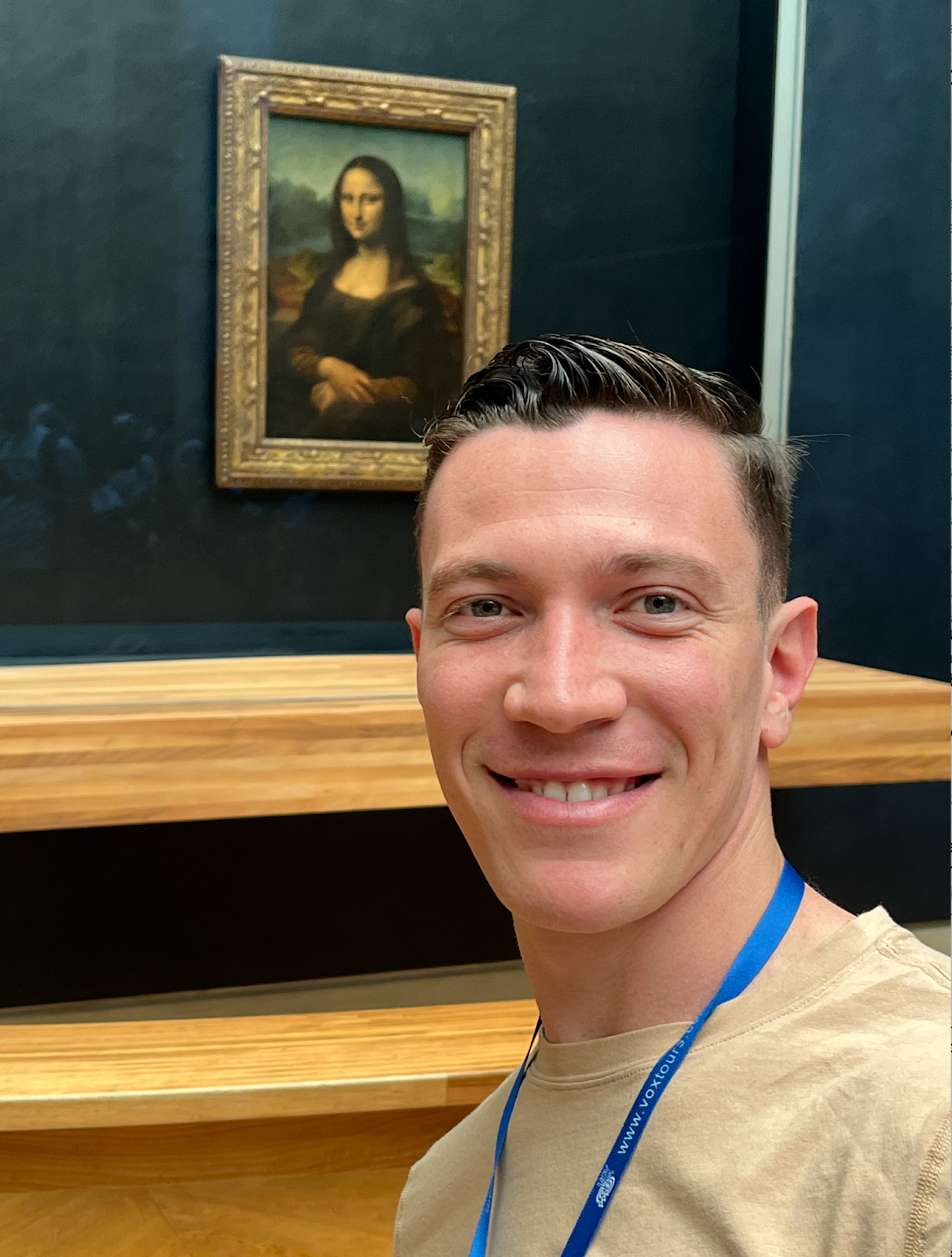
Obligatory photo in front of the Mona Lisa.
Checking out at a bookstore in County Clare, Ireland (where O’Donahue grew up).
Whenever things I admire cluster in a geographic location, I always try to visit. “Go to the source” is some of the best learning advice I know. Just as it helps to read the books that inspired your favorite authors, it’s worth visiting the geographical origins of your favorite art movements.
In 2022, before Paris, I also visited the West of Ireland, where my favorite poet John O’Donahue once lived. In 2023, I plan to visit Florence to learn about the linkages between French and Italian art.
While I’m there, I’d also like to tour the Brunello Cucinelliheadquarters in Solomeo and meet some of the higher-ups there. I haven’t found a company that better balances the desire to do excellent work with an appreciation for beauty and the desire to honor the human spirit. They don’t just make fine cashmere. They work with the kind of dignity I’d like to emulate.
You should know about Brunello Cucinelli.
He's the billionaire founder of a $450 million fashion brand. His company is valued at more than €1.6 billion, and it's fueled by his radical approach to business.
This thread is a collection of the best things I've learned from him.
Our human spirit comes alive when we’re surrounded by care. If you’re making something for a number on a spreadsheet, you’ll focus only on utility. But if you care about the person you’re making something for, you’ll transcend what can rationally be justified and make something to uplift their spirit.
A lack of man-made beauty is the hardest part about living in Austin for me. I love the people, but my artistic spirit feels dead here. The crude built environment is what you get in a Godless world of hyper-individualism and short time horizons.
I love books, but there’s so much they can’t express. When a friend visited Florence earlier this year, she said: “You can read about power all you want, but you can’t appreciate it until you visit the marble-filled, Michelangelo-decorated tombs of the Medici family. The grand statues and towering ceilings will make you feel the weight of your own insignificance.”
Moments like that are why I’d like to visit.
Company Goals for 2023
Flagship: Our Program for Adults
Coming into the year, just about everything about our Flagship product was stuck in my co-founder Will Mannon’s head. This was unsustainable, both for him and the company. We joke that the product felt like it was hanging from a string. If that string had been cut, it would’ve all fallen to the ground.
In the spring, we hired Dan Sleeman as our Director of Flagship. He spent the year operationalizing the product. He also built the infrastructure to track student writing and ensure that every piece of student writing receives feedback from our team.
We also defined our core commitments:
Publish Quality Ideas: Mediocre writing won’t get you anywhere in the GPT age. We help you write things only you could’ve written. The better your writing, the better the opportunities that’ll come your way too.
Find Your People: You’ll meet your closest friends by taking Write of Passage and sharing ideas in public.
2x Your Potential: We help students double their income, double their creativity, and find work that’s twice as meaningful.
The core commitments have made shaping our Flagship product much easier. It was the first time we were explicit about what we stand for. Before our commitments, we’d freak out whenever somebody asked for a refund. We’d re-evaluate the product, our sales strategy, and sometimes our worth as human beings. Now, we’re calmer about refund requests. Since most of the people who ask for refunds have buyer’s remorse or bought the wrong product, we’re much more comfortable saying “this product isn’t for you” and giving them their money back. But when we fail to deliver on our core commitments, we take it very seriously.
For 2023, we have two main goals: 1,000 full-paying students + second paid product to help people improve their writing and grow their audience between cohorts.
With each successive cohort, I’d also like the student experience to depend on me less.
We’ve also started working on an “Outplacement” program to match students with jobs. We tested it with Jim O’Shaughnessy. He funded 15 full-ride scholarships for Write of Passage. In return, we sent him people who’d be good candidates for writing internships at O’Shaughnessy Ventures. Jim wrote: “I am not exaggerating when I say I was BLOWN AWAY by the talented people he sent our way.” He planned to hire two students. But he was so impressed that he hired three.
Our outplacement program is turning into a full-on revenue stream. Think of it like the “career services” center at a university. We’re now working with three more companies to help them find public and internal-facing writers. By March, we’ll have somebody running the program full-time. If you’d like our help finding writers, send me an email or a DM on Twitter.
How do you like my In-N-Out hat?
Liftoff: Our Program for High Schoolers
Liftoff started slowly. My audience wasn’t as receptive to it as we expected and having only sixteen students join the beta program was a punch in the gut. We still want to help high schoolers write online but need a new way to attract them.
The most ambitious kids still apply to college. It’s the way of the world, and we’re going to use it to our advantage. With an estimated 80% of colleges that won’t require SAT or ACT scores for 2023 applicants, college essays are becoming more important. We are well positioned to help students write theirs. Students will find us through paid college essay workshops. Our goal is to make them so productive and enjoyable that our participants will itch to join the full Liftoff program and write with us consistently.
For the year, we want 2,000 paid students to join a workshop or a cohort. We want 80% of them to submit their college essays with something they wrote in Liftoff.
We’d also like to have 200 students in our Liftoff cohort by the end of the year.
Peter Thiel’s famous interview question is: “What important truth do very few people agree with you on?”
Our answer is that in the age of the Internet, big classes are better than smaller ones. Education products can now improve as they grow. For starters, my experience is basically the same regardless of how many students have tuned in. The more students we have, the more we can invest in production. A cohort with thousands of students makes it easier to meet people on your intellectual wavelength, which is why we eventually want to have thousands of students in our Liftoff program.4 At that scale, we can hire a team to provide 24/7 editing support. Students will be able to submit their essay before going to sleep and get it edited by the time they’re awake.
Ambitious high schoolers are seriously underestimated. They’re capable, but lack support. Their teachers underestimate them, their parents don’t know what to do with them, and their friends don’t share their passions. At school, they’re taught that individualism is a bad thing. They’re told to follow the syllabus instead of their innate curiosities. We want to encourage the opposite. One high schooler I spoke with (who’s an exceptional writer) hasn’t told anybody about her blog except for her best friend because she doesn’t want to be made fun of. There are tens of thousands of students like her. For them, Liftoff will be an oasis.
4
We’re working up to 100 students at once. Once we reach that milestone, we plan to increase the cap by 25 people each time. We won’t increase the cap unless we’re happy with the quality of our students, the way they interact, and the culture of the cohort.
Build an Independent Media Company
Until now, we’ve had a single-minded focus on product. Nearly every new hire we made helped us run our courses better. Growing the student body was mostly an afterthought. The focus paid off. Four years after starting Write of Passage, we’ve finally developed a sturdy system for building and improving our courses. There’s a bunch of work to be done, but the (very) basic foundation is in place.
We’ve cracked something with education. We teach in ways the establishment system won’t and cannot do.
We currently teach ~600 students per year. We’d eventually like to teach 10,000. In order to do that, we need to increase our reach.
Having a direct relationship with students is the first step. We don’t want to rely on the mainstream media for reach. They’re too invested in the status quo. The reporting is lazier now than it used to be (which is why I dropped out of the journalism track in college). We’re also going to route around the school system instead of working through it. Getting swept up in the cobwebs of the education establishment will slow us down and stop us from innovating until, eventually, we’re swimming in glue. The core ingredients are a company email list with hundreds of thousands of engaged subscribers, an armada of successful alums, a top-notch curriculum, essays that outline our approach, a podcast to attract high-level writers, and videos that show what it feels like to be a Write of Passage student.
It’s not enough to have good ideas about fixing education. We need people to actually take our courses.
The current education system is sorely broken. Kids hate school, the textbook industry is a sham, grade inflation is rampant, standardized test scores are falling, and end of semester surveys at many universities are used for budgeting purposes instead of improving the student experience. Doing more of what we’re already doing won’t solve much. For-profit education is the best way to fix the system.
The system is constrained by its own paltry economics. Talented people want to make money. If education companies can’t pay meaty wages, top talent will defect to industries that can (like law, tech, consulting, or private equity). Finding profitable business models for education is the first step to sustainably attract top talent.
If we’re profitable, we can also ensure that everybody who needs to be in our programs can join — no matter where they come from or how much money they have.
To make the changes we need to make, we need to focus on marketing and production:
1. Marketing
Building a great product isn’t enough to change the education system. We have to become great marketers too.
Steve Jobs comes to mind. It’s easy to think iPods, iPhones, or the computer you’re reading this on were inevitable in retrospect. But they only exist because of Jobs’ vision. When he started in Silicon Valley, computer geeks didn’t understand why people would want ready-made computers. They liked the industrial aesthetic too. Jobs saw things differently. He wanted computers to be elegant and beautiful. To realize his vision, he had to warm ordinary people up to the idea of personal computing. Every week, he hosted a three-hour meeting with his marketing and creative team. He personally approved each commercial print ad and billboard. Though the specifics of his approach aren’t my style, the spirit of it definitely is. Apple spent 100 times more than every other company combined advertising their music player. I don’t remember Zune ads and I don’t remember Walkman ads, but I sure as hell remember the dancing silhouettes in the iPod ads. Apple has done more to make technology cool than any other company.
I see parallels between the early days of computing and the education industry today. Like early computers, the idea of school needs a rebrand. The way schools advertise themselves is as stale as their teaching. Just as Jobs pioneered the idea that computers could be beautiful and powerful, we can pioneer the idea that education can be fun and effective.
By the end of the year, we want to have 50,000 new email subscribers (and a 50% open rate) on a Flagship email list, and 20,000 subscribers on the Liftoff one. Marketing is also responsible for getting 1,000 students into our Flagship course and 2,000 students into a Liftoff program.
2. Production
A savvy production team is a force multiplier for our marketing and product efforts.
Much of marketing is downstream of production. Like a space mission, production has required a bunch of work before launch. We spent six months this year building a full-on production studio in Austin, Texas. The gear is top-notch and the set is a teacher’s dream. Aesthetically, it’s a hyper-maximalist ode to beauty and creative excellence. Nothing so far has pumped me up more than a guest who described the studio as a “religious experience.”
We decorated the set for Halloween, and I dressed up as The Mandalorian. The studio aesthetic from a soon-to-be-released How I Write episode with Byrne Hobart.
We’re producing videos from the studio too. To date, we’ve struggled to communicate the energy with text on a website. Students repeatedly say they didn’t understand the Write of Passage magic until the first live session. Video is a more effective way to outline the experience, which is why we’re spinning up a production team.
Our production team will help with the product too. At the end of the day, we don’t compete with other schools. We compete with Netflix, YouTube, TikTok, and video games. If we’re going to win the attention battle against them, we have to make it fun to learn writing. We want our courses to be delicious and nutritious. Think back to your favorite teachers. In addition to being subject-matter experts, they were funny and captivating storytellers (Richard Feynman is a prime example).
I dream of changing the learning experience like Walt Disney changed amusement parks. Before Disneyland, amusement park employees coldly referred to their visitors as “marks.” Walt rejected the conventional wisdom. To create a warmer and more hospitable environment, he insisted on calling them “guests.” Instead of hiring industry experts, he brought in people from his movie studio. Imagining the park, he said: “Disneyland will be something of a fair, an exhibition, a playground, a community center, a museum of living facts, and a showplace of beauty and magic.”
Why can’t Write of Passage be the same?
How I Write Podcast
In the spirit of a Steve Jobs presentation, there’s “one more thing.” As part of the independent media company initiative, I’m launching a podcast called How I Write. Think of it like How I Built This, but for writing. Writers always do a podcast tour when they release a book, but never talk about their process for writing it. They only talk about the content of the book. In addition to interviewing my favorite published authors, I’ll interview online writers who embody the Write of Passage ethos.
The plan is to record most interviews in person. I’ll only record remotely if I really can’t be in the same physical location as my guest. In-person interviews inspire friendlier feelings of camaraderie and open up the potential for video. In advance of our launch, we’ve hired a full-time podcast producer and an insanely talented video editor to produce clips for the show.
Key goal: 30 episodes + 500,000 downloads by year’s end.
Solidify the Company Culture
Culture is the least tangible part of building a company, but arguably the most important. Watching the company 5x in size in one year has me paranoid about losing our gusto. I’m an absolute hawk about it. New employees can’t join without an interrogation interview from me. I’d faster blow up the company than lose our intensity and surrender to the creep of corporate mediocrity.
If you’re going to work with us, you have to be all in. You have to think deeply, work swiftly, care personally, have a flaming heart, and hold yourself to exceptionally high standards. Most people won’t like working here, but if somebody’s a fit, the outcomes have been supercalifragilisticexpialidocious.
Something is always off-kilter when you run a company. Conflict and confrontation are everyday occurrences. Somebody’s always agitated. Somebody’s always going through a hard time. If you demand total order and calmness, you won’t get anything done. Most people get angsty when something is wrong. Great CEOs don’t get distraught. They lean into the barrage of problems in their purview. Learning to navigate conflict and make hard decisions fast is the price of entry for running a successful company.
Unfortunately, a few of our hires haven’t worked out. Through trial-and-error, we’ve learned that people who thrive at Write of Passage relish an ever-present waterfall of information. They’re voracious readers who write well and enjoy doing so. Since we move at Internet speed and operate transparently, it’s a hard place to work for people who are easily overwhelmed by a lot of information.
When we saw the benefits of direct feedback, we embraced Radical Candor — the combination of caring personally and challenging directly — as one of our Ways of Working. Radical Candor isn’t some bumper sticker idea. In fact, as we’ve learned the hard way, it’s a jarring transition for people who’ve spent their work lives in a Dilbert comic. They’re not used to giving and receiving direct feedback, and they’re definitely not used to speaking so honestly with their managers or the CEO.
Radical Candor isn’t just about criticism. It’s also about praising others (which is often more effective). The best feedback is specific. If it’s critical, it should come with a concrete suggestion for how to improve.
Source: Candor Inc.
Radical Candor takes time to understand. When people hear Radical Candor, they default to worrying about “Obnoxious Aggression.” They think of the military sergeant who withholds praise and scolds their lieutenant for making an honest mistake.
Most tech and education companies suffer more from “Ruinous Empathy” though. They run from difficult conversations, for fear of hurting another person’s feelings. Anger pents up inside. Frustrations go uncommunicated. Nobody says what needs to be said. Even the praise feels hollow and sometimes, vaguely condescending too. Like the well-meaning parent who refuses to discipline their kids in the name of love, they do what’s easy in the short-term but destructive in the long-term. The result is a political culture filled with third-rail topics, where people talk behind each other’s back and get unexpectedly fired without any feedback in advance. Thanks, but no thanks.
There were multiple times this year when a message was poorly received on Slack. Text is a lossy medium. Messages will be interpreted in the harshest possible way, especially before you’ve gotten to know the other person. The recipient can’t see the smirk that comes with the snark. Videos and voice memos can help. So does picking up the phone and calling somebody like it’s 1983 or something. I even hopped on an airplane to have a few conversations because they required the delicacy of a high-resolution, in-person conversation.
To combat these challenges, I encourage everybody to be earnest and exceptionally kind in text communication (even if it’s a little over the top) until they have a strong relationship with the person they’re writing to.
For difficult conversations, the best mantra I learned this year is: “High care, high empathy, low emotion.”
High care: Difficult conversations go better when you genuinely care about the other person. People can feel when you’re really listening or when you’re treating them like a pawn.
High empathy: This is about looking at the whole person in front of you. People don’t just work for Write of Passage. They have families, friends, dreams, pains, and challenges outside of work.
Low emotion: This is the toughest one for me. All of my hardest conversations have an emotional undertone. People come to me when they’re angry, anxious, nervous, insecure, and frustrated. As a leader, I need to stay calm so I can soberly confront the situation.5
5
Barack Obama once said that when you’re president, only the hardest questions land on your desk. It’ll only climb the ranks if others can’t answer it, and by the time a problem makes it to him, all the proposed solutions are bad. The same is true for a company (though the problems are much more benign).
I aspire to be the combo of Spock and Mother Teresa. Most managers get it backwards. When somebody isn’t performing, they’re like Mother Teresa and refuse to provide direct feedback. Then, one day, when they let go of the person, they become as cold, distant, and half-human as Spock. Do the opposite. When somebody isn’t performing, be like Spock. Speak truthfully. Tell the other person what’s not working. Paint an objective picture for what success looks like. If it still doesn’t work out and you have to let them go, be like Mother Teresa. Lead with compassion, support their transition, and earnestly offer to help them find their next job.
Or, as one friend said after a few beers: Don’t blow smoke up people’s ass while they’re working for you, only to kick them out the door later.
Radical Candor flows more naturally once these habits are in place. A piece of positive or negative feedback is shared in almost every meeting I have. I’ve found it much easier to trust people who proactively critique themselves and earnestly define how they’re going to improve. “Everything’s going great” is a red flag. At times, I’ve even seen an inverse correlation between real and self-reported progress. The more honest people are about the ups and the downs, the more I want to work with them.
YC for Writers: Our Long-Term Vision
When Write of Passage started, I was the nexus of everything. Then Will joined and took ownership over the student experience. Coming into 2022, almost everything at the company rested on our shoulders. If either of us had been hit by a bus, all that we’d built would’ve instantly evaporated.
As the company’s grown, the Write of Passage brand has developed its own reputation. Each cohort, fewer and fewer people enroll because of me. Long-term, I want the Write of Passage brand to be much larger than the David Perell one.
For inspiration, I look to what Paul Graham did with Y-Combinator. Since he founded it, the grooves of his thinking (and essays) are etched into the program’s core. But the YC brand is bigger than his now. Nobody in the program expects the majority of what they learn to come from him directly. The program revolves around principles instead of people — principles like “talk to users,” “build something people want,” and “do things that don’t scale.” Even if many of the defining principles are Graham-isms, teachable lessons can come from anybody now. Like YC, Write of Passage is more about the people you meet and the things you do than what you actually learn.
I’d like Write of Passage to be similar. My DNA will always be inside the product, but we’ll ultimately limit ourselves if I do all the teaching.
In some ways, we’ve already achieved some separation. Our Editor-in-Chief, Michael Dean now owns the curriculum. Besides being a savant at structuring and visualizing information, he teaches the craft of writing better than I ever could. We’ve also hired a lead instructor for Liftoff (named JP) who transmits the Write of Passage spirit to high schoolers more effectively than I ever could. Beyond our full-time staff, there were 38 people involved in running our most recent cohort. Every mentor program is a course inside the course, and shares a different perspective on the craft of online writing, such as publishing psychology, finding your voice, and audience growth.
We also have a team of paid editors. Students collectively wrote almost 500,000 words during our most recent cohort, and every single piece received feedback from one of our paid editors. The edits had an average turnaround time of less than 24 hours too.
Due to the power law economics of venture capital, YC disproportionately benefits from attracting A-grade talent. With our product roadmap, so will we. Our approach is different though. YC turns people into entrepreneurs; we turn them into writers. YC attracts STEM types; we attract Liberal Arts types. YC gives people a network of advisors, investors, and fellow entrepreneurs; we give people a network of teachers, editors, and fellow writers. YC measures success on revenue growth and the quality of their product; we measure it on audience growth and the quality of their writing.
The challenge now is two fold: (1) give people at path to writing well and growing their audience until they’re ready to start a business, at which point we’ll (2) pair each creator with an operator who’ll run operations at the company.
To create such an experience, Write of Passage needs to grow beyond me. I’ve never been able to run the actual company during a cohort. That was acceptable when he had one product and a team of three people. It was a nuisance when we had a team of ten people. It’ll tilt towards destruction as we grow.
Become a Better Leader
Steve Jobs didn’t enjoy the company-building process. He didn’t care about companies as abstract entities. Instead, he saw companies (so long as they had strong cultures and capable people) as the essential ingredient for building great products — what actually mattered to him. He said, “For me, it’s about the products. It’s about working together with really fun, smart, creative people and making wonderful things. It’s not about the money.”
I agree. A company is fundamentally about mobilizing a group of people in order to make an impact. When you work alone, you’re limited by your own capabilities. Groups of people are far more capable. You can make stellar progress by setting a bold vision and bringing together the right combination of talents and personalities.
Here’s what haunts me though: Every entrepreneur I’ve studied was a far better leader at the end of their career than the beginning. I’m undoubtedly the same way. I constantly ask myself: “What am I doing wrong? How can I catch my weaknesses early?” This year, I asked my entire team to critique my performance.
Multiple people felt that I was acting too impulsively. Making quick decisions is part and parcel of running a successful startup, but impulsive has a negative connotation. Some people felt that I was jumping to conclusions and changing directions on a whim. To remedy this, I’ve already started speaking in more questions and hypotheticals instead of absolutes. I’ve also been sharing more context around my decisions. Whenever possible, I try to ground them in our mission, company values, and ways of working.
As I wrote to the team: “I once again want to thank you for being radically candid with me. At Write of Passage, we care personally and challenge directly. We do it with Hearts on Fire and whenever possible, offer concrete suggestions for improvement. These performance reviews are a core part of what we do here. Thoughtful critique, clear writing, and an unquenchable thirst for improvement will continue to be rewarded here.”
Open Questions
Measuring the Unmeasurable
I used to be against objective metrics. I gulped the Seeing Like a State black pill too fast. You need metrics as your company scales. As a leader, your ability to distribute decision-making is one of the core constraints on your ability to grow. Setting a few clear metrics is one of the best ways to do that. Metrics aren’t the problem. Poor metrics are.
One of my biggest open questions is how to measure the unmeasurable. Sometimes, the gap between success and quality is minimal. For example, we want more than 90% of Liftoff students to enjoy the program more than their high-school writing class — while learning more too. Sometimes, it’s a little more difficult. The incentives for creating marketing content skew towards giga-cringe, lowest-common-denominator milquetoast junk. I’d sooner resign as the CEO than have our name associated with such disposable writing. How can we measure and incentivize tasteful marketing that converts?
Then, there’s the spirit of the cohorts themselves. At Write of Passage, we passionately reject the assumption that learning environments have to be boring in order to be effective. Such thinking is nonsense yet oppressively pervasive. We aren’t just fighting the education system. We’re on a crusade against the soul-numbing, brain-deadening, spirit-crushing institutional apparatus that surrounds us.
Creating magic is one way to do that. With magic tricks, what looks wondrous to the audience is predictable for the magician. It takes a meticulously planned and well-rehearsed series of steps to seemingly bend the laws of physics.
Disneyland is similar. Their magic is enabled by clear metrics and rational thinking. One of their core metrics is the percentage of customers who return for a repeat visit (they hover at around 70%). Early on, they discovered that the average person would carry a piece of trash twenty-seven feet before throwing it on the ground, which inspired the spacing between their trash cans, all of which match the section of the park where they’re located. There’s a lot we can learn from them. Rumor has it that you can take a behind-the-scenes tour to see how they run the park. It’s top of my bucket list for 2023.
Write of Passage should be a wondrous and awe-inspiring learning experience. I don’t know how to measure that though. Should we aim to quantify these emotions? If so, how should we do it? If not, how can we sustainably create magical experiences as we grow?
Sitting in front of Snow White’s castle with my co-founder, Will Mannon.
How Can I Write in Public While Growing the Company?
I saved the hardest section for last. This is the third time I’ve fully re-written it because I’m struggling so mightily to write consistently while running the business, especially as the team has grown.
Until 2022, I was very disciplined about my writing time. I wrote for 90 minutes every day and basically didn’t let anything get in the way. I dropped that habit, and guess what? I had an atrocious writing year. Though I didn’t miss a single Monday Musings, I only published two long-form essays during the second half of the year.
Not spending enough time in a focused writing state was the culprit, and such poor writing output is a dark cloud under an otherwise sunny year.
Part of the challenge is that I’m so new to being an executive. I feel like the kinds of Write of Passage students who are new to writing and have a lot of potential, but still struggle with every piece because they haven’t published enough. When they worry they’re not doing a good job, I say: “Relax, you’re new to the craft.”
I feel like I have the potential to become a great business leader. I really do. But I have a lot of work to do in order to get there.
Though I’m voraciously working to level up, leading Write of Passage is going to be really demanding for the first few years — and I’m up for the task. The challenging tradeoff is that I won’t have the intellectual space to write the kinds of expansive, free-flowing essays I used to write. So if I’m going to publish frequently, I’m going to have to write about what’s top of mind: building a business.
Writing is the heart and soul of my craft. Time at the keyboard is how I make intellectual progress. Most of my best opportunities come through Twitter, and the platform generates the vast majority of my email subscribers too. Once somebody becomes an email subscriber, they’re much more likely to become a long-time reader or enroll in Write of Passage.
Waking up before the birds start chirping is my only chance to write consistently again. On weekdays, I’ve found that I can only write between the hours of 6-10 (am or pm). There’s too much going on outside of these blocks. I now have a 6am standing meeting to write for a few hours each morning. Fortunately, my stamina as a writer has increased. Writing used to be such a miserable experience for me that I could only focus for 90 minutes at a time. Now, I can write for three hours, which is what I’m aiming to achieve every morning.
Whenever it’s time to write, I’ll check-in on my time tracking app: Timeular. I also use software to disable Slack, Twitter, email, and text messages while I write. Keeping my phone out of sight helps too. According to this study, the mere presence of a smartphone in your field of view can lower your brain capacity even if you’re not using it.
My goal for 2023 is to log 400 hours of focused writing time.
The decision to focus on inputs instead of outputs was inspired by Isaac Asimov. He wrote for six hours per day, and either wrote or edited 500 books and almost 100,000 letters and postcards. Though I’ll never be that prolific, I’ve taken inspiration from him.
If I write for 400 hours this year and still have an unproductive year, I’ll write about my mid-life crisis in next year’s Annual Review.
I got a C- in my college writing class. At one point that semester, I skipped ten of those classes in a row because I didn’t see the value in learning to write. When I told my high school writing teacher that I’d taught thousands of people to write online, she spit out her drink because she thought I was joking.
If I didn’t grow up with the passion to write, where did it come from?
I started writing because I was jobless and needed to turn my life around. I was an over-saturated news consumer with nothing to show for it. I loved ideas, but had nobody to talk about them with. When I brought up intellectual subjects, my friends mocked me.
I was unemployed, overstimulated, and unfulfilled.
Desperate for a solution, I started writing online. At the time, I was nameless and stuck on the sidelines because I didn’t have the gumption to share my ideas. I experienced a cocktail of searing emotions — envy, inspiration, fear, curiosity, rage, hope, hopelessness, excitement, and self-loathing. But with each article, things got a little better.
For the first time in my life, I made use of the information I consumed. The friends I made shared my obsession with ideas. As I published, I realized that everything I wrote was a magnet to attract opportunities that felt like magic in the moment, such as a $20,000 grant from Tyler Cowen’sEmergent Ventures program and a podcast interview with Neil deGrasse Tyson, arguably the world’s most famous scientist.
Five years later, I can say that writing on the Internet is among the best life decisions I’ve made. The 90 minutes I spend writing every morning is my most important habit and the activation code for just about everything good that happens to me. For years, I thought that being successful and being myself were diametrically opposed, but becoming an online writer has shown me that I can succeed by bringing out more of myself — and so can you.
Writing gave me wings. It unlocked the latent potential of the Internet. You can access humanity’s best thinking, improve your own, and freely share your best ideas to a global audience. The writer’s path is no longer reserved for authors, journalists, or your aunt’s crazy Facebook rants. Anybody can walk it now.
My life is devoted to helping people write online. In Write of Passage, I teach a proven system that’s built for the 21st century. Our alumni base includes some of the fastest-growing online writers in the world right now (such as Packy McCormick and Ana Lorena Fabrega). I’ve distilled the most important principles from the course into this guide.
Writing from Abundance is the art of collecting ideas so you can think better and avoid writer’s block.
Writing from Conversation is the art of using dialogue to identify your best ideas and double down on them.
Writing in Public is the art of broadcasting your ideas to the Internet so you become a beacon for people, opportunities, and serendipity.
The game of online writing rewards people who publish consistently. Though frequency is the price of entry, quality writing is a force multiplier on your success. If your ideas resonate, the number of opportunities available to you will explode.
As you write, you’ll gain clarity around your Personal Monopoly — a unique online identity that emerges out of your skills, experience, and interests. As a compass, it’ll guide you towards the right people, meaningful work, and a life of freedom. By the end of this guide, you’ll have a roadmap for building one.
Now, I’m going to unpack what it takes to become a successful online writer.
Become known as the best thinker on a topic and open yourself to the serendipity that makes writing online so special. Uncover your strengths, clearly communicate your values, and start building your reputation online. Download the guide to your Personal Monopoly.
Write from Abundance
My Struggle with Writer’s Block
I used to face crippling bouts of writer’s block. My mind would race with ideas when I was away from my desk, only to turn off whenever I sat down at my computer to write. I’d spend hours looking at my screen, only to get no writing done and leave with a blank page. It was infuriating.
Fortunately, my writer’s block disappeared once I started Writing from Abundance.
The premise is simple — build a bank of inspiration while you’re away from the computer and before you sit down to write. Capture your epiphanies. Save the best quotes you read. Identify ideas that resonate with you and jot them down as notes.
Writing from Abundance is the art of collecting ideas so you never have to write from scratch. It’s about living a life that brims with inspiration. That inspiration can come from external sources—like social media, articles, or books. It can also come from internal sources– like dinner parties, work meetings, or shower thoughts. If you capture ideas when they’re in the forefront of your mind, you won’t have to pray for them to come back when it’s time to write.
Once I learned to Write from Abundance, I saw how the practice was alive in many fields. I last saw them when I visited my tailor and asked him for help making a blazer. Instead of starting from scratch, he put a bunch of materials on the table (silk, buttons, swatches, etc.). Then he mixed and matched the possibilities until a design emerged. Your notes are like those raw materials. If you ever get stuck, you can pour them onto the page and see what materializes when your ideas collide.
In order to start Writing from Abundance, there are three things to do:
Upgrade your Information Diet
Practice the Capture Habit
Build a Note-Taking System
1. Upgrade your Information Diet
FIND BETTER INGREDIENTS
Most people don’t use the Internet to learn. They use it to follow pop culture and keep up with their friends. Neither of these strategies are very effective for having better ideas.
Every great writer I know obsessively curates their information diet. They rightfully know that high-quality writing begins with good taste for what you consume. Writing is like cooking. If you walk into a Michelin Star restaurant and ask the chef: “What’s the fastest way to improve the quality of your food?” they’ll likely say: “Better ingredients.” At the end of the day, heaps of dressing can’t make up for stale lettuce. A salad can only be as good as the fruits and vegetables inside of it. Your experiences, conversations, and information sources contain the raw ingredients for your writing.
It’s easier to have unique ideas when you read things other people don’t. Early in his career, Warren Buffett got some of his edge by going beyond the Annual Reports that everybody else was reading and picking up 10-K filings that were tough to get your hands on back then. David Epstein aims to read ten journal articles per day when he’s working on a book. Many of his best ideas come from reading papers that others won’t and synthesizing them for a public audience.
Beware of too much news consumption. Yes, it’s good to be an informed citizen. But the idea that obsessively reading the news is the best way to stay informed is a lie sold to us by the propaganda machine. Most news is inconsequential. It’s entertainment dressed up as information. Though it can be good to have a general sense of what’s happening in society, you probably don’t need to be plugged into a 24/7 stream of news — or what I call: the Never-Ending Now.
ESCAPE THE NEVER-ENDING NOW
I once attended a comedy show with a group of friends. Since the venue was across town, we split a Chevy Suburban SUV. From the moment the driver hit the gas, everybody was on their phones. From the back row, I watched my friends scroll their social media feeds with ferocious intensity. One thing stuck out: everybody in front of me only consumed content created within the last 24 hours.
No exceptions.
I succumb to the same impulse. Chances are, so do you. Like hamsters running on a wheel, we live in an endless cycle of ephemeral content consumption — a merry-go-round that spins faster and faster but barely goes anywhere. The Internet is a novelty machine that pulls us away from age-old wisdom. Even though we’re just a click away from the greatest authors of all time, from Plato to Tolstoy, we default to novelty instead of timelessness.
We’re trapped in a Never-Ending Now — blind to history, engulfed in the present moment, overwhelmed by the slightest breeze of chaos. Here’s the bottom line: You should prioritize the accumulated wisdom of humanity over what’s trending on Twitter.
Short-form: Social media is at its best when it matches you with people who share your exact interests and teach you about what you want to write about. Unfollow celebrities. Replace them with people who make you smarter and bring long-lasting joy.
Medium-form: Read less of the news. Subscribe to magazines and YouTube channels that post timeless ideas. Read essays and speeches that have stood the test of time. Find people whose recommendations you consistently enjoy and subscribe to their newsletters.
Long-form: Get away from your screen and read more books. If it helps, start a book club. Find classic books to read. Watch old documentaries and listen to lecture series. Crawl the Internet for college syllabuses so you can read them on your own time.1
2. Practice the Capture Habit
Now that your incoming information is solid, you need a way to harness it. It’s not enough just to binge eBooks and list a stat on your website (one Write of Passage student refers to this as “Book Chugging.”) You should save the best parts of what you read, so you can easily reference them later.
By capturing ideas in the moment, you can effectively start essays when they’re 80% finished.
Notes are so central to my writing process that writing without them is like building a campfire without a pile of wood. Because I’m so diligent about writing ideas down, I don’t need to run back to the “forest” every time I get stuck. Instead of starting a new research process for each new article, I pull from ideas I’ve already captured in my casual reading, in conversations, and in the ordinary moments of my life. All those notes became intellectual fodder for future pieces.
AMBIENT RESEARCH
I call this process “Ambient Research.” By the time I sit down to write about a topic, I’ve already done most of the research I need to write about it.
This method of Ambient Research is the opposite of what I learned in school. My teachers promoted Active Research, which led me to spend hours reading in the library after I picked a topic. Without notes to build upon, I had to start from scratch whenever I began an essay. Since I’m a slow reader, I had to give up my weekends for research.
Being a writer doesn’t mean you have to sacrifice huge swaths of your life. You don’t need to bunker down in a library for days straight in order to find inspiration. You already consume media, have thoughts, and write ideas in group chats. When you practice the habit of capturing what’s already happening, you’ll find that you have all the material you need to start writing.
Effective ambient research happens when you capture the best ideas you consume, the epiphanies you have, and the things you’ve already written to friends and colleagues. I’ll focus on each in the next three sections.
SET UP ‘READ-IT LATER’ APPS
Have you ever had that feeling where you have like 200 tabs open on your browser, but you don’t want to close them because you’ll lose such valuable articles that you intend to read? I’ve felt that anxiety. Luckily, there’s a solution: Read-it-Later apps.
I never read articles in my web browser.When I come across an interesting article, I save it to an app that automatically downloads it to my phone so I can read it later. Saving these articles gets me out of a reactivity loop, where I read things immediately after I find them (which is what most people do). I want my reading to be much more intentional than that.
The app is called Instapaper. Instead of driving myself crazy with a bunch of open browser tabs that rise up like a game of whack-a-mole, I save articles I want to read to Instapaper and open the app whenever I’m in the mood to read. Since all the articles are downloaded to my phone, I can read them on the airplane or anywhere I don’t have service. No matter what, everything I highlight automatically saves to my note-taking system.
Read-it-Later apps act as a quality filter for your reading too. By saving articles to an app and refusing to instantly read things you come across on the Internet, you raise the bar for what grabs your attention. With a Read-it-Later app, whenever you sit down to read, you have hundreds of articles to choose from. You can allocate your attention to the best one.
Using a Read-it-Later app showed me how many ideas I consumed not because they were important, but because it was marketed with “You have to read this!!!!” language.
CAPTURE YOUR OWN IDEAS
Do you ever forget ideas? Maybe you forget to write down an insight from a buzzing conversation with a friend, and two months later, when somebody asks you about what you discussed, you don’t remember zilch.
The same thing used to happen to me while traveling. I’d have tons of epiphanies while walking through a new city, only to forget them once I returned home. These impressions and emotions were unique to me. No Internet search could have yielded them. Now, they’re lost to the entropy of time. The clarity of memory decays quickly, so we shouldn’t just save other people’s ideas. We should save our own ideas too. Until we have a central place to capture our best thinking, the joy of epiphany will turn into the anxiety of forgetfulness.
Many of your unique and provocative ideas will come when you’re away from the computer — doing chores, driving around, or walking through your neighborhood. Ideas are fickle. That’s why so many of history’s greatest writers have walked around with a notepad. When I read about the writing processes of historians, they repeatedly talk about how they capture their impressions immediately after an interview ends, while their memories are still sharp. They know that ideas that seem obvious in the moment will be forgotten by the time they’re ready to write about them. Following their lead, whenever I have an important idea, I assume I won’t remember it and write it down as soon as possible.
Note-taking is the closest thing we have to time travel. It’s rebellion against the entropy of memory. Kendrick Lamar insists that much of the “writing” for his lyrics happens in the note-taking process. In one interview, he said: “I have to write them down and then five or three months later, I have to find that same emotion that I felt when I was inspired by it, so I have to dig deep to see what triggered the idea… It comes back because I have key little words that make me realize the exact emotion which drew the inspiration.”
Your ability to transcribe an event is better than your ability to remember it. Writing down your observations makes you more observant, and once you commit to capturing them, your brain generates more of them. It’s like photography. Putting a camera in your hands turns every moment into a photo opportunity, which makes you more aware of your surroundings.
NOTICE WHERE YOU ALREADY WRITE
I have a friend who writes long and incredibly well thought-out messages in group chats, but says she can’t find the time to write. Her diagnosis is wrong though. The problem isn’t that she lacks time. It’s that she doesn’t realize how much she’s already writing. Context determines her capacity for creativity. She has no trouble writing something substantial to friends, but freaks herself out whenever it’s time to write for an audience of strangers on the Internet. She’s a keyboard warrior in group chats, and the more she can realize how brilliant her ideas already are, the easier it will be for her to share ideas in public.
Likewise, I often find that I’ve written parts of my piece without realizing it, either in emails to friends or Slack messages to colleagues. Sometimes, I’ll even search my tweet history. I’ve made a habit out of saving anything substantial I write to a central note-taking system so I can easily retrieve it in the future.
If you’re stuck on writing, look back at what you’ve already written for inspiration– emails, texts, tweets, group chats, and Slack Messages. Ask yourself: “Where have I been writing all along?”
Chances are, you’re already generating ideas. You just don’t realize it yet.
3. Build a Note-Taking System
Where are your notes from college? If you’re like me, you basically threw all your binders into a massive bonfire after the semester ended. Now, you have no way to find the best ideas you came across in school. Even if you magically found them, your notes would be scattered all over the places in random binders and notebooks.
The brain is great at creating connections, but terrible at remembering specific details (which is what computers are uniquely good at). Note-taking works best when the ideas are saved in a central location that contains the best reading and thinking you’ve ever done. The easier it is to search those notes, the faster you’ll be able to find them.
You don’t need the perfect note-taking system though. It can be chaotic and disorganized, and as messy as your high school bedroom. Though note-taking has been transformative for many writers, it’s telling that none of the best writers I know have a perfect note-taking system. They make something that works (even if it’s duct-taped together), and get on with what’s important: actually writing.
James Clear, who wrote the wildly popular Atomic Habits, keeps his notes in a massive, multi-hundred page Google Doc. Even Eminem, who sees note-taking as a way of “stacking ammunition” for his lyrics, packs words and phrases into a box with all kinds of folded and crumpled up paper.
There are tons of note-taking apps: Notion, Obsidian, Roam Research, Evernote. I don’t care which one you use.2 No matter which option you choose, remember that the point of taking notes is to write, not to have the perfect note-taking system.
I swear. There are people who put as much effort into their note-taking system as NASA engineers put into the rockets that got us to the moon. They spend so much time building the perfect system that they forget to actually write. Don’t do that. Note-taking is, literally, not rocket science.
If you’re just starting out, it might help to think of your note-taking system in two halves. First you collect the dots by capturing ideas, then, you connect them by writing.
Of all the drawings I’ve ever done, this one is my favorite.
COLLECT THE DOTS
Do you ever come across an exceptional tweet and feel like you need to save it? How about a fascinating paragraph that you’ll want to reference in the future? Both are worth capturing in a central location that you can easily flip through later.
Study the writing practices of history’s top writers and you may be surprised by how many kept a commonplace book. A commonplace book is a central place where you can save ideas, quotes, epiphanies, photos, drawings, and whatever else you want to remember. Marcus Aurelius, the former emperor of Rome, used his commonplace book to write Meditations; Montaigne, who basically invented the essay format, kept one; so did Napoleon, HL Mencken, and Thomas Jefferson.
Since most of your ideas will arise when you’re away from the computer, capturing ideas should be frictionless. You should be able to write an idea down within 10 seconds of having it. If writing a note takes too long, you won’t write the good ones down, and eventually, you’ll forget your best ones.
You should be able to instantly capture ideas while reading too. There are several ways to do this, but Readwise provides the most elegant solution. Everytime you highlight in Kindle or on Instapaper, and everytime you bookmark a tweet, it shoots that information into a central repository where it’ll live until the messiah returns or the heat death of the universe.
If the search function on your note-taking app is powerful, you don’t need to spend much time organizing ideas. You can throw a bunch of quotes and hunches and statistics and graphs and photos and rants into a single location, knowing that you’ll be able to find them later. Over time, you’ll develop a personal Google search engine. But unlike the actual Google, you’ll have pre-vetted everything inside of it and you’ll serendipitously stumble upon ideas you forgot you’d ever seen. So long as (1) you can capture ideas quickly, and (2) all those ideas go into the same place, you’re setting yourself up to Write from Abundance. It doesn’t really matter what note-taking app you use.3
CONNECT THE DOTS
Once you’ve built a simple and low-friction way to collect the dots, it’s time to connect them. Little-by-little, you’ve been planting seeds. Writing from Abundance is how you harvest all the little fruits you’ve sown. Jimmy Soni, who wrote The Founders, told me that he started the writing process for every chapter by dumping his notes on the screen and seeing what emerged. For him, it was so much harder to write from a blank page than 10,000 words worth of facts, quotes, and anecdotes.
His method reminds me of a line from Michelangelo, who said: “The sculpture is already complete within the marble block, before I start my work. It is already there, I just have to chisel away the superfluous material.”
I start my essays in split-screen mode. On the left side of the screen, I have my notes. On the right, my blank document. To fill up the blank page and give myself momentum, I’ll run a few searches through my note-taking system, and copy & paste the best stuff onto my new essay document. As I add ideas to the document, patterns emerge which become the structure of the piece. Usually, the piece’s structure organically emerges, as if I’m being guided by an invisible muse. What was recently just a bunch of messy ideas in my note-taking system turns into a structured outline. All I need to do is fill in the gaps, add transitions between ideas, and rewrite the prose until it reflects my best thinking on the subject.
It’s worth spending some up-front time to build a note-taking system. But remember, it doesn’t need to be fancy. Mine is a mess. Once you have an easy system for adding and searching ideas in a single location, it’s time to write. Gone goes the blank white page of doom. Now, when you sit down to write, you’ll instantly be able to draw from the best ideas you’ve ever had.
Write from Conversation
Writing Doesn’t Need to Be So Lonely
When most people think of writing, they think they need a weekend retreat to escape society. They imagine the writer as a lone genius crafting their magnum opus in a backwoods cabin with shoddy plumbing. In an existence of pings and obligations, it’s natural to think that isolation is the only way to focus. Maybe this works for veteran novelists, but not for online writers.
You don’t need to do it alone. In fact, being in conversation will make you a better writer. Humans are not fully autonomous thinkers; we are social beings. Conversations let us identify high-potential ideas and tweak their delivery until they represent our best thinking on a subject. My ideas took on a new level of refinement once I started Writing from Conversation. The concept may be new, but the method is centuries old. The Bible was spoken long before it was ever written. So were most Greek tragedies. More recently, Ralph Waldo Emerson, one of the top writers of the 19th century, developed his famous essays through public lectures. When lectures like The American Scholar resonated with the audience, he published them in writing.
In so many areas, from design, to startups, to relationships — improvement comes from feedback. When you’re so close to an idea, you’re victim to your own blindspots. Instead of assuming what’s good, conversations prove it. Before you sit down to write, you can test your ideas in conversation.
The gift of the Internet is that it lets us test ideas at scale. In this section, I’m going to show you how to do that. I’ll start by showing you how ideas develop: first, with friends; then with readers; and finally, with editors. Each phase helps you refine your ideas. What begins as messy notes get distilled into memorable phrases that’ll ring in your readers’ mind long after they’ve finished your piece.
This process of distillation begins with the Content Triangle.
The Content Triangle
Many writers suffer from perfectionism, where they refuse to share ideas until they’re perfect. Perfectionism is particularly pernicious because it’s a vice that looks like a virtue. It’s the child of two parents: fear and narcissism. It’s dangerous because you can rationalize away your fears with the excuse that your standards are higher than everybody else’s.
To shake the temptations of perfectionism, I share half-baked ideas all the time. Doing so helps my writing because I can run ideas through numerous filters, such as blogs, tweets, and email newsletters. By the time I’ve published an essay like this one, I’ve run the ideas through various forms of low-cost, high-speed trial-and-error. Each time I receive feedback, I keep more of what resonates and less of what doesn’t.
I call this method of refining ideas through a series of escalating social filters “The Content Triangle.”
The Content Triangle is embedded into the world of comedy too. I once lived with a comic who basically tested his stand-up routine on me every night. Turns out, he wasn’t the only one. Comedians are always testing jokes with friends and small audiences before they film their Netflix special. Chris Rock once said: “When I start a tour, it’s not like I start out in arenas. Before this last tour, I performed in this place in New Brunswick called the Stress Factory. I did about 40 or 50 shows getting ready for the tour.”
The standup special you see on Netflix is nothing like the first cut. In comedy, as in writing, you don’t see all the work it takes to make something great. You don’t see the 50 performances he gave at small comedy clubs around the country, and you certainly don’t see the jokes that bombed along the way.
You don’t have to be a comedian or professional lecturer to “write from conversation.” You’re having routine conversations all the time. Don’t discount the feedback you receive from them. Test your ideas out on intelligent friends. If an idea consistently surprises somebody, it’s probably good, but if people look bored or confused when you’re sharing an idea, you should either drop it or communicate the idea differently.
The Content Triangle is a method for developing ideas in various stages:
Conversations with friends help us discover surprising ideas that are worth exploring.
Conversations with readers tell us if an idea will resonate with our audience.
Conversations with editors help us improve how our ideas are delivered.
I’ll explain each stage below.
4. Conversations with Friends
THE POWER OF SPEECH
Writing from Conversation piggybacks on the brain’s natural ability to compress ideas.
Speaking is the first draft of thought. I often struggle to structure ideas when I’m writing about them. But once I start to speak, words have a way of coming together. Saying something out-loud gives me an initial structure that I can refine in subsequent drafts. When I feel an idea emerging in my head, I often pull a voice-to-text transcription app to record my thoughts (I recommend Otter).
Speaking is good for generating ideas, and writing is how you perfect them. When you write in a text editor, you have the ability to pause, edit, and dwell on a sentence. Often you can get stuck on perfecting your introduction for an hour before you even get into the meat of your idea. Speaking out loud doesn’t let you stop. You can only move forward.
The power of speech is amplified through conversation. In conversation, your partner’s reactions can help you gauge the quality of what you’re saying. Sparring partners take you to the heart of an idea. They force us to distill ideas to their essence. We change our delivery based on who we’re speaking with too. Your ideas will be funnier if you’re yapping at the bar with your college buddies. If you’re at a crowded boardroom roundtable, you’re more likely to give a compressed elevator style pitch than a full lecture.
LOOK FOR SURPRISE
When you start exploring an idea, it sprawls all over the place. Like a college smoke session, you’re in the “dude, if you really think about it, everything is connected” phase. In truth, most of the ideas are fluff (like somebody who tells 15 minutes of backstory before the good stuff begins). Even if there’s a “woah” moment at the end, the boring backstory puts you to sleep before the punchline.
Skip the 12-minute rant. Test facets of your ideas (briefly) and observe the reactions. Conversations aren’t the place to explore every nuance, counterpoint, backstory, and implication of your idea.
Embrace the dance of conversation. Good conversations push the frontier of consciousness. Pick one small part of your idea and put it out there. Observe. Watch their body language as you speak. Notice the questions they ask and the assumptions they bring to the table. All those responses yield new information. You see the map of your idea through their eyes, which shapes your next move.
You can identify each emotion in conversation, based on people’s facial expressions: they raise their eyebrows when they’re confused, invite you to speed up when you’re repeating yourself, lean in when they’re interested, look away when they’re bored, and open their eyes when they’re surprised. If you can pay attention to how people respond in casual conversation, you can develop ideas before you put them on paper, which makes the writing process more efficient, effective, and enjoyable.
If their eyes widen, they let out a gasp, and go “whoa!”— jackpot. You’ve surprised them. You’ve found something worth building your essay around. Remember what you said and remember to write down exactly how you said it (if you’re fired up, sneaking off to the bathroom is the most socially acceptable way to take notes in the heat of conversation).
Surprise signals that someone’s mental model of the world has changed (AKA, you’ve blown their mind). It’s more than just learning a new fact. It’s the kind of epiphany that comes deep from left field and breaks your expectations. Sometimes we grow so familiar with ideas that we stop recognizing the surprise in them.
Optimizing for surprise means cutting out the filler and doubling-down on the parts of your idea that defy expectations.
WRITER BRAIN / FRIEND BRAIN
A serious advantage of writing from conversation is that you avoid “Writer Brain.” When you open a Google Doc (hint, doc.new), it’s easy to boot up the tedious writing patterns you picked up in school. You tense up. “Time to get serious,” you say. You become a risk averse, politically correct dweeb— and more status obsessed than Regina George in Mean Girls.
The rising costs of WrongThink leads to self-censorship when it’s time to write. For fear of cancellation, we lock away unpopular opinions. Gone go the flames of passion and the snarky one-liners. Writer Brain inevitably takes over, becoming a cock block that keeps our personality away from our ideas.
“Friend Brain” is our natural way of speaking. It comes easily to us in conversation, and it knows how to party. It’s the friend your Mom warned you about — the one who was super mischievous and high-agency and gave you that intrepid spirit.
Conversations with trusted friends awaken your primal nature. They’re arson for your scared and timid self — the weakling inside of you that cares too much about what other people think. Only with trusted friends can you speak with an unfiltered and passionate fury. Cry. Scream. Rile yourself up. Rant like a Jewish grandmother. And if you really need to, get whiskey drunk and see what spills out after drink #3. In these moments of sweltering honesty, once we’ve freed ourselves from a self-induced prison of the mind, we’re able to unleash brave and surprising ideas.
5. Conversations with Readers
TESTING IDEAS AT SCALE
Once an idea resonates in conversations with friends, it’s time to test it with your readers online. Before the Internet, your testing was limited to in-person social interactions. Never has it been so easy to be in constant conversation with people around the world who can respond directly to your ideas.
It can help to think of your writing like a tech company thinks about their product. Great products are spurred by tons of feedback. The same is true for writing. Conversations with readers make your ideas crisp and free you from the curse of knowledge. The Amateur’s Mind is one of the best books written about playing better chess. The author, Jeremy Silman, an International Master, spent a bunch of time speaking to amateur chess players about their challenges. Patterns emerged. Those conversations with readers helped him understand his readers and know what to write about.4
Twitter and email are good places to share half-baked (but still edited) thoughts.5 Asking questions to your audience can work too. Done right, the feedback you receive can lead to interesting ideas you wouldn’t have found otherwise. If a response surprises you, it’ll probably surprise your readers too.
The sooner you receive feedback, the better. Conversations with readers are the way to determine which ideas are worth sculpting into full-fledged essays.
THE FEEDBACK-DRIVEN BOOK
I’ve never seen a non-fiction book pierce the winds of culture like James Clear’s Atomic Habits. He followed a feedback-driven writing process. He used Twitter to test his ideas. The engagement (or lack thereof) he received showed him when to double-down on an idea. Reader questions helped him find the best ways to articulate a concept.
His success points to a new paradigm in the way writers shape ideas. In the past, authors have developed their writing in private, only to share their magnum opus once it’s complete. Online writers are different. They share ideas with readers along the way. This dialogue has the twin benefit of helping authors refine their ideas while they build their audience. As I write this, Atomic Habits is the most popular non-fiction book on Amazon. In 2021, it was likely the best-selling book in the world.
Feedback-driven books are simply… better.
Until you develop a form of low-grade telepathy, your best bet is to cultivate feedback. By doing so, your writing will have less fat and a hell of a lot more meat on the bone. By the time you publish your book (or a long-form essay like this one), you’ll have gone through multiple cycles of the Content Triangle until each section has Idea-Market-Fit.
NEWSLETTER REPLIES
Though I recommend data-driven writing, it’s just a tool. Your intuition can be just as important as metrics from the market. Though Twitter is a good place to test the popularity of an idea, it doesn’t exactly encourage thoughtful responses — which are more likely to arise via an email newsletter.
Many of my best essays have started by sharing embryo ideas in my newsletters and engaging in conversations with readers. I read every reply. Those replies highlight which ideas have legs and are worth pursuing. Sometimes, the responses catapult my writing on a new trajectory.
In one Monday Musings edition, I wrote about the commitment crisis. Time horizons are shortening and young careerists prefer optionality over commitment. Towards the middle of the piece, I criticized them for “Hugging the X-Axis.” Multiple people said they resonated with the phrase. Those replies encouraged me to polish the idea and turn it into a full-fledged essay.
These responses encouraged me to turn the ideas into a full-fledged essay.
6. Conversations with Editors
HONEST, CRITICAL ADVICE
There’s a reason why professional writers with decades of experience use editors. No matter how good of a writer you are, you can’t see your blindspots. You’re simply too close to your ideas to know how certain parts of your essay land.
Chances are, your friends and coworkers aren’t interested in helping you rewrite sentences and shift around paragraphs. Nor do they have the courage to be blunt and say: “this part sucks.”
That’s what editors are for.
Once you’ve developed ideas with a crowd, it’s time to bring them to a small group of fellow craftsmen. You don’t need to pay a professional editor. Packy McCormick grew his audience to over 100,000 subscribers, and his editors were his brother and his wife (mine was the lady who still freaks out whenever I have a sore throat… thanks Mom!).
Your goal is to have a small network of trusted people who are good with words, willing to be honest with you, and want to see you succeed.
TYPES OF FEEDBACK
When you’re starting a conversation with an editor, it’s important to know which kind of feedback you’re looking for.
Types for feedback? What do you mean? Isn’t editing all about proof-reading?
Nope. In fact, software has gotten very good at editing. Tools like Grammarly and Hemingway have pole vaulted over primitive spell check.6
But if you’re doing serious writing, it’s worth working with a human editor. Depending on what you’re struggling with, you can ask them for different kinds of feedback. Early in a piece, when you’re vomiting ideas onto the page, editors can help you identify what to focus on. They can also tell you if the piece is out of balance, like when you have a swarm of interesting observations but no personal stories to bring them to life.
In later phases, when the piece is coming together, it helps to get reactions from your editor. As they read, they can highlight sentences from your draft and share their feelings with you. In Write of Passage, we use an acronym called CRIBS. Editors mark if a section is confusing, repetitive, interesting, surprising or boring. The method is universal because it focuses on standard emotions that everybody has instead of the mechanics of writing, which fewer people are familiar with.
Ask your editor to identify each letter in the CRIBS acronym, as explained below:
Confusing: The more friction in the communication process, the harder it’ll be for an idea to get from the writer’s mind into the reader’s. Most of the time, when the reader is confused about what I’m trying to say, so is the writer.
Repeated: Good writing is compressed. By definition, if you’re repeating yourself, your writing isn’t as tight as it could be. Compressed writing doesn’t mean short (just look at the length of this guide!). It just means that the pacing is brisk and each word serves a unique purpose. If people on the Internet always wanted the shortest thing they could find, Joe Rogan wouldn’t have the most popular podcast in the world.
Interesting: A fraction of what you initially write will account for the majority of insight. Ask your editor to identify the most interesting parts of your writing, so you can double down on them.
Boring: If a section causes your reader to lose interest, you need to change something. Remove the non-essential ideas. Rewrite the essential ones until they’re worthy of your readers’ attention.
Surprising: This is the holy grail of quality writing because surprising ideas challenge the reader’s worldview. It is the writer’s equivalent of a laugh. It’s the metric we use to determine if our writing is engaging. It comforts the confused and confuses the comforted. Ideas that are novel but not surprising are the definition of trivia (which sounds a lot like trivial for a reason).
The way you frame your essay to your editor will completely affect the kind of feedback you get. As you get experience sharing your work, you’ll get better at shaping these conversations.
The three stages: Conversations with friends turn into conversations with readers, which turn into conversations with editors — and all that turns into a piece worth publishing.
Expression is Compression
In school, the longer we work on an essay, the longer it gets. We’re trained to write bloated thesis papers to satisfy the teacher’s word counts (and if you’re anything like me, you also increased the spacing between every line so you didn’t have to write as much). But online writing is the opposite. Fluff is punished and compression is rewarded.
Moving through the Content Triangle generates new ideas and sharpens your existing ones.
Early ideas become final drafts in the same way that tree sap becomes maple syrup. What begins as a bunch of raw material gets distilled into sweetness. Just as it takes 50 gallons of sap to make one gallon of maple syrup, writing is always a process of distillation. Good writers distill hours (or weeks) of experience into a short, compressed artifact.
Conversations guide the compression process. They help you arrive at battle-tested ideas that’ll resonate and stand the test of time.
Write in Public
THE FEAR OF PUTTING YOURSELF OUT THERE
You’ve spent years thinking about a topic, jotted down a bunch of notes, devoted multiple weekends to research, blocked off your calendar for dedicated editing time, and given every word its due. When there are no more changes to make, the time to publish comes. You start squirming. A rush of doubt overwhelms you. Then, horrors of insecurity. But someway, somehow, somewhere, you find the courage to hit publish.
You aren’t sure what to expect. Deep down, you want a round of applause. Actually, that’s not realistic. Maybe just eight likes. Or at least a few kind replies. How about one text? But you get nothing.
Nothing.
Nothing but crickets of indifference — and it feels terrible because you feel so invisible. This section is about overcoming that feeling of being invisible.7 Publishing is the cost of admission, but there are time-tested methods to spread your ideas and grow your audience.
A NEW WAY TO THINK ABOUT MARKETING
Effective promotion has worked long before the Internet. Christianity invented viral, word-of-mouth marketing long before engineers in Palo Alto ever did. The 12 disciples were the original brand evangelists (but back then, you didn’t get free brand T-shirts for converting your friends).
The means may have evolved, but the core methods are similar. More recently, Arnold Schwarzenegger became the world’s biggest movie star because unlike the other actors of his time, he saw acting as only part of his job. As he writes in his biography: “Too many actors, writers, and artists think that marketing is beneath them. But no matter what you do in life, selling is part of it.”
His work was only halfway done once the filming for a movie was over. No matter how good it was, it wouldn’t spread without great marketing. Arnold looked down upon other actors who relied on agents and managers to do the marketing for them. By outsourcing promotion, they didn’t just lose a cut of the cash they deserved. They also lost control over how the movie was framed and the narrative of their own career. Little surprise that today, Arnold writes the best email newsletter of any celebrity I know.
AUDIENCE VS. ATTENTION
No matter how good your work is, building an audience will take time.
It’s a slow process, but don’t let that fact turn you off. That’s what makes having an audience so powerful. An audience is valuable because it takes time to build. If it happened quickly, it wouldn’t be a sustainable advantage. You can buy attention, but you can’t buy trust. It has to be earned, and that’s what makes it so precious.
Just because you have attention, doesn’t mean you have an audience. An audience isn’t the number of people who know your name. It’s the number of people you can contact at any time (which is why traditional celebrities don’t have audiences even though they’re famous). Some audiences are far better than others too. Large followings don’t necessarily lead to loyalty, like the Instagram bikini model with 2 million followers who couldn’t sell 36 T-Shirts. And then there are writers like Byrne Hobart whose work is read by some of the world’s smartest people, and Jack Butcher who earns freakish amounts of cash per subscriber.
How do you build an audience?
The Public to Private Bridge
Building an audience begins with attracting people on public platforms like Twitter and Reddit, both of which act like public squares where you can reach people at scale, for free. These public platforms are governed by algorithms that match people with similar interests. Since the biggest ones have hundreds of millions of people, they are divided into tiny subcultures, most of which are too niche to function in the physical world.
Even if public platforms are the top of your marketing funnel, they come with a tradeoff. What they give you in free reach, they take away in the lack of a connection to your audience. Their terms and conditions agreements state that they have a right to kick you off the platform. Since they own your data, you can’t download your follower graph and transport it to another network.
I like Naval Ravikant’s line on this: “Building an audience on a public platform is like building a castle out of sand.” One second, you have a fancy following to show your friends. Next, you’ve been booted off your favorite platform with nothing to show for all your hard work.
Don’t let a public platform control your audience relationships.8 If the president of the United States can get kicked off Twitter, so can you.
Find people on public platforms. Build a relationship with them on private ones.9
Do what James Clear did. He grew his audience on the back of Google, Instagram, and Twitter. Though search engines and social media platforms are fickle, Clear converted ~2 million readers into email subscribers who he can now contact directly at any time. Unlike Twitter and Instagram, Clear’s email list isn’t mediated by an algorithm. He can save and download all the emails he’s gathered at any time. He built his audience by initially standing on the shoulders of a public platform and transferring those relationships to a private one.
I call this process of transferring people from public platforms to private ones “The Public to Private Bridge.”
In the next section, I’ll walk through the mechanics of audience building. First, I’ll show you how to add value on a public platform so readers can find you. Then, I’ll show you how to engage those readers with your website and email newsletter.
7. Engage the Public
FIND YOUR PUBLIC PLATFORM
You can’t launch a random, no-name blog and expect people to magically find it. Start by identifying the places on the Internet where your readers like to hang out. You can go in two directions:
Big Social Networks: Places like Twitter and Reddit where millions of people can learn about an industry or subscribe to specific sub-communities. Think of these like massive public squares.
Small Forums: If massive networks aren’t for you, look for intimate public spaces where like-minded people gather. Maybe it’s an industry-specific forum. Maybe it’s a Slack channel focused around a specific theme. Though small forums are less likely to give you scale and reach, they’re a good way to find people who share your interests.
Resist the temptation to build an audience on multiple platforms at once. I once had a conversation with an aspiring online writer. We’ll call him Mike. He’d been writing online for five years, but struggled to build a meaningful audience. When I asked him about his distribution strategy, he told me he’s re-purposing his content for all the major social media platforms: Twitter, Facebook, Reddit, Instagram, YouTube, Snapchat, and even the new up-and-coming ones that everybody knows won’t live up to the hype. All that work paralyzed him. He was so scattered that he didn’t allow himself to commit to a single platform. From Mike, I learned that even if it’s okay to experiment with different platforms in the early days, you should quickly go all-in on one of them.
The Internet is a game of power laws. One of the biggest myths in marketing is that you need multiple marketing channels to succeed. Every creator I know has one public platform that works way better for them than the others… combined. Don’t move to a second platform until you’ve mastered the first.
ADD VALUE TO PLATFORMS DIRECTLY
Reaching people on public platforms starts with adapting your ideas to the network you’re using. Don’t send people to another platform. Reach them where they already are instead. Each one has a different culture. Twitter is focused on ideas, IndieHackers is focused on mid-length forum posts, and Medium is focused on long-form essays. Like any club, participants reward those who make the platform a better place. They intuitively reward good actors and punish the bad ones — fraudsters, hucksters, and link spammers.
As Harry Dry, the founder of MarketingExamples wrote: “The best self-promoters aren’t self-promoters. They take the time to become a genuine member of each community. Share others’ content. Write detailed comments. Make friends.”
My writing coach EllenFishbein built her career with thoughtful discussion prompts on the Farnam Street learning community. At the time, the forum had less than 1,000 people, but they were exactly the kinds of people she wanted to meet. Eventually, her posts came to define the culture of the forum. Collectively, her posts received thousands of replies and she became “niche famous” on the forum. A fan of Ellen’s, who found her on the forum, introduced me to her and we’ve been working together ever since.
If there’s anything I’ve learned by writing online it’s that small tweaks in how information is packaged can alter the reach of an idea by orders of magnitude.
On Twitter, write threads instead of linking to articles.10
Consider the difference in strategies between two Ukrainian newspapers: The Kyiv Post and The Kyiv Independent. Every public platform wants to keep people on it because they can’t show people ads once they leave. Thus, the algorithm downranks posts that take people off-platform. Though both newspapers were covering the same war, The Kyiv Independent was much more successful because they condensed stories into multi-part Twitter threads instead of sharing article links.Twitter threads led to engagement, engagement led to virality, and virality led to The Kyiv Independent’s rapid follower growth.
As Harry at Marketing Examples wrote: At the start of the war, The Kyiv Post had 10x more followers than the Kyiv Independent. Today they have 5x less.” (Source)
DIRECT PEOPLE TO YOUR DIGITAL REAL ESTATE
A bunch of people may know your name, but that doesn’t mean you have an audience. Make it easy for people to engage with your work more deeply.
Link people to your newsletter or an article that expands on what you’ve written. On Twitter, people will link to their website in their bio and their newsletter at the end of a thread (I’ve picked up at least 30,000 email subscribers by writing threads and linking to my email list in the last tweet). No matter where you’re posting, a good bio should tell people what you write about, who you serve, and link to your website or newsletter.
8. Build your Online Home
As newsletter platforms like Substack have become more popular, online writers are wondering “Do you need a website anymore?”
Setting up a Substack is like 100 times faster than building a comprehensive website. When you’re getting started, Substack is a worthy choice, and in certain cases, a Substack may be all you ever need. But that doesn’t mean personal websites are dead.
Newsletter platforms shine with simplicity, but fall short on their personal touch. The lack of customization features makes it hard to show off your personality. Substack isn’t built for people who want to dial in their aesthetic, sell products, or hyper-customize their site. Instead, it’s engineered for people who want to monetize their writing directly, via subscriptions, and it does that very well.
On Substack, you’re a template in a network of sameness— and that’s where a personal website comes in.
WHAT’S UNIQUE ABOUT A WEBSITE?
The difference between Substack and a website is like the difference between a mall kiosk and a retail store. Sure, you can sell clothes from a kiosk. You have low overhead and a bunch of walk-by foot traffic too. The problem with a kiosk is that each one looks undifferentiated to the casual observer. In a retail store, you can control the branding, lighting, sound, smell, the checkout experience, and the whole shebang.
Like a retail store, personal websites require up-front investment. But you can do whatever you want to make it yours. Your online home is an all-in-one bundle — a resume, business card, store, portfolio, and whatever else you please. The best ones are expressive, and therefore, memorable. A testament to who you are and what you stand for.
There are two key benefits of a website that you don’t get through newsletter platforms:
Navigation: The ability to guide your readers to work that resonates with them.
Aesthetics: The ability to express your personality through visuals.
NAVIGATION
Newsletter platforms don’t guide readers towards the ideas they care about. They have a recency bias, and care more about email delivery than a coherent archive of your work. Since the archive is sorted chronologically, it prioritizes things that we published recently, and so the best stuff is often buried. If you’re writing timeless, “evergreen” articles, you seriously want to consider a website.
Websites let you design your reader experience. By using a Start Here pageand Essay categories, you let readers choose their own adventure. Guided by their curiosity, they carve a unique path through your body of work.
Your ‘Start Here’ Page
Your Start Here page will be the first thing people see when they land on your site. Readers want direction. They want to know who you are, what you write about, and which essays they should read first. Aim to achieve all that in 10 seconds or less.
Here’s a list of things you can share on your Start Here page. Pick a few, but not all of them:
Photos of yourself
Short introduction
Quick bio
List of interests
Where you’ve worked
What you’re working on
Featured essays
Book recommendations
Links to podcasts you’ve been on
Your life story in 50 words or less
Don’t just share a hodgepodge of details though. Aim for a higher-level narrative. For example, everything on Ana Lorena Fabrega’s Start Here page revolves around childhood education.
She talks about what she does for work and her crusade to rethink education. When she writes about herself, she gets specific. Instead of saying, “I have a lot of experience in schools,” she writes: “When it comes to schools, I’ve been around the block a few times. Growing up, I attended 10 schools in seven different countries. I then became a teacher and taught hundreds of kids in New York, Boston, and Panama.”
Then, she links to articles, podcasts, and YouTube videos that show how she thinks.
Essay Categories
Most essay pages are terribly organized. Instead of featuring the writer’s best pieces, they overwhelm the reader with a bunch of essays listed in chronological order. New readers shouldn’t necessarily start with the piece you just published. For example, this guide is way, way, way too long to recommend to a reader who just landed on my site and has no idea who I am.
I like the way JulianShapiro displays his essays. He uses an information hierarchy to guide people to his thinking about startups, writing, and exercise. Through design, he’s letting the reader choose where they want to start. And if they feel like starting with something shorter, they can click on the “short blog posts” section instead.
Julian’s website also has an iconic style. Something about the light blue color and the playful animations makes it instantly memorable. He could’ve never pulled off something so unique without his own website.
There are all sorts of ways you can categorize your published ideas: by topic, by length, by format, or by date. Consider how tags can help your reader experience. Not only do they create groups on your Essay page, but they let you feature ‘Recommended Articles’ at the bottom of each essay.
AESTHETICS
Newsletter platforms restrict the aesthetic quality of your site. You typically get to pick one accent color, and then you choose from one of three fonts (modern, newspaper, or robot world). Everything looks the same.
But when somebody lands on your site, they should be able to get an instant feel for you. Through design, you can instantly communicate what would otherwise take 1,000 words.
Tim Urban, who writes a blog called Wait But Why, does design as well as any online writer. The second you open his site, you realize something’s different about it. Instead of being buttoned-up, the site looks like it was designed by a 4th grader because of all the little stick figure drawings; and instead of professional photos, he uses hand-scribbled drawings. But since his essays are so well-researched, the juxtaposition between playfulness and intelligence is hilarious. His aesthetic, combined with his voice is so distinct that he can basically write about whatever he wants, and it’ll still feel like a “Wait But Why” post.
You can’t forget this site.
That unique look can help your Start Here page too.
Charlie Bleecker is a pseudonymous writer who pushes the limits of openness and vulnerability. Compared to Ana, her Start Here page feels less like a classroom and more like a campfire (to match her writing style). Sometimes she’s snarky, sometimes she’s crazy, sometimes she’s unhinged. But no matter the topic, she writes with honesty — like this story about the one time she accidentally tripped on mushrooms.
She’s not hiding… there’s literally a swear word at the top of her Start Here page. With it, she went all-in on who she is, which is why it combines the enchantment of Harry Potter with the mystery of a Gillian Flynn thriller. Aesthetically, from the way her name is displayed to the high-contrast image of her, her Start Here page is as spunky as her writing.
The visuals set the tone, and bring you into the right headspace before you start reading.
GETTING STARTED
Start with a site that is simple, but distinct. Eventually, as you build a writing habit and grow your audience, it’ll grow into a full expression of yourself. As you build it, don’t forget what matters most: writing and publishing.
Don’t forget, your website isn’t just a place to share ideas or express yourself. It’s a place to grow your audience too, and the best way to do that is by capturing email addresses. You can include email captures at the top of your Start Here page, in your footer, or nested in your essays.
At first, you can use the stock “Subscribe” button, but as your site matures, you want to be specific to your potential reader on why they should subscribe. Be specific, be persuasive, and offer something. This gives them a solid reason to cross the Public to Private Bridge.
9. Start an Email Newsletter
RECURRING ATTENTION
Getting people to your website isn’t enough. The goal is to get them on your email list. If you’re posting on public platforms without driving people to your private ones, you’re leaving cash and friendships on the table. Online relationships (like real-world relationships) are best built through repeated interactions. If someone isn’t on your email list, they either have to seek you out directly, or hope to come across you when the algorithm feels like it.
No matter what kind of writing you want to do, waiting to build an email list is one of the biggest mistakes you can make.
As every experienced marketer will tell you, email subscribers are digital gold. I’m embarrassed to admit that I was a card-carrying member of the “email is going to die” club. Fortunately, I’m no longer part of that cult. Now that the head on my shoulders is better adjusted, I know email is going to stick around because of how entrenched it is in professional circles.
Social media is magnetic, but email is sticky.
On Twitter, even though I have more than 300,000 followers, only my most viral tweets reach that many people. Meanwhile, the emails I send reach basically every person who subscribes to my newsletter (partially because everybody checks their inbox). Just as subscriptions lead to recurring revenue for software businesses, email lists lead to recurring attention for online writers.
Send enough quality emails and you won’t just have an email list — you’ll have a group of people who trust you and have chosen to hear from you consistently and indefinitely. That’s why my email list is my most valuable professional asset. It’s expanded the number of people I can keep in touch with by an order of magnitude. The same thing can happen to you. With an hour of work per week, you can keep a relationship active with thousands of people who want to learn from you and hear about what you’re working on. In the five years since I started Monday Musings, I’ve sent an edition every single week.
Writing online without building an email list is like playing Monopoly, passing GO, and not collecting $200.
There are two ways to think of newsletters. Some people see newsletters and articles as separate (like me). They see newsletters as a short hello and save more substantial thoughts for articles on their website. Others see newsletters and articles as the same thing. I have one newsletter for each strategy (don’t copy me. If I wasn’t a full-time writer, I’d use a simpler strategy). Monday Musings features mini-essays, while Friday Finds is more like a digital postcard with my favorite links from the week.
In this section I’ll cover both strategies, which are equally useful.
DIGITAL POSTCARDS
When Articles and Newsletters are Different
Separating articles from newsletters is the more traditional route. Here, the biggest mistake you can make is to spend so much time on your weekly newsletter that you forget to write articles that’ll live on in perpetuity.
Think of newsletters like little “Digital Postcards.” They can be quick and personal. They’re less about cramming your best ideas and prose into an email, and more about staying in touch. It makes sense given the fleeting nature of email. Rather than putting essays in your email, you can link back to your personal website.
If you need an example of what a friendly ‘Digital Postcard’ looks like, here’s one from JustinMares, the founder of Kettle & Fire.
If you can’t commit to a regular newsletter, send a quarterly newsletter to friends and family. Pick 2-3 items from the following menu: talk about what you’ve been working on, an eye-opening story, something you learned about your Personal Monopoly, a few of your favorite links, or a photo with a short description of what’s going on in it. Keep it light and fun, but still intelligent. Everybody enjoys receiving their friends’ personal updates.
Get in the habit of sharing your newsletters to other platforms. I shared my first personal update on Facebook and Linkedin, which attracted a swarm of friends and family.
INBOX ESSAYS
When Essays and Newsletters Are the Same
Substack pioneered this format. When you write on Substack, each article you publish is automatically sent to subscribers as a newsletter, which makes it the simpler option.
Using Substack as a de facto online home has worked for many creators like Packy McCormick, a Write of Passage alum. He built a giant audience with more than 100,000 newsletter subscribers by publishing straight to Substack. It’s easier to publish there because you don’t have to worry about designing your site, paying for a subscription, or linking an email capture form to your site. Substack is free and the emails you collect are yours to download too. The tradeoff is that every Substack article basically looks the same. You can’t change your font and the archive section is pretty clunky.
From Packy, I learned that if you’re going to use Substack to build a Personal Monopoly, I recommend using a bunch of branded images. For Packy, they came in the form of pop culture memes. Building a Personal Monopoly comes easier when you have a distinct visual identity.
Which format should you choose?
Both strategies work well.
If the thought of setting up a website overwhelms you, skip it. Writing consistently is the most important thing. I detest anything that takes you away from that. In the early days, you don’t need the perfect system. You just need to write frequently, so commit to a publishing schedule and stick to it.
Some people ask: “In the age of information overload, shouldn’t you only publish when you have something to say?” When you’re a beginner, no. Once you’ve been writing for a while, do what you want. If, eventually, once writing’s become a habit, you feel compelled to step back and publish only when you’re compelled to do so, go for it. I like the motto: consistency comes before choice.
No matter what option you choose, remember that you need a public platform to spread your ideas and connect you with new readers. Once they find you, it should be easy for them to sign up for your newsletter.
The Craft of Internet Writing
Good marketing can only take you so far. You have to write well too. Like a startup, a company’s marketing budget can number in the millions, but they won’t be a success if the product is terrible and doesn’t solve a worthy problem. Writing is the same. Good products win. Though there’s an element of luck in success, J.K. Rowling is such a talented writer that she’d be successful in any version of the simulation.
School didn’t train me very well though. In school, my teachers focused on grammar, clauses, and tenses — things that don’t cut to the heart of great writing. Worse, I was trained to pen bloated, verbose MLA-cited essays. Since the standard methods of writing instruction didn’t work well for me, I developed my own.
In this section, I’ll show you how POP Writing can make your ideas memorable. Instead of encouraging you to reach preposterous word counts like your 6th grade English teacher, I’ll show you how to organize sprawling ideas into singular concepts with memorables titles. And finally, I’ll show you how to hone your voice so you can stand out as an online writer.
10. Make it POP
Good writing has three components: it’s Personal, Observational, and Playful. Writing that feels stale is almost always lacking in one of these three dimensions.
Every writer has a pillar that comes most naturally to them. Observational writing is easy for me, but only after four years of consistent writing did I start sharing personal stories.
The paragraph above, written by RorySutherland, is one of my favorite examples of POP Writing and a good primer on how not to treat your spouse.
I’ll describe the three pillars of POP Writing below:
PERSONAL
Revealing things about yourself helps readers connect with you. Facts aren’t enough. You can find those on Wikipedia. Instead, write about intimate emotions or intense experiences. Tell stories about your life (This one is true: In 4th grade, I played the saxophone at my school talent show. But because I was too weak to hold it, I had to rest it on a chair, which made me so embarrassed that I bombed in front of everybody, and I haven’t once picked up a saxophone since). If your words make you feel naked, you’re probably onto something.13
Personal writing goes wrong when it lacks the other components of POP because it’s neither insightful or fun to read. Remember, nobody cares about you as much as you do. If you don’t distill the lessons from your life stories, they aren’t relevant to others.
So many writers have stage fright, especially at the beginning.14 If you’re scared of judgment, write under a pseudonym.15
The idea that our parents, co-workers, or clients could potentially read our essay is enough to give us the heebie-jeebies and scare the life out of our writing voice. Writing under a pseudonym lets you write with honesty. A pen name can give you joy without judgment, and freedom without fear. When you write from behind a cloak, you can say what’s truly on your mind and pluck the hearts of your audience.16 Don’t think of a pseudonym as a mask to hide behind, but as a key to uncover what’s locked within you. When we step into a costume, we feel comfortable stretching the boundaries of our identity. Every day has the freedom of Halloween.17
OBSERVATIONAL
Susan Sontag once said that “writers are professional observers.” It’s true. Good observational writers either have a deep knowledge set or a distinct way of looking at the world, which makes readers say: “Huh, I’ve never thought of it like that before.”
When writing is only observational, it’s boring. School textbooks come to mind because they are neither personal or playful.
Observation will come easily to you once you start taking notes. With a database of facts and epiphanies to draw from, you’ll be able to expand your readers’ knowledge set.
PLAYFUL
Jokes, riddles, slang, coined terms, funny phrases, and thought experiments are all part of the repertoire. Sneak your sentences some swigs of tequila until they’re a little tipsy (too much will make your reader gag). If you’re making your prisoner reader smile, you’re onto something. Like relish on a hot dog, playfulness is a condiment — not the main dish. You don’t need to TRY to make people laugh. Instead, write what makes you smile and you’ll be surprised at how well your words will resonate with others. Smiles are contagious. Pass them on.
How much sizzle you want depends on why you’re writing, what you’re writing about, and who you’re writing for. You probably shouldn’t swear in a corporate memo, but by all means, turn up the playfulness when you write for the best friend group chat. The Economist (which writes for a high-end clientele)doesn’t have the same voice as Barstool (which writes for bar-talking Stoolies), and that’s the way it should be. But if your writing is only playful, it’ll read like a tabloid without substance.
11. Find your Key Idea
I’ve always liked the movie title: Snakes on a Plane.
It tells the viewer so much about what they’re going to watch, and it adds suspense without spoiling the plot. As a movie-goer, you know you’re not going to get parrots on a train or elephants in the ocean. That simple title also helped the creators because they could instantly discard anything that didn’t point back to the core theme: Snakes on a Plane.
I call this simple idea a Shiny Dime.
SHINY DIME
A shiny dime is the smallest viable idea you can write about. Like “Snakes on a Plane,” it’s the most compressed distillation of what you’re trying to say. Psychologically, shiny dimes are a coping mechanism for writers who foolishly try to explain their entire worldview in a single article. They’ll talk about every company they’ve ever worked for, every book they’ve ever read, and every experience they’ve ever had until they end up with gargantuan topics like “Everything You Need to Know About Fashion” or “Artificial Intelligence in the Digital Age.”
Good writing is focused. It orbits around a single point. Once you find your shiny dime, you can instantly reject every idea that doesn’t relate to it. Just as every verse in a song should relate back to the chorus, every idea in an essay should relate back to the shiny dime.
You don’t need many ideas to write a successful essay. You just need one. Instead of focusing on a bunch of tangentially related ideas, a shiny dime will push you to double… triple… and quadruple down on the best ones you’ve already found.
“Snakes on a Plane” is reflected in the image and the catchphrase at the top as well.
COINED PHRASES
A coined phrase is the most compressed version of a shiny dime.
When you distill an essay down into a simple word or phrase, you not only create a memorable title for your work, but you make a contribution to the English language. Think about phrases like “FOMO” (fear of missing out), “doom scrolling,” or “the meat sweats.”
Coined phrases are more than just short and insightful. They’re catchy. They’re earworms. They’re fun to say out loud, and once you hear one, you can’t help but repeat them while talking to friends. When your essays can be compressed down into lingual memes, you open yourself up to free viral marketing.
Coined phrases often hold these characteristics:
Surprising – They surprise us in the moment, but feel obvious in retrospect. Once we see them, we can’t unsee them.
Ambiguous – They create suspense and spark the reader’s curiosity.
Visual – Good metaphors activate the reader’s senses and are as vivid as they are true.
Fun – Like a jingle, you can’t help but say them out-loud.
12. Develop your Voice
Your voice is about how you write, not what you write. It’s your personality on the page. A unique voice gives you flexibility and freedom. Writers who are known for covering a topic have to stay inside that box. But if you have a unique voice, die-hards will follow you wherever you go. Hunter S. Thompson comes to mind. His voice was as unique as a fingerprint, which is why he was able to cover such a breadth of topics like horse racing, political campaigns, or a motocross race in Las Vegas.
Great writers have singular and instantly identifiable voices, which is why you can read a paragraph-long excerpt of David Foster Wallace and instantly know it’s him. His language is so descriptive that he can say more in a paragraph than you can in a year. Like the Space Mountain roller coaster, you’ll feel completely in the dark as you read his work, but have teary eyes by the time you get off the ride. You’ll shake your head like a dog shakes their body when they get out of the water, and say: “Woah, that was a hoot.”
If you have a distinct voice, you don’t need to have all the answers because readers will enjoy going on the journey with you so much. They’ll want to crawl inside your mind and see the world from your perspective for a little while. The more distinct your voice, the wilder the ride will be.
BE DISTINCT
Great artists are distinct. In the world of art, I think of Van Gogh’s swirling lines; in the world of design, I think of Kelly Wearstler’s flamboyance; in the world of photography, I think of Ansel Adams’ black-and-white landscapes; in the world of acting, I think of Matthew McConaughey’s sayings like “Alright, Alright, Alright.”
Good writers have distinct voices too. From talking to writers, I’ve found that singular voices are developed by looking in uncommon places. Some say that Shelby Foote was respected for his Civil War expertise, but beloved for his storytelling. Though he was a historian, he credits Marcel Proust’s novel, In Search of Lost Time as a key inspiration. It’s 3,000 pages and he’s read it nine times. Even though Proust’s ideas have nothing to do with his area of study (The Civil War), his fingerprints are all over his writing — which is why the details are so vivid. Likewise, the legendary biographer Robert Caro says: “If you want it to endure, the level of the writing has to be the same as great fiction.”
Like Foote and Caro, take inspiration from people who are nothing like you. A unique voice can show up in all kinds of ways. Packy McCormick injected humor to the antiseptic world of business writing, and explained ideas with memes. Tim Urban got tired of buttoned-up explanations of intellectual concepts and played around with stick figure drawings instead. Nassim Taleb personifies his ideas by pulling from a cadre of make-believe characters like Fat Tony, an Italian guy with serious street smarts who belongs in a mafia movie like The Godfather.
Like your personality, your voice will take time to develop. There’s no substitute for writing (and publishing) frequently. If you don’t feel like you’ve found your voice, write more.
You ain’t gonna think your way to finding your voice. Don’t get upset with your lack of progress until you’ve published at least 50 articles. As you write, experiment with different styles like a teenager going through phases. One day, they’re wearing Hot Topic. Next, they’re a jock. And next, they’re throwing it back to the 70s and dressing like Danny and Sandy from Grease. Like an angsty teenager, good writers are always experimenting with new styles.
Every person has a distinct voice. As Tyler Cowen put it so eloquently: “It’s the weird that’s truly normal. It’s how people actually are—what they really care about. In a sense, you’re getting them out of the weird. The weird is the stage presence we put on—all the ‘puffery’ and unwillingness to say what you really think.”
To Cowen’s point, I’ve yet to meet somebody who isn’t exceptionally strange once I’ve gotten to know them. The problem is that so many writers get stuck with Writer Brain and Memo Speak. Sure, some people are weirder than others, but everybody has parts of them that are one-of-a-kind. The difference between somebody who writes with the personality of a doorknob and somebody whose prose you can instantly recognize is the decision to embrace and enhance your quirks instead of running away from them.
IMITATE, THEN INNOVATE
I’ve heard people say: “Voice is just something you have. Don’t think about it. It’s natural. It just comes out, so don’t clutter your mind with outside influences.” While this might eventually be true, it’s hard to write authentically in the early days. The ideas are beautiful in our head, but awkward on the page.
To uncover your voice, study and imitate your favorite writers. Admiration (and its twin named Envy) is an internal compass that tells you who you want to become. We’re inspired by writers when we see a piece of ourselves in their work. The goal of imitation isn’t to plagiarize (or even to copy them word-for-word). The goal is to understand how they express their personality through language.
Early in his career, the artist Cézanne received a letter from the novelist Émile Zola, who shared advice for improving his craft. Paris was the best place to study painting because it offered so many avenues for imitation. Zola told him to start the day by visiting museums like the Louvre to copy the work of old masters. In the evening, he returned home to paint his own work. The next day, repeat.
The craft of writing may be different, but the method is the same.
Reverse engineering your favorite writers starts with changing how you read. Don’t just highlight their best ideas. Highlight the ways they use language too. Notice their word choices and sentence structures. Notice the analogies they use and how they transition between paragraphs too. Try on different writing styles and see how they feel. Most of what you try will feel unnatural, but some of it will feel right, and when it does, double down.
Through reading and experimentation, you’ll come to sound more like yourself. Beethoven imitated Haydn. Picasso imitated Cezanne. Johnny Carson imitated Jack Benny. Beethoven, Picasso, and Carson may have started as imitators, but we talk about them because they eventually found their own fingerprint of a style.
Their stories show us that deliberate imitation can reveal what makes us unique. One Hollywood actress told me she has to rehearse some lines 100s of times before she can “be natural” on camera. All those anecdotes remind me of a line from Miles Davis, a jazz musician who once said: “It took me years to play like myself.”
DEVELOPING YOUR STYLE
Though you should follow the rules early on, you’ll eventually want to break away from them to develop your own style. The problem is that so much contemporary writing lacks edge. It all reads the same. Just as logos are homogenized and Instagram pushes girls to look like Kim Kardashian, it seems like every non-fiction book follows the same regurgitated formula of making an assertion and backing it up with a study — over and over again, until the reader falls asleep.
But seriously.
When did we decide we needed a scientific study to justify every obvious intuition? Where’s the spunk? Where are the flames of intoxicating passion? And where are the Hunter S. Thompson’s of the world who write with such fiery prose that each sentence and each paragraph is unequivocally theirs?
Contemporary non-fiction also follows the same treated blueprint of short sentences, simple words, and logic so basic a five-year-old can understand. And yeah, it’s efficient, but all of us would benefit from some more unhinged writers who look at what you’re “supposed to do” and instead of bowing down, give it the New York Salute.
In the pursuit of excellence, painters like Claude Monet are a good model to follow. Though his Impressionist style eventually shattered the conventions of art, his early paintings demonstrate technical mastery. When he broke the rules of painting late in his career, he did so intentionally, and that intentionality was enhanced by a mastery of standard techniques.
Look at the paintings below and you’ll see that the famous water lilies he painted late in his life had none of the realism he displayed early in his career. Using a more abstract approach, he shattered the rules of landscape art. Unlike other paintings of the time, his water lily paintings have no sky, no horizon, and barely any stable reference points.
Monet’s Garden at Sainte-Adresse is so realistic that it essentially looks like a stylized photograph. I captured this one at the Metropolitan Museum of Art.
Visit the Musée de l’Orangerie and you’ll find a room filled with Monet’s expansive water lily paintings. I snapped part of one in the photo above.
The writing equivalent is that perfect grammar & syntax is a good place to start, but not necessarily the best place to end up. If you doubt this, try reading a piece from somebody who doesn’t know proper grammar. It’ll hurt your brain.
Ideas and personality are what ultimately matter though. Nobody has ever recommended a book because there weren’t any typos.
You can do things your own way. I promise: the rules of composition weren’t handed down to Moses on stone tablets — which is why we devour Reddit comments written by neckbeards in their underwear, but get bored with academic writing by the second paragraph.
Don’t get too carried away with style though. It’s like basketball. Master the basics first. Stephen Curry can make behind-the-back passes whenever he wants, but my 4th grade basketball coach was right to immediately take anybody who tried such a superfluous maneuver out of the game.
Keep your grammar simple at first. Extravagant punctuation can distract from your main message. If you break the rules, do it deliberately (like Monet).
Be careful with tools designed to improve your writing, especially once you have some experience. Turn off the recommendations in Google Docs. Don’t use Grammarly while you write because it’ll make your writing sterile. But if you’re like me and make tons of typos, go ahead and use it to check what you’ve already written.
A reader named Marc Posch ran Hemingway’s writing through Grammarly, and the software recommended these changes.
I like Michael Mayer’s line about writing software: “Writing tools often lower variance which is good if you’re a bad writer and bad if you’re a good writer.”
The better your writing, the less you should rely on software tools. Like life itself, you should generally follow the rules. But if you follow all of them, you won’t end up anywhere interesting. And since grammar suggestions are the bureaucrats of the writing world, “accepting every suggestion” is a recipe for tin-eared sentences.
Ultimately, you should aim to develop a distinct and unmistakable voice, which will become a pillar of your Personal Monopoly.
Conclusion: Personal Monopoly
I used to fear writing about a single subject because of the way it would narrow my horizons. In retrospect, I didn’t appreciate the benefits of such commitment.
Write frequently around a consistent theme. If you do, you’ll attract inbound messages you could never imagine. Some people will want to work with you. Others will become your closest friends. Others will open doors you didn’t even know existed (like the time the former CEO of Home Depot funded five-figures worth of grants for my writing students). If you write on the Internet and become known for something unique, the same things can happen to you.
Writing well and consistently makes you top of mind for people in Internet communities. Serendipity will come next. The number of opportunities that come your way will astonish you and everybody close to you. As my girlfriend often says to me: “The amount of crazy coincidences in your life is like something out of a fantasy novel.”
Strangers will find you on Google or the social media app du jour. Friends will think of you when they need help. Your published writing will double as a proof of work mechanism for how much you’ve thought about a subject. For decades, books have been the world’s best business card because they instantly signal rigorous thinking. Now, online blogs are having a similar effect. You don’t need to spend three years writing a 300 page book to become known for a subject. Instead, you can write 500 words once a week, and distribute them instantly and directly to your audience.
What is a Personal Monopoly?
A Personal Monopoly is a unique combination of skills, interests, and personality traits. The more unusual it is, the more valuable it’ll be because there are so few substitutes. A distinct Personal Monopoly makes people say: “Wow, I’ve never met anybody like you before.”
On the Internet, where everybody is screaming for attention, only the most differentiated people stand out. I’ve always liked Derek Thompson’s idea that “The Internet is Tokyo.” The Japanese capital is famous for its weird shops (such as a museum of kites, a feudal Japan-themed restaurant where the waiters are dressed as ninjas, and a place where you can take a real-life Mario Kart tour of the city). These niches can only exist because the city has a population of 40 million people. The Internet is like Tokyo on steroids. People can be niche at scale.
Asking the question of “What is my Personal Monopoly?” often leads to a low-grade identity crisis. Who am I? What do I stand for? What do people want from me? Should I write about the liberal arts, science funding, or the economics of Babushka dolls?
Well, let me help. Every successful Personal Monopoly has basically four characteristics:
Complimentary: Different skills come together to form a special superpower. Since the elements work together, the sum of a Personal Monopoly is greater than its parts.
Useful: People demand the Personal Monopoly because it provides something rare and valuable.
Specific: By precisely defining your Personal Monopoly, you instantly stand out and distinguish yourself.
Experiential: The more your expertise is rooted in experience, the harder it is to replicate. Or, to state the inverse, the easier it is to learn something on the Internet, the less valuable that knowledge will be.
A Personal Monopoly can take on many different forms. Some, like Lenny Rachitsky, have niche expertise (which makes him a one-stop shop for all things startup growth). Others, like Tim Urban, pair an unforgettable writing voice with intellectual rigor. Readers come back for an experience.
For some writers, their Personal Monopoly path is clear. They know exactly what they want to write about and how they want to write about it. Like an architect, they can design the blueprints in advance and follow them as planned. Little variations are okay, but certainly nothing major.
Finding a Personal Monopoly isn’t so easy for most people though. Some don’t know what they want to write about. Others haven’t found their voice. And then there’s a stubborn few who refuse to commit to anything consistent.
If you’re uncertain about your Personal Monopoly, I say: just keep writing.
Don’t let a lack of clarity stop you. You don’t have to know your Personal Monopoly before you start. Don’t worry about “confusing your audience” or anything like that. Putting your ideas on paper and publishing consistently will show you what you actually care about. Once you’ve published a litany of articles and heard back from readers about what they enjoyed, your Personal Monopoly will emerge.
To find it, you can follow the three pillars of writing, which we’ve discussed in this guide:
Write from Abundance: Curate your online feeds so you can pull from a unique set of ideas and information.
Write from Conversation: Get feedback from your friends and readers to learn which topics and quirks you should double down on.
Write in Public: Write consistently. Develop your command for language, so your real-life voice and expertise translates onto the page. Once you’ve published a bunch of articles, look back on what you’ve written to identify the patterns in your thinking.
DOWNLOAD YOUR PERSONAL MONOPOLY GUIDE
Become known as the best thinker on a topic and open yourself to the serendipity that makes writing online so special. Uncover your strengths, clearly communicate your values, and start building your reputation online. Download the guide to your Personal Monopoly.
Where to Begin?
There are many ways to write. Your system can (and probably should) look different from mine, so think of this guide as a starting point, not a manual you have to copy. Throughout it, I’ve tried to keep the advice broad enough to be widely applicable, but specific enough to be practical.
Your next step depends on where you are as a writer.
If you’re a beginner, starting out:
Build Your Systems: Integrate the three pillars of writing into your lifestyle. Writing from abundance will shake you away from writer’s block, writing from conversation will get your ideas flowing, and writing in public will attract the kind of inbound that makes online writing so magical. Don’t get tangled in the more complicated stuff until you’ve integrated these three pillars. No custom websites, expensive growth hacks, or NASA-grade note-taking systems. Don’t worry about your Personal Monopoly either. It’ll come if you write consistently.
Develop a Writing Routine: Set up your note-taking system, start capturing your best ideas, and turn them into essays. Pick a publishing cadence and stick to it. If possible, aim to publish one article per week. To do that, you’ll either want to write every day for 30-60 minutes, or, free up one day per week to write an article from start-to-finish. Become obsessed. If you do, your chances of success will be much, much higher. Give your mind time to wander as well. A busy schedule will suffocate your spirit, but free time is nuclear fusion for creativity.20
Live Like a Writer: If your ideas are boring, get a life. If you already have a life and your ideas are still boring, you’re not listening carefully enough. If you don’t listen to yourself, you’ll suppress your most honest and fire-branded ideas; if you don’t listen to others, you’ll be deaf to the wisdom of experience; and if you don’t listen to the world, you won’t see how the wick of opportunity surrounds you, waiting to be kindled by an adventurous spirit.
See the World Differently: Writing consistently makes you see the world through a new lens. Every experience, epiphany, and conversation becomes potential inspiration for your craft. Take notes. Pay attention. Writing isn’t some intellectual pursuit separate from your life. Writing is the translation of your life into words that outlive you.
As you develop your writing process, mix and match different techniques. Don’t try to implement everything at once. Focus on what resonates, and discard the rest. Don’t confuse the process for the end result by obsessing so much over the tactics in this guide that you forget about what’s actually important: writing and publishing.
If you’re an intermediate writer with a small body of work:
Stay consistent so you can sharpen your craft: Set deadlines in order to publish consistently. This intermediate phase can last years, even for the best. James Clear honed his craft by publishing two articles per week for four years. Morgan Housel published more than 1,000 articles. You’re going to be writing a lot, so find ways to relish the process. Pursue a combination of careful reading, deep conversations, an intellectual friend group, purposeful travel, and quiet time for contemplation.
Build your audience: Promote your work. When you publish a piece, share a summary in a Twitter thread or a popular Internet forum like Hacker News. Link to the article on your website. If they like it, they should be able to easily subscribe to your email list. Go on podcasts. Collaborate with other writers, so you can cross-promote each other.
Move towards a Personal Monopoly: Publishing dozens of essays will teach you something. Maybe you hated that topic you thought you loved. Maybe something went viral and it surprised you. Maybe readers love the risks you took with your writing voice, and now, they’re encouraging you to double down on them. Whether you want to perfect your website or double down on what you write about, walk in the direction of your Personal Monopoly.
If you’re an advanced writer with a bunch of published articles and a massive audience:
Call Me: I want to learn from you.
Monetize your writing: Turn your writing into cash. Start a company, grow your existing one, launch a subscription newsletter, apply for a grant, or switch to a better job.21 That monetization will fuel your writing endeavors because you’ll be able to devote so much more attention to it. The things people are willing to pay you for can inform your Personal Monopoly.
Solidify your Personal Monopoly: Make a commitment. Explore the nooks and crannies of an idea. Invest in a website, so you can become the one-stop shop for whatever it is that you do. Expertise isn’t something bestowed upon you by the gods of credentialism. It’s something you cultivate with deep thought, careful research, and a serious writing practice. Ultimately, you cannot copy anybody else’s Personal Monopoly. You have to find your own. If you do, online writing will come easily to you and the gravitational pull of your ideas (and personality) will bend the Internet to your innate interests.
The world has changed. Writing in public is no longer reserved for a special class of people like journalists and professional authors. But today, anybody can do it.
When you write online, you unleash the full potential of the Internet. You’ll open doors to meaningful work, vibrant friendships, and a life of freedom and adventure. Your ideas work for you while you sleep — 24/7, all around the world.
But I get it. Writing is hard, especially when you do it in public. You’re birthing something into existence, so of course it’s painful. (Writing this guide was like birthing a whale.)
To write something, you have to do things, collect ideas, process them, put words on the page, structure them, edit them, rewrite them, and publish them to your site — and that’s all for one article. Then, there’s the emotional challenges: writer’s block, imposter syndrome, lack of time, judgment from strangers, and criticism from friends.
If you want to dive deeper into the system I’ve shared in this guide, join me in Write of Passage. While you could embark on this journey alone, it’s better to do it with friends. A community of trusted writers will give you the feedback you need to learn, the support you need to grow, and the courage you need to take risks.
Your future is waiting to be written. Your story is waiting to be told. Your knowledge is waiting to be shared. You’re meant for more than superficial friendships and endless Zoom calls for a job you can’t stand. The Internet could become your most powerful asset, if only you were using it correctly. Now that you’ve finished this guide, you have the tools to do that.
The next step is to actually write.
Acknowledgments
Writing an essay like this isn’t a solo endeavor (I write from conversation too).
Thanks to my co-founder, Will Mannon for the hundreds of hours he’s devoted to critiquing and improving these ideas over the past three years. Also, thanks to Michael Dean for the laborious rounds of feedback he provided. Seriously, he put God-mode levels of effort into this piece. I’ve been writing online for seven years, and I wouldn’t have been able to see these concepts with fresh eyes without him. I hope you find an editor who cares as much about the craft of writing as Michael.
Austin is a mediocre city, but a great place to live.
Since I moved to town, a bunch of people have asked me, “What’s up with Austin?”
This article is an answer to that question. It’s the answer I’d give at a bar with friends, so there’s basically no research to back up anything in here. Most of the comparisons are to the places I’ve spent the most time: New York and San Francisco. Since I wasn’t able to interview all 1,028,225 people who live here, it’s based on my personal experiences.
My quick summary is this: Just about everything is a 7/10. The food, the weather, the music, the sports, the nature, the comedy. It’s pretty good in almost every category.
Austin also has glaring flaws—especially its general eyesore-ness. The buildings look like they were built in a rush by contractors on a budget and architects without taste. Like much of what goes up today, Austin suffers from a coldly utilitarian aesthetic that strips out beauty in the name of efficiency. Walking around town, it’s easy to forget that beauty is worth striving for in the first place.
And yet, I’ve chosen Austin as my home for the foreseeable future. It’s a good place to live. The people are down to earth. Instead of defaulting to drinks at a bar, people meet up for active, outdoor activities like pickleball and paddle boarding. Though it’s the capital of Texas, the quirky vibe hardly resembles the guns and cowboys culture that rightly defines the rest of the state. Socially, it’s one of the most communal places I know. Intellectually, it’s a haven for the kind of free-thinking that’s historically defined America but is on the way out these days. It’s as far as you can get from a coastal city, while still being able to work out at Equinox. And technologically, it has its finger on the pulse of the future — maybe more than any other American city.
Austin: A Free-Thinking City
I’ve lived in San Francisco and New York. In both, it felt like every conversation centered around either the news or the culture wars. But conversations in Austin are less likely to revolve around what’s happening in the media. Partially because of that, a diversity of opinions is welcome (although I know some people have left because they were frustrated with the lack of racial diversity). Unlikely groups come together here. I once had BBQ with a canceled journalist, a sex worker, and a YouTuber with 400,000 subscribers. You won’t really get shut down for saying something unpopular here. If you meet somebody who judges you for your ideas, chances are they’re married to a much freer thinker who got tired of coastal politics and insisted on a family move to Austin.
That makes it a good home for weirdos. My friend’s hairdresser smokes weed every night and supports gay marriage, even though she’s pro-life and a passionate supporter of the Heartbeat Bill that Texas passed. I also know of a gun-carrying Greenpeace advocate, and an uber-masculine, tatted-up ranch-owner who’s super into psychedelics.
Moving to Austin is the geographical equivalent of saying: “I don’t read the news anymore.” The people moving here are tired of others telling them what to think, which is why the people here are so much less likely to police your speech. That’s basically why I’ve stayed here too. I grew up in San Francisco and lived in New York, but became disillusioned with the intellectual homogeneity of both cities.1
1
Don’t get me wrong. There’s intellectual homogeneity in Austin, but it’s nothing like what you find in cities in California and New York.
Austin’s freethinking culture, combined with Joe Rogan’s presence in town, is turning the place into a top-tier comedy hub. Though the comedy world has historically centered in New York and Los Angeles, Austin’s gotta be the fastest-growing comedy city in the country. Comedians know they’re not likely to be harassed after shows here, which makes it a good place to do stand-up.2
2
Rogan’s presence is also turning Austin into a podcasting hub, with hosts like Tim Ferriss, Lex Fridman, Aubrey Marcus, Sam Parr, Chris Williamson, Ryan Holiday, and Andrew Huberman.
Politically, Austin is classically liberal and progressive. Locals tend to believe in free markets, the unconstrained exploration of ideas, and the notion of a better future. In the early days of computing, Austin birthed big companies like Dell. Today, the frontier spirit is still here. Tesla just moved its headquarters here, and they’ll manufacture the cybertruck here too. Apple has a new billion-dollar campus in North Austin, and Google just plopped a 35-story building in the heart of downtown.
An Experimental Town
The underbelly of Austin tech is one of the most interesting things about it.
Cultural and technological leaps happen when wealthy people (who often don’t have ideas) meet ambitious creatives on the intellectual frontier (who have lots of ideas). In Austin, the way tech wealth clashes with an established hippie movement makes it feel like a new San Francisco. The fusion of Austin’s growing reputation as a “tech town” and Texas’ libertarian ethos has also made it a crypto hub. Since the Bitcoiners got rich by betting against the establishment, their philanthropy and investments will steer the city’s evolution on an anti-establishment vector.
Like the Texans around them, Austinites are skeptical of authority. That skepticism shows up in the underbelly of Austin’s tech scene, where people are pursuing radical visions of the future.
For example, there’s long been a passionate cadre of Bitcoiners in town. Today, the city is dotted with pro-crypto ads and there are a rising number of Urbit obsessives in town too (Urbit reminds me of Bitcoin in 2012). These two movements are driven by sister questions. Bitcoiners ask: “What would the financial system look like if we could build it from scratch?” Urbiters ask: “What would the Internet look like if we could build it from scratch?”
Even the food scene is rebellious.Many of America’s cutting-edge food companies are based in town. If you look at the shipping labels of healthy DTC foods in your pantry, a surprising number of them will be based in Austin: LMNT, Waterloo, Kettle & Fire, and PerfectKeto come to mind. There are all kinds of experimental foods too. Never have I seen so many foods with an adaptogenic mushroom base (or heard so many people talk about psychedelic trips, cold plunges, MCT oils, or zero-gravity float tanks). 3
3
Austin’s health-focused energy shows up in gyms with strong perspectives on fitness. Central Athlete is revitalizing gym memberships by focusing on holistic health and giving everybody a personal trainer; Squatch facilitates a social environment with a garage vibe, outdoor CrossFit gear, saunas, and ice baths; and Onnit (a supplement company that sold to Unilever for nine-figures) has a 10,000 square foot gym with martial arts classes an infrared hybrid sauna and a wall of squat racks that resembles an NFL locker room.
Intuitively, it also seems like Austin is a food hub because Whole Foods is based in town. Aligned with its farm-to-table ethos, the restaurants here are uniquely upfront about their ingredients. Picnik doesn’t cook with seed oils. The honey is served raw and all the butter is grass-fed. Ziki Kitchen, a food truck with ambitions to become the next Sweetgreen, overtly prepares their food to eliminate pathogens, and they don’t cook with soy, peanut oil, or palm oils. 4Even the bodega stores have fresh food, healthy snacks, and drinks beyond the typical trifecta of soda, booze, and energy drinks.5
4
People in Austin look for an excuse to put tortillas on everything. Just about every coffee shop and convenience store sells breakfast tacos.
5
As my friend Alex Hardy has observed, though Austin’s food scene is rapidly improving, it only does well across price points in three categories: BBQ, steakhouses, and Tex Mex. But other categories such as Sushi and Italian have a few good options at the high end of the market (Uchi, III Forks, and Red Ash), but slim pickings after that.
Austin’s experimental scene comes from the synthesis of youth, prosperity, psychedelics, technological dynamism, a free-thinking spirit, and a stubborn belief that the world can be radically improved.
Clashing Cultures
The counter-forces against economic dynamism are worth mentioning though.
There’s a saying in town: “Keep Austin Weird,” which expresses some of the frustration with how the city is changing. It’s about the inflow of new money. You don’t have old-money tycoons in Austin like you do in Houston and Dallas, where most of the Texas oil billionaires live. Rather, their reluctance comes from wanting to preserve the culture and keep costs low. Many college towns are like this. Austin was once a humble university town with a kind of funk that felt more like Berkeley than stereotypical Texas. Many of the longtime locals I’ve met are livid about how aggressive development and the influx of wealth has commercialized the city. They feel like Austin skews too much towards high-end residences. If they’re right, it’s partially because Texas doesn’t allow zoning permits that require developers to set aside additional homes for low-income residents.
No place illustrates the evolution of Austin more than South Congress Avenue. The closer you get to downtown, the more you see the sterile, globalist, and hyper-contemporary aesthetic that defines so much of modern urban architecture. You have the same brands that you see in every major American city too: Equinox, Nike, Everlane, Alo, Lululemon, Allbirds, Sweetgreen, Warby Parker, and SOHO house — all of which are foreign to Austin’s native culture (seeing these brands in order is like a game of Millennial brand bingo).
These brands clash with the uniquely Austin spots that’ve historically defined South Congress: Ego’s Bar (the hot spot for local karaoke), The Continental Club (where you can see local bands for the price of a beer), a hippie 24/7 breakfast spot called the Magnolia Cafe, a hardcore “Keep Austin Weird” collectible store, and a funky open-year-round costume shop that treats every day like Halloween. I’ve seen drag queens dance on top of tables at brunch too. Gone are the comic book store and the castle-themed wax museum, though. Fortunately, other Austin classics, such as Uncommon Objects(which is exactly what it sounds like) have managed to relocate.6
6
Though most of the longtime locals I meet say that Austin used to be better, they cite different years as Austin’s peak — usually the first five years they lived here. I’m not sure what to make of this, but it makes me skeptical of this-city-used-to-be-better claims.
For whatever reason, Austin doesn’t have many good bookstores either. Given its position as an intellectual hub and prominent university town, the lack of bookstores is quite the anomaly. Come to think of it, maybe my friends and I should open one. Fortunately, the intellectual culture shines in other ways. The public library downtown is well-run, well-stocked, and a lovely place to work.7 At cocktail parties, people say things like: “Let’s make Austin the center of online education.” It’s already happening. Besides the University of Texas, we have the University of Austin, Ender, Acton Academy, GT School, and Alpha School.8 Maven was founded here and Dell Medical is at the cutting-edge in its field too.910
7
The best bookstores in town are Book People and Half Price Books. Also, American society suffers from a lack of public spaces that celebrate knowledge. Bookstores don’t just sell books. They sell the idea of intelligence and intellectual curiosity, which should be praised and promoted.
8
Elon Musk wanted to start the Texas Institute of Technology and Science in town, partially because of the acronym it’d create: TITS.
9
Full disclosure: I’m an investor and advisor to Maven.
10
One of my favorite education writers, the Austin Scholar, lives here too.
When it comes to dining, I appreciate how many restaurants operate out of converted Airstreams or food trucks, like Levercraft and Flitch Coffee in the photos above.11
11
My favorite coffee shop on the East Side was broken into so many times that the owners shut it down.
The views from Auditorium Shores, just across the lake, are some of the prettiest ones in Austin. They remind me of Brooklyn Bridge Park in New York. The difference is you’re way closer to the skyscrapers, but the city is much smaller. Also, the building that looks like a sail is Google’s new office.
The first photo shows Austin’s skyline in 1987. The second one shows it today. (Source: Reddit | Larz Frazer at CoStar)
Austin is like Portland with cowboy hats.
The “Keep Austin Weird” movement is fueled by immense local pride. People here are proud of this place. They’ll say things like “Austin’s water is the best water” and raise hell when their favorite local shops close. Support for local brands has kept away chain restaurants (though I’m seeing more of them now). The local pride is also evident at the airport. Because of a mandate for Austin-based restaurants, almost all the chains are local: Juiceland, TacoDeli, Amy’s, Jo’s, and Salt Lick. There’s even live music and taco trucks.12
12
A commenter on Tyler Cowen’s Marginal Revolution blog writes: “The airport rule used to be that all the brands had to be local – there didn’t even used to be a Starbucks… Airport contracts are signed off on by the city council.”
Here’s a pet theory too. Economically, the Austin airport also support a local food scene because the vast majority of passengers are starting or ending their travels in Austin. Since it’s not a hub for any airline, there are few connecting flights (in contrast, hub airports like Dallas Fort-Worth, Atlanta Hartsfield-Jackson, and Chicago O’Hare are tailored toward connecting passengers with short layovers).13 The more flyers need to rush through the airport, the less they’ll care about the local city and the more they’ll defer to fast-food chains between flights.
13
The lack of direct flights has kept many frequent travelers away. Rumor has it that Delta Airlines is considering a hub here though.
Austin will struggle to preserve that pride because of the mindset of people moving here. They aren’t moving to Austin as much as they’re moving away from California and New York. As a result, they’re trying to replicate the culture they wish they had in their former cities instead of embracing the one that’s already in Austin.
With the influx of newcomers in town, social trust seems to be falling. Though it’s reminiscent of America in general, I’ve noticed a decline in the two years I’ve lived here. Public bathrooms that were open when I arrived are now closed. The rates of homelessness are tragic. I know a guy who shut down his coffee shop because it was vandalized so many times. In some interactions, people have their guard up by default. For example, in my own apartment building, I once asked the front desk if I could leave my dry cleaning with them, so a cleaner could pick it up while I was traveling. They said no. It was too much of a liability. When I told the story to an Irish friend, he chuckled and mockingly replied: “That would never happen in my country.”
In physics, the second law of thermodynamics says that energy cannot be created or destroyed. It’s true for Austin too. Though the funky shops aren’t as present as they once were, the “Keep Austin Weird” energy has shifted towards the consciousness & spirituality community. Since it’s a bit of a black box to me, I asked Alex Hardy, the guy who convinced me to move here, for help with this section.
I knew about the shamans, the life coaches, the cacao ceremonies, the breathwork, the sound baths, the polyandry, the kambo ceremonies (where people inject themselves with poison from giant Amazonian toads), and the recreations of Burning Man. But only after I spoke with Alex did I understand how spirituality and careerism coexists so strongly in Austin. As he wrote to me:
“It could be Austin’s proximity to Latin America where shamanic culture and Ayahuasca ceremonies originate. Or maybe it’s just the type of person that moves to Austin – everyone here is a transplant. But this current of counterculture is refreshing. These rituals ask us to question default assumptions, and remind us that there’s more to life than heeding a siren’s song to chase fame, money, or power.
However, some Austinites get trapped by so-called Spiritual Materialism. They reject the status games of other cities, but substitute them with a quest up the mountain of “Spiritual Success.” Who can build the biggest instagram following, have the most mind-blowing psychedelic experience, or appear the most enlightened?
But if you stay in Austin for long enough, you’ll learn to distinguish the people who’re earnestly exploring spirituality from those who are using it to scratch an egoic itch.”
Where are the Pretty Buildings?
The lack of beautiful architecture is one of the things that kills me about Austin. The downtown is sterile. Too much of it has an Airbnb aesthetic where things are nice, but without character, and many of the local restaurants are being replaced by national (albeit delicious) chains like Chipotle and Sweetgreen.
A friend tells me that downtown Austin doesn’t have any building restrictions, which means there’s going to be an explosion of high-rise growth. That explosion will be fueled by the fact that the traffic is already terrible and there aren’t really places to expand highways. Nor is there a culture of public transportation.14 Since it’ll be so hard to get downtown, demand to live there will rise, and the property values will soar.
14
To be fair, there’s a new train line between downtown and North Austin, and I’m a huge supporter of it.
Like many cities, the road customs contradict their design. Though pedestrians technically have the right of way, the streets are built for cars instead of people. Cars move so fast that pedestrians are always on edge. There are no walking streets where you can take a stroll either. Instead, the communal areas are places like Mueller and The Domain, which you have to drive to. The downtown area is organized into a grid so there’s little room for the kind of walking spontaneity you find in Europe and neighborhoods like Greenwich Village in America. Given Austin’s weather, a narrow walking street with a few fountains and a bunch of local shops would be an instant hit.
Luckily, there are bike lanes around the city. Because of them, I was able to survive in Austin for a year without a car. Though I drive now, I still scooter all the time.
Frankly, it’s the perfect city for scooters. It’s too big to walk but small enough that you can get anywhere on two wheels in less than 15 minutes. Even if you wanted to drive downtown, the parking is terrible. The weather is warm, the geography is flat, and there are now enough bike lanes that you can rip through town safely.
As the wind whisps through my hair, I like to study the architecture. The city’s prettiest building, the state capitol, is also one of its oldest ones. Seeing it down South Congress Street (the Broadway of Austin) is one of the great joys of living here. I wish the city had been more deliberate about preserving sight-lines to the building (Washington D.C does this well). The capitol’s classical style makes it stand out in a city of lazy architecture. Though there are some pretty Victorian-style homes west of downtown, most of Austin’s architecture lacks detail. It’s functional and utilitarian. The gargantuan parking lots and parking garages spur an allergic reaction in me too.
Austin is run by a pair of major bureaucracies: the state government and the University of Texas, so even the architecture matches the bureaucratic ethos. Like many institutions these days, the buildings look a little run-down. (Of course, when an Austin-native friend of mine read this, she framed it as “rustic”).
The Texas State Capitol Building in downtown Austin. (Source: Texas Highways)
The Texas legislature first established the capitol view corridor policy in 1983, long before most of the skyscrapers were built. To be clear, they did a decent job! I just wish there were even more unobstructed views because the capitol building is such a delight. (Source: KUT)
Some homes even look like they’ve been slapped together.
Two neighborhoods in particular, the East Side and Bouldin Creek, are littered with the same repetitive modern homes that look like they’ve been copied & pasted by a slapdash architect. Professional architects might say that the style is “minimalist,” but I think the buildings are just soulless. Though minimalism can be beautiful, it’s become a justification for rampant mediocrity. Many of the new homes are as bland as the temporary modules on the back of 18-wheelers.
A typical neighborhood in the East Side, where Teslas and new builds clash with old homes and empty lots.
If there’s one saving grace to Austin’s built environment, it’s the charm of big backyards in a climate that’s ideal for outdoor get-togethers. Since the weather is warm and people aren’t as constrained for space as they are in major cities, the backyards are ginormous. (Some of the trucks are bigger than my first NYC apartment, too). Many people’s backyards are furnished with string lights and long wooden benches. Though they’ve historically had live music, it’s less common nowadays.
Live Music Capital of the World?
The shift away from backyard music is consistent with broader trends. Austin is a music city that’s becoming a technology hub. But as you move through town, you’ll see the slogan “Live music capital of the world” is still up there. Austin is home to SXSW15 (one of the world’s biggest music festivals) and Austin City Limits (the longest-running music series in television history), and it also hosts a festival by the same name. There are statues downtown of musicians like Willie Nelson and Stevie Ray Vaughan.
15
SXSW is a marketing asset for Austin’s growth because it brings hundreds of thousands of dynamic people to town every year. It’s so popular that the downtown area is so crowded that it effectively shuts down throughout the festival.
When it comes to music, it’s nothing like it used to be.16 Longtime locals tell me that the bars used to center around music more than they do now. Sometime in the past decade, the baton for the live music capital was passed to Nashville. 20 years ago, young people came to Austin to pursue a music career. Now, they work in tech. The influx of money has upsides. Until recently, we haven’t had a modern live event arena, which is already attracting big-name musicians to town. Whatever its brand implies, Austin is certifiably not the live music capital of the world anymore.
16
A lot of the energy that once went to music has shifted to comedy.
A classic Austin restaurant backyard.
With more money come higher prices. Austin is much more expensive than it used to be. When my barber moved to Austin in 2009, his two-bedroom was $600. Now, the same one is $1,500. There are reasons to smile though. During that time, his surrounding neighborhood became much safer, and the actual apartment is a lot nicer than it used to be. The floors have been renovated, the light fixtures actually work, and if you’re lucky, there’s a doorman to hold your Amazon packages.
Austin’s Vibe
If you can afford it, New York is a better place to launch a career than Austin (although Austin’s getting better). The people I know only arrived in Austin once they were making decent money, had a network, were in a serious relationship, and were ready to raise kids.17
17
Since Texas doesn’t have state income taxes, I have a few friends who’ve moved here to liquidate their assets in the next few years.
From a city marketing perspective, one of Austin’s major disadvantages is that it’s not very photogenic. It doesn’t have the California cool of Los Angeles, the views of San Francisco, the grandeur of New York, or the neon-lot buildings of Miami. At its best, Austin is understated. At its worst, it’s ugly. No matter how you cut it, the city’s not very photogenic.
For example, you would never see something like South Florida’s Hard Rock Hotel in Austin. (Source)
Matthew McConaughey is Austin’s unofficial mascot. He’s a University of Texas graduate and often leads chants on the field during Austin FC soccer games (our one professional sports team). (Sources: KTLA and Southern Living
Also, as a writing teacher, it’s my duty to give you a free writing lesson. Everything in an essay should logically follow what came before it, and lead into what’s coming after it. Finding a linear order for these ideas was the hardest part about writing this piece. But because I couldn’t find a natural fit for this McConaughey feature, I added it as an image, which let me include him without hurting the flow of this piece.
Though the greater Austin area is growing faster than Miami, you won’t hear about it as much in the news because people here are less showy.18 Miami is the home of slick lambos, flashy neon-lit buildings, slick consumer products, and high-end nightclubs. Austin is quieter. It attracts a quieter set of people who want to mind their own business (although you’ll still see the occasional lambo).
18
The United States census bureau reports that the two fastest growing cities in America are both suburbs in Northern Austin: Georgetown and Leander. Travis County, where Austin is located, is also half the size of Dade County, where Miami is located.
Austin is an anti-scene.
The people aren’t snobbish and want to repel the ones who are. Just look at what people wear. As one friend whispered to me: “The chicks who were dressed like normal chicks in New York were all lawyers in Austin.” I feel overdressed whenever I wear a button-down. Throw me in a blazer and I’m gonna get some serious eyebrow raises. If there was ever a home of athleisure clothing, Austin would be it.19 The combination of sweltering heat, a chilled-out culture, and a generally in-shape populace (especially compared to the rest of Texas) has people revealing their sexy and sculpted figures.
19
The athleisure company, Outdoor Voices is based here and in true Austin fashion, their hats say “Doing Things.”
Even the neon signs are chiller in Austin than they are in Miami. The ones in South Beach are extravagant. They add color to the local buildings and have louder pastel colors. In Austin, the neon signs are more functional. Though there are a bunch of neon signs here too, they tend to use simple primary colors, unlike Miami.
Austin has some fantastic neon signs. Driving by them is one of my favorite things about living here. (Source: Austin Monthly)
Aesthetically, Austin is a masculine place. The architecture is functional, but hard on the heart. Buildings on the skyline have straight lines, sharp right angles, a bunch of glass, and little ornamentation. Beauty is the exception, not the rule.
Maybe the urban ugliness is a Texas thing. None of the cities in this State give me my beauty fix. Dallas, Houston, and San Antonio are all aesthetically hostile, car-centric sprawls of concrete. Outside of Southern California, Texas has the most gargantuan highway overpasses in the country. Future generations will look at them with the kind of fascination we reserve for Roman aqueducts.
Traditional gender roles aren’t questioned in Austin as much as they are on the coasts. The people have more of a masculine vs. feminine divide. When I was dating in New York and the bill arrived, some women insisted on paying for drinks. That didn’t happen once here. A much higher percentage of women in their 40s and 50s are stay-at-home moms too.
A typical downtown intersection in Austin.
Some notable exceptions to the lack of beauty are the Trail of Lights (which goes up every winter at Zilker Park), McKinney Falls State Park, Mount Bonnell, and the lake below it. (Sources: Statesman Photo Blog | The Bridge | Wikimedia | Wikipedia)
Urban sprawl and giant highways in Houston, both of which have been replicated on the outer edges of Austin.
Ambition
People don’t really move to Texas for glitz and glamor.
As Justin Murphy once said to me, people historically moved to California in search of a fortune. This goes all the way back to the gold rush. But people moved to Texas for freedom. They wanted land and a free-living, don’t-tread-on-me lifestyle. These patterns persist today. People don’t come to Austin if accumulating wealth is their top priority.20 The people I know in San Francisco want money, the people I know in Los Angeles want fame, and the people I know in Texas want liberty and self-reliance (maybe that’s why so many dudes here are hardcore preppers who take jiu-jitsu lessons).21
20
The anti-government bent may also be why there are fewer cops here. Growing up in San Francisco, we were always worried about parking tickets, speed traps, and red light cameras. But it seems like there aren’t as many police officers in Austin, and therefore, not as much law enforcement on the roads.
21
Locals embody the mindset of a Texas rancher. When you work on a farm, you’re constrained by the limits of nature, such as the biology of your cattle and the physics of agriculture. Against the stereotype, Ranchers are some of the most curious people I’ve met down here. Eager to improve their yields, they balance a belief in progress with a hearty respect for proven methods. Like Austinites, they’re eager to experiment with new tactics, but ground their thinking in the wisdom of previous generations.
Austin’s laptop class is different from San Francisco’s too. For starters, it’s cool to be ambitious in Austin but uncool to be too ambitious. The grindset is frowned upon. Some of the coffee shops don’t allow computers on Sundays, and people will scoff at you for skipping weekend social events to work. Austin entrepreneurs also care more about profit than growth. The people I know aren’t in a rush to build their company. They have a life to live and an income-to-effort ratio to maintain. Slow, steady, and sustainable is the name of the game (which makes it a tough place to be a venture capitalist).
The most successful people I know are understated because it’s not cool to flaunt your wealth here. That said, a trusted friend insists that almost 100 billionaires will move here in the next decade, and these days, I’m seeing more and more private jets at the airport. Though they’ll call Austin their home base, they’ll leave town for the summers, just as snowbirds on the East Coast migrate to Florida in the winter.
Being in Austin lowers my ambitions. The city doesn’t inspire me to be great like San Francisco or New York. But what I lose in ambition, I gain in focus. The city’s relative slowness makes it easy to focus (though 250 days of blue sky per year is arguably too much sun for serious writing. Perhaps, I’d benefit from colder and gloomier weather that makes it easy to sit inside. If I never reach my potential as a writer, blame it on my decision to move here).
With all the big shakers coming to town, the level of ambition is going to rise, though it won’t reach the levels of San Francisco and New York.
On the theme of “Keep Austin Weird,” Austin signage has a sense of humor. The trend was started by a Tex Mex spot called El Arroyo, and now a bunch of restaurants compete for the wittiest signage. (Source: Good News Network)
A City that Feels Like a Town
Though the greater urban area is growing fast, the Austin core still feels like a small town. There are only a few good walking neighborhoods in the center of the city: South Congress, the East Side, 6th Street, and Downtown. I’m always running into people when I’m there.22 Once you drive more than 20 minutes away from downtown, the combination of highways, strip malls, and fast-food chains resembles the rest of middle America.
22
In The Complacent Class, Tyler Cowen argues that Austin is once of the most segregated cities in America. The Whole Foods, high-end apartments, and tech startups are concentrated close to downtown. The poorer parts of town are to the East, as shown in the BBQ. Cowen writes: Even the barbecue is highbrow [in downtown], made of expensive cuts of meat and carried by well-dressed servers. Drive out by the airport and… there is again barbecue, but in smaller and less glamorous settings, often trailers, and it makes the best of inferior cuts of meat.”
Friends who visit comment on how social Austin feels. Barton Springs Pool comes to mind because it feels so foreign. It’s a clean and jam-packed outdoor swimming pool 10 minutes away from downtown that’s so communal that it reminds me of Europe or Australia.23 On the social front, I also know a bunch of people in their late 20s and early 30s who want to escape town, buy a ranch, and start a co-living community with their friends.
23
Here, I’m referring to Barton Springs Pool. Deep Eddy Pool is on the other side of the lake, and is the oldest swimming pool in Texas.
People here also escape the toasty summer heat by paddleboarding on the Colorado River which runs through the middle of the city (it’s too dirty to swim in though).24 Technically, the waterway is a chain of reservoirs to mitigate flooding and power the city. At dawn and dusk, rowers speed down the lake, where they look like silhouettes in an Impressionist painting.
24
It’s called Lady Bird Lake in honor of the former first lady of the United States, Lady Bird Johnson, the wife of Lyndon B. Johnson. During his presidency, the two of them spent a bunch of time LBJ’s ranch in the Hill Country, an hour’s drive west of town. Lady Bird attended the University of Texas in Austin and met the president in town. LBJ proposed on their first date at the Driskill Hotel, a classic hotel in the heart of downtown. After LBJ died of a heart attack in 1973, Lady Bird took on a beautification project for Town Lake in the center of town. She led the initiative to clean up the lake, and create a walking and biking tail around it that I use basically every day.
The combination of weather, water, density, green space, and constrained ambition makes Austin a recreational place. My friend Pratyush noticed that “In San Francisco, people have hobbies to escape and decompress from work: hiking, yoga, endurance sports, etc. In Austin, people have hobbies they want to excel in and are just as important as work: high-end cooking, making their own crafts, team sports, etc.”
Locals bring that same extracurricular energy to dogs too. I swear: it feels like the city forces you to get a dog once you move here. When I was single, multiple girls brought dogs to our first date.25
25
An abundance of puppies and dog parks for them to run around in makes the city even more social.
Barton Springs Pool, which feels like something in another country because of the way it breaks America’s individualism. I like going in the mornings because the cold water wakes me up more than a hot cup of coffee ever could.
Okayyyyyy, I found one place where Austin is very photogenic. Evening walks on Lady Bird Lake are one of my favorite things about living here. They help me keep pace with all the construction going on and I’d enjoy Austin much less if this path didn’t exist.
Greenspace and bars serve a similar social function: they’re easy places to congregate because people don’t have to plan or do the work that being a host requires. The difference is that places like Zilker Park in Austin make people healthier, while bars lead people towards alcohol.
Zilker is the soccer and spikeball capital of Austin. The Austin City Limits music festival happens at the park every fall too. (Source: Sara Marjorie Strick)
Austin is a place where you can make last-minute plans. You can thank geography for that. The city’s small and somewhat dense, which means your friends are rarely more than a 15-minute drive away.26 For whatever reason, it seems like people are always free here. As a contrast, I could only see people in New York if I planned three weeks in advance and committed to a 90-minute round-trip commute.
26
There are neighborhoods within a few miles of downtown that feel like suburbs, with gated driveways and yellow “slow down, there are kids playing” signs on the streets.
Making friends is easy because Austin is a little boring too. When I say boring, I mean that there are few museums, one professional sports team, and no significant landmarks.27 You can basically see the city in a weekend. There’s a good bar scene too, which makes it a hub for bachelor and bachelorette parties, without the hubbub of Vegas and Miami.28
27
Though the entertainment is minimal, there are good professional shows at the ZACH Theatre and I saw a solid production of The Lion King at Bass Concert Hall. The Paramount Theatre also does a summer classics series, where they show iconic films on the big screen.
28
Austin’s bar scene is a black box to me because I’m not a big drinker.
But because there’s so little entertainment but many things to do as a group, Austin is a great place to develop friendships.29 It reminds me of the time when I was applying to colleges, and my dad encouraged me to apply to small schools in boring places. The lack of activities would force me to make friends because I’d be so bored without them. He was right. Austin’s the same way. You have to entertain yourself when there are so few shows and sporting events to do it for you. The chilled-out vibe makes for laughter and lengthy conversation. Easy access to big backyards and public parks means that people tend to hang out in groups. Unlike San Francisco and New York, where people get out of town on the weekends, Austinites stick around which facilitates deep friendships as well.
29
I know a few women who’ve struggled to make friends here though. They felt like the density of cool and interesting women was much lower than New York and Los Angeles.
Long Time Horizons
The people here, overwhelmingly, plan to stick around for the long term. Most people I knew in New York wanted to make it, then move out when the time came to raise a family. My college town of Elon, North Carolina was the opposite. Though there was no ambition, just about everybody planned to live there forever. Many of them lived in homes their grandparents bought after World War II.
I think, in general, the more ambitious a city is, the less likely people are to raise their kids there.30 Austin is an anomaly though. People here have long time horizons for such an ambitious city.
30
Many wealthy people move to Westlake, a suburb of Austin just outside the city. High schoolers tell me that Westlake high school Football games are the hottest social event in town. It’s like Friday Night Lights in real life. Football is religion in the great state of Texas, and they’ve won multiple state football championships and have one of America’s top cheerleading football programs. Multiple professional athletes, such as Drew Brees and Nick Foles went there too.
People in Austin have long time horizons for how ambitious they are. Most places fall somewhere on the spectrum of ambitious with low time horizons like New York, and unambitious with high time horizons like my college town of Elon, North Carolina. Austin transcends the efficient frontier though.
This is the essence of game theory. People who plan to interact for multiple decades are more cooperative with each other. In Austin, I have two sets of friends who are recruiting friends to buy the homes around them, so they can live near each other. The effort to stay on top of the real estate market only makes sense if you plan to stay. Because of these long-time horizons, people in Austin are uniquely supportive.
Austin: A Great Place to Live
Great cities instantly reveal their benefits. San Francisco has tremendous natural geography, Paris is a temple of artistic excellence, New York compresses the entire world into one city, London is a historic pedestrian’s paradise, and Amsterdam is a delight to bike around. They deserve their shining reputations because they are, indeed, great cities. They all have some combination of easy public transportation, good museums, cultural variety, green space, professional sports, and the kind of high density that breeds serendipity.
Austin’s charm is of a different sort. It only reveals itself with time. It isn’t the best in many categories, but it’s good in a bunch of them. From a nature perspective, I recommend the view from Pennybacker Bridge or a Sunday hang at McKinney Falls. Even if it’s the 7/10 city, the people are great, and it’s a great place to live because of what it does for your life. People here adopt the “Keep Austin Weird” ethos and apply it to radical visions of the future. Since Austin bats above its weight for such a small city, it has a tip-top hassle-to-joy ratio (New York was exceptional, but living there is like going to war with the world).
Living here has made me healthier, more focused, and a red meat connoisseur. Since moving here, I’ve gone on some hunting trips, eaten rattlesnake, debated the likelihood of Texas seceding from America, bought a pair of cowboy boots, road-tripped for BBQ, met a Chabad rabbi who I study Torah with every week, joined a Christian men’s group, purchased the same Stetson that LBJ used to wear, taken swing dancing lessons, and eaten hundreds of breakfast tacos.
Though I’m not ready to say “Texas Forever” like Tim Riggins in Friday Night Lights, Austin is my home for the long term.
Thanks to Ellen Fishbein, Rabbi Levertov, Alex Hardy, Ana Lorena Fabrega, the Austin Scholar, Peyton Price, Justin Mares, and Miles Snider for the conversations that shaped this essay, and also to Devon Zuegel whose piece on Miami inspired this endeavor.
For more about Austin, I recommend this piece by Paul Millerd, who is certifiably one of my favorite people in town.
I updated a few parts of this piece after publishing it. I rewrote the section about the airport to reflect the mandate for local restaurants and updated the capitol view corridor section too.I also added some photos of Mount Bonnell and McKinney Falls State Park. Please keep the comments coming. I read them all, and if you see a way to improve this piece, I’ll happily update it!
There is an epidemic of people who bash Christianity but haven’t read the Bible.
I don’t care where you stand on faith. I’m not here to convert you. I’m here to improve how you think and educate yourself. If it gives you any comfort, know that I’m not a believer.
I do believe one thing strongly though: Reading the Bible is a contrarian activity that shouldn’t be contrarian at all. You rarely see it on lists of must-read books, partially because people assume there’s no “alpha” in a book that everybody’s read. Even if the Bible is the best-selling book of all time, the majority of highly educated people today, especially in major cities, aren’t familiar with it. Instead, they spend their time with contemporary writing that has a fraction of the depth you’ll find in the Old and New Testaments.
Academia is partially to blame. In the second half of the 20th century, university departments started to prioritize multiculturalism over the teaching of Western civilization. In theory, students would graduate with knowledge of all the major world religions. In practice, students now graduate with superficial knowledge of different cultures that barely goes deeper than anything you’d find on Wikipedia.
Though the intentions of “objective” multiculturalism were worthy, the outcome has been problematic. Universities have become secular cathedrals that mock religious folk instead of trying to understand them. Somehow, I was able to graduate from a top-tier private high school and a solid Liberal Arts university without ever opening the New Testament — half of the West’s most influential book.
I’m not the only one either. Travel through cities like San Francisco (where I grew up) and New York (where I lived for five years), and you’ll find a legion of “hyper-educated” people who have little first-hand knowledge of The Bible— and are proud to have kept it on the shelf.
Embarrassingly, I used to hold this delusional perspective too.
The Bible is a Tree Trunk
Elon Musk was once asked: “How do you learn so fast?”
He replied: “It’s important to view knowledge as a semantic tree. Make sure you understand the fundamental principles, ie the trunk and big branches, before you get into the leaves/details or there is nothing for them to hang on to.”
The Bible is the trunk that branches and leaves hang onto. For example, many of the most trivial and seemingly self-evident ideas come from Christianity. Though just about everybody supports human rights, most people don’t realize that it’s downstream from Judeo-Christian ideas. Human rights are downstream of America’s Declaration of Independence, which is downstream of the ideas in the Bible.
Childhood, too. Of course, we should protect children and give them special care… right? Not so fast. The historian O.M Bakke argues that children were considered nonpeople in ancient Greece, and fathers in Ancient Rome could kill their children for any reason, until they became of age. Only with the invention of Christianity did we start to condemn sexual abuse and infanticide — let alone treating children well. Though ideas like justice in the courtroom and forgiveness in personal relationships have been rationalized by logic, they stem from the Bible.
So much of our worldview unconsciously rests on Christian ideas that I describe them as the dark matter of Western civilization. Astrophysicists posit that there’s something like a mysterious substance floating in space. Though we don’t know exactly how it works, we know it exists because of the way it exerts a gravitational influence on the nighttime sky. Biblical ideas similarly hold up much of the modern world. It’s easy to assume you single-handedly arrived at manners and morality on your own, but every Westerner I know has the fingerprints of Christ all over their worldview. They overestimate the influence of government-ordained law over their life because they forget that even America’s founding documents were constructed through a Christian prism.
Just about every Western book written before World War II assumed Christian knowledge. Familiarity with the Bible is, therefore, a prerequisite for reading any piece of classic literature. How are you supposed to understand Dostoevsky or Paradise Lost if you’re not familiar with the Bible?
Even if you reject Christianity, the Bible is filled with stories that contain more depth than just about anything written today. Take the story of Cain & Abel. You don’t need to believe in God to appreciate its brilliance. In just 18 lines in the book of Genesis, it captures central aspects of the human spirit which cannot be explained by mere rationality. That’s why the story shows up all over the place. In the world of art, just about every major museum will have a painting about it. In the world of movies, the relationship between Scar and Mufasa in TheLion King directly parallels the envy that Cain feels for Abel, which helped it become the highest-grossing animated film of all time. In the world of literature, the Cain & Abel story shows up in the tension Shakespeare creates between Hamlet and King Claudius (in what many consider to be the greatest play of all time), and in the ongoings of the Trask family in East of Eden (which some say is the greatest novel of all time). Practically, Cain & Abel style rivalries are exactly what Peter Thiel tried to avoid when he insisted that every person at PayPal would be responsible for one thing and one thing only.
If you’re a student of history, the Bible is a barometer for the rate of cultural change because it’s a fixed object in a dynamic environment. These days, it feels like our entire culture is in flux. Cultural mores are changing so fast that if you escaped society for 10 years and returned to the average conversation, you’d be labeled as a bigot for saying things they used to take for granted. The same people who strongly condemn the past for their backward views don’t realize that the same thing is going to happen to us in the future. Perhaps, even stronger because we’ve become so unhinged.
When we blindly trust people’s changing interpretations of the Bible instead of pointing to the static text itself, we become like confused army ants. Since they’re blind, they rely on pheromones to keep up with the ants in front of them. Sometimes, the ants get off track and walk in a circular death trap until they die from exhaustion.
Notice all the dead ants in the middle of the circle.
Go to the Source
Whatever you do, don’t take the shortcut of only looking at how Christians act. Doing so is lazy because every Christian falls short of the teachings of Christ, and the majority of them aren’t actually familiar with what the Bible says. Too many use the Bible as a self-help book that they read whenever they need a pick-me-up, while others use it mainly as a tool to manipulate others or make more money.
If you doubt the influence of Christianity on your life, remember that it’s so foundational that it even frames our perspective on time and space. We calculate the year by counting how many times the earth has rotated around the sun since the birth of Christ. When we talk about geography, we reference “East and West” in relation to Christ’s birthplace.
Ignoring the Bible is one of the biggest mistakes that smart people make — and they’re proud to make it too.
Familiarity with it is table stakes for becoming an educated person. Even if you think Christianity is the scourge of civilization, your crusade against it will be stronger if you know what the Bible actually says. A core teaching of any Debate 101 class is that you’ll be a much stronger participant if you understand the other side’s arguments better than they do.
There’s big upside in reading the Bible too. If you’re looking for alpha, you’ll find it between Genesis at the beginning and Revelations at the end, both because the ideas are so weighty and because so many otherwise educated people reject it.
The lesson is simple: Stop rushing towards hot new hardcovers and pick up the book that built Western Civilization instead. No matter where you stand on religion, if you don’t know what the Bible actually says, it’s time to change that.
Imitate, then Innovate is my motto for improving at any skill.
It’s counterintuitive, but the more we imitate others, the faster we can discover our unique style. In the entertainment world, there’s a long lineage of comedians who tried to copy each other, failed, and became great themselves: Johnny Carson tried to copy Jack Benny, but failed and won six Emmy awards. Then, David Letterman tried to copy Johnny Carson, but failed and became one of America’s great television hosts.
Reflecting on his own influences, Conan O’Brien said: “It is our failure to become our perceived ideal that ultimately defines us and makes us unique.”
Modern creators do the opposite though. They refuse to imitate others and stubbornly insist on originality, which they hold as their highest virtue — even when it comes at the expense of quality. They might deny their ambition toward originality when you talk to them, but they reveal it in their actions. In general, creators spend much less time imitating their heroes than they do trying to make something new. I call it the Originality Disease — a pervasive plague that makes creators feel scared to imitate other people’s styles.
The problem may be worst among writers, who speak about their craft with levels of mystery that are usually reserved for the numinous. Writers would be smart to learn from other fields, though.
Quentin Tarantino
Hollywood film directors come to mind because they’re seen as the essence of what creative professionalism looks like. When people look at Quentin Tarantino, they see a mad creative with a singular talent for making original movies. But Tarantino’s originality begins with imitation. He’s famous for replicating and building upon scenes from other movies, and he once said: “I steal from every single movie ever made.”
Looking at Tarantino’s work, I revel in the paradox that imitation and innovation are not opposed, but operate in tandem.
I don’t know about you, but I’m a “sit back, grab some popcorn, and enjoy the movie” kinda guy. Movies are pure entertainment for me. A chance to escape the world of responsibilities and enter the trance of a captivating story. I thought everybody was like this until I watched a film with a director who was the total opposite. He was attentive to all the tiny details, from the way the musical score enhanced the film’s emotional journey, to the way light moved across the actors faces, to the way camera movements foreshadowed upcoming plot developments.
Listening to him reflect on the film, I had to ask: “Did we even watch the same movie?” I felt like I was stuck in flatland, while he lived in four-dimensional space.1
1
A director friend tells me that in Joker, the musical score helps us empathize with the Arthur Fleck who would eventually become the Joker. The composer Hildur Guðnadóttir used the cello in the opening scenes to create empathy with the protagonist. But then, as the Joker’s dark side and inner turmoil was revealed, the orchestra got louder and louder. The angrier he was, the bigger the orchestra became. Through it all, the music created the audience’s perception of him: simple, naive, and uncool.
From him, I learned that creators consume art differently than consumers. They’re far more intentional in what they consume. Consuming art is productive work for them. Directors watch movies not just to be entertained, but also to see how they’re made. Consciously or not, they’re developing their own mental Pinterest board of ideas to borrow and build upon in their own work.
George Lucas comes to mind here. To create Star Wars, he went back to the teachings of Joseph Cambell, who spent his career studying mythology and religion. Through his writings, he laid out a theory of the archetypal hero which shows up in all kinds of stories throughout history. Today, it’s known as “The Hero’s Journey.” Chances are, you’re familiar with it. While writing Star Wars, Lucas drew inspiration from Campbell’s most famous book: The Hero with a Thousand Faces. Lucas felt the triad of mythology, folklore, and fairy tales had disappeared in the West—and he wanted his new film to revive it. In order to align the story with the classical motifs that’d reverberated through so many human cultures, Lucas re-wrote his draft of Star Wars in order to align it with Cambell’s work.
Lucas’ artistic originality was enhanced by an imitative respect of Campbell’s work and the recurring themes he discovered. Had Lucas suffered from the Originality Disease that plagues so many contemporary writers, Star Wars wouldn’t be what it is today.
Originality Disease
Where does this Originality Disease come from?
I have three explanations.
The first is pretty clear: misunderstanding inspiration. Some of the juiciest inspiration comes from admiring (and maybe even reverse-engineering) other people’s work. But many people think inspiration needs to strike out of thin air, like a bolt of lightning. They fear that the Muses of novelty won’t visit them if their mind is contaminated with what’s been done before. In blind pursuit of originality, they avoid studying anything that’s come before them out of a fear of tainting their minds with the stain of influence. Rather than standing on the shoulders of people who’ve come before them, they look within themselves for a breakthrough idea.
The second is more subtle: fetishizing originality. I think this part of the disease comes from academia, where people do study those who’ve come before them—but only so they can do something different. Since scholarly journals insist on original contributions, academics are incentivized to study things nobody else is studying. The challenge, though, is that originality and usefulness are not the same thing. I worry that academics are so focused on checking the “nobody’s ever written about this before” box that they sometimes forget to make useful contributions to human knowledge.
The third is pure conjecture: self-obsession. Perhaps our Originality Disease has its roots in Freud’s work, which still underpins our model of human psychology. To the extent that ideas like the ego and the subconscious seem trivial, it’s only because they’ve been so influential. Freud’s ideas basically went viral, and as they did, made their way to Salvador Dalí who led Europe’s surrealist painting movement. Instead of trying to capture reality like the Realists or interpret it like the Impressionists, the Surrealists went inwards and painted the landscape of their own consciousness. They rejected logic and reason in favor of dream-inspired visions.
Then, the psychedelic movement of the 1960s may have entrenched us even deeper inside the internal world. As the twin movements of self-love and free expression grew, people rejected the authoritative declarations of Christianity and, in the terrifying wake of World War II, anything that smelled like orthodoxy. Instead of looking outward for answers, people turned inwards. This trend has only accelerated with the rise of therapy and meditation—fields in which many advocates insist that the self knows best and the answers are within us. We think of ourselves as tiny little islands. This is a uniquely contemporary mindset. As the pastor at a local church said to me recently, the early Christians believed that our lives were porous. Rather than buffering themselves from exterior influences, they welcomed the divine in their lives and let it grow in them like a lush springtime flower.
It is said that art reflects the spirit of the times. Perhaps the thinking of our secular age has infiltrated our creative mindset too. In the world of art, our paintings are increasingly abstract in order to reflect the subjective experience of the artists who made them. So often, they aim to capture attention with the originality of shock value instead of quality. This narcissistic self-worship has people rejecting the canon. As we’ve turned inwards for inspiration, we’ve turned originality into our cardinal virtue.
The alternative is a pursuit towards truth. In the words of C.S. Lewis, who is famous for the vivid imagination he presented in stories like the Chronicles of Narnia: “No man who cares about originality will ever be original. It’s the man who’s only thinking about doing a good job or telling the truth who becomes really original—and doesn’t notice it.”
Lewis’ words align with the premise of Roger Scruton’s excellent documentary Why Beauty Matters.2He opens it with the idea that before the 20th century, if you asked anybody about the purpose of creating art, they would have said: “To make something beautiful.” But beginning around the time of Duchamp’s urinal in 1917, the primary purpose of art shifted to shocking its viewer with originality instead of beauty. To capture their viewers’ attention, artists disturbed their viewers and violated taboos. Rather than pursuing the lofty goal of objective beauty, we’ve turned inward and the results have been terribly ugly. Scruton insists that our language, music, and manners have become increasingly offensive and self-centered too. He blames the decline in beauty on the self-centeredness of modernity and a nonsensical break from tradition.
Fountain 1917, replica 1964 Marcel Duchamp 1887-1968 Purchased with assistance from the Friends of the Tate Gallery 1999 http://www.tate.org.uk/art/work/T07573
Don’t think I’m advocating for stasis though. I like watching humanity innovate, and valuing tradition too much can limit progress. Here, the artists of ancient Egypt come to mind. They trained to write in a rigid script, so their apprenticeships were only complete once they could cut images and symbols clearly in stone, according to the established rules. As Ernst Gombrich wrote in The Story of Art: “No one wanted anything different, no one asked him to be ‘original’. On the contrary, he was probably considered the best artist who could make his statues most like the admired monuments of the past.” Driven by a philosophy of imitation without innovation, Egyptian art didn’t change much. A thousand years later, new works that closely resembled the ancestral ones were praised equally. There was little change, little progress, and little development. It was stagnant — imitation without innovation.
Doing the opposite of the Egyptians doesn’t work either. Innovation without imitation is a fool’s strategy. Just look at the historical examples. Einstein’s paradigm-shifting invention of general relativity was enabled by decades of studying classical physicists, whose ideas he later built upon. Many of the most original musicians have spent hours practicing scales in order to pick up on the creative powers of those they admire. In the world of writing, Hunter S. Thompson once hand-wrote every word of The Great Gatsby so he could feel what it’s like to write a great novel. Robert Louis Stevenson meticulously copied paragraphs he enjoyed, and once he got familiar with them, he threw the books to the other side of the room to force himself to rewrite paragraphs from memory.
These days, writers are hesitant to promote these imitative strategies. Perhaps their aversion comes from how gung-ho schools are about the dreaded P-Word: plagiarism. The fear of plagiarism is injected into us in school, where we’re taught to fear anything that smells like imitation. Plagiarism was so heavily punished that I imagined it like the electric chainsaw that promised instant expulsion.
Of course, plagiarism is wrong. The problem is that our tormented fear of plagiarism has clenched its claws around the things that are actually good for you. Out of excessive trepidation, we’ve lost touch with the subtle, but important distinction between stealing other people’s work without giving them credit (which is obviously a bad thing) and mirroring the style or values of a writer you admire (which should be praised and promoted).
What Happened to Imitation?
The etymology of the word “imitate” is one of my favorites. During the time of Shakespeare, the word “ape” meant both “primate” and “imitate.” Perhaps the etymology indicates that knowledge of imitation is core to who we are.3
2
That’s one reason why Christianity, the world’s largest religion, tells us to imitate another human being: Jesus Christ.
Throughout human history, most imitative learning happened through apprenticeships. Leonardo da Vinci comes to mind. He had almost no formal schooling, but secured his first apprenticeship at the age of 14. Time in his master’s studio led him to study math, anatomy, drawing techniques, and the beauty of geometry. In true “Imitate, then Innovate” fashion, there were obvious similarities between what da Vinci observed as an apprentice and what he’d later produce on his own. In fact, one of his master’s most famous sculptures was of the young warrior David standing in triumph over Goliath. (In fact, some scholars think their master-apprentice relationship was so close that da Vinci posed for Verrocchio’s David). Given that, we shouldn’t be surprised that it resembled the one da Vinci painted later in his career and likely contributed to his fascination with Michelangelo’s statue of David.
Today, things have changed. We’ve dropped apprenticeships in the name of efficiency. Instead of doing an apprenticeship, wannabe Da Vincis are training at professional art schools. With the decline of apprenticeships came the decline of imitative learning. The twin rise of the printing press and, later, mass schooling, led us to disproportionately value knowledge that could be codified in textbooks. What humanity gained in its ability to scale the transmission of facts it lost in its disproportionate focus on ideas that could travel in textbooks. The transmission of technique and tacit knowledge was lost in translation.
To see what I mean, look at writing education. English class teaches you how to be a good editor because it’s the easiest thing to systematize and communicate in textbooks. That’s why we learn grammar and syntax. Though they’re useful, they don’t have much to say about the deeper but indescribable aspects of writing: idea generation, how to recognize the shape of an interesting argument, honing your style, overcoming the fear of criticism, and fighting writer’s block. Common pieces of advice like “get rid of the passive voice” are shallow, low-leverage points of instruction compared to the real, but hard-to-describe benefits of creating your own vocabulary or becoming a more observant person — both of which are better learned through imitation.
What kinds of skills are best trained through imitation?
The harder it is to put the core knowledge into words, the more a skill should be developed through imitative learning. Often, these skills have a bunch of subtleties that are best learned in conversation with a master, or by watching them do their work. Cooking is the ultimate example. Though I’ve bought a few cookbooks from my favorite steakhouses, the charr on the outside of my Ribeyes are never quite as perfect and the meat is never quite as juicy. Following a recipe can make you a great dinner host, but it won’t turn you into Gordon Ramsay. Though every chef should know the basic science of food preparation — such as the four elements of good cooking (salt, fat, acid, heat) and the five taste buds (sweet, sour, salty, bitter, and umami) — the highest levels of cooking are driven by supple rules of thumb that are best acquired through the apprenticeship model that every high-end chef goes through. Knowing the science of cooking can take chefs to the top 10% of their craft, but knowing the art takes them to the top 1%. This is because rigid frameworks are too strict for the contoured nature of reality in the kitchen.
Creative work is similar. The difference though is that you can imitate the end product of creative work in a way you can’t do with cooking. This is why reading a lot of good writing is among the best ways to become a good writer. Even if the principles of effective writing are hard to communicate, reading a lot hones your intuition for what quality writing feels like.
For knowing when to embrace imitative learning, I’ll throw one more principle into the pot: the more you’re drawn to learning the skill on YouTube, the more it’ll benefit from imitative learning. “YouTube skills” tend to be more bodily than intellectual. They’re hard to describe in words. Nobody learns to dance by reading a textbook. Instead they watch videos they can copy, emulate the people they see moving on their screen, and if they’re serious, work with a coach who can provide instant feedback. Likewise, people often say that books about writing are categorically bad — and they’re right. It’s not because the writers are bad, but because when you try to distill the deepest parts of writing into text, the ideas become so reductive that they stop being useful.
Improving creative education begins with retrieving the benefits of apprenticeships. When you imitate somebody’s work, you’re forced to think about why they made the decisions they made. Through consumption and creation, you weave the threads of other people’s work into a tapestry of your own.
Lessons from Painting
They say that social situations will reveal who you are because personality is relative and you don’t have anybody to compare yourself to when you’re alone. I like how the poet John O’Donohue put it when he wrote: “In the presence of the other, you begin to see who you are in how they reflect you back to yourself.”
Imitation helps us discover our creative personalities because it reveals our taste and which parts of the creative process come most naturally to us. This is what writers mean when they say they’re trying to find their “voice.”
Through imitation, you can create your own apprenticeship. I know a painting coach who tells her students to listen for resistance in the imitation process. She says that your authentic artistic voice shines in the delta between your own style and the style of the painter you want to emulate.
One of my favorite parts of visiting art museums is watching up-and-coming artists sketch in the gallery rooms. I always try to talk to a few of them because the act of imitation makes them think so deeply about the art before their eyes. Through conversation, I can pick up their observations and integrate it into my memory bank of knowledge. During a trip to the British Museum, I once met an aspiring painter named Finley. He was sketching some ancient Greek statues, and aimed to magnify the sense of movement in them. With each black line and each smudge of shadow, he was forced to consider why the sculptor shaped the marble in the way he did. Though these statues were centuries old, Finley was engaged in a spirited conversation with the ghost of this bygone craftsman.
It’s no coincidence that many professional writers are trained in painting. Learning to see as a painter is among the best things you can do to become a more articulate writer. Both skills require a keen sense of observation. Where painters aim to illuminate the world with color and shadow, writers aim to illuminate it with words and metaphors. Both activities are acts of composition and sometimes, the selective withholding of information. Writing and painting have similar essential properties that manifest themselves in wildly different ways — like different parts of the electromagnetic spectrum. Likewise, visible light, X-rays, ultraviolet, and infrared light waves are simply different ways of capturing the same reality.
The most surprising part of sketching is seeing all the little details in a scene that only occur to you after you’ve been observing it for a few hours. To write and to paint is to learn how to see. Maybe that’s why David McCullough, a trained painter and arguably America’s greatest biographer once said: “Insight comes, more often than not, from looking at what’s been on the table all along, in front of everybody, rather than discovering something new… That’s Dickens’ great admonition to all writers, ‘Make me see.’”
If painters get so much out of imitating work that resonates with them, maybe writers should take a page out of their playbook and do the same.
The Two Kinds of Imitation
There are two kinds of imitation: near imitation and far imitation.
When most people think of imitation, they think of near imitation. This is when you imitate people who do similar work to you. It’s what Hunter S. Thompson was doing when he rewrote every word of The Great Gatsby, it’s what musicians do when they practice their scales, and it’s what Kobe Bryant was doing when he studied and adopted the moves of history’s greatest basketball players. In fact, Kobe once said: “I seriously have stolen all my moves from the greatest players.”
But far imitations—transfering ideas from one domain to another—can be just as useful.4 Sigmund Freud’s Interpretation of Dreams is known as one of the most original works of psychology ever created, but most people aren’t aware of how much he pulled from Nietzche. Concepts like repression, instinctual drives, the unconscious mind, and the symbolism of dreams are rooted in Nietzche’s work.
3
The discipline of philosophy has an ethos of studying the canon. Just about every serious philosopher spends a decade reading the core works of philosophy, and many of them spend years interpreting the work of a single scholar they admire.
The premise of my essay about Peter Thiel is that his investment approach is really the practical application of Rene Girard’s philosophy. You can do something similar. Like Thiel, you can be innovative in what you choose to imitate. As for where you should look, here’s a clue: Much of the future originates in art before it becomes our reality. This is why the world of technology holds a close ear to the world of science fiction. Steve Jobs famously pulled from Star Trek to design the iPad, and early concepts for FaceTime appeared in 2001: A Space Odyssey.
Sometimes it isn’t so simple though. As a general rule, the closer you are to the frontier, the more your intellectual breakthroughs will come from far imitations. The best intellectual breakthroughs I’ve had for the cutting edge of education have come from people outside my industry. I’ve looked as far as live electronic music, the history of Christianity, and Alcoholics Anonymous. And it isn’t just me. One of the people I admire most in the education space spent years studying cults to codify how they create such a strong sense of mission and fraternity. Likewise, while many experts doubted the possibility of manned heavier-than-air flight, the Wright brothers studied a book called Animal Locomotion and Etienne-Jules Marey’s Bird in Flight image. Unlike their contemporaries, they weren’t so exclusively focused on what’d been published by people who were working on similar projects.5
4
Until this point, photographs only captured a single moment in time. But to solve the problem of capturing movement, Marey designed a process for taking multiple photos in succession and putting them all on a single page. With the photos, people could appreciate motion in ways that were invisible to the naked eye. In accordance with our Imitate, then Imitate theme, the photo was original because it solved a pressing problem — not because Marey set out to create an original image.
Here, I’d like to emphasize an important point. Imitation doesn’t mean you should become just like everybody (or even somebody) else. When people conflate copying for imitation, we end up with a homogeneity of style that robs society of dynamic individualism. These days, patterns of blind imitation are most evident in the design industry where it seems like every Fortune 500 company is using the same bland caricature drawings.6
5
A friend tells me that these drawings are popular because they allow anybody from any demographic to see themselves in the avatar. Since they’re abstract, it’s easier for people to see themselves in these avatars than a traditional model photo.
These cartoon drawings are everywhere.
The problem gets worse in tightly networked environments, when people make art to impress their peers. When every up-and-comer in an industry goes through the same insular professional studies program, they tend to adopt the same general style. What we gain in scalable education, we lose in unique output. In a piece called How the MFA Swallowed Literature, Erik Hoel argues that contemporary novels have the same beliefs about how society should function and the same minimalist style. Contrast them with history’s best writers, many of whom weren’t classically trained. William Faulkner didn’t finish high school, Dostoevsky had an engineering degree, and Virginia Woolf was mostly homeschooled.
The fields of design and writing point towards the same truth: if we want to be innovative, we should be less imitative in who we choose to imitate.
With social media, the effects of imitation are even more pernicious. The incentives of every platform create a homogenous creative style. Twitter rewards short sentences and bold, aggressive statements. YouTube rewards fast-paced and high-energy videos that are nothing like your average movie. Off the Internet, the abundance of audio and video content is reducing the diversity of regional accents. One study of Texans found that as recently as the 1980s, 80% of people interviewed spoke with a Texas twang. Today, that number’s fallen to a third. The authors blame our media environment: “The uniquely Texas manner of speech is being displaced and modified by General American English, the generic, Midwestern dialect often heard on television.”
An easy way to improve who you imitate is to escape the Never-Ending Now by diversifying your inputs, escaping your industry, and reading more about history and less about the present.
The innovators I’ve learned the most from combine near imitations with far ones. Patrick Collison comes to mind. I once asked him why, if Stripe is so innovative, they haven’t experimented with a radically different kind of corporate structure. He told me that companies shouldn’t be innovative for the sake of being innovative. Sometimes, it’s best to take the standard route so you can learn from a lineage of resources whenever you run into a problem. But imitating the best practices for the majority of what you do doesn’t mean you can’t innovate when you need to. Stripe has a famously transparent way of sharing information internally, launched a publishing company, a climate initiative, and was one of the first big tech companies to go all-in on remote work.7
6
Beyond Stripe, on the science front, Patrick told me that he and the other Arc cofounders were comfortable launching Arc Institute only once they’d studied the major biomedical institutions —LMB, Broad, HHMI, Allen, CZB, and major research universities.
In summation, Patrick said: “Stripe’s orientation is probably a combination of Chesterton’s fence instincts, a disinclination from being original absent strong arguments, and a curiosity about past solutions.”
Silicon Valley is a fairly ahistorical place. For how well the techies speak about current events and global history, they’re remarkably unaware of the history of their own industry. It’s as if they’re so focused on their future that they ignore their past. Patrick bucks that trend with his interest in early Silicon Valley institutions like ARPA and Xerox Parc, and industry pioneers like Alan Kay, Stewart Brand, and Douglas Englebart. Speaking to a Stanford class about Englebart, Patrick said: “So much of this early work is better than what we have today… Sure, we have solved all kinds of scaling issues, deployments, technology — but the core problems of helping people work together were thought about more back then.”
Outside of the technology industry, he’s studied the dynamics of hyper-productive intellectual cultures such as the Scottish Enlightenment which birthed a cadre of fierce scholars such as Adam Smith and David Hume, and the Renaissance — the entirety of which was centered in a single city and funded with the rough equivalent of $500 million in today’s dollars. In the grand scheme of things, that’s not a lot of money. It’s less than 10% of Stanford’s annual operating budget and roughly 5% of San Francisco’s.
Deconstructing the dynamics of these world-changing cultures initiates the “Imitate, then Innovate” method. Weirdly enough, Stripe is an original company because its founder doesn’t insist so much on being original.
How to Pursue Originality
Observing Stripe has reminded me that originality is only useful insofar as it serves a higher end. In business, a lack of originality hints that you don’t understand the problem you’re trying to solve well enough. Once you understand a problem deeply enough, the solution becomes fairly obvious. The same industries that look like neat and organized machinery from the outside are actually duct-taped together. They’re riddled with all kinds of issues that are waiting for an entrepreneur to swoop in like Spider-Man and solve.
Writing is the same way. Through teaching, I’ve discovered that the surest sign of an amateur writer is somebody who values originality as their ultimate goal — when they should value quality, beauty, or clear communication instead.
As it turns out, getting the Originality Disease isn’t a good way to become original. Rarely is a creator so stuck as when they feel like their ideas aren’t original enough. The mere presence of this thought can send them into a downward inner spiral because of the way pursuing originality too directly can lead to its exact opposite. Those who hold originality as their highest virtue are bound to either get stuck or create nothing of substance.
Better to imitate, then innovate instead.
Thanks to Ellen Fishbein, Patrick Collison, Pranav Mutatkar, Johnathan Bi, Tiago Forte, Michael Dean, Tyler Cowen, and Will Mannon for the conversations that shaped this essay.
I committed to my writing, committed to my business, committed to my existing social circle, committed to my longtime hobbies, and committed to my new hometown of Austin, Texas. This posture of commitment stands in contrast to the first five years of my career, which were defined by novelty and experimentation. In those early years, I was fueled by New York City’s hustle and bustle energy and the lust for achievement that hangs in the air. Since I didn’t know what I wanted, I moved faster than the Energizer Bunny, hoping that something would eventually pay off.
Only in 2021 did I discover what I was chasing career-wise. Though the pace of my progress was slower than expected, my vision for the future of my professional life has never been so clear. Instead of being a lone wolf, I now have three full-time employees and a team of 25 people who help me run Write of Passage and all the ideas I share. Instead of seeing every day as an anxiety-fueled sprint, I’ve dialed down my intensity and asked myself what a sustainable career looks like. Instead of following the ephemeral chatter of Internet culture, I’ve developed a slower and more contemplative reading practice. And instead of trying to be as prolific as possible, I’ve slowed my publishing cadence so I can spend more time with the ideas I commit to.
I’ll start this Annual Review by reflecting on 2021. I’ll share highlights and reflect on the goals I set at the beginning of the year. Later, I’ll outline how I plan to improve my life and set a new vision for 2022.
In the spirit of commitment, this is the same method I used in previous annual reviews from 2019 and 2020.
80,000 Email Subscribers: Email subscriber growth is the most important metric in my professional life. It’s the ultimate leading indicator for business growth, and I fell short of my own expectations this year. In 2020, my list grew by 32,000 people. This year, growth slowed and the list grew by only 20,000. Though I have email capture forms on my website and YouTube channel, linking to my email list in my tweets is by far my most effective growth tactic. I didn’t link to my email list as much this year because I didn’t tweet as many threads. Changes to Twitter’s algorithm hurt too. In 2020, almost all my biggest email growth events came from linking to a free workshop or asking people to opt into my email list. But this year, Twitter de-promoted these link posts because they take people off the platform. (They want to keep people scrolling because it increases advertising revenue).1 The good news is that Twitter’s algorithm is increasingly promoting threads, which I plan to take advantage of in 2022. To begin the year, I’m going to put a sign over my desk that says: “Strategically use Twitter to grow the email list.”
1
In 2020, my Personal Monopoly workshop with Jack Butcher led to roughly 5,000 subscribers. In 2021, my launch workshop led to only 700, even though we promoted it the same way — by linking to the workshop on Twitter.
You can see how the graph has flat-lined in the past year.
40,000 YouTube Subscribers: Once again, the growth was slower than expected. I ended the year with 17,000 subscribers. It’s hard to say why. YouTubers are subject to the whims of the algorithm more than users of any other platform, with the exception of TikTok. YouTube rewards timely click-bait, exaggerated titles, and extreme controversy — none of which I want to define my videos. Balancing the incentives of the algorithm with my innate desire to produce quality videos is one of the toughest tensions in my life. Serve the algorithm too much and you become a homogenized slave to corporate incentive structures. But if you follow the path of pure expression, you’re likely to stay stuck in obscurity.
Every week, we look at two metrics to assess the health of the channel: retention rate and clickthrough rate. At times, our desire to increase the metrics hurt the quality of the videos. The videos moved so fast that people didn’t have time to reflect on what I was saying. When that happened, I told my team to ignore the numbers and trust their gut for what a well-produced video looks like.
Video retention, defined as the average percentage of a YouTube video that people watch, increased from 25% to 48% during the first seven months of the year. This is not an accident. Every week, we look at the metrics to see what causes people to keep watching and what causes them to drop off. Then, we double down on what works. I’ll be honest though: Graphs like this make me scared of running into Goodhart’s Law.
The quality of output has improved since then. That said, the rate of subscriber growth hasn’t accelerated. Early in the year, we had an outbreak hit with How to Take Notes Like Kendrick Lamarthat we haven’t been able to replicate. Something about channel strategy is off the mark, and I’m not sure what it is. Maybe we’re not submitting enough to the whims of the algorithm. But that feels like a cop-out.
To encourage myself to persist, I like to remind myself that YouTube is fickle. My friend Chris Williamson has provided worthy encouragement. In February, he had more views in one hour than he did in the first six months of the channel: 100,000 subscribers and more views than in all of the previous two years combined. In June, he hit 200,000. He’s ending 2021 with more than 250,000. The same thing will happen to our channel, which will turn it into an dependable marketing channel for Write of Passage.
We improved my camera setup during the first half of the year, which required a surprising amount of effort. The before-and-after images above are the result of a new camera, an upgraded lens, better lighting, a rearranged background, and new positioning inside my studio.
700 Write of Passage Students: We fell a little bit short of this goal, likely due to the slow growth of my email list and the timing of our second cohort. Revenue numbers and student totals climbed in 2020, and the summer cohort was the biggest one we’d ever had. Without thinking twice about it, we launched our second cohort of 2021 during the summer as well. But it turns out that, during normal times, people don’t take courses during the summer. People are traveling and want to spend time outside. Online education is a seasonal business, and we learned this the hard way. For the foreseeable future, we’ll run flagship cohorts in the spring or fall, and offer events in summer and during the Holidays.
Two Long-Form Essays: I devoted the first half of the year to writing Saving the Liberal Arts with Jeremy Giffon. Though I’m proud of the thesis and the arguments we made, it’s too long and all over the place. At some point, I’ll either re-write it or turn individual sections into shorter essays of their own. At least writing it solidified my relationship to the Liberal Arts. It inspired me to get a Liberal Arts education of my own by launching a lecture series around the Western intellectual tradition. Maybe I’ll even start a Liberal Arts school someday. During the second half of the year, I forewent the long-form essay route and worked on a documentary about my favorite musician, Porter Robinson, instead.
Long-form essays are the most rigorous intellectual work I do. They’re short enough that I don’t feel wedded to an idea but long enough to permanently shape my worldview. From a consumer perspective, the people who enjoy my long-form essays are the most loyal. They’re the kinds of people who enroll in Write of Passage, turn into real-life friends, and respond with intelligent criticism.
To prepare for the documentary, I saw Porter Robinson’s Nurture live show in New York, Austin, and Dallas. I’ll be premiering it at a movie theater in Austin sometime in the spring of 2022.
Work with a Philosophy Tutor: During last year’s Annual Review, I mentioned that I wanted to work with a philosophy tutor in Austin. A reader responded to connect me with a guy who was working on his PhD at the University of Texas. I started a reading group with him, and together, we explored the blind spots of the Enlightenment mindset. To do so, we read early Enlightenment thinkers like Locke and Galileo. We were on a roll when our tutor accepted a job in Dallas halfway through the year. Since everybody in the group insisted on in-person sessions, we haven’t met since then. Next year, I intend to find another local philosophy tutor and meet in person once a week.
We studied philosophy outside with a view of Austin’s Lady Bird Lake.
Get Tournament Good at Tennis: This goal sounded nice, but I didn’t actually want to achieve it. Besides, I’d rather devote my outdoor time to playing golf.2
2
Someday, I’d like to get good enough at tennis to serve well and pass what I call “The Vacation Test”, where, if a friend says: “Want to play tennis?” I can confidently say “Yes,” knowing that I’ll be able to hold my own.
Beyond my stated goals from the beginning of the year, here’s a collection of things I accomplished and enjoyed in 2021, some of which have inspired my 2022 goals:
Refined 50 Days of Writing: In 2020, I wrote 50 articles about writing in 50 days. Though it was grueling, I’m glad I did it because the articles now form the basis for the 50-day email series I use to introduce people to Write of Passage. I feel like I hit a bullseye with them because the final email in the series has a 53% open rate, which is far beyond the industry standard. After many subscribers mocked me for not mentioning Write of Passage enough, we rewrote aspects of the series. In the upcoming cohorts, we’ll see how much these changes increase enrollment.
Launched the Write of Passage Podcast: If you like audio, this is the best place to learn about my writing philosophy. I’ve long been a fan of the YNAB (You Need a Budget) marketing strategy, where they educate you about the problem they intend to solve instead of advertising the product directly. Their podcast is particularly good. Most episodes are shorter than seven minutes. That’s exactly what I’ve tried to do with the Write of Passage Podcast. Each episode offers a distilled lesson about how to write online. In 2022, I plan to better promote the podcast on Twitter threads and in my email list. Zooming out, more people should create short podcast series about the topic they know best. Since you’ve already thought about what you’re going to say, you can outline each episode in short bullet points and knock out the entire project in a single weekend.
Traveled: Exploring big cities is one of my favorite activities. Never is my mind more active than when I land in a new one and have to figure out its history, culture, and geography. This year, I visited New York, Los Angeles, San Diego, Montreal, Dallas, Miami, and San Francisco. Inspired by the reflections I wrote this year about some of these cities, I now plan to write posts whenever I visit a big city.
Here are my essays on Montreal and San Francisco, which I wrote after visiting these cities.
Montreal is a taste of Europe in North America. I fell in love with these homes during my time there. Architecturally, it feels like a mix between Amsterdam and Brooklyn.
Golfed: In what was less of a goal and more of a pleasant surprise, I returned to golf this year. Between my freshman year of high school and my freshman year of college, I spent a solid 25% of my waking hours on a golf course. I stopped taking the game seriously once I quit my university golf team and barely played when I lived in New York. This year, I fell in love with the game again. To accelerate my improvement, I started working with my childhood coach again. Terry maintains the world’s largest public collection of slow-motion golf swing videos (random, I know), and today, Golf Digest ranks him as one of the top 50 instructors in America. The most important lesson I’ve learned from Terry has little to do with golf. He was one of the first instructors to use a military-grade measurement tool called TrackMan, which golfers use to measure their swings and shots. The data it provided invalidated a lot of common knowledge about the game. I started using it in high school and the more I learned about TrackMan, the more I saw how profoundly most experts misunderstood the swing. It was my first “Emperor has no clothes” moment. Since then, I’ve maintained a skepticism of authority and a thirst for knowledge.
Fitness: Without realizing it, the pandemic took away a lot of my passion for fitness. Working out at home isn’t nearly as enjoyable as working out at a gym. It was only when I started working out at a gym of hardcore bodybuilders that I fell in love with weightlifting again. The second half of 2021 was the most committed I’ve ever been to lifting weights and eating properly.
Lived in Oaxaca: Austin summers are unbearably hot, which makes it a perfect time to travel. In June and July, I lived with three friends in a small town in southern Mexico called Oaxaca. It’s a hub for authentic food and culture because it’s retained so much of the indigenous spirit that has been lost in other parts of Mexico.
This was the daily lunch scene inside our home. The woman on the right was our housekeeper, who prepared local Oaxacan dishes for us. As you can see, Oaxaca is known for its pottery and colorful food. In Oaxaca, I lived with an artist named Marianna Phillips who captured this photo of me drawing at night.
Goals for 2022
As I reflect on 2021, I’m surprised to see how few goals I achieved. When I first completed the tally, I looked myself in the mirror and said, “You should try harder next year.” But after some reflection, I no longer think that’s the solution. Since attention is finite, adding something new means you have to stop doing things you’re already doing. Plus, it’s easy to add goals but hard to take an honest look at all the ways you can use your time better.
Furthermore, when I started writing Annual Reviews, everything I achieved was the result of my own time and effort. At the time, I had no employees and very little extra cash. Without much help, trying harder was the simplest way to achieve more. Now that Write of Passage is profitable and growing, I can hire people to help me push projects forward. Achieving my goals now depends more on my ability to hire and lead a team.
Before I share what I want to add to my life in 2022, here’s how I plan to free up my time:
Weekly All-Hands Meeting: I can no longer depend so much on one-on-one communication. It takes too much time. Instead of communicating with everybody independently, I’ll communicate announcements and receive key information in a weekly Write of Passage team meeting.
End-of-Week Reports: Everybody who works for me has tons of autonomy. Instead of micro-managing them with an onslaught of calls, I’ll ask for a weekly report. In it, my team answers three questions: (1) What went well this week?; (2) What am I struggling with?; and (3) Where do I need help?” That’s it. They take no more than 15 minutes to write, keep people focused, and keep me in sync with the team.
Production: I spend way too much time dealing with cameras, lighting, teleprompters, and microphones. Of everything I do — this might be the thing that drives me craziest. Since I’m simultaneously dealing with non-technical elements of production, I often make mistakes like turning up the audio levels too much or not realizing that my SD card is full. Whenever I make gaffes like this, I have to re-record. Next year, I plan to find a production manager in Austin to handle the technical aspects of production. That way, I can walk into the studio with everything already set up and immediately hit record.
Live Session Preparation: During the summer of 2020, we re-designed the entire Write of Passage curriculum from scratch. Though it was good enough to deliver in Cohort #5, we looked at student feedback and tweaked it for Cohort #6. For Cohort #7, we cut four live sessions from the curriculum, and instead of adding content, we removed fluff and added structure. The entire course now orbits around the three pillars of writing online: (1) Write from Abundance, (2) Write from Conversation, and (3) Write in Public (here’s a primer on the three pillars). Not needing to make any big-picture changes will make live session preparation much easier in 2022. In the past, each live session required 4-8 hours of preparation. This year, we’ll reduce our preparation time to two meetings: a 60-minute planning session and a full dress rehearsal before we go live.
Focused Reading: Eliminating Internet access is the key to deep reading. When I read without Internet access, I can focus for hours. But once I have social media at my fingertips, my attention span is no better than that of a sidewalk pigeon. Increasingly, I mostly read paperbacks and make highlights with the Kindle app, though that unfortunately puts me back on the grid. So, I’m going to make highlights with an actual Kindle instead of the Kindle app. For books that don’t have a Kindle version, I’m going to use Readwise’s OCR text-recognition feature. Instead of taking a photo of the quote after I read it, I’ll put stickies in the book and batch process the highlights once I finish a chapter. By doing so, I’ll reduce my total number of times picking up my smartphone and finding a distraction.
Help with Personal Tasks: When I hired my first assistant, Becca, there wasn’t very much work for her to do. Write of Passage was a young business, and most of my production output centered around writing. Thus, she managed responsibilities across the business, production, and my personal life. Everything’s grown in the 18 months since I hired her, and Becca became overwhelmed towards the end of the year. That’s why I hired a second assistant, Cece, who is responsible for my personal life. Meanwhile, Becca is responsible for my professional one. The clear delineation was inspired by Peter Thiel’s rule at PayPal where employees were only allowed to work on one thing. Inspired by Rene Girard’s philosophy, he reasoned that clear boundaries between roles would reduce mimetic contagion.
Becca, Cece, and I met in Austin to clearly define professional roles.
100,000 Email Subscribers: This year, I’m going to set fewer goals and heavily commit to the ones I choose. If I could only have one goal this year, email growth would be it. I’m putting myself on the line to say this: If I don’t reach this goal, the year will be a disappointment. Email list growth is that important to me. It’s the metric that correlates most with a quality readership and the success of my business.
Growing an email list comes from a combination of increased web traffic and a better incentive to people who are interested in signing up for your list (in the industry, the equation is Growth = Traffic x Offer).
To increase traffic, I’ll focus on four tactics: (1) Twitter threads, (2) reducing email sign-up friction on my website, (3) paid advertisements on other newsletters, and (4) a newsletter referral program. If there’s one sentence to remember this is it: The email list grows when I write Twitter threads and link to my email list — this is the one-two punch of my professional life.3
3
Though there are other ways to grow the list, this way is the cheapest and simplest.
Sustain Writing Momentum: I’m not going to set any explicit writing goals this year. Here’s my rationale: The longer you do something consistently, the more gracious you can be with yourself. It helps to be disciplined when you pick up a new habit. Commit to following through on the schedule of your choosing, and don’t let yourself skip days. Only once the habit becomes second nature should you allow yourself to follow a more intuitive flow.
When I started writing, I forced myself to sit at the keyboard every day because I hadn’t yet learned to enjoy the craft. But now that I’ve been writing for more than half a decade, I shouldn’t need to force myself to write. Instead of being driven by discipline, my goal is to be so compelled to express ideas that I have to write about them. Thus, I’m not going to commit to any publishing quotas this year. I’m going to give ideas space to develop instead. Tactically, that means writing more essays like Hugging the X-Axis, which required three months of grueling thought to develop (50 pages of notes for a seven-page essay).
However, without a quota to guide me, I need to be careful. At times in 2021, I didn’t write as much as I would’ve liked. I got busy and distracted. That’s a problem because, more than any other activity in my life, consistently writing and sharing high-quality ideas is how my business grows and writing improves. Ultimately, I think implicit writing goals are a step in the right direction.
Chances are, there’s an equivalent focal point for your life. No matter what you do for work, so much of your success will come from a simple mantra: Master the basics and show up consistently — even when it feels mundane. That’s what I need to do for writing. And while my goals are less strict, because of the need for consistency, I’m not ready to remove the full regimented schedule. I’ve been writing Monday Musings every week for four years, and I’ve never skipped an edition. Writing a weekly newsletter is the best forcing function I’ve found for making steady intellectual progress, and I plan to publish 52 more editions in 2022.
While traveling in Oaxaca, I plopped my bum in that red chair to write whenever possible.
Hire an Executive Team for Write of Passage: Though I’ve long looked forward to operating a business, it turns out that I don’t have a natural aptitude for it and don’t enjoy it very much. It’s almost impossible to simultaneously be a creative and an operator, and I enjoy the creative side much more. Thus, I’m going to hire a team to run the cardinal pillars of Write of Passage: product, operations, and growth.
On the product side, I’ve delegated almost everything to Will Mannon. He’s in charge of student experience and making sure our courses run smoothly. I call him our “Chief Vibe Officer.” He’s been with Write of Passage since the beginning. After the second cohort, he phoned me with a bunch of ideas about how to improve the course. I hired him for the third cohort and we’ve been working together ever since. For most of that time, he was also working for Tiago Forte’s Building a Second Brain course. One of the great gifts I got this year is that he’s working full-time for Write of Passage now. He’s fingerprints are etched so deeply into the business that he’s become a co-founder and co-owner of the business. Anybody who knows him knows he’s the best in the game, and I’m thrilled to have him by my side for the foreseeable future.
Will, Becca, and I did the classic Los Angeles tourist thing and hiked to the top of the Hollywood sign.
Both of us are kinda like little children though. Creativity comes easily to us. Planning, data, and operations and all that serious stuff does not — and neither of us have experience running a business. To give you an idea of how inexperienced I am, I didn’t have an official Profit & Loss Statement until November of this year — three years after I started the company. As a result, every planning session and every hiring decision was driven by feeling instead of fact. If I was in business school, they would have rightly failed me.
We’re hiring help so we can double down on our strengths. Under Will, we’re hiring a Director of Course Operations who will oversee the day-to-day mechanics of course operations, from data collection to backend integrations to customer success metrics.
We’re also looking for somebody to focus on business operations. We’re currently hiring an experienced executive who will oversee the day-to-day mechanics. Their role will range from legal to finance to human resources. More than anybody, they’ll guide our maturation as a company. If our company is an adolescent right now, they’ll turn us into an adult. We’re looking for somebody experienced who has built a company like the one we’re trying to build before. Once they’re hired, I’ll give them tons of autonomy and effectively say: “You’re in charge of operations. Only bring me in if you absolutely need me.”
Along with product and operations, growth is the third pillar of our business. To date, I’ve managed almost all of it. To start the year, we’re working with an agency who we already trust and like working with. They’re going to improve our automated email sequences, grow my email list with a referral system, run paid advertisements, create Write of Passage branded email templates, oversee web development, and create an ecosystem of testimonials that show how deeply our students resonate with the course. No matter how long we work with them, I’d like to make a full-time growth hire by the end of 2022.
But David, if you’re hiring people for all these positions, what are you going to do?
A wise friend recently told me to write down all the things I do in a month. Then, he told me to look at the list and hire people to manage every item on the list, except for the ones I do best. Looking at that list clarified the future. I’m going to delegate everything except for vision, voice, and growth.
Vision: The long-term roadmap is clear. For a skill so fundamental, I’m surprised there isn’t a go-to school for learning how to write. Something like Kaplan, but for writing instead of test preparation. Write of Passage is going to fill that void. We’re going to double-down on our unique approach to writing education too. Where schools bring a left-brain approach defined by syntax and grammar, we bring a right-brain approach defined by play, intuition, and conversation. We also help people write specifically for the Internet. Though we’re focused on the consumer market thus far, I believe the business market is even bigger. It’s my job to clarify the vision, set the destination, and steer the team towards it.
Voice: Teaching our five-week flagship courses is one of the best parts of my job. I want to continue teaching it, which makes me the voice of the course, literally. To the outside world, I want to speak on behalf of the Write of Passage brand. Internally, I want to keep leading the team. That said, many people are already becoming a voice for the brand. This year, we launched our first satellite course called The Writing Studio, which is run by an alumni named Michael Dean. It’s a deep dive into the art and science of crafting essays. Building upon my “practice analytically, perform intuitively” motto, Michael designed the course around drills, live exercises, and a kind of visual writing feedback I haven’t seen anywhere else.
Michael’s spent tons of time with me shaping the Porter Robinson documentary. Instead of marking up essays with a red pen, Michael uses color and images, which adds an element of playfulness to the editing process.
Next year, we’re thinking of teaming up with another alum to launch another satellite course about creative blocks. I envision a world where many people teach courses under the Write of Passage umbrella. As that happens, it’ll be my job to ensure they maintain the energy of our flagship course — a beacon of earnestness in a cynical world.
Growth: This is the core function I’ll never give up completely. Hiring people to run growth allows me to focus on my personal writing, which grows the business. As an online writer myself, I want to be the ultimate example of the Write of Passage lifestyle because I believe in it so much. As my audience grows, so will the course.
Tactically, my friend Ryan Deiss says there are two kinds of people: zero to one people, and one to ten people. Zero-to-one people like to start a lot of different projects. One-to-ten people like to execute and refine a few projects. Since I’m a zero-to-one type, I prefer novelty to optimization. On the growth front, I need the balance of a one-to-ten person who can refine existing ideas, tweak existing email sequences, and get into the nitty-gritty details of projects like website redesigns.
Focus on Long-Term Friends: Back when I was living in New York, I had four friends move away in three months. Half the pillars of my social life disappeared in the space of a season — it deflated me. Part of the reason why I chose not to move back is that the people I know in New York aren’t planning to stay long-term. I’ve chosen Austin because I want to have more social stability. Unlike New York or San Francisco, Austin is a place where the people I know want to put down roots — buy a home and start a family. I want to cultivate a group of friends with the next decade in mind. Specifically, I plan to prioritize a small group of people who plan to call Austin home for the foreseeable future.4
4
Austin isn’t without its issues. Specifically, there are four things that get to me: grueling summers, ugly architecture, poor museums, and the car-centric culture.
Outside of Austin, I want to prioritize three relationships: the ones with my sister, my closest friend from high school, and my closest friend from college. Since they all live in different cities, seeing each of them requires a lot of planning. To put concrete goals around this initiative, this year, I’d like to do a golf trip with Zander, spend five days with JJ, and travel with my sister Sabrina. Once the studio is up-and-running, they’ll have a cozy place to stay in Austin too.
Caption: JJ and I attended a Dallas Cowboys game together, which was one of my favorite events of the year.
Health: Americans are shockingly ignorant about their bodies even though we spend 18% of our GDP on healthcare.5 We basically have a sick-care system, not a health-care one. Future generations will scratch their heads at how a society as modern as ours failed to do preemptive health screenings at scale. Beyond the basics, most people talk about their bodies with pure conjecture. For example, they don’t know anything about the health of their kidneys, any hormone imbalances, or how their heart-rate variability is trending over time.
Unfortunately, neither do I. Though changing the broken incentives of the healthcare system is above my pay grade, I’d like to understand my body better this year. The plan is to start the year with a q.bio scan. If necessary, I’ll use something like Inside Tracker for regular blood tests. I’ll use the results to inform my fitness and nutrition plan.
So far, there are two places I’d like to focus. First, I’d like to balance my weightlifting with at least 90 minutes of Zone 2 training per week (cardio at roughly 60-75% of my maximum heart rate). I’ll start on an exercise bike. Second, I’d like to improve my breathing. The average person will take 670 million breaths in their lifetime. But among mammals, humans are uniquely bad at breathing, which partially explains why we’re unique in our susceptibility to overbites, crooked teeth, and misaligned jaws. Eight percent of Americans also suffer from asthma, a 400% increase since 1980.
One issue is that humans increasingly breathe through their mouths instead of their noses. Mouth breathing is the number one cause of cavities — not sugar, bad hygiene, or a poor diet. Humans breathe too much and too deeply too. For millennia, we’ve intuitively known that the healthiest breathers inhale and exhale roughly 10 times per minute — 2,000 years ago, Chinese doctors advised taking 13,500 breaths per day, which is the equivalent of 9.5 breaths per minute.6 Practically, I already put tape over my mouth to encourage nose breathing. In 2022, I’d like to adopt techniques that also slow the tempo of my breathing and take in the correct amount of oxygen with each breath.
6
All the information in this paragraph is sourced from an excellent book called Breath.
Returning to fitness, one of my biggest achievements of 2021 was falling in love with weightlifting again. The pandemic forced me to work out at home, where I didn’t have access to benches, barbells, and dumbbells. Working out at a convenient gym in Austin didn’t increase my intensity because it was always empty, which meant I couldn’t feed off the energy of others. I escaped my slump when I found a hardcore bodybuilding gym in Oaxaca. It had an abandoned warehouse vibe where people were drenched in sweat. For motivation, the walls were covered with photos of famous bodybuilders. Through osmosis, I rediscovered the love for weightlifting that I lost during the pandemic and obsessively started learning about Arnold Schwarzenegger. Once I returned to Austin, I joined an intense gym and started working with a trainer.
My friend Chris Sparks says: “When it comes to creating your environment, assume you have free will. When it comes to living in it, assume you have no free will.” He’s right. When it comes to the intensity of my workouts, I assume I have no free will. I’m a lazy bum who will do what everybody else around me is doing. But at the same time, I know that I can ramp up my intensity by architecting my environment. As a result, I likely gained more muscle in the fall of 2021 than the previous two years combined.
During this weightlifting phase, I ate six raw eggs per day. Though bodybuilders consider this standard practice, everybody I told looked at me with disgust and said I’d get sick. But after slonking more than 200 raw eggs this year (all fresh, high-quality, locally sourced, and free of industrial-scale supply chains), I’m in the best shape of my life. Though the gains aren’t all from raw eggs, eating them is a daily reminder of how often well-meaning people are terrified of things they’ve never studied. Besides, most of the danger of raw eggs comes from the industrial conditions that chickens are exposed to. This small act of rebellion is a ritual reminder to remain skeptical and move forward with unconventional beliefs when I think they’re justified.
Beyond weightlifting, I’ve stayed in shape with long walks on Lady Bird Lake.
Study the Bible: No book has influenced Western civilization more than theBible. Spending time with it is my most important learning goal for the year. To create some accountability for myself, I’m going to host two reading groups. One for the Christian perspective and another for the Jewish one. I’ve already found an Austin-based Chabad rabbi who is going to host a Torah study for me in 2022. On my own, I’ve also been watching The Bible Projectvideos on YouTube and reading The Biblical Theological Study Bible, which offers commentary on every page.
Reading the Bible is part of a broader theme of commitment that I explored in 2021 (with essays like Against 3x Speedand Hugging the X-Axis). I want to go deeper on a few books instead of trying to read widely. I’ve thought about changing my Friday Finds newsletter into a monthly email (or creating an automated email sequence) because it incentivizes me to read broadly instead of focusing on a few books or a single subject. But for now, I’ll keep marching forward on the same weekly cadence.
For the inspiration, I have to credit Peter Thiel. I’ve followed his intellectual pursuits closely since I wrote Peter Thiel’s Religion(my most popular essay) in 2019. This year, I finally got to have a meal with him. At dinner, I was surprised to see just how much he valued ideas as ends in themselves. He has a better understanding of the Liberal Arts than just about anybody I’ve met, outside of a university department. At dinner, he cited sources like the Bible, Francis Bacon’s The New Atlantis, and Rene Girard’s Battling to the End — all of which traditional profit-oriented investors would dismiss as superfluous. Sometimes, it even feels like Thiel is a pre-Enlightenment thinker. In a science-driven world where people insist on empirical and easy-to-verify knowledge, Peter’s given me faith in the religious, theoretical, and story-driven knowledge that defines the Liberal Arts. His fascination with secrets drives that curiosity.
Studying the Bible is also a metaphor for studying long-form, canonical works instead of recently published content. The Internet traps us in a Never-Ending Now, where the vast majority of information we consume was created in the past 24 hours. As a result, we’re like little hamsters running on an endless cycle of ephemeral content consumption. Like puppets on a string, our minds are ruled by manufactured news cycles and trends promoted by corporations in the dogfight for attention.
Why would you ignore the accumulated wisdom of past centuries in favor of this consumption style?
I want to do the opposite, and, within reason, escape the common conversation. I’ve muted keywords on Twitter, stopped listening to podcasts, and haven’t consistently read a news publication in years. I want to focus on timeless ideas instead. Ironically, the canon which was once worth studying because every educated person knew it is now worth studying because so few people are familiar with it. But reading the canon is like examining the source code of society. Even if people are (rightly) down on the Liberal Arts because they’ve so often been polluted by politics, studying the history of ideas is among the best ways you can spend your time. No book exemplifies that directive better than The Bible.
Build a Production Studio in Austin: I’m ready to double down on what I do. Everything from writing consistently and producing podcasts to teaching Write of Passage. Beyond work, I’m committed to Austin as a home base for production. Though the world praises optionality, it’s sometimes worth committing to projects that will pay off over the long haul. A production studio is just that. It’s a huge one-time cost, especially if I buy the place. But if it becomes a home base for my professional life and raises my production quality, it’s worth it. By the end of the year, I’d like to have a studio where I can record all kinds of content — from podcasts to lecture series, YouTube videos, and Write of Passage live sessions.
Beyond production, the studio will double as a headquarters for Write of Passage. Though we’ll always be a remote-first business, our most creative work is done in person. As our team grows, this will be a central place for us to meet. We’ll have a central room for big-group brainstorming and office spaces where people can work. The studio will improve my social life too. Once it’s ready, I’ll be able to host parties and host friends there whenever they visit Austin.
Deep Conversations: If there’s anything I live for, it’s long dinners with smart people who are obsessed with ideas. They’re a great way to build relationships, introduce your friends to each other, and learn about the world. In 2022, Justin Mares and I plan to start hosting salon dinners in Austin. Attracting intellectually stimulating people, especially ones who live far away, begins with offering high-quality service. Each dinner will have a private chef, a dress code, and a theme for the conversation. Long-term, I’d like these to grow into small, multi-day conferences where we invite scholars, creators, and entrepreneurs to explore a single idea for the weekend.
Record Three Lecture Series: The studio will accelerate my learning too. Long-term, I’m considering building a Liberal Arts school for adults. Doing so begins with cultivating an online audience of people interested in Western intellectual history. To build the audience, I plan to start a second YouTube channel, where I’ll post lecture series about various authors in the Western Canon. Recording these lectures will double as my own Liberal Arts education too.
This is where the production studio comes in. Instead of delivering the lectures myself, I’ll fly in scholars from around the world and give them full access to the studio. We’ll work together to produce a lecture series on the scholar they know best. For the project’s pilot, I’m starting the year with a 10-part lecture series about Rene Girard (the entire series is funded by Tyler Cowen’s Emergent Ventures grant program). Later in the year, I have plans to record one about Shakespeare and another about Gilles Deleuze.
The lectures should be entertaining and dense with insight. They should have all the rigor but none of the stuffiness of an Ivy League professor. Quality standards will be ruthless. We’ll prepare for these lectures like we’d prepare for a TED talk, and if a lecture isn’t engaging, I won’t publish it. Why would somebody want to do these lectures? Though I’ll start by working with friends, people will start asking me to give lectures as the channel grows and gains notoriety. Should it become an intellectual hub for people interested in the Liberal Arts, giving a lecture will become a Write of Passage rite of passage for up-and-coming intellectuals. It’s a sweet deal for the right kind of scholar: free distribution, a high-quality audience, and a nice place to stay while recording.
State of Write of Passage
The course has now been taken by more than 1,000 students in more than 50 countries.
Though I’ve been raving about the quality of our alumni since the beginning, this was the year they gained momentum. Packy McCormick (Cohort #1) and Ana Lorena Fabrega (Cohort #3) come to mind. Both launched their newsletters and published their first articles while taking Write of Passage. They’ve grown into stars. Packy is arguably the fastest-growing business analyst in the world right now (measured by whose name comes up the most in conversation). Due to the success of his Not Boring newsletter, he was featured on CNBC, raised $8 million for his investment fund, and accepted a position with Andreessen Horwitz. In similar fashion, Ana has one of the world’s largest social media audiences devoted to childhood education. This year, she amassed more than 100,000 Twitter followers, started writing her first book, and joined the founding team of a fast growing education startup called Synthesis. (Disclaimer: I’m an investor and an advisor to the company). Beyond the writing, she’s also become one of my closest friends, which makes her success even merrier for me.
In October, I flew down to Miami to surprise Ana. As always, I stayed with her and her husband.
Other star alumni include Johnathan Hillis who founded Cabin, Pamela Hobart who now has a thriving coaching practice, Michael Ashcroft, who has become the go-to teacher for the Alexander Technique, and Rohun Jauhar who is building a Personal Monopoly of his own in the real estate market.
For others, writing online is more about curing Intellectual Loneliness than building a career. So many people come alive whenever they learn about ideas on the Internet, only to have their curiosity instincts suppressed when they bring up those same ideas with friends. Writing online is the best way to cure Intellectual Loneliness because the Internet is such an effective matching tool. Just as Craigslist matches sellers and buyers and Airbnb matches homeowners with travelers, the Internet matches people who share similar interests.
Writing on the Internet is the cure to intellectual loneliness.
It's that feeling of getting excited about ideas when you learn on the Internet, only to have that excitement squashed when you share the same ideas with friends and family.
Removing Myself as a Bottleneck: Entrepreneurship happens in three stages. When you start a company, you’re in the hustle stage where you do all the hard work yourself. This is essentially a job because you only get paid if you show up to work. Then, you move into the management phase where you hire people to do the work you used to do. Finally, you operationalize the company by building systems and codifying your decision-making principles so the company can run without your active involvement. Only then do you have the kind of company that’ll build generational wealth for you and your family.
Like I mentioned earlier, I’m moving into the management stage. I’m the bottleneck in many of the core business functions, either because I haven’t delegated certain tasks or I haven’t hired the right people yet. No matter how hard I work, I’m always holding things up. Maybe I’m just pursuing too many projects, maybe I’m not efficient enough, or maybe I just need to be okay with a certain amount of disorder in my life. But the overwhelming issue is that I’m the bottleneck in too many business-related projects right now. The more I can delegate my work to a group of experienced executives and build a team under them, the more I’ll be able to remove myself as a bottleneck. At the end of the day, my job is to find differentiated ways to grow and improve Write of Passage.
Mentors and Stewards: Though our full-time team is small, we need a huge team to run our cohorts. Our most recent one required a team of 25 people, most of whom participated as mentors and community stewards. These alumni engagement opportunities improved the quality of the course more than anything else this year. Every mentor hosts a weekly session of their own, where they help students implement the Write of Passage system. Mentors run exercises, lead discussions, and supplement my live sessions with their own takeaways. Students can opt into whichever mentor session they’d like.
I like how Tiago Forte describes the differences between them: Mentors are singular personalities. They tend to be older, more authoritative, and teach from experience. Community stewards are different. They tend to be more technical, and detail-oriented. They’re responsible for leading the discussion forum, adding energy to the live session chats, and making sure that every piece of writing receives feedback — that’s right, every single piece of writing.
Why should students return as mentors and stewards?
James Clear once wrote: “If you think you can learn a lot by reading a book, try writing one.” For Write of Passage, the equivalent is: “If you think you can learn a lot by taking a course, try teaching one.” Taken together, these leadership positions allow us to invest in our top students in ways that also benefit our new ones. Moreover, the best ones will also graduate into full-time employees.
Finding our Core Competency: Here are the key questions for Write of Passage going forward: Should we focus on the customer base of online writers and build a bunch of products for them? Or, should we focus on live writing instruction and serve a bunch of different customer segments?
If the distinction sounds trivial, the implications are not. If we exist to serve online writers, we’ll expand into investing and job recruiting. At a professional level, some of our students want to start their own companies, others want to climb the corporate ladder, others want to become full-time creators, and others want to shape the future of education. Given the size of the market, we can build a very profitable business if we help them climb the professional ladder.
Thus, we may branch out from just offering courses in the future. I’ve had serious conversations about raising an investment fund to invest in up-and-coming writers and the companies they start. We’ve also thought about launching a job recruiting business line. Multiple companies ask me for recruiting help every week, and hiring is amongst the biggest challenges for almost all 11 companies I’ve angel invested in. What if we could connect our students with employers? If so, the course would become a career launching pad akin to a coding bootcamp.
The other option is to focus on live educational experiences. Instead of launching new products for our existing audience, we’ll tweak our existing products for new audiences. Business writing is the most lucrative opportunity. The market for business writing education is growing because of how remote work inverts the structure of corporate communications. In-person work is synchronous and speech-based. Remote work tends to be asynchronous and text-based. Moreover, entrepreneurs want to see those same practices in their company (Stripe and Amazon are good examples of a writing-first company). Nearly every executive wishes their team could write better because good writers are good thinkers — and good thinking leads to good strategy.
Business writing courses could also contrast the five-week cohort model. Financially, cohort-based courses are stressful to operate and hard to forecast around because they’re so spiky. Twice per year, we bring in revenue. The rest of the year is dry. In that way, cohort-based courses are the opposite of a subscription business where you have passive, recurring revenue. Plus, since I don’t want to launch and lead more than two flagship cohorts per year, my full-time, growing staff has a lot of dead time in the calendar. Satellite programs like business writing are a solution. We’d start with one-day and one-week courses that will also appeal to people who aren’t able to commit to a five-week program.
If the flagship program is a business-to-consumer product, the business writing one would follow a business-to-business approach. From a sales perspective, we’d be like Slack. The company was founded with a focus on the consumer market. They relied on ordinary employees, who were generally engineers, to recruit teams to use the product. Word about the software eventually trickled up to the C-suite, who’d often purchase it for the entire company. As Slack grew, they transitioned towards a top-down sales approach where they sold directly to higher-ups. Their reputation with consumers made it easier to pitch executives on enterprise-grade plans because their employees were already familiar with the product. Like Slack, the consumer-focused Write of Passage flagship course could become a top-of-the-funnel marketing tool for our business writing product. Instead of selling every customer individually like we currently do, we could sell hundreds or thousands of seats without scaling our workload.
This is super random, but speaking of job searches, here’s an email I sent to a Slack employee when I was a junior in college.
Building an Independent Publishing Company: Until now, Write of Passage has revolved around me. All of our marketing comes through my personal email list, which means that growing the “David Perell brand” is the best way to grow the business. The challenge is that my interests don’t always overlap with the principles of effective marketing. The truth-seeker in me wants to travel to obscure and unpredictable places while the business builder in me says: “Write about online writing.”
My plan is to turn Write of Passage into an independent publishing company, which will become the main growth channel for Write of Passage. We’ll produce essays, podcasts, and videos — many of which I won’t create. The company will have its own email list too. It will be the go-to destination on the Internet for free writing education. It’ll be like the company Y Combinator, where only a sliver of the content about how to start a company was created by the founder Paul Graham. By the end of 2022, I’d like to have a full-time director of content to run it. Making the Write of Passage brand as visible as my personal one is the first step to building a business that can run without me. The less I’m a linchpin, the more valuable the business will become and the less I’ll have to be in the spotlight.
As I write this Annual Review, I’m seeing a theme emerge: commitment. I spent the better part of the past decade experimenting with projects and trying to figure out what I was good at. Now, my priorities are coming into focus. The life I’d like to cultivate has never been clearer.
Write of Passage is the nucleus of my professional life, so I’m not about to become one of those Internet guys with a bunch of revenue streams. That simple decision clarifies many aspects of my life. Professionally, my career improves when I write high-quality essays and grow my email list by being active on Twitter. Socially, I want to surround myself with people who love ideas and intellectual conversations. Athletically, I’d like to play golf at a high level again and develop a cardio routine that’s as enjoyable and effective as my weightlifting one. Creatively, I’d like to continue pursuing ideas for their own sake, just as I’ve done with the Porter Robinson documentary. Intellectually, I want to spend as much time as possible in pursuit of interesting ideas and writing non-fiction essays about emerging themes (with a focus on culture, education, and digital technology). Geographically, even though I’d like to keep exploring major cities around the world, Austin will be my home for the foreseeable future. Done right, the harmony of all these pursuits will create a trampoline effect where I can jump higher — and do so with less effort and more joy.
How Everything Ties Together
All these interests unite around a single initiative: the intersection between online writing, the Liberal Arts, and Judeo-Christian teachings.
I can’t shake the feeling that something is still missing though. Specifically, I have two friends (Lyn and Brent) who radiate with a level of peace that I’ve never been able to achieve. It’s a feeling that I only know how to illustrate with a story.
In college, I used to take weekend trips to Great Smoky Mountains National Park in North Carolina. The park is famous for the way a pillow of clouds hangs halfway up the mountainside. It’s been foggy every time I’ve visited, which has made it impossible to see the sky from the ground. The one exception sticks out. It was a fall morning so frigid that I woke up shivering just before the sunrise. Unable to sleep, I zipped open my tent and walked out to a friend sitting by the river. His name was Nate and he’d visited the camp before. With stars in the sky and headlamps on our faces, he led me to a serene waterfall where we watched the sunrise. For once, the fog had lifted. With the waterfall as a soundtrack, we gazed at the peaks of the mountains, which sat below a luscious purple and magenta sky. Once the sky turned blue and the fog cover returned, we marched back to base camp. Years later, we still talk about that morning.
My mission for 2022 is to find paths that’ll help me ascend above the fog belt — where the skies are saturated with color, loved ones surround me, and together, we can sit by the water and watch those sweet, sweet sunrises.
I’ve always struggled with commitment. In a world as grand as ours, shouldn’t we try to experience it all? Change it up. Visit every country. Try a bunch of careers. The menu of life is vast, and it’d be a shame to only order a single entrée.
When I say I was allergic to restraint, I mean it. I was the tantrum-throwing 3rd grader who refused to RSVP to birthday parties because I didn’t want to be tied down on a Saturday afternoon. Early in my career, I was also the guy who kept up with ten different industries so I wouldn’t have to define myself by any single one of them. But recently, my values have started to change. I now want multi-decade friendships and a professional life where I can build things that compound in value at an exponential rate; I want a place I call home and a large family I can share that home with; and I want to become an expert in the ideas that resonate with me most instead of suffering from shiny object syndrome.
As my priorities have shifted, I’ve discovered a tradeoff between the shine of novelty and the consistency of commitment. Western culture over-indexes on novelty. It suffers from commitment phobia. I see this in our culture of digital nomadism, job-hopping among yuppies, and listening to books at 3x speed instead of reading them deeply. Anxiety is the driving force behind this game of hopscotch.
The problem is that a life without commitment is a life spent hugging the X-Axis.
I often see the same pattern with Write of Passage students, when I mention the idea of a Personal Monopoly at the start of the course. You achieve a Personal Monopoly once you become the go-to person in your area of expertise. Though students are drawn to the benefits of such expertise, they don’t want to pay the price of commitment required to achieve it.
They’re scared of trapping themselves in an intellectual box that’ll constrict their identity. But in that fear, they’re underestimating the depth of expertise and the range of opportunities available to people with a reputation for excellence in a particular area. (One of my students, Ana Lorena Fabrega comes to mind — she’s become one of the most influential minds in childhood education because she’s so committed to it). And besides, people with Personal Monopolies choose their own limitations. What looks narrow to another person ends up feeling expansive to them. Through commitment, they step off the X-Axis and unlock a new world of potential.
Commitment Phobia
Where does our culture of commitment phobia come from?
I have hypotheses, but no firm conclusions. Here, I’ll present three theories: a cultural one, a technological one, and a sociological one.
For a cultural explanation, I look at the rise of liberalism. In Why Liberalism Failed, Patrick Deneen argues that the project of liberalism seeks to detach us from the constraints that once tied us down — family, culture, place, identity, tradition. As liberalism grew more popular, the circumstances of kin and place became more malleable. Thus, today’s Westerners are increasingly free to shape their identity. I don’t think liberalism is inherently a bad thing, but like anything else, it has its tradeoffs. Freed from the ties of kin and place, people aren’t bound by the traditional virtues of honor and loyalty, which are two of the defining pillars of a commitment-heavy culture.
For a technological explanation, I look at our culture of abundance. The “so muchness” of modern life has given us commitment anxiety. It’s a version of the Paradox of Choice, which argues that people can reduce anxiety by eliminating choice. You see this in the New York dating scene, where the same people who complain about their inability to find a partner refuse to commit to good matches. I get it, though. When the dating market is large and liquid, people hold out for their dream partner thinking that a better option is just a swipe away. But happily-ever-after matches are made more than they’re found. When I moved to Austin, where the dating market isn’t nearly as big, I was immediately struck by how much faster couples committed to each other. Those who do seem happier because of it. The same principle applies outside the dating market and on the Internet, where information is always a click away. The more options surround you, the less likely you are to make long-term commitments. That’s why I can read a book on a Kindle, but not on my iPhone Kindle app. The words are the same, but the context isn’t — and easy access to the Internet reduces my attention span to that of a sidewalk pigeon.1
1
Our culture of abundance may explain one of the weirdest parts of the Internet: even though we’re just a click away from the greatest authors of all-time, from Plato to Tolstoy, we default to just scrolling social media.
For a sociological explanation, I look at shortening time horizons. People in most Western countries are having kids at below replacement rate. People are getting married later too. Instead of thinking about building intergenerational family wealth, people are thinking about their own desires and their own freedom. People are more likely to grind for their own success instead of their family name. Furthermore, I worry about our culture of antinatalism because having children gives you a stake in the world of tomorrow, and that stake is driven by blood. What happens when our world leaders don’t have children? Here’s a guess: a culture of shortening time horizons where people value the present more and the future less.
Short time horizons may increase anxiety too. Consider the difference between a day trader and a buy-and-hold investor. The archetype of the day trader is something like Jordan Belfort from Wolf of Wall Street. He lives in a state of perpetual urgency, as his portfolio swings between immense highs and lows. Looking at my friends who used to trade, I swear their hairs have grayed a little faster. I contrast them with the buy-and-hold style of Warren Buffett, who is famous for sitting in his office and reading all day. Though he’s been investing for decades, his strategy’s never really changed: buy good companies at an under-valued price and hold them for a long time. Though his life is certainly more hectic than the one he projects, Buffett reminds us that a long-term outlook will narrow your emotional amplitude.
The cadence of your work shapes your temperament. When you’re a day trader, every phone notification matters. But when you’re a committed buy-and-hold investor, you can mostly ignore them. The longer your time horizon, the calmer life becomes. Zoom out far enough and once-gargantuan hurdles turn into tiny speed bumps on the road of life.
I’ll never get a tattoo, but if I had to get one, this image from Carl Richards would be in the running.
Doing anything meaningful starts with a long time horizon. That’s one reason why the Romans allowed only the land-owner class to vote. When you can’t just pack up your bags and move to a new property, you have to consider the long-term implications of your actions. Though the spirit of this ancient law can’t be replicated today because the real estate market is so liquid, it’s fun to consider how society would change if only people who committed to owning land for the next 100 years could vote. For one, whether by selfless love or selfish gain, people would invest more in their communities. Ownership affects how people treat objects too. For a more modern example, the same car owners who frequent the local car wash wouldn’t consider washing their rental car on vacation.
Long time horizons change our incentives, usually in good ways. This is one of the core findings of game theory: people treat each other better when they intend to interact repeatedly in the future.
It’s not just humans either. Primates engage in social grooming where they’ll clean each other’s bodies to get rid of parasites like fleas, lice, and ticks. But primates spend far more time grooming each other than they’d need to if cleanliness was their only goal. Even more bizarre, there’s no correlation between the amount of fur on a primate’s body and the amount of time they spend grooming each other. What’s going on? Primatologists like Robin Dunbar argue that grooming rituals are as much about creating alliances as they are about hygiene. Though Gelada baboons could keep their fur clean with only 30 minutes of social grooming per day, they devote 120 minutes per day to the practice. This kind of hyper-social behavior only makes sense in a tribe, where the primates will have many engagements with each other.
The point is that a decision that’s irrational with a short time horizon can be hyper-rational with a long one. Consider clothing. As a kid, my parents never bought nice clothes for me because I outgrew them so fast. Though it made me upset at the time, they were right. The less you think you’re going to wear something, the less it makes sense to invest in high-end garments. But knowing that I won’t have any more growth spurts, I recently bought an expensive winter coat. Though the price tag stung as much as the cold it was protecting me from, the cost was justified because I plan to wear it for the rest of my life. Hopefully, I’ll pass it onto my children too. Amortized over a long enough time horizon, buying a high-end coat you can wear for decades can actually be an economical decision.
Hugging the X-Axis
As a result of these convergent trends — the rise of liberalism, technological abundance, and short time horizons — we’ve been overvaluing optionality at the expense of commitment.
The genesis of my realization goes back to a Harvard commencement speech called TheTrouble with Optionality.2 In it, professor Mihir A. Desai defines optionality as “the state of enjoying possibilities without being on the hook to do anything.” With enough optionality, you can always change what you’re doing in order to pursue something better. Desai critiques students for seeing optionality as an end in itself. Instead of trying to work towards a meaningful goal they can commit to, they try to accumulate options in order to delay making a firm commitment. The result is that we’re under-committed as a society (with the curious exception of tattoos, which are everywhere now).
2
Long time horizons are distinct from definitive step-by-step plans. Though life will always exceed my ability to plan in advance, I’m committed to Write of Passage and the regular writing practice that generates essays like this because they help me climb the Y-Axis.
People think they’ll be happy if they don’t have any obligations. In actuality, total optionality is a recipe for emptiness — and hugging the X-axis — because opportunity and optionality are often inversely correlated. The challenge is that the greatest rewards generally go to people who are tied down in certain ways. A real lifelong marriage is the deepest relationship you’ll ever have because you’ve committed to a lifetime of faithfulness.3 Likewise, you only get to raise money for a startup when investors are confident you’re committed for the long haul. The challenge is that people who treat their lives like a game of hot potato, always moving from thing to thing, can’t take advantage of exponential curves — and climb the Y-axis.
3
While writing this piece, I attended my first Indian wedding. I learned that in traditional arranged marriages, the bride and groom meet for the first time during the wedding. To a Westerner like myself, the divorce rates are surprisingly low for people in arranged marriages (the reality is complex and beyond the scope of this footnote. And no, I’m not about to step into an arranged marriage). Perhaps their success comes from a cultural belief that great marriages are made more than they’re found. If so, commitment is even more important than I’m making it out to be.
Though the point of having options is to eventually commit to something, having too many options can prevent us from committing to anything at all. When the going gets tough, people with a litany of options are more likely to jump ship than navigate the rocky waters.
No, I’m not saying you should commit to everything right away. Committing to everything is an oxymoron because attention is zero-sum, and committing too early and for too long at the get-go is foolish (don’t get married after your first date). Commitment also has opportunity costs. You can only commit to things that matter to you if you’re discerning about those that don’t. For example, committing to your kids means saying no to other obligations. Entrepreneurship is similar. Once I committed to running Write of Passage for the long term, my FOMO disappeared and I felt calmer. Though I classified my first few cohorts as an experiment until I proved out the business model, I committed to it in perpetuity long before my friends thought it was reasonable.4 I’ve seen how surface-level experimentation at the beginning can lead to deeper commitments down the road. Part of the reason I’m so tied to online writing is that I’ve explored many other paths in the past. I’ve dabbled in cryptocurrencies, consulting, advertising, broadcasting, and sports. Taken together, I’ve learned that the commitments you make in the present are made possible by the experiments you’ve tried in the past.5
4
Internally, we have a saying that: “A good product is subtle improvements, compounded over time.”
5
Though commitment is a top-down way of navigating life, most of my projects begin as bottom-up endeavors. They’re driven by intuition, curiosity, and experimentation. Once the bottom-up projects start feeling chaotic, I look at what’s naturally emerged and add a top-down structure to it. Consolidating those efforts is a form of commitment.
But, crucially, you have to experiment with the goal of eventually committing. Otherwise, you’ll remain in a state of perpetual optionality, where, like a log in the ocean, you’ll float thousands of miles without going anywhere in particular.6 This is what people mean when they say people are “adrift” these days.
6
When should you stop exploring and commit? Mathematicians have tried providing an answer. There is always a tradeoff between exploring new opportunities and exploiting the best ones we’ve already found. Spend too much time exploring and you’ll never enjoy the fruits. But if you jump straight into exploitation, you’ll miss the best possible opportunities. Mathematics, though, offers the optimal solution for knowing when to stop searching and commit to the best options you’ve already discovered. This is called the “Secretary Problem.” Suppose you want to hire the optimal secretary. How many people should you interview and when should you make a decision? The math shows that you maximize your chances of making an optimal choice by looking at 37% of the candidates and selecting from the best one among them. Though I’m happy to know the math, the reality of commitment is much more complicated.
Problems arise when people associate freedom with a lack of commitments. The kind of freedom that ultimately fulfills and uplifts us comes from making the right kinds of commitments. Only once these commitments are in place can we climb the Y-Axis. In business, if you want the freedom that comes with wealth, you have to commit to a company by investing your time or money. If you invest your time, you can no longer frolic from passion project to passion project. The benefits of building a company — purpose, financial security, and the sense of worth that comes from doing something important in the world — are granted only to people who show up day after day, especially when they aren’t in the mood. 7
7
I have to ask: How much of “Side Hustle Culture” is downstream from our fear of commitment?
We spend so much time thinking about squeezing juice from the fruit that we forget to ask what kinds of fruits are worth planting in the first place. Even if you’re just inching towards your goal, working on the correct thing is the most productivity-enhancing thing you can do. Side hustle culture is the opposite of commitment culture because you have to grind when you can’t prioritize. Most hustlers would benefit from slowing down and committing to a small number of projects instead.
Why We Should Commit
Tolstoy opens Anna Karenina by writing: “All happy families are alike; each unhappy family is unhappy in its own way.”
When it comes to commitment, I’ve created my own twist: “All young relationships are alike; each committed relationship is deep in its own way.”
Young relationships are characterized by the same awkward small talk and the same game of basic biographical ping-pong. Where are you from? Where’d you go to school? What do you do for a living? Blah, blah, blah.
Contrast that with the high-context relationships of childhood friends and immediate family members. Here, I think of my sister. Though our relationship has been rocky at times, we’ve developed a unique way of speaking over the years. Between memories, made-up words, and RomCom movie references, our conversations require so much context that even my parents don’t always understand what we’re talking about. We speak in a language called Breen-glish (which is an inside joke based on an inside joke). At least Mom and Dad are used to it though. Non-family members are uniquely perplexed by the way we speak in conversations that sound like code. No matter how hard I work, I could never build a relationship like the one I’ve built with her again. It’s singular. Our memories are pillars in the foundation of a relationship that can never be replicated and they bring us together in moments of disagreement. Perhaps the sunk cost “fallacy” is nature’s way of telling us to commit to each other.
But if commitment is such a worthy enterprise, why are people so hesitant to commit to things?
Because they have cause and effect backward. In Orthodoxy, G.K Chesterton writes: “Men did not love Rome because she was great. She was great because they had loved her.”
To illustrate the point, Chesterton distinguishes between the optimist and the patriot. The optimist loves their country because it’s on an upward trajectory, while the patriot loves something simply because it’s worthy of their love — and the trajectory is irrelevant. Being an optimist is easy. Being a patriot is hard. But with patriotism comes wisdom. Patriots know things can be worth caring for even when they’re imperfect. Often, their love expands in moments of difficulty. Think of the mother who kisses her son’s bleeding finger or the citizen who sees the brokenness of their country and runs for political office. A world without patriots is a world without perseverance, and when there’s no perseverance, there’s no meaning.
Chesterton argues that people are ultimately fulfilled not by riding the bandwagon but by acts of commitment — loving, working, and tending to things worthy of care and affection, often without rational justification. He writes: “The man who is most likely to ruin the place he loves is exactly the man who loves it with a reason. The man who will improve the place is the man who loves it without a reason.”If Chesterton is right, then the impetus to love things as deeply as they need to be loved is beyond the calculus of rationality. I see how love transcends logic in the ways parents talk about their children. They’ll do just about anything for them, even if they aren’t able to articulate why. The second we demand reasons to love something, we descend into a sphere of utilitarian self-interest. But that’s not love. That’s a transaction. A society can’t thrive when people use a double-entry accounting system for love because intending to give more than you receive is the only way to truly love something.
Raising Your Bar for Commitment
The bottom line is commitment is undervalued. If you have commitment phobia, you’re not taking control of your own life. You’re taking your hands off the wheel of reality and letting happenstance define your life. And yeah, you take a stand whenever you make a commitment and expose yourself to the potential for pain and criticism.
In matters of the heart, commitment brings meaning. In matters of the mind, commitment brings knowledge. And in matters of the material world, running towards the responsibility that comes with commitment takes courage — and with courage comes achievement. People can only become world-class at things they commit to. Ultimately, the more hesitant people are about making commitments, the higher the rewards are for people who do. The alternative is empty hedonism and hard work without the rewards to show for it.
Long story short, commitment is undervalued.
So here’s how I suggest responding to this trend: whatever your tolerance for commitment is, raise it.
If today you’re comfortable committing to something for two hours, try committing for a weekend. If you’re comfortable committing for two weeks, then raise it to two months; once you’re comfortable with two months, raise it to two years; and once you’re comfortable with two years, raise it to two decades. It’s okay to start small. All big things do. But they have to start somehow and with commitment comes momentum. Commitment happens in stages, and only by embracing it can you stop hugging the X-Axis and climb the compounding curve.
Thanks to Ellen Fishbein, Johnathan Bi, William Jaworski, and Brent Beshore for the conversations that inspired this essay.
Mike boastfully reads 100 books per year. He listens to audiobooks at 3x speed whenever he drives and swears he can remember it all. His browser has a plugin that lets him speed up YouTube videos, and for a while, he listened to podcasts on a special app because of its unique “Smart Speed” feature. All around, his strategy for learning is simple: shove as much information into the mind as possible.
He’s one of those white-collar workers who’s always on the brink of quitting his job. He listens to podcasts while making pivot tables in Excel and stopped taking the subway to work because the train noise made it impossible to hear the audiobook narrators. During coffee breaks, he avoids conversation because he doesn’t like living life at “1x speed.” With a sped-up voice in his ear instead, he looks out of the 32nd floor of his company’s office and dreams of the day when he can finally quit his job and have the time to consume even more information.
200 books per year, he hopes.
Despite all the information he’s sped through his ear, he’s never actually built anything. “Someday,” he insists.
“Right now, I’m still learning.”
I’m not constructing a strawman here. I know many people like Mike, and I used to be just like him.
Mike is so busy preparing for the future that he never steps into it. The satisfaction of binge consumption brings instant gratification, so why try anything else? The problem is that shoving information into your mind can create the illusion of knowledge, especially when you rush it. True learning requires contemplation. And implementation. And a commitment to reflecting on great ideas over and over again.
Measuring your learning with a scorecard of consumption is anxiety-inducing. If you ground your identity in how much you’ve read, you’re always going to feel like a fraud because you’ll never be able to check every book off your want-to-read list. Plus, you can’t take action if you think you need to know everything about a topic before you step into the arena.
Mike’s Problem
Listening to audiobooks at 3x speed is born out of a flawed model of learning — and it’s the same one that underpins our modern education system. The assumption is that people can acquire knowledge as if it’s a substance they can pour into their minds. I call it the Water in a Cup method—and anybody with a lick of common sense or the initiative to read a few research papers will see how misguided it is.
What’s happened with Mike is this: he’s taken a flawed assumption of how learning happens, which he picked up in grade school, and without questioning it, brought it into his adult life. Only now, he’s turned it up a notch. Faster is better, so he no longer consumes ideas at human speed. Instead, he figures that if he can pour information into his mind 3x faster, he’ll learn 3x faster than he did growing up.
To which, Mike replies: “I mean, obviously — the math checks out, bro.”
The core assumption is that delivering more information is the best way to help people learn more. In school, most of that information is delivered through lectures, which focus on cleanly packaged ideas that are, ideally, easy to memorize and regurgitate. But thinking you know something because you can repeat what the teacher said is like calling yourself a chef because you’re good at following Blue Apron recipes. Only when you remove the scaffolding of sliced carrots and pre-packaged portions do you confront the limits of your knowledge.
Reflecting on his classroom experience, the philosopher Mortimer Adler once said: “A lecture has been well described as the process whereby the notes of the teacher become the notes of the student without passing through the mind of either.”
In accordance with Adler’s assertion, two researchers from Indiana University studied the ebbs and flows of students’ focus during a typical class period. They found that attention spans started to lapse after 10-18 minutes, no matter how good the teacher or how compelling the subject matter. After that, students’ attention would eventually return, but in briefer intervals each time. By the end of class, students could only stay focused for 3-4 minutes. Though this finding hasn’t been refuted, the implication of it — that long lectures aren’t an effective way to teach students — has been ignored by an educational establishment which still relies on lectures.
If we embraced the benefits of active learning, our classrooms would look nothing like they do today. The average classroom is set up for passive listening. It’s geared towards consuming knowledge, not integrating it. Desks are lined up in punitive rows that are designed to limit interaction between students. Subliminally, they say: “Shut up and listen to your teacher.”
In my experience, lectures are most effective when they’re only a component of the classroom experience. In fact, two of the sharpest 15-year-olds I know, who attend one of the best K-12 schools in the country, haven’t had a formal teacher since the 4th grade. My favorite college professor, Mrs. Cahill, saw how classrooms limited the integration of knowledge and rebelled against their architecture. We rearranged the entire classroom at the beginning of every class. That way, we could have the kinds of small group conversations that traditional classroom arrangements prevent. Her class was also less about consumption and more about conversation. Before arriving, we were responsible for reading 10 pages and writing a 750-word reflection on them. Class always began with small group conversations, in which we discussed the reading from the night before. By ungrouping and regrouping into different groups, we gained different perspectives on the reading.
In other classes, I slouched in my chair and watched the seconds tick for 90 minutes. In Professor Cahill’s, we were always on the move. Time was precious because each conversation was so short. Only at the end of class, when we came together for a group discussion and a short lecture to fill in our gaps in understanding, did we do anything that resembled a traditional approach. I may not have consumed the most knowledge in Professor Cahill’s class, but I certainly retained the most.
Why do classrooms revolve around the water in a cup method?
Because the water in a cup method is easy to deliver and scale.
Schools assume that learning is inevitable if students read enough books and spend enough time in the classroom. Systems are easy to scale when they use this reductive, cookie-cutter mindset. That’s why dates and key terms are bolded in textbooks and also the subject of exams at the end of the semester. But knowing the name of something without also understanding the context behind it isn’t knowledge. It’s trivia — and trivia is an ignorant person’s idea of what knowledge looks like.1
1
Sal Khan shows the limits of rote trivia in his book, “The One World Schoolhouse.” He offers the example of the Louisiana Purchase. When I studied it, I was forced to memorize the year (1803), the amount of land required (828,000 square miles), or the amount all the land was purchased for ($15 million). But without knowledge of the geopolitics of the time, these facts are nothing more than trivia.
Khan writes: “Louisiana was offered at a fire-sale price only because Napoleon was desperate to finance his land wars in Europe and had had his navy destroyed at Trafalgar (so he couldn’t protect Louisiana even if he wanted to keep it).” You understand the Louisiana Purchase not when you can memorize the trivia, but when you understand the relationships between Napoleon, his ongoing war, the destruction of his Navy, and in turn, the negotiating leverage that Americans had over Napoleon.
Differences between classrooms were much greater before the invention of textbooks. Teachers taught through lectures and sometimes even apprenticeships that students couldn’t find anywhere else. But the invention of textbooks standardized direct instruction, moved it into the classroom, and downplayed individualistic teaching styles. For the first time, authors had more legitimacy than the teachers who taught their textbooks. No longer were teachers the ultimate authorities on a subject who taught whatever they wanted. Instead, they served as informational middlemen who transferred ideas from authoritative writings to student minds. Every student could now study the same material, no matter where they lived. In tune with this post-industrial mindset, fuzzy and hard to quantify educational methods like apprenticeships and the singular teachings of local sages were overtaken by national benchmarks and one-size-fits-all curriculums.2 Individuality was removed from the system and replaced with the rote monotony of a trip to the DMV. Like the factories they aimed to prepare students for, schools acted like a conveyor belt where every pupil moved at the same speed.
2
The quest for American standardization began in 1892, when the “National Education Association” gathered a “committee of ten” to standardize primary and secondary education in the United States. The group was led by Harvard president Charles Elliot, and those ten men decided that every American should learn the same things at the same age and often, in the same way. These men determined that America should have eight years of elementary education followed by four years of high school — where students would initially focus on English, math, and reading before learning chemistry and physics toward the end of high school.
A lecture-based class is predictable because you can prepare what you’re going to say in advance. As long as students remain in their seats, the teacher will feel like they’ve accomplished something, even if the students are just passing notes or picking their nose the entire time. Projects or Socratic discussions aren’t so simple. Since anything can happen when the students are in charge, the system doesn’t have the copy & paste repetition that industrial scale systems demand. Plus, the establishment says, if you’re a teacher, isn’t it your job to deliver information? No. Your job is to make sure they learn. That process is accelerated when you move beyond the “Water in a Cup” theory of learning.
The Alternative
The smartest people I’ve met reject the “Water in a Cup” theory. They focus less on consuming as much information as possible and more on cultivating the deepest possible understanding of the ideas that resonate with them most.
Their neverending springtime harvest reminds me of the way my approach to travel changed after some trial and error. I once went on a month-long Euro Trip during which I tried to visit as many cities as possible. In four weeks, I visited Amsterdam, Berlin, Prague, Vienna, Budapest, Interlaken, Innsbruck, and Salzburg. My goal of visiting as many cities as possible was the “Water in a Cup” theory applied to travel. Though I got to survey these cities, my international game of hopscotch made it hard to cultivate meaningful experiences. By the time I’d build an emotional attachment to a city or somebody who lived there, it was time to pack my bags. Upon returning home, I vowed to avoid trips like that in the future. Instead, I vowed to spend more time in the cities I visited.
The meaningful parts of a culture, like books, only show up when you give them time. They hide parts of their personality and only reveal themselves once you stop, slow down, and commit to them for a little while.
I noticed this recently when I spent a month in Oaxaca, a small town in southern Mexico. This time, I tried to behave less like a tourist. Only after a few weeks did I discover the kinds of local rituals that fly-in tourists rarely participate in. Most memorably, a local recommended a Temazcal ceremony—we sat in a clay sweat lodge for 75 minutes where, in pitch black, we listened a shamanic lectures and rubbed local foods like mezcal and cacao and oranges and some kind of THC-heavy substance all over our bodies. Each day also brought us closer to a woman named Petra, who prepared a new Oaxacan dish for us every day and explained the history behind each one. On my flight home, I realized that places can be as complicated as people are. Though you can pick up the gist pretty fast, relationships need time to blossom. Just when you think you know them, they’ll reveal something that adds a new dimension to their being. In travel and learning alike, you can’t rush your way to a relationship.
In school, writing essays was the closest I got to that deeper experience. If going 3x speed is like country-hopping, writing an essay is like being an expat. When you write your essay, you’re effectively saying: “This is my intellectual home for the next little while.” It’s the opposite of the intellectual nomading that’s become so popular. To that end, schools are right to see essay writing as one of the most effective methods of learning. Syllabuses, too, are useful because they force you to focus on a single topic for longer than you naturally would.
Come to think of it, writing and careful reading are like spaced repetition for the mind.
Spaced Repetition
The research on spaced repetition shows that listening to audiobooks at 3x speed is a terrible way to retain information. In fact, it’s the opposite of what you should do. If you want to retain information, you should review the stuff you’ve already read.
Spaced repetition yields exponential benefits for increased effort. So, at least at first, you gain more from a piece of information every time you return to it. Your ability to remember something improves every time you review it, and the more you do it, the less time it takes to do so. Taken all together, racing through ideas at 3x speed is precisely the opposite of what the research says you should do.
At the risk of oversimplification, humans have two kinds of memory: short-term and long-term. When you read books at 3x speed, you make it hard for your mind to transfer knowledge to long-term memory, which is more stable and lasting than short-term memory. Though brain scientists are still learning how this process of consolidation happens, researchers like Eric Kandel have written: “For a memory to persist, the incoming information must be thoroughly and deeply processed.”
The science of memory reveals why writing is such an effective way to learn. Putting ideas into your own words forces you to internalize them. Rather than memorizing disparate pieces of information, writing helps you deduce their logic and bring them together into a coherent whole. Moreover, the process of brainstorming, typing, and editing our words acts like spaced repetition. Taken all together, a systematic implementation of spaced repetition may be the lowest hanging fruit in education right now — and it’s the opposite of the “Water in a Cup” method of learning.
But if spaced repetition is so effective, why don’t people embrace it?
It’s boring. Since humans crave novelty, returning to the same ideas can be a painful experience. And besides, all the information available to us on the Internet makes us feel insecure about the thing we haven’t read, which heightens our instinct to race through ideas. Though I realize the effectiveness of spaced repetition, I have no interest in returning to the same flashcards over and over again, maybe because it reminds me so much of school.
Our intuitions for effective learning sometimes deceive us. Just because you feel like you’re learning something doesn’t mean you actually are. One study found that active learning makes students think they’re learning less even when they’re actually learning more. That’s one reason why, even though they’re less effective, lectures have persisted for so long.
Learning is most effective when we implement spaced repetition, sometimes without even realizing it. The benefits don’t necessarily come from seeing the same exact piece of information multiple times. They can also come from returning to similar states of consciousness over time. Like writing, direct experience makes that inevitable.
Direct Experience
There’s a whole level of knowledge, most of which is hard to define, that only reveals itself once you step outside the classroom and actually do the thing. I’ve always liked the idea that in theory, there’s no difference between theory and practice. But in practice, there is. That’s why, even when it’s logically sound, academic knowledge often falls short when people try to implement it.
If you want to learn, you can’t just take things in. You have to figure things out for yourself. It’s like riding a bike. The classroom can give you instructions and training wheels, but at the end of the day, you’re only going to learn by putting your butt on the seat, pushing the pedals yourself, and falling off a few times before you eventually learn. Otherwise, you’ll be like the archetypal academic who’s read every book on their subject of expertise but doesn’t have the three-dimensional knowledge that comes with taking real-world action.
Language learning provides another example. You can pick up trivial knowledge by banging your head against a classroom wall for 10 years. Or, you can immerse yourself for a year and walk away fluent. Conversations with native speakers are far more effective than learning in a classroom.
Lectures shouldn’t be the main event. Same goes for anything that resembles a lecture, like an audiobook. When it comes to language learning, you aren’t fluent when your grammar is perfect. You’re fluent when you can joke around using slang and other colloquialisms. Usually, that means you’re no longer translating words from your native language before you say them. You’re not thinking about grammar or pronunciation either. Everything flows together. The vast majority of language speakers can only reach this kind of fluency once they’ve immersed themselves in the day-to-day realities of a foreign culture.
An Alternative to 3x Speed
Look, I’m not saying Mike should stop listening to audiobooks. They’re a savior because he lives an active lifestyle and struggles to sit down for long periods of time. Though he originally listened to audiobooks at their standard speed, he caved to the urge to listen to each one faster once his stack of unread books grew to an anxiety-inducing length. First, it was 1.25x speed. Then 1.5. And now, 3x.
But if he’s doing 3x speed now, where does it end? Should he crank it up to 5x? How about 7x? At some point, the quest for speed breaks.
Audiobook sprinters sometimes defend their habit by citing the research showing that some languages are spoken faster than others. Maybe, just maybe, that implies that we can crank up audiobook speeds without harming recall. But even though some languages are spoken faster than others in terms of syllables per second, the amount of information communicated per second is roughly equal, no matter what language you’re speaking. There’s a tradeoff between complexity and speed. The higher the information density of a language, the slower it is spoken.3
3
If Mike wants to retain information, he can speed up the audio for less information dense books. But no matter the book, he shouldn’t come close to 3x speed.
It’s okay to not know everything. The world rewards people who develop expertise in a specific subject. When that expertise is unique, it’s developed through direct experience and deliberate reflection. Mike should study the meta-practice of learning itself and embrace a model of learning that respects the limitations of the human mind. The water in a cup theory is a false, robotic assumption that was instilled in us, wrongly, by an archaic education system.
Newsflash: Mike is a human, not a computer. He needs time to synthesize what he reads and transfer knowledge from short-term to long-term memory. He should think more strategically about what he wants to learn and why. By learning at a more human speed, he can spend more time integrating knowledge. Racing through audiobooks isn’t helping Mike as fast as he thinks. He’ll serve himself far better by slowing down and embracing the triad of writing, spaced repetition, and direct experience.
Thanks to Ellen Fishbein for helping me write this essay.